Notes:
First uploaded at youtube / channel012 and posted via imichel.com May 25-26, 2009.
Republished via michelvanderburg.com with updated info Dec 17, 2013.
November 9 – marking the 75th anniversary of Kristallnacht – Richard Bloom Productions is releasing “Defending Holocaust History” which focuses in with razor sharpness on the 1941 onset of actual genocide in Eastern Europe, particularly Lithuania and Latvia, and which is now the subject of a massive state campaign to rewrite history to confuse the issues. Further details and contact info at Richard Bloom Productions
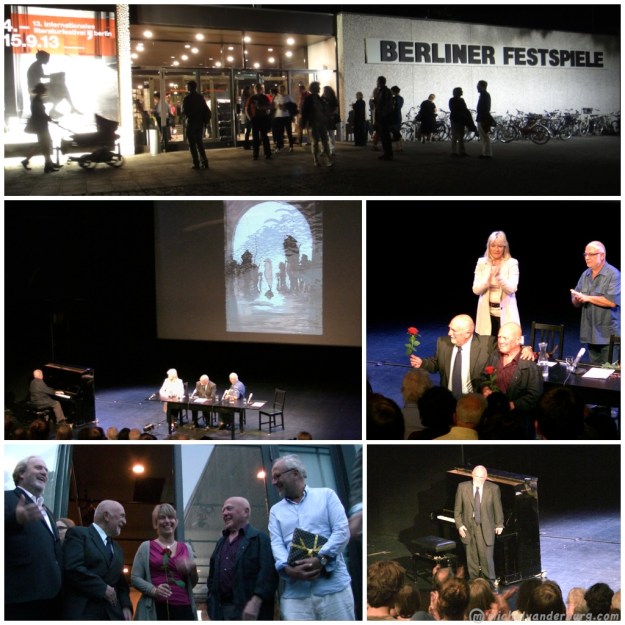
Simon Gronowski and Koenraad Tinel present “Finally Free after 70 years” on Sept. 7, 2013 at the 13th Internationales Literaturfestival Berlin – with Vincent von Wroblewsky (interpreter) and Christine Eichel (host), Joachim Sartorius (Berliner Festspiele), Ulrich Schreiber (festival director), and Joke Schauvliege (Flemish Minister for Culture) in the Haus der Berliner Festspiele. Photo report (BUM10022V01): Michel van der Burg – michelvanderburg.com
Below the English translation of Simon Gronowski’s letter by Michel van der Burg
Auschwitz and forgiveness
I lost my mother and sister in the gas chambers of Auschwitz – Birkenau and my father died in despair, in July 1945.
I myself was 11 years old when, on 17 March 1943, the Nazis took me, threw me into a dungeon, the basement of the Gestapo on the Avenue Louise in Brussels, then in a big prison, the Dossin barracks in Mechelen, the ‘Belgian Drancy‘. A month later, April 19, 1943, they put me in a cattle car of the 20th Convoy to Auschwitz. Miraculously, I jumped off the train and escaped death. And all this for what? Because my parents were born Jews.
It took me 60 years to tell the drama of my childhood (L’enfant du 20e convoi [tr. The child of the 20th convoy], ed. Luc Pire, 2002, reprinted Renaissance du Livre, 2013). It took sixty years for Koenraad Tinel to tell his own history of a son of a Flemish Nazi. He did this courageously by extraordinary drawings in a book titled Scheisseimer (Lannau, 2009); he is an artist, a sculptor, and he draws.
Forgiveness
His father adored Hitler. He had his two elder sons in the Waffen SS, the oldest one to the eastern front, the other, at sixteen and a half years old too young to fight, in the Flämisch Wachzug (Flemish Guard), a subsidiary of the Gestapo, camp guards of Breendonk and Mechelen. Fortunately, Koenraad was only 6 years old when Hitler came into Belgium, otherwise he would have imitated his brothers. He has rejected completely the ideology of his father.
We met by chance in February 2012. A 16 year old boy I did not know but who knew our two stories, brought us together. Koen said at that time: “When I read your story, I cried.” I replied: “Children of the Nazis are not responsible.” A great friendship is born between us. We were two children crushed by a war we did not understand at all, one on each side of the fence, I at the side of the victims, he the side of the executioners.
For sixty years, he has carried the burden of his father’s fault. Our grief is not comparable but I understand his. He has freed himself of it first by his book Scheisseimer, then by our friendship.
We made a book on this: Neither victim, nor guilty, FINALLY LIBERATED (Ni victime, ni coupable, ENFIN LIBÉRÉS; Renaissance du Livre, 2013): I wrote, Koenraad drew with ink. In January, Koenraad told me: “My brother knows your history, he wants to see you“, this brother, guardian at the Dossin barracks (Kazerne Dossin) when I was detained there, took me at gunpoint into the wagon of death.
So he regretted what he had done and asked me to forgive.
When I saw him, we hugged each other without saying a word, in tears. I forgave him only on my own behalf, not on behalf of other victims and I forgave him alone, not all Nazis. I did it especially for me, feeling I transcended it.
Forgiveness does not mean forgetting. On the contrary, it gives the memory greater prominence, a larger dimension. Our memory is essential: we must know the barbarism of the past to defend democracy today. Democracy is a struggle every day.
Amnesty is unacceptable : it is a blind collective measure that absolves all culprits without requiring them to repent.
Forgiveness is a religious virtue. For Buddhists, it is an act of liberating wisdom.
The bigger the crime, the greater forgiveness.
Some say they would not be able to forgive: – this statement does not make sense because they have never been asked as I have been and it is unlikely they will ever be, but if it happened to them, what would they do ? – 70 years later, they still suffer from their wounds and their resentment when they should love life and believe in happiness, out of respect for the deceased relatives.
When the culprit repents and asks for forgiveness, the victim not only can but must forgive, for refusing means maintaining hatred from both sides. Some criticize my friendship for Koenraad and my forgiveness for his brother.
They want to keep the children and descendants of victims and perpetrators separated forever into two enemy camps.
They are often victims of Nazism. This is normal, they have suffered terrible trauma in their body and in their soul. But they freeze in their victim posture, locked in their bitterness.
Aren’t they thinking too much of their own pain, and not enough of that of the other? Some, born after the war and who have not suffered the Holocaust, are not less hateful.
Such an attitude opens the way to new animosities, new wars, new suffering for our children.
It is not because children of victims and children of offenders for long, for generations, unconsciously, carry the stigma of absolute evil, that they must stay pitted against each other.
Men should not be divided but brought closer together, one must go toward the other to progress and grow together for a better world of peace and mutual respect. This is a message of hope and happiness.
I who lost my family by criminal hate, I do not hate. Despite the tragic events of yesterday and today, because even today in the world there are peoples who suffer, men who suffer, I keep my faith in the future because I believe in human goodness.
Long live peace and friendship between men !
Simon Gronowski (Lawyer)
Simon Gronowski – escaped from the 20th convoy – received the 2006 Grand Prix Condorcet-Aron for democracy – is a former president of the Union of Jews deported from Belgium (Union des Déportés Juifs de Belgique).
Notes – by Michel van der Burg
– English translation (with help from Richard Bloom) by Michel van der Burg
– I inserted some extra links
– “Auschwitz and forgiveness” – a letter by Simon Gronowski (lawyer) was published in French originally as “Auschwitz et le pardon” in Le Monde (France) on Sept. 20, 2013. (I left out the photo published with the Le Monde letter)
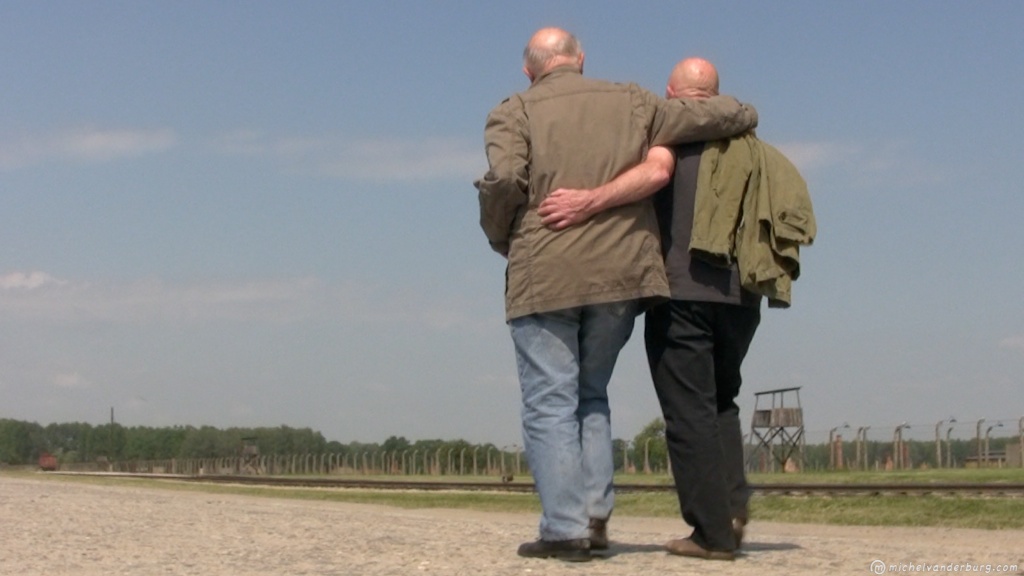
– The image in this post is a frame from video I captured during the visit of Simon Gronowski and Koenraad Tinel in the Auschwitz-Birkenau State Museum, Oświęcim, Poland on May 24, 2012. (image BUM10010V01 – michelvanderburg.com)
Update – Full letter – Sept. 27. Now the translation of the (final) 2nd part of the letter was added (after it became publicly available for all on the website of Le Monde today). This second part starts with: Forgiveness does not mean forgetting. On the contrary,……. Also the last sentence of the first part was altered.
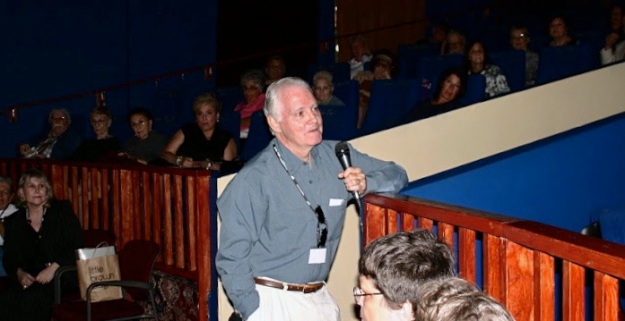
USA. Florida. October 27, 2012. Richard Bloom (director) speaking at the premiere of the film “Transport XX to Auschwitz” at the Fort Lauderdale International Film Festival at the Cinema Paradiso. In the audience also director Karen Lynne Bloom (bottom left in picture). Image Reference: BUM10006V02 (michelvanderburg.com)
Richard Bloom’s latest version of the documentary “The Litvak Connection”.
During the Shoah, Nazi collaborators from Lithuania and Latvia, helped murder more than 275,000 Jews – their neighbours – many of them known as Litvaks, 96% of those countries Jewish population, the highest percentage rate in any European country.
The film explores the search for these collaborators, the efforts to prosecute them and the refusal of countries to bring their citizens to justice.
More info at richardbloomproductions.com