2001 — Establishing the Dutch Islet Bank in the LUMC • 1MEMO_20260824

25th Anniversary of the Islet Bank • Isolation of Islets of Langerhans for Transplantation in Diabetic Patients

by Michel van der Burg, Monday 24 August 2026

Abstract

This account documents the establishment of the Dutch Islet Bank at Leiden University Medical Center (LUMC) between 1997 and 2003. Following a 1997 mandate from Onno Terpstra to develop a clinical islet transplantation programme, and a 1998 working visit to the Diabetes Research Institute in Miami to learn state-of-the-art human islet isolation from their team, during which he also tested the Iodixanol-UWS purification method, the author set up the Clinical Islet Laboratory (Klinisch Eilandjeslaboratorium, KEL) within LUMC’s new GMP facility, opened in February 2000. Between 2000 and 2001, the isolation procedure was upgraded to the automated “Ricordi Method” and a clinical-grade Iodixanol-UWS purification method, Standard Operating Procedures were drafted and reviewed, and permit applications were submitted to the Medical Research Ethics Committee and the Dutch Healthcare Insurance Board (CVZ). The Clinical Islet Laboratory began operating under cGMP conditions in April 2001, followed in September 2001 by CVZ’s positive advice on permits for both islet production and transplantation. Collaboration with the Geneva and Edmonton islet teams in 2001–2002, amid heightened interest following the Edmonton Protocol’s 2000 publication, informed further refinement of the isolation procedure. Formal government approval for the islet bank followed in 2003, culminating in its official establishment via ministerial regulation on 5 December 2003. Clinical islet transplantation itself began at LUMC in late 2007, following restructuring and team expansion; more than 100 transplantations have since been performed in over 50 patients. The account closes by noting that LUMC’s current automated islet-production method still relies on the iodixanol-related purification approach the author introduced three to four decades earlier.

Citation info : 2001 — Establishing the Dutch Islet Bank in the LUMC • 1MEMO_20260824 • Michel van der Burg • Miracles.Media • URL https://michelvanderburg.com/2026/08/24
2001 — Establishing the Dutch Islet Bank in the LUMC

Plan

In 1997, Onno Terpstra, Head of Surgery at Leiden University Medical Center (LUMC), asked me (Michel van der Burg) to develop a plan for a clinical islet isolation and transplantation programme (1). Islet transplantation was at the time practised at only a handful of centres worldwide, and building such a programme from scratch meant starting not with patients but with technique. In 1998, I undertook a working visit to the Diabetes Research Institute in Miami, then among the world’s leading centres for human islet isolation, to learn state-of-the-art isolation methods directly from their team. During this visit I also tried the Iodixanol-UWS purification method, a density-gradient approach I had just recently developed in animal experimental research in Leiden, that later became a recurring part of my work in the field, though its longer-term relevance wasn’t clear at the time (2).
Back in Leiden, I began the islet isolation programme at the LUMC with my Surgery co-workers, and the setting-up of the Clinical Islet Laboratory (Klinisch Eilandlaboratorium, KEL) in the new GMP facility then being build at the LUMC, in collaboration with Amon Wafelman, executive head of the future GMP facility. A business plan, submitted to the LUMC Board of Directors in November 1998 , was approved on February 22, 1999 — formally launching our LUMC islet transplantation project.

Surgery Laboratory

In March 1999, a first experimental series of islet isolations was started, applying the manual method of donor pancreas digestion and purification of the islets in our new Iodixanol-UWS gradients. With the approval of the Board of Directors — since the GMP facility was still under construction — work began in our Surgery Laboratory, gaining hands-on experience with human islet isolation, the donor procedure, islet culture, and all other facets of operating an “islet bank.”
Opening GMP Facility

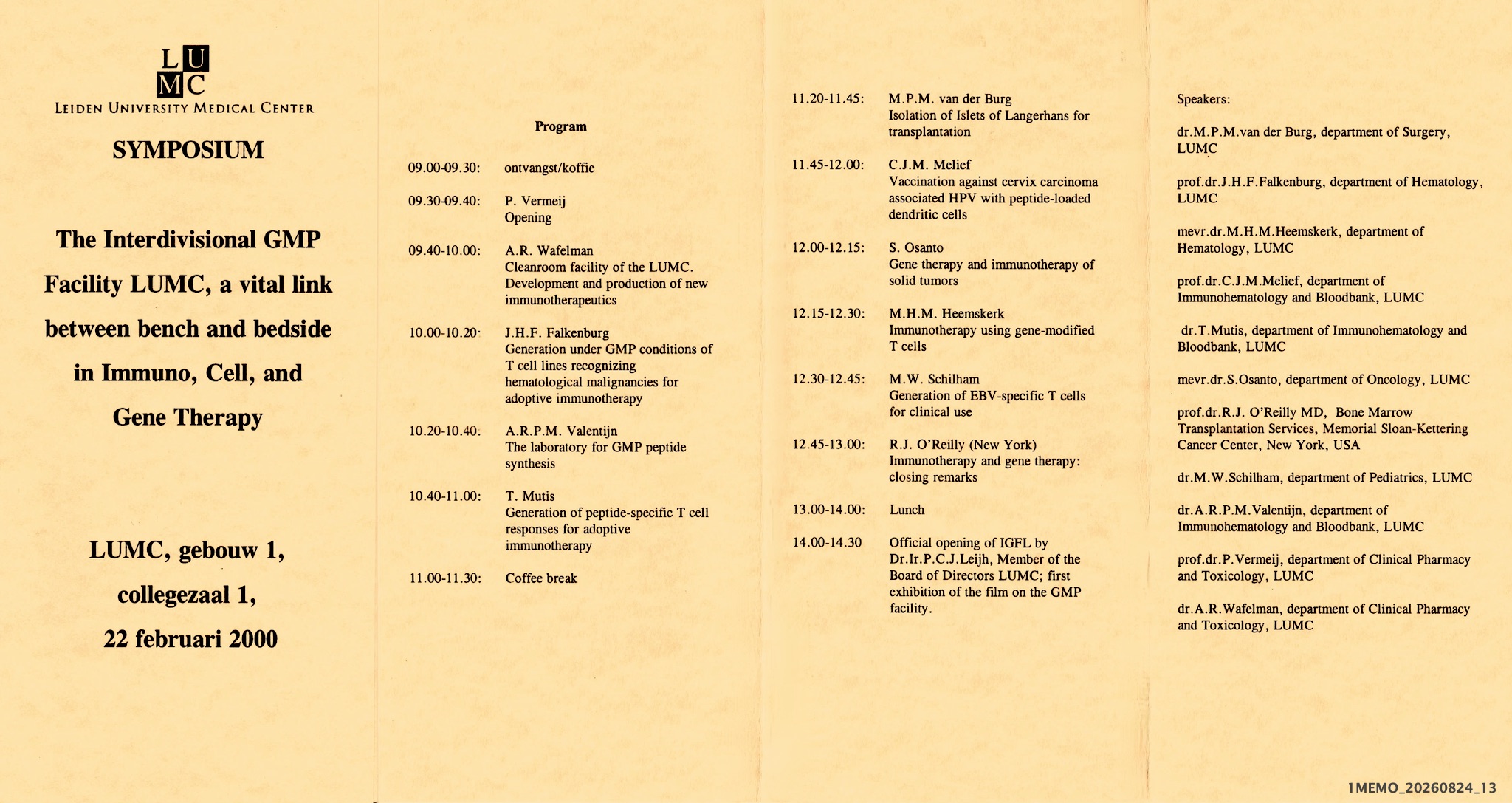
On 22 February 2000, exactly one year after the official start of our islet transplantation project (1), the GMP facility of the LUMC was officially opened — the centre with six special laboratory spaces, the “cleanrooms,” for the Good Manufacturing Practice (GMP) preparation of Immuno, Cell, and Gene Therapy products (3).

As coordinator of the LUMC Clinical Islet Laboratory (“Klinisch Eilandjeslaboratorium”), I presented our project for the GMP production of clinical-grade islets in a talk that day during the symposium “The Interdivisional GMP Facility LUMC, a vital link between bench and bedside in Immuno, Cell, and Gene Therapy”, to an audience of LUMC staff and government representatives, including the Ministry (4).

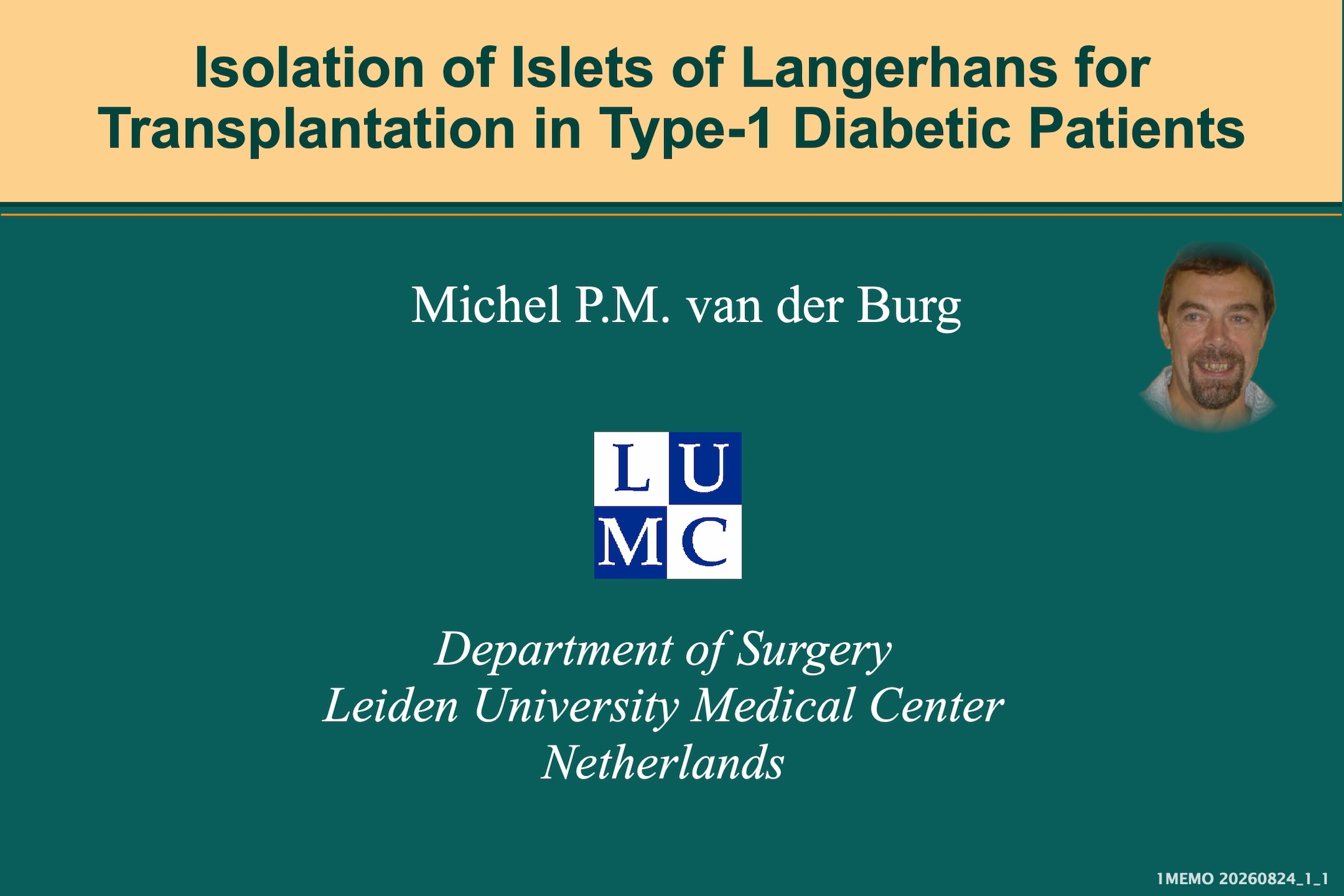
Slideshow (video & audio)Isolation of Islets of Langerhans for Transplantation in Diabetic Patients • Symposium GMP Facility LUMC 2000 • Michel van der Burg • Miracles.Media • 1 MEMO_20260824_1

Video of the slideshow of this talk was previously posted online in 2019 (4). Here video is posted of the remastered second edition (2026) of the slideshow, now also with audio reading the original transcript using my personal synthesised voice, and supplemented with a few notes including the symposium programme. Handout available in Notes (4).

From 2000 onward, following the opening of the new GMP facility, the laboratory adopted the state-of-the-art “Ricordi Automated Method” for pancreas digestion and islet isolation (named for Camillo Ricordi’s semi-automated digestion chamber, by then fairly standard in the field), using equipment supplied through BioRep Technologies in Miami (5).

Standard Operating Procedures (SOPs) & Permit application

This shift prompted the drafting of (i) the ‘core’ SOPs (the Standard Operating Procedures for the isolation and storage of islets) for review by GMP deputy head Wafelman, (ii) the training of Surgery research co-workers for the islet isolation team, and (iii) the drafting of the “Transplantation Pancreatic Islets Protocol” (6) for our Permit Application (7) co-authored with surgeons Jan Ringers (head of the transplant section) and our head and supervisor, Onno Terpstra.

In July 2000 , we submitted our transplant protocol (6) for review to the Medical Research Ethics Committee , and our ‘Permit Application Transplantation of Islets of Langerhans’ (7) to the Dutch Healthcare Insurance Board (College voor Zorgverzekeringen; CVZ) now the National Health Care Institute of the Netherlands, advising the Ministry of Health, Welfare and Sport (VWS).
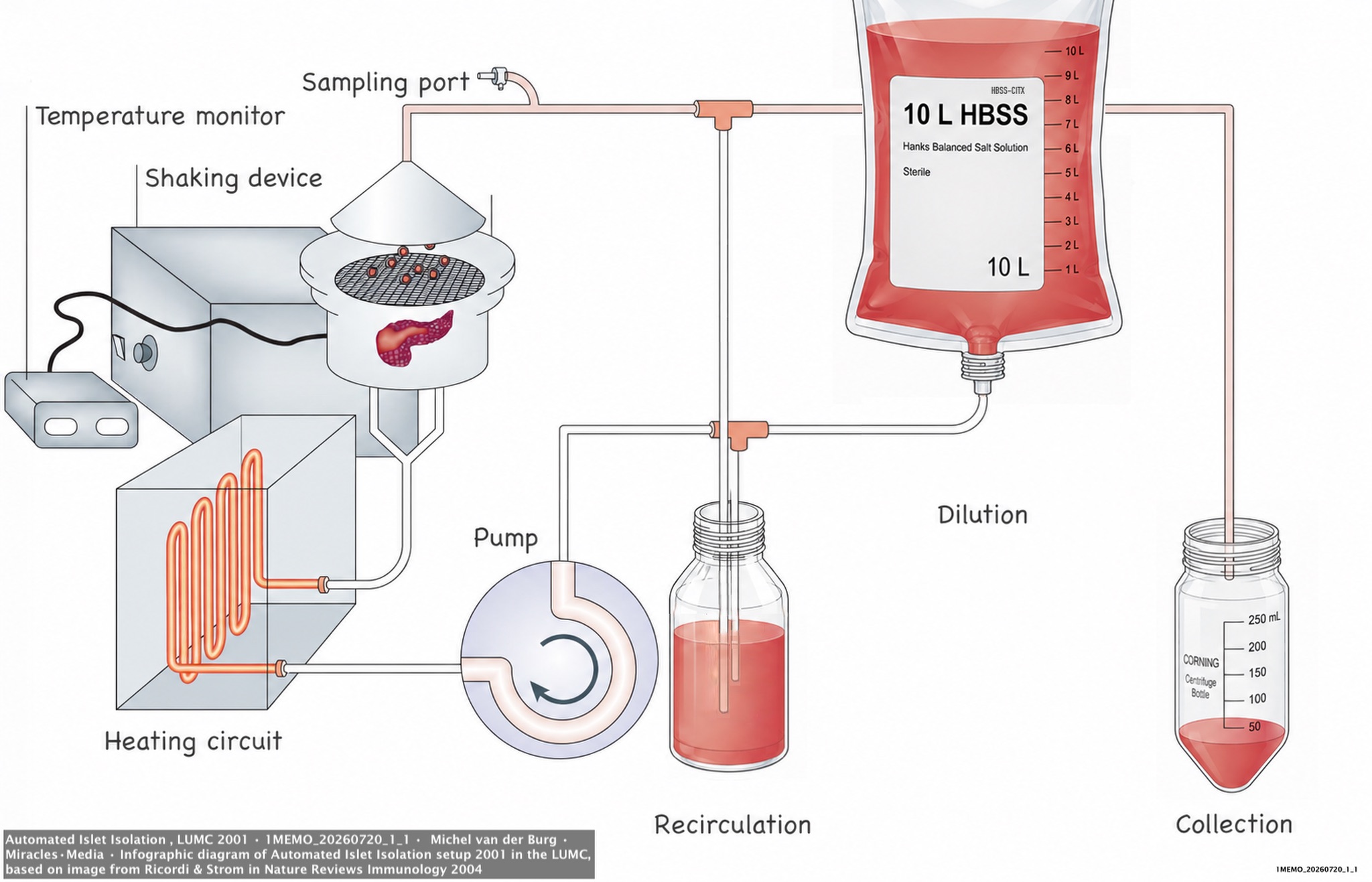
In July 2000, our new series of islet isolations began, assisted by our Surgery islet isolation team, using the automated method for pancreas digestion, and islet purification with “IsletPrep” — our new Iodixanol-UWS islet purification solution. This new solution had a slightly modified composition, in preparation for the planned commercial production of the solution as the GMP-certified, ready-made product “IsletPrep” (5, 8).

By the end of 2000, we had gained sufficient experience in carrying out our procedures for human islet isolation, and all our SOPs were reviewed together with GMP head Wafelman (9), so that work could continue in the GMP facility. This revealed that our existing procedure for purifying the islets in Iodixanol-UWS needed to be adapted — a procedure for which we had used in-house-produced “IsletPrep,” a reformulated Iodixanol-UWS solution developed together with Nycomed/Axis-Shield (8).

As GMP production of IsletPrep would not be ready in time for the planned start of work in the GMP Facility in early 2001, we validated a simpler alternative combining clinical-grade Visipaque and ViaSpan, which matched IsletPrep’s results in islet purification (5). This Visipaque-ViaSpan protocol became the standard, enabling the opening of the LUMC’s Clinical Islet Laboratory (Klinisch EilandLaboratorium) in April 2001.


2001 – Opening Islet Bank in GMP-Facility

On Thursday 26 April 2001, I was able to open the Clinical Islet Laboratory (“Klinisch Eilandjeslaboratorium”) in the GMP Facility of the LUMC, enabling islet isolation to be carried out under cGMP conditions from then on.

Our standard operating procedure for clinical-grade islet production comprised (i) preparation of the donor pancreases in the operating theatre of the LUMC, including collagenase infusion, followed by (ii) transport of the pancreata to the nearby cleanroom of the Clinical Islet Laboratory in the LUMC GMP Facility for (iii) islet production: the isolation, purification, storage, and quality control of the isolated human islets.

In July 2001, we received the green light from GMP head Wafelman for the delivery of a cGMP-certified islet preparation meeting our criteria for transplantation, subject to obtaining approval from the Medical Research Ethics Committee and the Board of Leiden University Medical Center.

On 27 September 2001, the positive advice also followed from the Dutch Healthcare Insurance Board (College voor Zorgverzekeringen) (CVZ), now the National Health Care Institute of the Netherlands, issued to the Ministry of Health, Welfare and Sport, to grant permission for Transplantation of Islets of Langerhans at Leiden University Medical Center. Their advice to the Cabinet Minister in fact included two permits for the LUMC, covering both islet production and transplantation:
1) a permit for the Dutch Islet Bank in the LUMC (for the production and storage of islets in our Clinical Islet Laboratory, “Klinisch Eilandjeslaboratorium”);
2) and also the permit to transplant islets from the islet bank into patients at the LUMC.

The report is available for reading and downloading below in the References section (10).

Implementation of the Edmonton Protocol — ITN Trial

By this time, expectations surrounding islet transplantation were running high, after the Edmonton team (University of Alberta, Edmonton, Canada) reported in the 27 July 2000 issue of ‘The New England Journal of Medicine’ their initial findings with up to a year of follow-up in seven consecutive subjects treated with infusion of an adequate mass of freshly prepared islets from two or more donor pancreases, combined with a steroid-free immunosuppression regimen. In all seven subjects, insulin independence was achieved, with tight glycemic control and correction of glycated hemoglobin levels (18). This treatment became known as the Edmonton protocol.

I was collaborating on our Iodixanol-UWS purification procedure with surgeon José Oberholzer of the Geneva islet team, who had invited me for a working visit to their islet centre. In July 2001, I shadowed the Geneva team during the islet isolations they performed according to the successful Edmonton procedure, as part of a multicentre International Trial of the Edmonton Protocol (ITN).

José Oberholzer and his co-worker Raymond Mage, together with Jonathan Lakey of the Edmonton centre (Edmonton, Canada), subsequently helped me in 2002 with the further development of our isolation procedure, incorporating the ITN procedures into the 2nd edition of our SOPs (11), and with custom-made apparatus — a gradient mixer — for purifying islets in continuous density gradients in the Cobe centrifuge.

2003 — Official Establishment of the Dutch Islet Bank

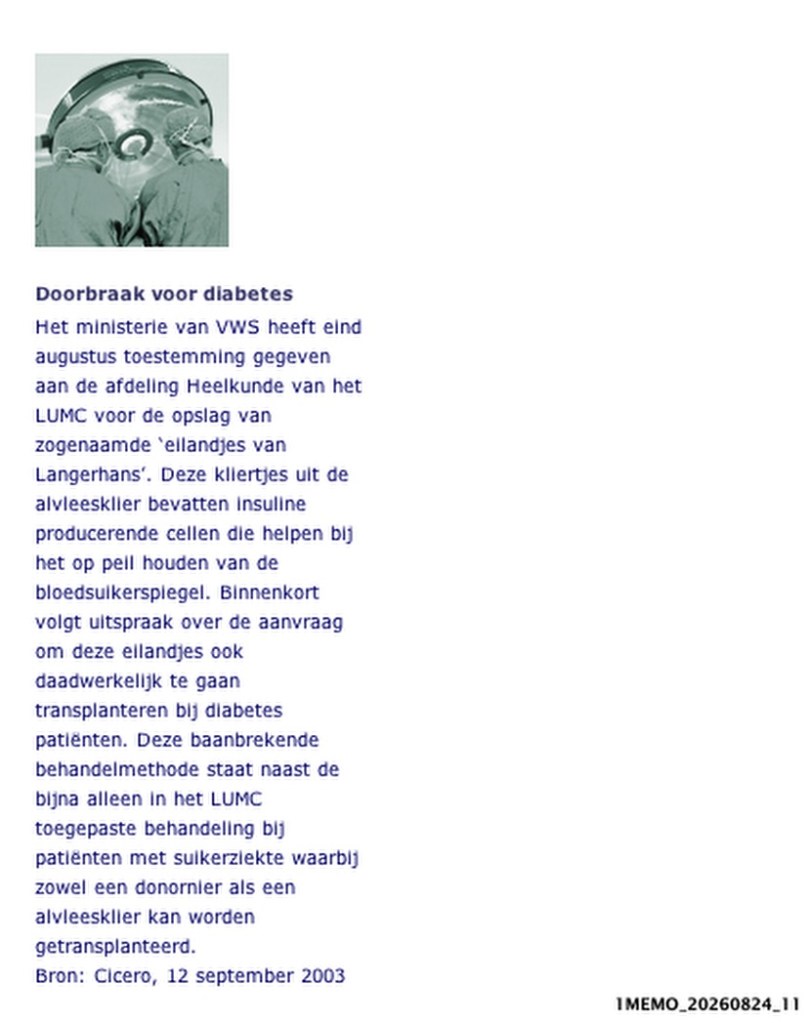
On 22 May 2003, the Healthcare Inspectorate (Inspectie Gezondheidszorg) — at the request of the Ministry of VWS — inspected the Islet Bank in the GMP facility of the LUMC and our Standard Operating Procedures (SOPs), and decided to advise the Minister favourably on our permit application (“Eilandjesbank,” Onno Terpstra, Surgery, LUMC email newsletter, 22 May 2003); in August 2003, the Ministry’s approval of our islet bank followed (12).

“Breakthrough for diabetes • At the end of August, the Ministry of Health, Welfare and Sport (VWS) granted permission to the Department of Surgery at the LUMC for the storage of so-called ‘islets of Langerhans’. These small glands from the pancreas contain insulin-producing cells that help maintain blood sugar levels. A decision regarding the application to actually transplant these islets into diabetes patients will follow shortly. This groundbreaking treatment method stands alongside the treatment applied almost exclusively at the LUMC for patients with diabetes, in which both a donor kidney and a pancreas can be transplanted.”
— Source : Cicero, September 12, 2003 (13)

Finally, the official establishment of the Dutch Islet Bank at the LUMC followed on 5 December 2003, with the publication on 3 December 2003 in the Government Gazette of the Kingdom of the Netherlands (Staatscourant 2003, 234, p. 31) of the ‘Regulation on the Transplantation of Islets of Langerhans’ (Dutch: ‘Regeling transplantatie eilandjes van Langerhans’) issued by the Minister of Health, Welfare and Sport on 25 November 2003, no. IBE 2431923.

The regulation is available for viewing and downloading in the Notes (14).


Quote (translated)

“… the Leiden University Medical Center will be granted permission to start transplantation of islets of Langerhans immediately.”
— The Minister of Health, Welfare and Sport, J.F. Hoogervorst

25th Anniversary of the Islet Bank

The year 2026 marks the 25th anniversary of the islet bank, started by Michel van der Burg and his Surgery co-workers on Thursday 26 April 2001 as the “Clinical Islet Laboratory” (Dutch: Klinisch Eilandjeslaboratorium) in the GMP Facility of the LUMC.

Islet Transplantation

In the early years, prior to the permit for the islet bank, the small Surgery islet team did not yet have access to donor organs that were both qualitatively suitable and quantitatively sufficient for islet transplantation.

For the transition to the future transplantation programme — with continuous, 24/7 islet production in the islet bank from as many suitable organs as possible — expanding the isolation teams’ staffing in the islet bank was now the highest priority.

Following the granting of the permit for the islet bank, the islet transplantation project was restructured from 2004 onwards, so that, under a new board drawn from the various divisions of the LUMC, a new and larger isolation team for the islet bank could be assembled. With that new team in the islet bank, islet transplantation could begin at the LUMC from the end of 2007 onwards, and more than 100 islet transplantations have since been carried out in more than 50 patients (15, 16).

Today, the LUMC islet bank works with a further-developed automated procedure for the machine-based production of islets (17). It gives me great satisfaction to see that this once again involves collaboration with BioRep Technologies in Miami, and that the purification method I introduced some 30–40 years ago is once again the method of choice — using iopromide (Ultravist 370), related to iodixanol, and the UWS organ preservation fluid introduced for islet isolation and purification in 1989.

Notes

References

1) 1999 — Pioneering the LUMC Clinical Islet Transplant Project • 1MEMO_20260705 • Michel van der Burg • Miracles•Media • URL michelvanderburg.com/2026/07/05

2) Human Islet Isolation • DRI Miami 1998 • 1MEMO_20250204 • Michel van der Burg • Miracles.Media• TakeNode 86e4a319-a769-44d5-8fa5-de2ca90ab63c • URL michelvanderburg.com/2025/02/04/

3) Cicero • 1MEMO_20260824_2_2 • Miracles.Media • Feature story ‘Schoner kán het niet’ (It doesn’t get any cleaner than this) by Elmar Veerman in the LUMC news magazine Cicero, 25 February 2000 (ISSN 0920-2900) . Article for viewing and download below (1MEMO_20260824_2_2.pdf)

4) Michel P.M. van der Burg . Isolation of islets of Langerhans for transplantation in type-1 diabetic patients. Symposium ‘The Interdivisional GMP Facility LUMC, a vital link between bench and bedside in Immuno, Cell, and Gene Therapy’. Leiden (Netherlands) Februari 22, 2000 .
Video of slideshow presentation : Isolation of Islets of Langerhans for Transplantation in Diabetic Patients • Symposium GMP Facility LUMC 2000 • Michel van der Burg • Miracles.Media • 1MEMO_20260824_1_Video • TakeNode 976e1d79-8cc6-4348-8ecb-c3ffb34c2f57

Handout of slideshow presentation • 1MEMO_20260824_1_Handout • TakeNode 717f2297-0a93-4d99-8deb-0eb809cf21e4 • Available for viewing and download below .

PS – First video edition of the slideshow posted in 2019 : Isolation of Islets of Langerhans for Transplantation in Type-1 Diabetic Patients • 1MEMO_20191213 • Michel van der Burg • Miracles.Media • URL https://michelvanderburg.com/2019/12/13/

5) 2000 — Pioneering Automated Islet Isolation & Clinical Grade Purification in the LUMC • 1MEMO_20260720 • Michel van der Burg • Miracles•Media • URL https://michelvanderburg.com/2026/07/20

6) Transplantatie van pancreaseilandjes – Protocol (tr. Transplantation Pancreatic Islets Protocol) by Jan Ringers and Michel van der Burg (JR / MvdB / 07 ; edition 7 , date 15 May 2000). In : LUMC Vergunningsaanvraag Transplantatie Eilandjes van Langerhans (7,10).

7) LUMC Vergunningsaanvraag Transplantatie Eilandjes van Langerhans (LUMC Permit Application Transplantation of Islets of Langerhans) , In (Bijlage 1) : Advies vergunningsaanvraag transplantatie Eilandjes van Langerhans , College voor Zorgverzekeringen, 27 September 2001 (CVZ , Rapport 01/71). Download available below (10).

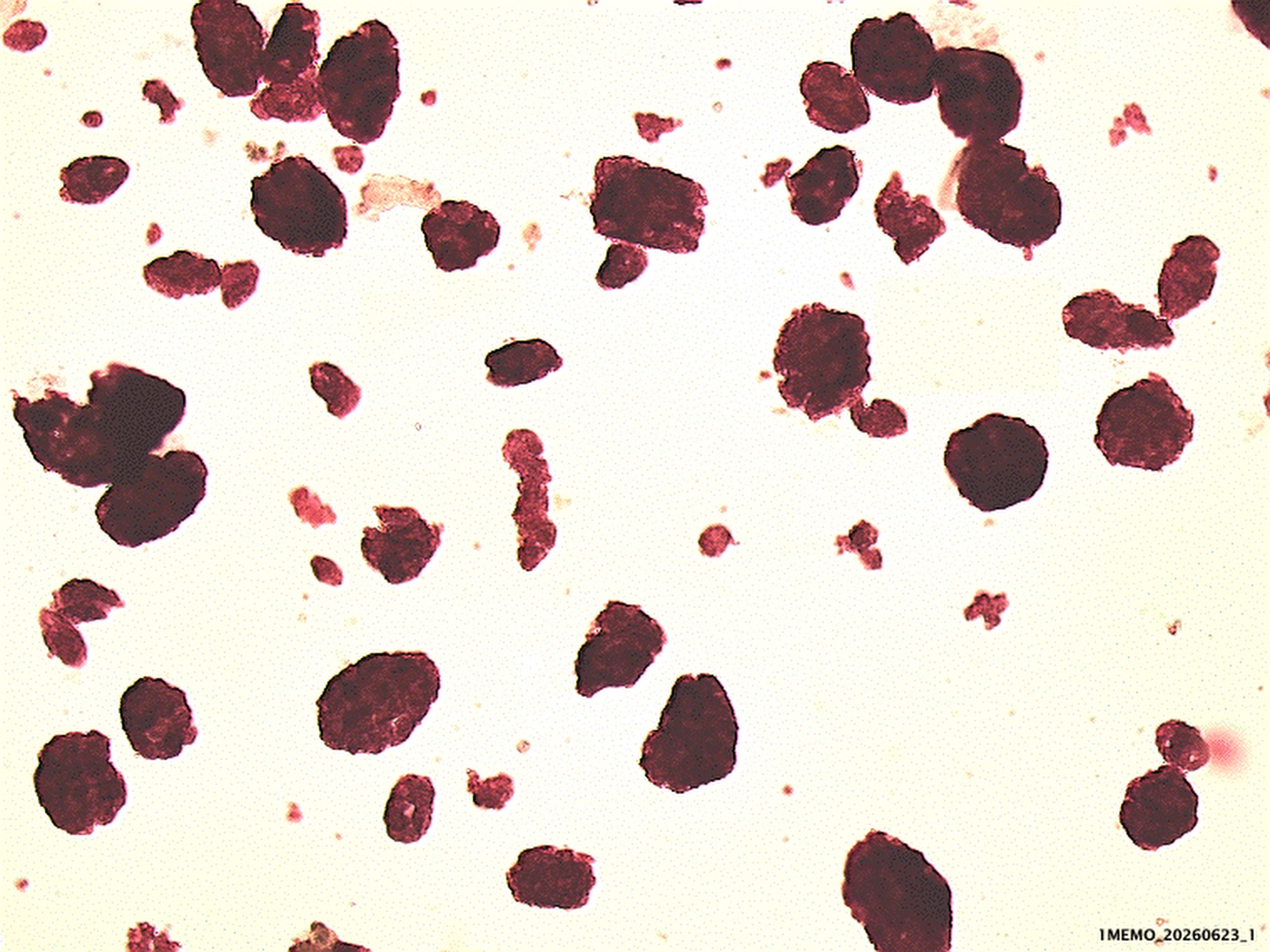
8) Islet purification from bench to bedside • @1MEMO_20260623 • Michel van der Burg • Miracles.Media • URL michelvanderburg.com/2026/06/23/

9) GMP Documentation Clinical Islet Laboratory (Klinisch Eilandjeslaboratorium) LUMC , 1st edition (December 2000) by Michel van der Burg , Department of Surgery , LUMC.

10) Advice LUMC Permit Dutch Healthcare Insurance Board CVZ 01/71 • 1MEMO_20260824_5_ebook • Miracles.Media • TakeNode 5b2238fc-0f44-4523-8e7e-a084a5f193de • The September 2001 advice of the dutch National Health Care Institute issued to the Ministry of Health, Welfare and Sport, to grant permission for the islet bank and for islet transplantation in the LUMC In : Advies vergunningsaanvraag transplantatie Eilandjes van Langerhans , College voor Zorgverzekeringen, 27 September 2001 (CVZ , Rapport 01/71). Preview and download e-book below (1MEMO_20260824_5_ebook.pdf).

11) GMP Documentation Clinical Islet Laboratory (Klinisch Eilandjeslaboratorium) LUMC , 2nd (revised) edition 8 May 2002, by Michel van der Burg , Department of Surgery , LUMC • 1MEMO_20260824_CITX_20020508 • Michel van der Burg • Miracles.Media • TakeNode • E-book copy (1MEMO_20260824_CITX_20020508.pdf) available on request.

12) Nier plus klier werkt beter (Kidney plus gland works better) by Willy van Strien in the LUMC news magazine Cicero #14, 12 September 2003 (ISSN 0920-2900)

13) Doorbraak voor diabetes • Cicero 12 September 2003 • 1MEMO_20260824_11 • Michel van der Burg • Miracles.Media • TakeNode fe71b42f-f1ff-49c3-8668-ee8ce4c8b636 • Source : Archive Michel van der Burg • Miracles.Media : Screenshot LUMC website retrieved 12 January 2006. Transcript : “Doorbraak voor diabetes | Het ministerie van VWS heeft eind augustus toestemming gegeven aan de afdeling Heelkunde van het LUMC voor de opslag van zogenaamde ‘eilandjes van Langerhans’. Deze kliertjes uit de alvleesklier bevatten insuline producerende cellen die helpen bij het op peil houden van de bloedsuikerspiegel. Binnenkort volgt uitspraak over de aanvraag om deze ellandjes ook daadwerkelijk te gaan transplanteren bij diabetes patlenten. Deze baanbrekende behandelmethode staat naast de bijna alleen in het LUMC toegepaste behandeling bij patlenten met suikerzlekte waarbij zowel een donornier als een alvleesklier kan worden getransplanteerd. Bron: Cicero, 12 september 2003”
14) Regulation transplantation islets of Langerhans • Regulation of the Minister of Health, Welfare and Sport of 25 November 2003, no. IBE 2431923 • In : ‘Regeling transplantatie eilandjes van Langerhans’ van de Minister van Volksgezondheid, Welzijn en Sport van 25 november 2003, nr. IBE 2431923 . Staatscourant 2003, 234, p. 31 . Published 3 December 2003. (Retrieved 20 August 2026) URL https://zoek.officielebekendmakingen.nl/stcrt-2003-234-p31-SC62493.html • View and download copy of Regulation below (file stcrt-2003-234-p31-SC62493.pdf ).

Quote (translated)

“… the Leiden University Medical Center will be granted permission to start transplantation of islets of Langerhans immediately.”
—The Minister of Health, Welfare and Sport, J.F. Hoogervorst

Dutch original

“…zal aan het Leids Universitair Medisch Centrum vergunning worden verleend om nu al te starten met transplantatie van eilandjes van Langerhans.”
—De Minister van Volksgezondheid, Welzijn en Sport, J.F. Hoogervorst

15) Berney T, Andres A, Bellin MD, de Koning EJP, Johnson PRV, Kay TWH, Lundgren T, Rickels MR, Scholz H, Stock PG, White S and the International Islet Transplant Centers (2022) A Worldwide Survey of Activities and Practices in Clinical Islet of Langerhans Transplantation. Transpl Int 35:10507. doi: 10.3389/ti.2022.10507 .
URL (retrieved 22 August 2026) https://www.frontierspartnerships.org/journals/transplant-international/articles/10.3389/ti.2022.10507/full

16) Islet transplantation (Eilandjestransplantatie). LUMC, Patient information leaflet (retrieved 22 August 2026) • URL https://www.lumc.nl/afdelingen/transplantatie-centrum/diagnoses-en-behandelingen/eilandjestransplantatie/

17) Doppenberg JB, Engelse MA, de Koning EJP. PRISM: A Novel Human Islet Isolation Technique. Transplantation. 2022 Jun 1;106(6):1271-1278. doi: 10.1097/TP.0000000000003897. Epub 2022 Jul 22. PMID: 34342959. URL https://www.ovid.com/jnls/transplantjournal/fulltext/10.1097/tp.0000000000003897~prism-a-novel-human-islet-isolation-technique

18) Shapiro AM, Lakey JR, Ryan EA, Korbutt GS, Toth E, Warnock GL, Kneteman NM, Rajotte RV. Islet transplantation in seven patients with type 1 diabetes mellitus using a glucocorticoid-free immunosuppressive regimen. N Engl J Med. 2000 Jul 27;343(4):230-8. doi: 10.1056/NEJM200007273430401. PMID: 10911004. URL https://www.nejm.org/doi/full/10.1056/NEJM200007273430401 . Paper copy URL https://www.ualberta.ca/en/alberta-diabetes/media-library/about/documents/nejmedmontonprotocol.pdf

Acknowledgements — I thank Camillo Ricordi (Director of the Diabetes Research Institute, Miami) and Ramon Poo (BioRep Technologies, Miami), Daniel Brandhorst (Giessen, Germany), José Oberholzer and co-workers (Geneva, Switzerland), and Jonathan Lakey (Edmonton, Canada) for their help in implementing their state-of-the-art islet isolation procedures in our Clinical Islet Laboratory; Onno Terpstra ((Head of the Surgery department) , Amon Wafelman (deputy head of the Interdivisional GMP-Facility, Department of Clinical Pharmacy and Toxicology, LUMC) and the numerous LUMC co-workers from other LUMC departments for collaboration in establishing the Clinical Islet Laboratory; our Transplant Coordinators Marijke van Gurp and Ruth Dam (EuroTransplant/LUMC) and my co-workers of the Transplant section of the Surgery Department (LUMC) : surgeons Jan Ringers, André Baranski, Jeroen Dubbeld, Xandro Schaapherder for dedicated organ procurement, and the researchers Eelco Bouwman, Annemiek Töns (staff) and Josephine Rijkelijkhuizen, Gabe Bleeker (students) for our collaboration in the ‘islet team.’

#islets #islet #Langerhans #isolation #automated #purification #ITN #Edmonton #bank #surgery #clinical #laboratory #establishment #start #GMP #SOP #eilandjes #transplantatie #eilandjestransplantatie #cleanroom #facility #Surgery #KEL #CITX #LUMC #VWS #vergunning #regeling #Holland #Netherlands #Leiden #university #hospital #human #donor #IsletPrep #Visipaque #Optiprep #iodixanol #ViaSpan #UWS #density #gradient #pancreas #transplantation #diabetes #history #research #memoir #1memo #michelvanderburg #Klinisch #Eilandlaboratorium #BioRep #Ricordi #Geneva #Oberholzer

Portfolio Science Posts
https://michelvanderburg.com/category/science/

Citation info : 2001 — Establishing the Dutch Islet Bank in the LUMC • 1MEMO_20260824 • Michel van der Burg • Miracles.Media • URL https://michelvanderburg.com/2026/08/24

2000 — Pioneering Automated Islet Isolation & Clinical Grade Purification in the LUMC • 1MEMO_20260720

Automated isolation, IsletPrep, and Visipaque-ViaSpan: the road to the LUMC's Clinical Islet Laboratory

by Michel van der Burg, Monday 20 July 2026

Synopsis

The LUMC Clinical Islet Transplant project’s 2000 series of human islet isolations marked the transition from manual to automated pancreatic digestion using the Ricordi method. This shift prompted the drafting of our core SOPs and the training of the required isolation team.
Islets purified with “IsletPrep” — a reformulated Iodixanol-UWS solution developed with Nycomed/Axis-Shield — showed outcomes equivalent to the 1999 manual-method series: high purity, no islet loss, and preserved integrity. As GMP production of IsletPrep would not be ready in time for the planned start of work in the GMP Facility, we validated a simpler alternative combining clinical-grade Visipaque and ViaSpan, which matched IsletPrep’s results in both human and porcine islet purification. This Visipaque-ViaSpan protocol became the standard, enabling the opening of the LUMC’s Clinical Islet Laboratory (Klinisch EilandLaboratorium) in April 2001.

Citation info : 2000 — Pioneering Automated Islet Isolation & Clinical Grade Purification in the LUMC • 1MEMO_20260720 • Michel van der Burg • Miracles•Media • URL https://michelvanderburg.com/2026/07/20

2000 — Pioneering Automated Islet Isolation & Clinical Grade Purification in the LUMC

Presentation : 2000 — Pioneering Automated Islet Isolation & Clinical Grade Purification in the LUMC • 1MEMO_20260720_1_Video • Michel van der Burg • TakeNode e0f677e3-689d-4697-bdad-e270eb949ee5

After the official start of the LUMC Clinical Islet Transplant Project on 22 February 1999, we began our first series of human islet isolations at the LUMC.

Our GMP facility was still under construction, so work began in our Surgery Laboratory, gaining hands-on experience with human islet isolation, the donor procedure, islet culture, and all other facets of operating an “islet bank” (1).

That first series of human islet isolations was performed using the manual pancreas digestion method and Iodixanol-UWS purification. The results were published in December 1999, presented at the AIDSPIT Workshop in January 2000, and recently posted on this site (1,2,3).

State-of-the-Art “Automated Method”

The second series of isolations was started using the advanced “automated method” for pancreatic digestion, as developed by Camillo Ricordi — first in David Scharp’s team in Paul Lacy’s laboratory in St. Louis, and eventually in Miami with Ramon Poo of BioRep Technologies, Inc (4,5,6).

In November 1999, after setting up the custom-made equipment from BioRep Technologies in the Surgery Laboratory, I began pilot work with a few human islet isolations using the automated method, to gain hands-on experience with its elaborate set-up of equipment.


In this method, the pancreas sits in a steel digestion chamber together with glass beads (“knikkers”), behind a screen that allows only particles smaller than 0.5 mm to pass through. Collagenase solution (Liberase-HI in Hanks’ solution) is pumped through a heating coil, warmed to 37°C, and recirculated through the chamber, progressively breaking the gland down into its component pieces. After around 30 minutes, once most islets are free, recirculation and heating are stopped, and over the following 30 minutes a room-temperature Hanks’ solution (HBSS) is pumped through the chamber while the digest leaving it is collected — then held in cold UWS for 60 minutes on ice ahead of purification.

That experience allowed me to start writing our core SOPs (Standard Operating Procedures) — the step-by-step instructions on islet isolation and related procedures required to establish the islet bank in the GMP Facility of the LUMC, in what was then still a virtually unexplored, rapidly evolving field: translating cell research into Good Manufacturing Practice (GMP)-compliant cell therapy for patients.

Islet Isolation Team

Next, the islet isolation team was built. At least two professionals are needed to perform islet isolation with the Ricordi automated method in an experimental setting; in a GMP facility, a team of three qualified professionals — sterile and non-sterile operators, plus a data recorder — is typically required.

In April 2000, having finished the core SOPs, I began training the islet isolation team — transplantation research colleagues and students — on the new islet procedures and the use of SOPs that would soon be required in the GMP Facility.

Pre-Commercial IsletPrep Trial

In July 2000, this series of islet isolations with the automated method began with our Surgery islet isolation team, now using “IsletPrep” — our new Iodixanol-UWS islet purification solution.

This new solution had a slightly modified composition, in preparation for the planned commercial production of the solution as the GMP-certified, ready-made product “IsletPrep” (7).

Our original, standard protocol for preparing the Iodixanol-UWS density gradients used a Working Optiprep Solution (WOP) containing 30% (w/v) iodixanol in UWS, produced by mixing OptiPrep (60% w/v iodixanol in water) with an equal volume of double-strength UWS (UWS2x). That protocol was shared with other islet centers in 1997 and has been published in OptiPrep Application sheets since 1998 (7).

I was collaborating with OptiPrep Product Manager Bjørn Henriksen (Nycomed / Axis-Shield, Oslo, Norway) to explore modifications of our Iodixanol-UWS purification solution — avoiding the need for in-house production of double-strength UWS — to facilitate its implementation in clinical human islet transplantation, both in our center and at other islet centers worldwide.

The plan was to bring the Iodixanol-UWS density solution into commercial production as a GMP-certified, ready-made product coined “IsletPrep” — the WOP mixture of equal volumes of double-strength UWS (UWS2x) and OptiPrep, in 200 ml bottles, first produced as a small batch in the Pilot Plant of Nycomed / Axis-Shield. To facilitate pharmaceutical pilot production, I modified the formulation of UWS2x by: (i) leaving out components not required for the density solution (allopurinol, glutathione, and adenosine); (ii) replacing the proprietary Pentastarch with the hydroxyethyl starch supplied by Bjørn Henriksen (HES 200, Serum-Werk, Bernburg) for use in the commercial solution; and (iii) determining the amount of solid KOH (pellets) required to obtain the desired pH of 7.4 without the need for adjustment during preparation.

The IsletPrep solution was prepared in our LUMC laboratory that same month, July 2000, for purification using the modified Iodixanol-UWS gradients in the new series of automated islet isolations with our Surgery islet team.

That work is presented in the accompanying slideshow, with a PDF available below (9).

The innovative method we introduced — first performing a test purification during islet isolation on a fraction of the digested pancreatic tissue (digest), to predict the best density solution for a simple method of islet purification in centrifuge tubes — proved to be a good alternative to the more complex method of purification in conventional continuous gradients in the Cobe centrifuge.
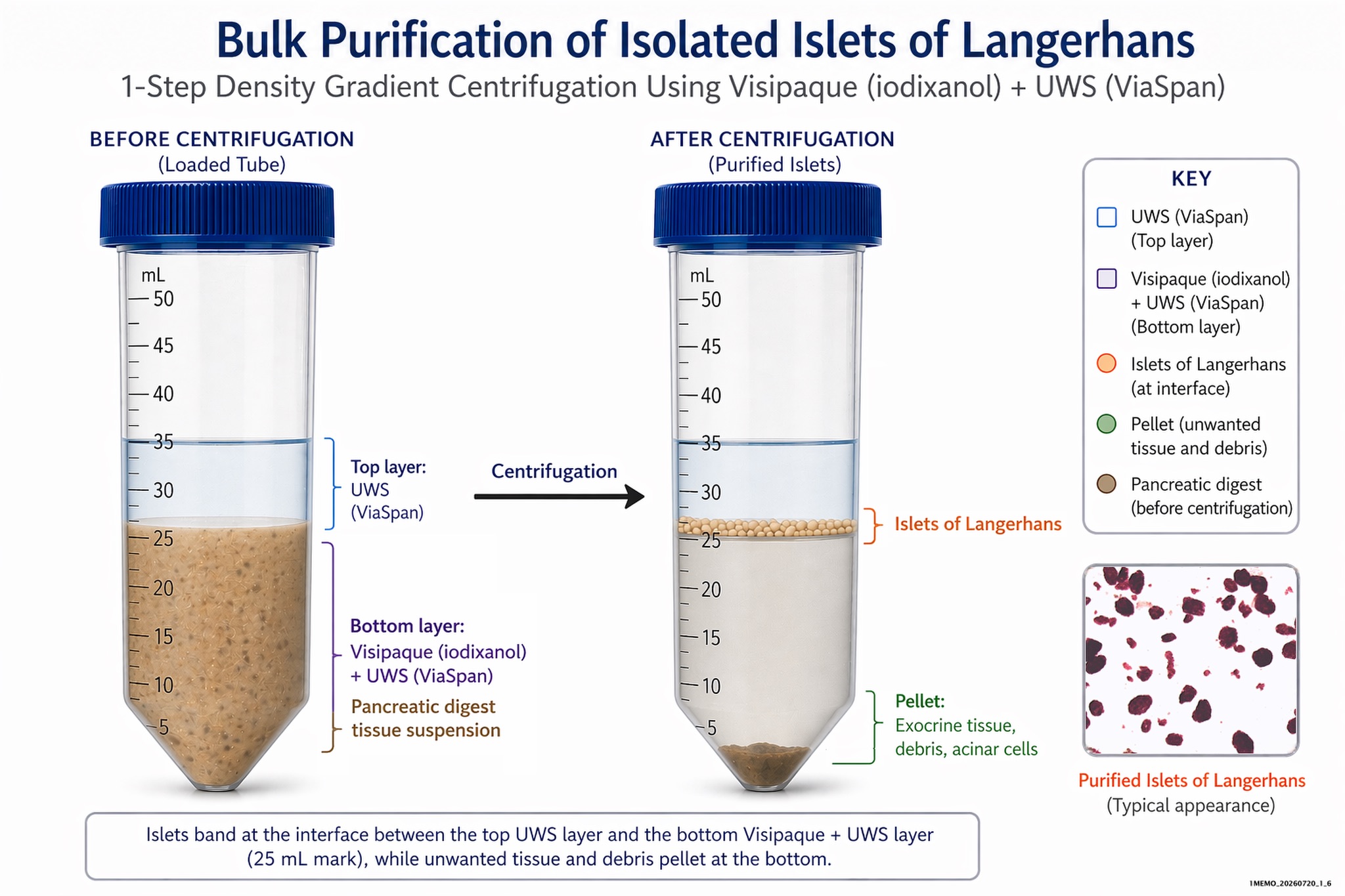
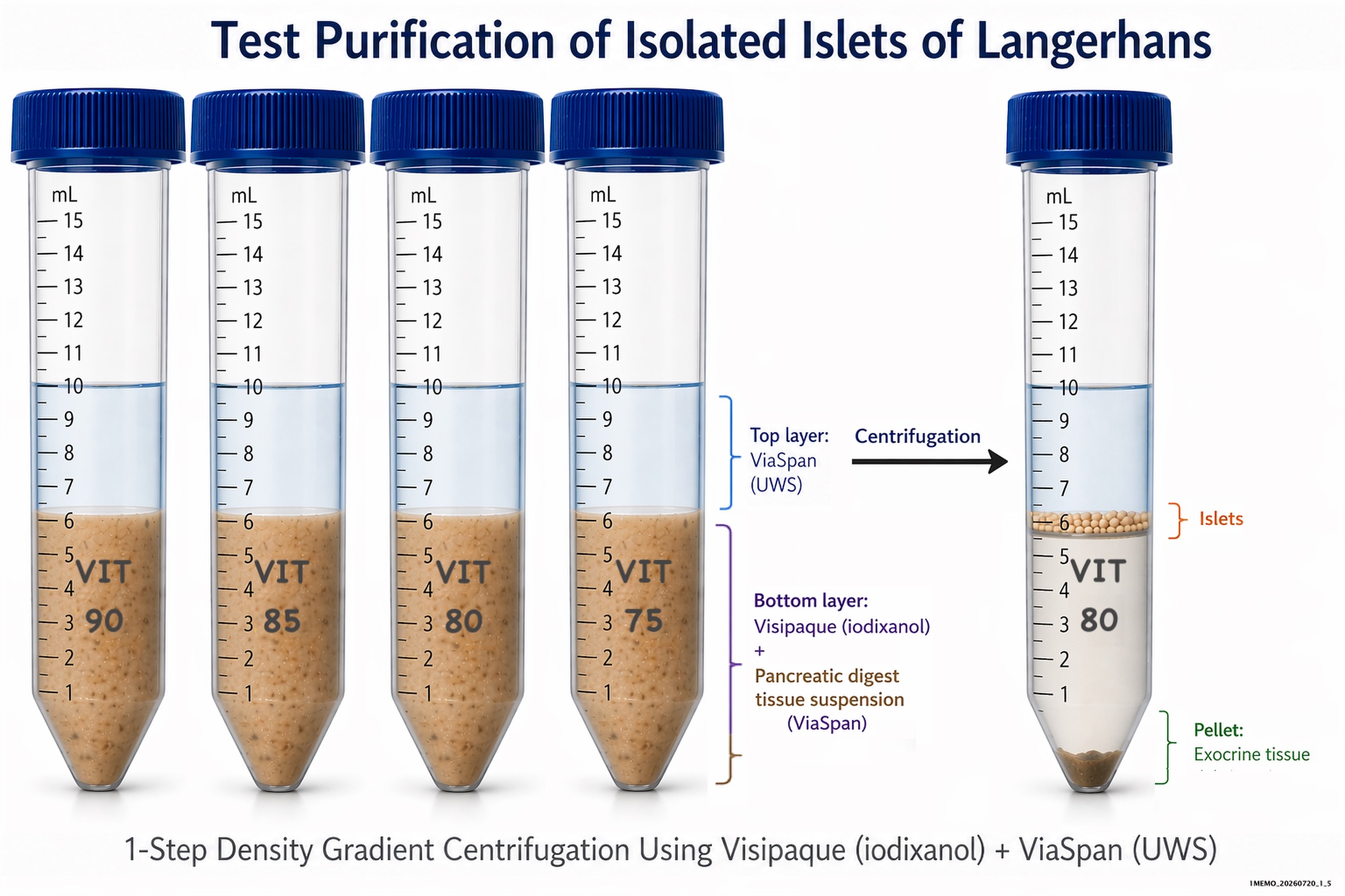
In practice, a 5% aliquot of the digest was distributed across four to seven small tubes, each mixed with IsletPrep to form the bottom of a one-step gradient at densities ranging from 1075 to 1090 (optional 1072, or 1100) and topped with UWS; analysing the resulting interfaces and pellets after centrifugation predicted the optimal density for bulk purification, which averaged around 1090 g/L across our isolations. For bulk purification, the digest — in 200–450 ml UWS — was mixed with IsletPrep, distributed across 10–20 conical tubes, topped with UWS, and spun for 5 minutes at 500 g, 4°C, with purified islets collected from the interface.

After the successful pre-commercial test of IsletPrep, its full production seemed only a matter of time.

Visipaque-Viaspan Purification

By the end of 2000, our isolation team had gained sufficient experience with the automated method to transition to GMP-compliant production of islets in our new lab in the LUMC GMP Facility. However, GMP production of IsletPrep itself could not be arranged immediately.

Purification without IsletPrep — that is, without the double-strength UWS component — also seemed an option: simply mixing OptiPrep and UWS had already proven sufficient for purification in animal experimental work in 1998 (7), indicating that double-strength UWS (i.e. IsletPrep) might not be strictly necessary for our Iodixanol-UWS gradients.

OptiPrep was a research-grade solution of 60% iodixanol, but could be replaced by the clinical-grade Visipaque solution of 65% iodixanol. Simply mixing Visipaque (iodixanol) and ViaSpan (UWS) — both commercial, cGMP-certified solutions — would be an elegant alternative for our Iodixanol-UWS gradients.


During the first months of 2001, the 2000 series of human islet isolations was completed in our research laboratory with a successful pilot of islet purification using Visipaque-ViaSpan, again demonstrating no loss of islets, preserved islet integrity, and purity above 70%. Test purification — following the same density-prediction approach used for IsletPrep — pointed to an optimal gradient density of ≤1085 in Visipaque-ViaSpan. Against the digest (1437 ± 15 IEQs/g; 18 ± 13% mantle-islets; 185 ± 16 µm diameter), bulk purification of the full batch with Visipaque-ViaSpan yielded 1681 ± 55 IEQs/g — a 118% recovery — 13 ± 3% mantle-islets, 184 ± 8 µm diameter, and 71 ± 16% purity, under mild hyperosmotic conditions (~315 mOsm, calculated) and a low endotoxin content.


Parallel pilot animal research in early 2001 also demonstrated that Visipaque-ViaSpan purification of porcine islets yielded the same recovery and purity as the standard OptiPrep-UWS gradient based on UWS2x — as had first been found in 1998, with the similar OptiPrep-ViaSpan purification solution (7).

With these good results, Visipaque-ViaSpan was adopted as the Standard Operating Procedure.

Opening Clinical Islet Laboratory — “Klinisch EilandLaboratorium”

With the Surgery islet team, the state-of-the-art islet isolation procedure, excellent purification results, and the Visipaque-ViaSpan SOP completing our GMP documentation (8), the following month — April 2001 — our “Klinisch EilandLaboratorium” (“Clinical Islet Laboratory”) was opened for GMP-compliant production and storage of islets, in what would become known as the Dutch “islet bank” at the LUMC…to be continued…


Notes

1) 1999 — Pioneering the LUMC Clinical Islet Transplant Project • 1MEMO_20260705 • Michel van der Burg • Miracles•Media • URL (1) michelvanderburg.com/2026/07/05 • URL (2) https://1memo.substack.com/p/1999-pioneering-the-lumc-clinical

2) Van der Burg MPM, Ringers J, Baranski A, Bouwman E, Terpstra OT. No loss of human (mantle-) islets by OptiPrep-UWS purification following isolation in UWS (Abstract). Acta Diabetol 36, 230 (1999). URL https://doi.org/10.1007/s005920050168 . PMID: 10664329 . Abstract available online (1).

3) Van der Burg MPM, Ringers J, Baranski A, Bouwman E, Terpstra OT. No loss of human (mantle-) islets by OptiPrep-UWS purification following isolation in UWS. 19th AIDSPIT Workshop of the European Association for the Study of Diabetes (EASD) in Igls (Austria) Jan 23–25, 2000. Oral presentation slideshow available online (1).

4) Piemonti L, Pileggi A. 25 YEARS OF THE RICORDI AUTOMATED METHOD FOR ISLET ISOLATION. CellR4 Repair Replace Regen Reprogram. 2013;1(1):8-22. PMID: 30505878; PMCID: PMC6267808. URL (1) https://www.cellr4.org/wp-content/uploads/sites/2/2013/06/Article-2013-1-e128.pdf URL (2) https://pmc.ncbi.nlm.nih.gov/articles/PMC6267808/

5) Who we are. Biorep. URL https://biorep.com/who-we-are/

6) Scharp DW, Arulmoli J, Morgan K, Sunshine H, Hao E. Advances in Human Islet Processing: Manufacturing Steps to Achieve Predictable Islet Outcomes from Research Pancreases. OBM Transplantation 2019; 3(1): 052; doi:10.21926/obm.transplant.1901052. URL https://www.lidsen.com/journals/transplantation/transplantation-03-01-052

7) Islet purification from bench to bedside • @1MEMO_20260623 • Michel van der Burg • Miracles.Media • URL michelvanderburg.com/2026/06/23/

8) IsletPrep based standard operating procedures (SOPs) were submitted for review with the 1st edition of the GMP Documentation for the LUMC Clinical Islet Laboratory (29 November 2000). The IsletPrep based SOPs were replaced with Visipaque-Viaspan based SOPs in the 1st edition (2001) GMP Documentation of the LUMC Clinical Islet Laboratory (KEL). Illustrated in presentation (9).

9) Presentation : 2000 — Pioneering Automated Islet Isolation & Clinical Grade Purification in the LUMC • 1MEMO_20260720_1 • Michel van der Burg • Miracles•Media • Automated isolation, IsletPrep, and Visipaque-ViaSpan: the road to the LUMC’s Clinical Islet Laboratory by Michel van der Burg • URL michelvanderburg.com/2026/07/20 • Video (1MEMO_20260720_1_Video) • Poster (1MEMO_20260720_1_Poster) • Handout (1MEMO_20260720_1_Handout)


Presentation : 2000 — Pioneering Automated Islet Isolation & Clinical Grade Purification in the LUMC • 1MEMO_20260720_1_Handout • Michel van der Burg • TakeNode ddda9083-ca1e-4b00-b29d-b1377a0f050e

Images (License TakeNode)

Presentation : 2000 — Pioneering Automated Islet Isolation & Clinical Grade Purification in the LUMC • 1MEMO_20260720_1_Poster • Michel van der Burg • TakeNode 42097357-1944-456b-b3a7-ce81ba03903b

Presentation : 2000 — Pioneering Automated Islet Isolation & Clinical Grade Purification in the LUMC • 1MEMO_20260720_1_Video • Michel van der Burg • TakeNode e0f677e3-689d-4697-bdad-e270eb949ee5

Presentation : 2000 — Pioneering Automated Islet Isolation & Clinical Grade Purification in the LUMC • 1MEMO_20260720_1_Handout • Michel van der Burg • TakeNode ddda9083-ca1e-4b00-b29d-b1377a0f050e

Automated Islet Isolation , LUMC 2001 • 1MEMO_20260720_1_1 • Michel van der Burg • Infographic diagram of Automated Islet Isolation setup 2001 in the LUMC, based on image from Ricordi & Strom in Nature Reviews Immunology 2004 • TakeNode 9c80e644-543c-4d2d-9775-1073465aeefa

IsletPrep-UWS , LUMC 2000 • 1MEMO_20260720_1_2 • Michel van der Burg • TakeNode 03a466fd-fa84-4044-a9ca-06116b5fb1ca

Test Purification Set IsletPrep , LUMC 2000 • 1MEMO_20260720_1_3 • Michel van der Burg • TakeNode 75bc6084-f93d-4e02-acbc-a541fb9b7233

Bulk Purification IsletPrep , LUMC 2000 • 1MEMO_20260720_1_4 • Michel van der Burg • TakeNode 09726d07-8cd5-44f2-a412-32f524f4825f

Test Purification Set Visipaque , LUMC 2001 • 1MEMO_20260720_1_5 • Michel van der Burg • TakeNode c79006b7-4752-4e49-9248-bdb134aa2fbc

Bulk Purification Visipaque , LUMC 2001 • 1MEMO_20260720_1_6 • Michel van der Burg • TakeNode d0ea62a3-580a-429a-a45d-6d912de4d2cd

Visipaque-ViaSpan SOPs • 1MEMO_20260720_1_7 • Michel van der Burg • Illustration of “Procedure report” pages on using Visipaque for “Test tubes” preparation (right) and “Purification” (middle) during human islet isolation, with the pancreatic digest in UWS (ViaSpan), from the 2001 standard operating procedures — the SOPs, now “Obsolete” (i.e. outdated) — from the GMP documentation for the Clinical Islet Laboratory (Klinisch Eilandlaboratorium) at LUMC (Leiden, Netherlands). Translated from Dutch by the author, Michel van der Burg • TakeNode 66f5207b-db1a-4166-bc22-0104ec509449

Acknowledgements — I thank Bjørn Henriksen (International Product Group Manager Density Gradient Media Nycomed / Axis-Shield PoC AS (Oslo, Norway) for our collaboration on our iodixanol and IsletPrep work ; Camillo Ricordi (Director of the Diabetes Research Institute, Miami) and Ramon Poo (BioRep Technologies, Miami) for their help in setting up automated islet isolation in our lab ; Amon Wafelman (deputy head of the Interdivisional GMP-Facility, Department of Clinical Pharmacy and Toxicology, LUMC) for collaboration on our SOPs and GMP setup of the clinical islet laboratory ; our Transplant Coordinators Marijke van Gurp and Ruth Dam (EuroTransplant/LUMC) and my co-workers of the Transplant section of the Surgery Department (LUMC) : surgeons Jan Ringers, André Baranski, Xandro Schaapherder for dedicated organ procurement, and the researchers Eelco Bouwman, Annemiek Töns (staff) and Josephine Rijkelijkhuizen, Gabe Bleeker (students) for our collaboration in the ‘islet team’.

This work was shared previously with the other islets centers, in personal communication in 2001 — in detail with Jonathan Lakey (Edmonton, Canada), and in summary with Daniel Brandhorst (Giessen, Germany), José Oberholzer (Geneva, Switzerland) — and with Sue Swift (Leicester, UK) in 2003.

#IsletPrep #UWS2x #islets #islet #Langerhans #isolation #automated #purification #isletbank #surgery #clinical #laboratory #launch #GMP #cleanroom #facility #Surgery #KEL #CITX #LUMC #Holland #Netherlands #Leiden #hospital #Eurotransplant #human #donor #Visipaque #optiprep #iodixanol #ViaSpan #UWS #density #gradient #pancreas #UW #university #Wisconsin #transplantation #diabetes #history #research #memoir #1memo #michelvanderburg #BioRep #CamilloRicordi #DRI #Miami #Nycomed #Axis #Klinisch #Eilandlaboratorium

Citation info : 2000 — Pioneering Automated Islet Isolation & Clinical Grade Purification in the LUMC • 1MEMO_20260720 • Michel van der Burg • Miracles•Media • URL https://michelvanderburg.com/2026/07/20

1999 — Pioneering the LUMC Clinical Islet Transplant Project • 1MEMO_20260705

by Michel van der Burg , Sunday 5 July 2026 , Updated 10 July 2026

Abstract

In 1997, Onno Terpstra, Head of Surgery at Leiden University Medical Center (LUMC), asked Michel van der Burg to develop a plan for a clinical islet isolation and transplantation program. Following a working visit to the Diabetes Research Institute in Miami in spring 1998, where the Iodixanol-UWS purification method was tested on human islets, van der Burg began the islet isolation program at LUMC and the setting up of the Clinical Islet Laboratory (Klinisch Eilandlaboratorium, KEL) within a new GMP facility at LUMC, in collaboration with Amon Wafelman, executive head of the GMP facility. A business plan was submitted to the LUMC Board of Directors in November 1998 and approved on February 22, 1999, formally launching the project. The first series of human islet isolations, using manual pancreas digestion and Iodixanol-UWS purification, began in March 1999. The results were published in December 1999 and presented at the AIDSPIT Workshop in January 2000. From 2000 onward, the laboratory adopted the automated Ricordi method, using equipment supplied through BioRep Technologies in Miami.

Citation info : 1999 — Pioneering the LUMC Clinical Islet Transplant Project • 1MEMO_20260705 • Michel van der Burg • Miracles•Media • URL michelvanderburg.com/2026/07/05


The LUMC clinical islet transplantation project began in 1997 on the initiative of the Department of Surgery at the LUMC, where I had been conducting animal-experimental research within the Transplantation Section since 1981 — first into the optimal method for pancreas transplantation, and subsequently into the transplantation of islets of Langerhans following isolation and purification of the islets from the pancreas (1-11).

Following successful animal-experimental islet transplantation, and a brief period of experimental human islet isolation in the early 1990s (8,9), Onno Terpstra, the head of our Surgery Department, asked me in the summer of 1997 to explore our options for starting clinical islet isolation and transplantation at our center — the Leiden University Medical Center (LUMC) — and to prepare a roadmap.

After first gaining experience in the spring of 1998 with the human islet transplant program in Miami — during which, in the course of isolating human islets of Langerhans, our new islet purification method also proved successful (11,12) — I was able to begin actually setting up the human islet project in Leiden in the summer of 1998.

Our innovative procedure for purifying islets in Iodixanol-UWS was further developed and published that summer of 1998 in collaboration with Nycomed (10).

The LUMC had recently begun renovating a wing of the building to establish a GMP facility with six so-called cleanrooms, intended to guarantee maximum protection and quality in the manufacture of medicinal products. After the summer of 1998, I was just in time to join those renovation plans, working together with Amon Wafelman — the executive head of the future GMP facility — to realize the necessary modifications in the GMP wing, with one of the six cleanrooms specially fitted out for use as our clinical islet laboratory. Although the cleanrooms had not originally been intended for permanent use, round-the-clock use of a cleanroom for the islet project could nonetheless become an option, with support from the Board of Directors.

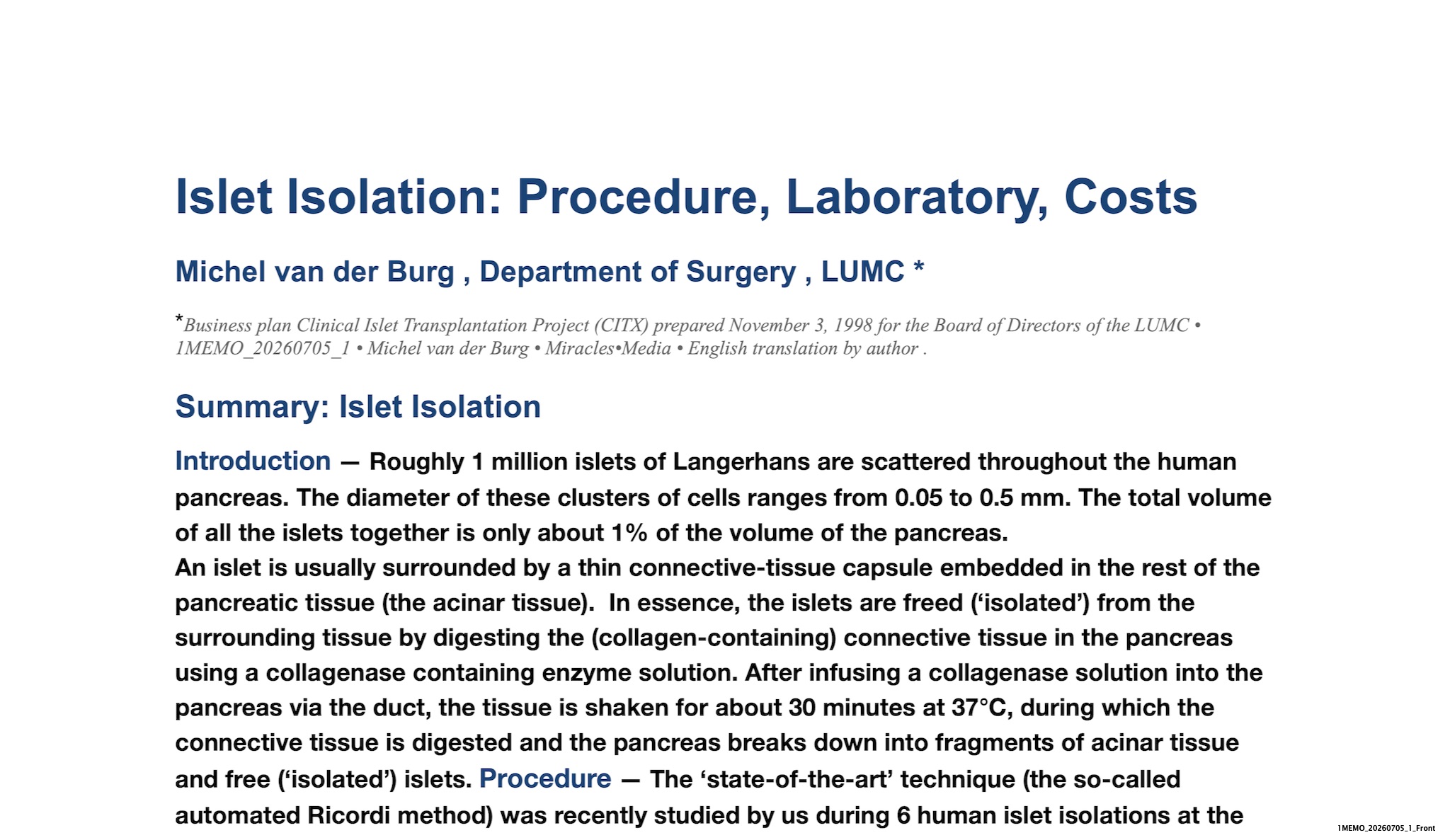
By November 1998, I had incorporated a plan for setting up the Clinical Islet Laboratory (KEL) — and for the first 20 islet isolation procedures — into a business plan presented on behalf of our Department of Surgery to the LUMC Board of Directors (13; 1MEMO_20260705_1).

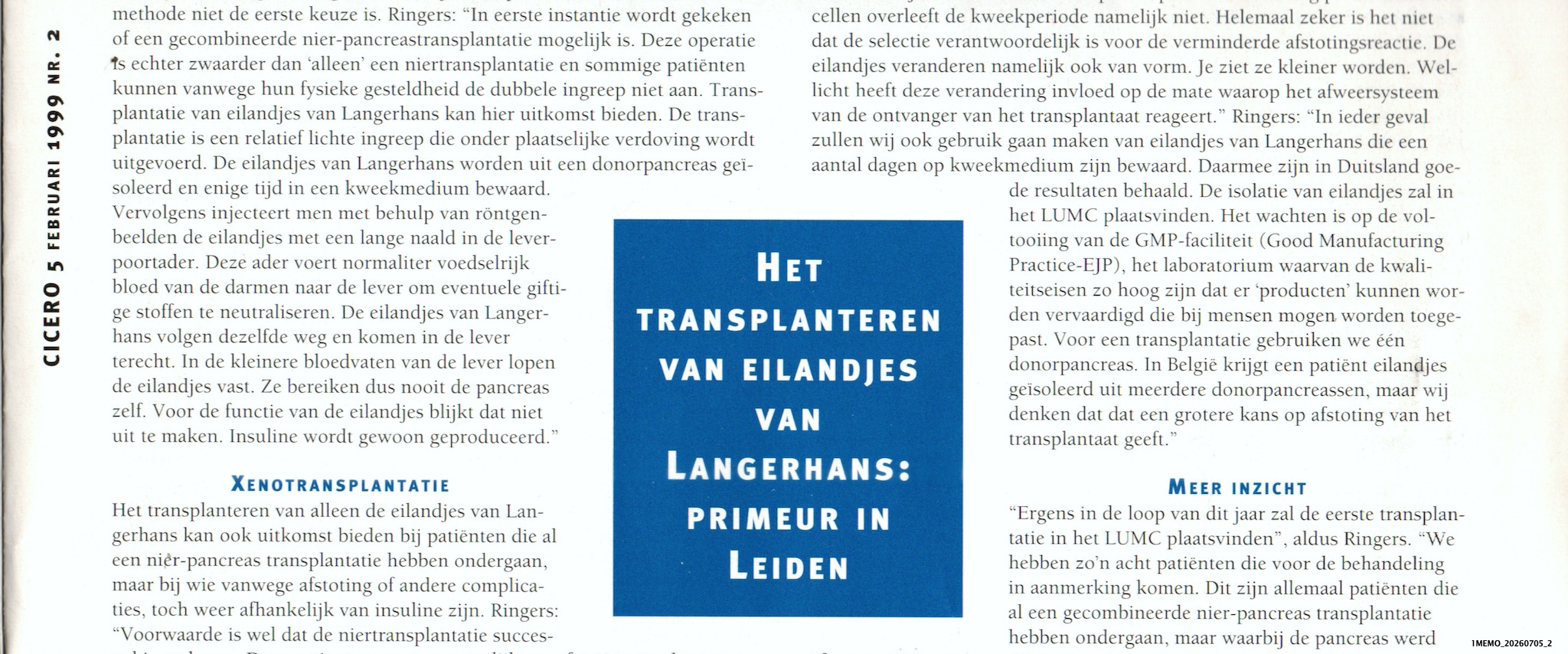
On February 22, 1999, the LUMC Executive Board approved the plan and authorized the necessary material resources, officially launching the islet transplantation project — as announced that month in the LUMC magazine ‘Cicero’ (14; 1MEMO_20260705_2).


Quote (my translation):

The Transplantation of Islets of Langerhans: A Leiden First

… The isolation of islets will take place at the LUMC. What remains is the completion of the GMP facility (Good Manufacturing Practice), the laboratory whose quality standards are so stringent that “products” can be manufactured that are suitable for administration to humans …”

The project was registered with the Eurotransplant organization for the allocation of donor organs — marginal donor organs, i.e. not suitable for clinical transplantation — to start up the islet isolation procedure, without transplantation being the aim at that stage.

In March 1999, we received the first donor organs via Eurotransplant for an initial experimental series of islet isolations. With the approval of the Board of Directors — since the GMP facility was still under construction — work could already begin in the Surgery Laboratory, gaining hands-on experience with human islet isolation, the donor procedure, islet culture, and all other facets of operating an “islet bank.”


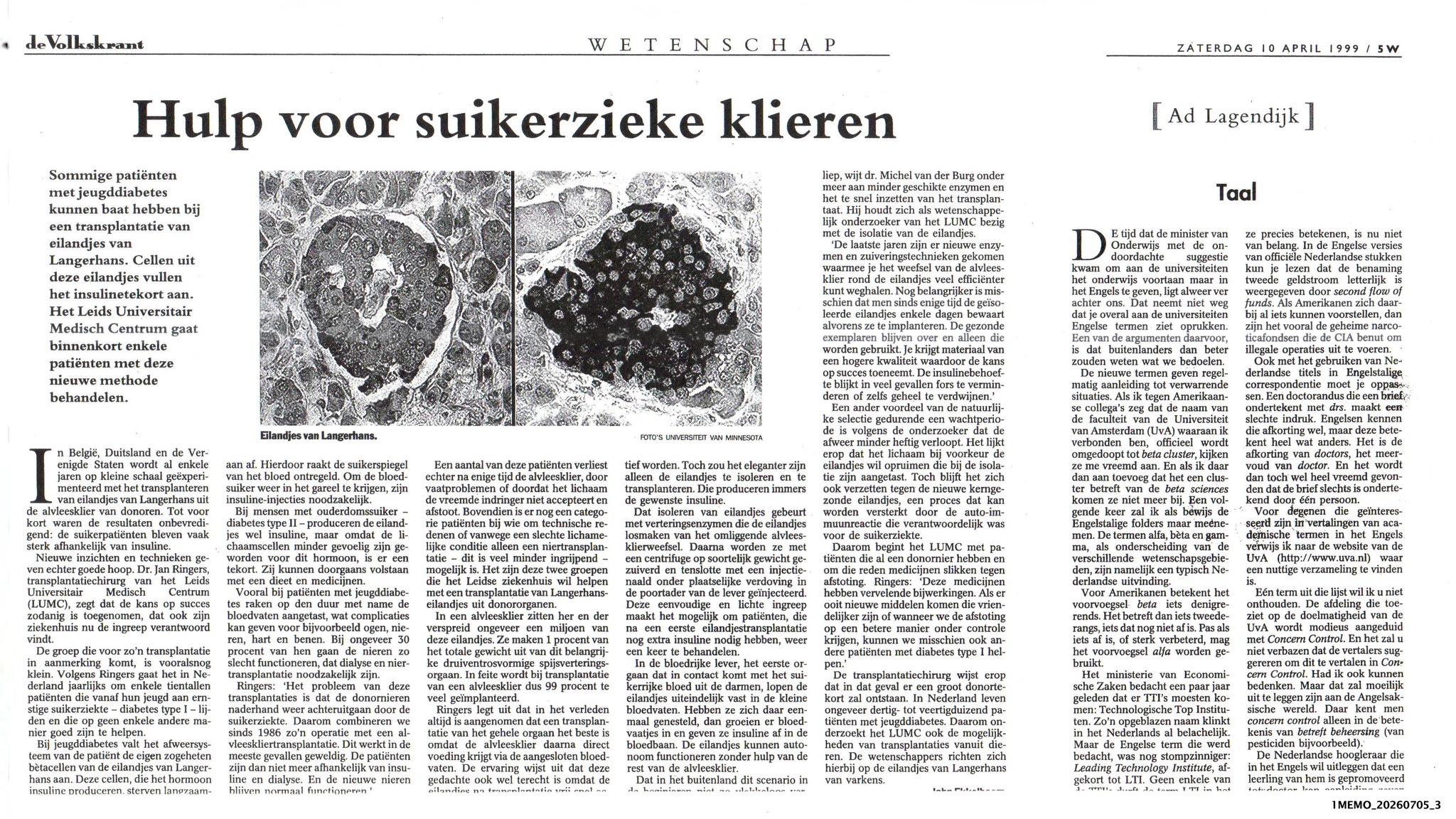
In April 1999, the Dutch national newspaper ‘De Volkskrant’ announced the LUMC project in the article “Help for diabetic glands” (“Hulp voor suikerzieke klieren”) by John Ekkelboom (15; 1MEMO_20260705_3), with contributions from Jan Ringers (Head of the Transplantation Section of our department) and myself.
Excerpts (translated from Dutch):

Help for diabetic glands

Some patients with juvenile diabetes may benefit from a transplantation of islets of Langerhans. Cells from these islets replenish the insulin deficiency. The Leiden University Medical Center (LUMC) will soon treat several patients with this new method.

… Dr. Jan Ringers, a transplant surgeon at the LUMC, says that the chance of success has increased to such an extent that his hospital now also considers the procedure justifiable …

… Dr. Michel van der Burg attributes the fact that this scenario did not go as well abroad in the early years to, among other things, less suitable enzymes and the premature insertion of the transplant. As a scientific researcher at the LUMC, he focuses on the isolation of the islets …”

— John Ekkelboom, April 10, 1999, Volkskrant

First series of human islet isolations in Leiden

In March 1999, the first series of human islet isolations began in the LUMC Surgery Laboratory, applying the manual method of donor pancreas digestion, with purification of the islets in the new Iodixanol-UWS gradients.


This Iodixanol-UWS purification method had been developed in our animal-experimental research on the isolation and purification of porcine islets for successful transplantations, first in diabetic mice, then in rats and monkeys (7,16).

The Iodixanol-UWS purification method had also proved promising the previous year in my pilot research during human islet isolations at the Diabetes Research Institute in Miami, where the purified human islets were successfully transplanted into nude mice (11).

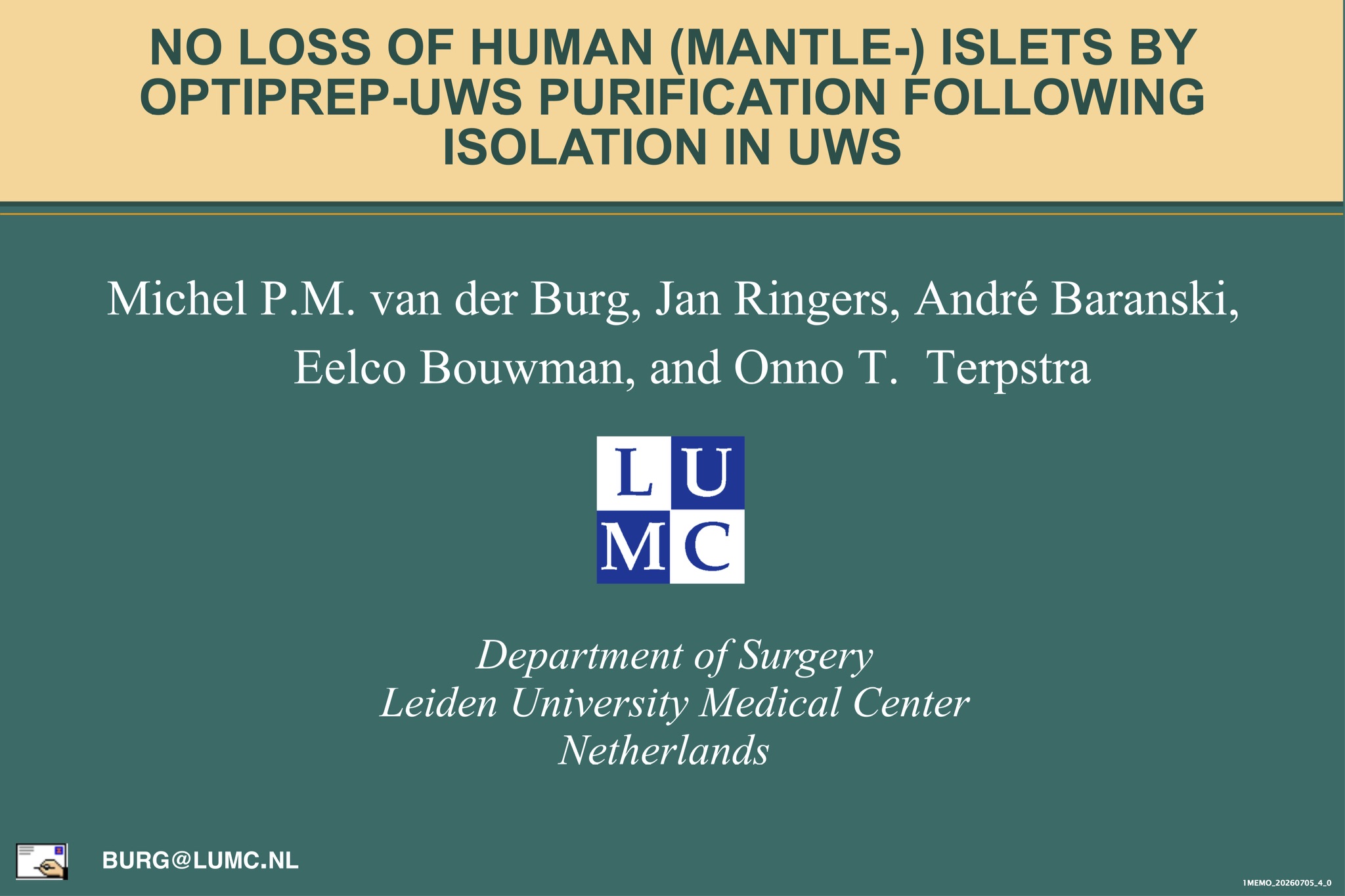
The results of our first series of human islet isolations at the LUMC in 1999 were published in December 1999 and subsequently presented at the 19th AIDSPIT Workshop of the European Association for the Study of Diabetes (EASD) in Igls, Austria, in January 2000 (17,18,19,20; 1MEMO_20260705_4).

No Loss of Human Islets • AIDSPIT 2000 • 1MEMO_20260705_4 • Michel van der Burg • Miracles•Media • Outcome 1st series in 1999 of human islet isolation in LUMC presented at the 19th AIDSPIT Workshop of the European Association for the Study of Diabetes (EASD) in Igls, Austria, January 23–25, 2000 . Details , plus handout and abstract for download in Notes (17,18,19,20).

State of the Art — Ricordi Method & BioRep Technologies

Work then began on the second series of isolations, this time using the state-of-the-art “Ricordi Automated Method” for pancreas digestion (21), as further developed by Camillo Ricordi, first in David Scharp’s team in Paul Lacy’s laboratory in St. Louis (USA) and eventually in Miami together with Ramon Poo of BioRep Technologies, Inc.

In setting up the state-of-the-art procedure for islet isolation from the pancreas using the Ricordi Automated Method at the LUMC, I worked at the end of 1998 together with Gerard Verschagen, head of the precision mechanics workshop of the Laboratory of Physiology of the LUMC (22), on developing a compressed-air-driven shaking device for the Ricordi chamber, for which modifications to the GMP complex were also planned.

Earlier in 1998, during my working visit to the Diabetes Research Institute in Miami, I had met Mr. Ramon Poo, who — alongside his day job as a designer and manufacturer of plastic bottles in Miami (Altira, Inc.) — also contributed on a voluntary basis to Ricordi’s islet project in Miami. Through his firm founded specifically for this purpose, BioRep Technologies, Inc., Poo designed and manufactured the special equipment for the Ricordi isolation method, including the digestion chamber and a shaking device for the Ricordi chamber (23,24). During that working visit, Mr. Poo also gave me a stainless-steel Ricordi chamber and other components for the “Ricordi setup” to start up the procedure in our laboratory in Leiden, Holland, in the LUMC.

During discussions at the end of 1998, by phone and fax, with Mr. Poo about our design in Leiden of the shaking device based on the BioRep model, it emerged that BioRep could supply us with a new model of shaking device — the Wrist Shaker, a model not yet patented — with the permission of Camillo Ricordi’s team, on condition of “no disclosure.”

From 1999 onward, the Wrist Shaker (Model No. B-3-G) and other BioRep equipment were imported, after which, from 2000 onward, the Ricordi Automated Method for pancreas digestion was applied for islet isolation at the LUMC…to be continued…

Notes

1) Pancreatic islet transplantation Thesis Repository Leiden University • 20221125 • Michel van der Burg • Miracles•Media • . Persistent URL https://hdl.handle.net/1887/3486604

2) Leiden Islet Laboratory History • 20240803 • Michel van der Burg • michelvanderburg•com • URL https://michelvanderburg.com/2024/08/03/leiden-islet-laboratory-history-20240803/

3) Pancreas & Islet Transplantation Program • 20240912 • Michel van der Burg • michelvanderburg•com • URL https://michelvanderburg.com/2024/09/12/pancreas-islet-transplantation-program-20240912/

4) Pancreatic Islet Isolation With UW Solution • A New Concept • Michel van der Burg • Miracles.Media • @1MEMO 20241224 • URL michelvanderburg.com/2024/12/24/

5) Percoll UWS Purification Pancreatic Islets • ESOT 1991 Talk • Michel van der Burg • Miracles.Media • @1MEMO 20250114 • URL michelvanderburg.com/2025/01/14/

6) Islet Transplantation Breakthrough in Leiden University Hospital • 20240830 • Michel van der Burg • michelvanderburg•com URL https://michelvanderburg.com/2024/08/30/islet-transplantation-breakthrough-in-leiden-university-hospital-20240830/

7) Successful Islet Transplantation After Purification in Iodixanol-UWS • IPITA 1999 Sydney • @1MEMO 20260326 • Michel van der Burg • Miracles.Media • URL michelvanderburg.com/2026/03/26/

8) 1989 — First series of human islet isolations in Leiden. In 1989-1990 we performed a first series of islet isolations from human donor pancreases using our novel techniques of isolation and purification in UW organ preservation solution – in association with a European Concerted Action for the Treatment of Diabetes – the Brussels headed (Daniel Pipeleers) ‘Multicenter program on the treatment of diabetes by islet cell transplantation’.

9) Pittsburgh 1992 Cell Transplant Society • 20240812 • Michel van der Burg • michelvanderburg•com • URL https://michelvanderburg.com/2024/08/12/pittsburgh-1992-cell-transplant-society-20240812/

10) Islet purification from bench to bedside • @1MEMO_20260623 • Michel van der Burg • Miracles.Media • URL michelvanderburg.com/2026/06/23/

11) Efficacy of the novel iodixanol-UWS density gradient for human islet purification • Igls Aidspit 1999 • Michel van der Burg • Miracles.Media • 20241202 • URL michelvanderburg.com/2024/12/02/

12) Human Islet Isolation • DRI Miami 1998 • Michel van der Burg • Miracles.Media • @1MEMO 20250204 • URL michelvanderburg.com/2025/02/04/

13) Business Plan CITX • 1MEMO_20260705_1 • Michel van der Burg • Miracles•Media • TakeNode 62317860-28ff-46a6-9e2b-20910f7f4aa6 • Business plan Clinical Islet Transplantation Project (CITX) prepared November 3, 1998 for the Board of Directors of the LUMC (English translation by author). PDF for viewing and download below 1MEMO_20260705_1.

14) A Leiden First • 1MEMO_20260705_2 • Miracles•Media • TakeNode d3d3effe-ee4c-479c-8051-c78a90746eb1 • “The Transplantation of Islets of Langerhans : A Leiden First “. Pull quote from the feature story ‘Ernstiger ziek en wèl genezen’ by Evert Pronk, in the LUMC news magazine Cicero, 5 February 1999 (ISSN 0920-2900) .

15) Help for diabetic glands • April 1999 News Volkskrant • 1MEMO_20260705_3 • Miracles•Media • TakeNode ccbd39ce-9498-4bc9-aefb-96ae6f9e5791 • Help for diabetic glands (dutch: Hulp voor suikerzieke klieren) in Dutch national newspaper De Volkskrant , 10 April 1999 , by John Ekkelboom . Text (only) online in Volkskrant archive URL https://www.volkskrant.nl/wetenschap/hulp-voor-suikerzieke-klieren~b7046616/

16) Primate Islet Isolation and Purification in Iodixanol-UWS • @1MEMO_20260425 • Michel van der Burg • Miracles.Media • URL michelvanderburg.com/2026/04/25/

17) Van der Burg MPM, Ringers J, Baranski A, Bouwman E, Terpstra OT. No loss of human (mantle-) islets by OptiPrep-UWS purification following isolation in UWS. 19th AIDSPIT Workshop of the European Association for the Study of Diabetes (EASD) in Igls (Austria) Jan 23–25, 2000 . Abstract (Page 230) in : Acta Diabetol 36, 205–231 (1999). https://doi.org/10.1007/s005920050168 . PMID: 10664329

18) No Loss of Human Islets • AIDSPIT 2000 • 1MEMO_20260705_4 • Michel van der Burg • Miracles•Media • Video of slideshow TakeNode bb4091a1-374f-4a04-86a1-67e371074109 • URL https://youtu.be/txSFax_nR2I

19) Ibid. Handout of slideshow : 1MEMO_20260705_4_PDF • Michel van der Burg • Miracles•Media • TakeNode 35766a9b-d1b1-47af-9371-4edca9c3ad0d • Download PDF below ( 1MEMO_20260705_4_PDF )

20) Van der Burg MPM, Ringers J, Baranski A, Bouwman E, Terpstra OT. No loss of human (mantle-) islets by OptiPrep-UWS purification following isolation in UWS (Abstract). Acta Diabetol 36, 230 (1999). URL https://doi.org/10.1007/s005920050168 . PMID: 10664329

Ibid. Abstract copy : 1MEMO_20260705_4_PMID_10664329 • Michel van der Burg • Miracles•Media • TakeNode fa10d5e9-3df9-46e0-b8cf-7f9f9f853526 • Download PDF below ( 1MEMO_20260705_4_PMID_10664329 )

21) Piemonti L, Pileggi A. 25 YEARS OF THE RICORDI AUTOMATED METHOD FOR ISLET ISOLATION. CellR4 Repair Replace Regen Reprogram. 2013;1(1):e128. PMID: 30505878; PMCID: PMC6267808. URL https://pmc.ncbi.nlm.nih.gov/articles/PMC6267808/

22) Leiden Islet Isolation Chamber • Michel van der Burg • Miracles.Media • @1MEMO 20250116 • URL michelvanderburg.com/2025/01/16/

23) How a Family Business Has Buoyed the Diabetes Research Institute (DRI) URL https://www.mwhoskinsmedia.com/2019/12/how-family-business-has-buoyed-diabetes.html

24) Who we are. Biorep. URL https://biorep.com/who-we-are/

#islets #islet #Langerhans #isolation #purification #isletbank #first #launch #Cicero #Volkskrant #newspaper #news #GMP #cleanroom #facility #Surgery #KEL #CITX #LUMC #Holland #Netherlands #Leiden #hospital #Eurotransplant #human #donor #surgery #clinical #laboratory #optiprep #iodixanol #ViaSpan #density #gradient #UWS #pancreas #UW #university #Wisconsin #transplantation #diabetes #man #history #research #history #memoir #1memo #michelvanderburg #BioRep #CamilloRicordi #DRI #Miami #Nycomed #Visipaque

Citation info : 1999 — Pioneering the LUMC Clinical Islet Transplant Project • 1MEMO_20260705 • Michel van der Burg • Miracles•Media • URL michelvanderburg.com/2026/07/05

Genocide • 20260519

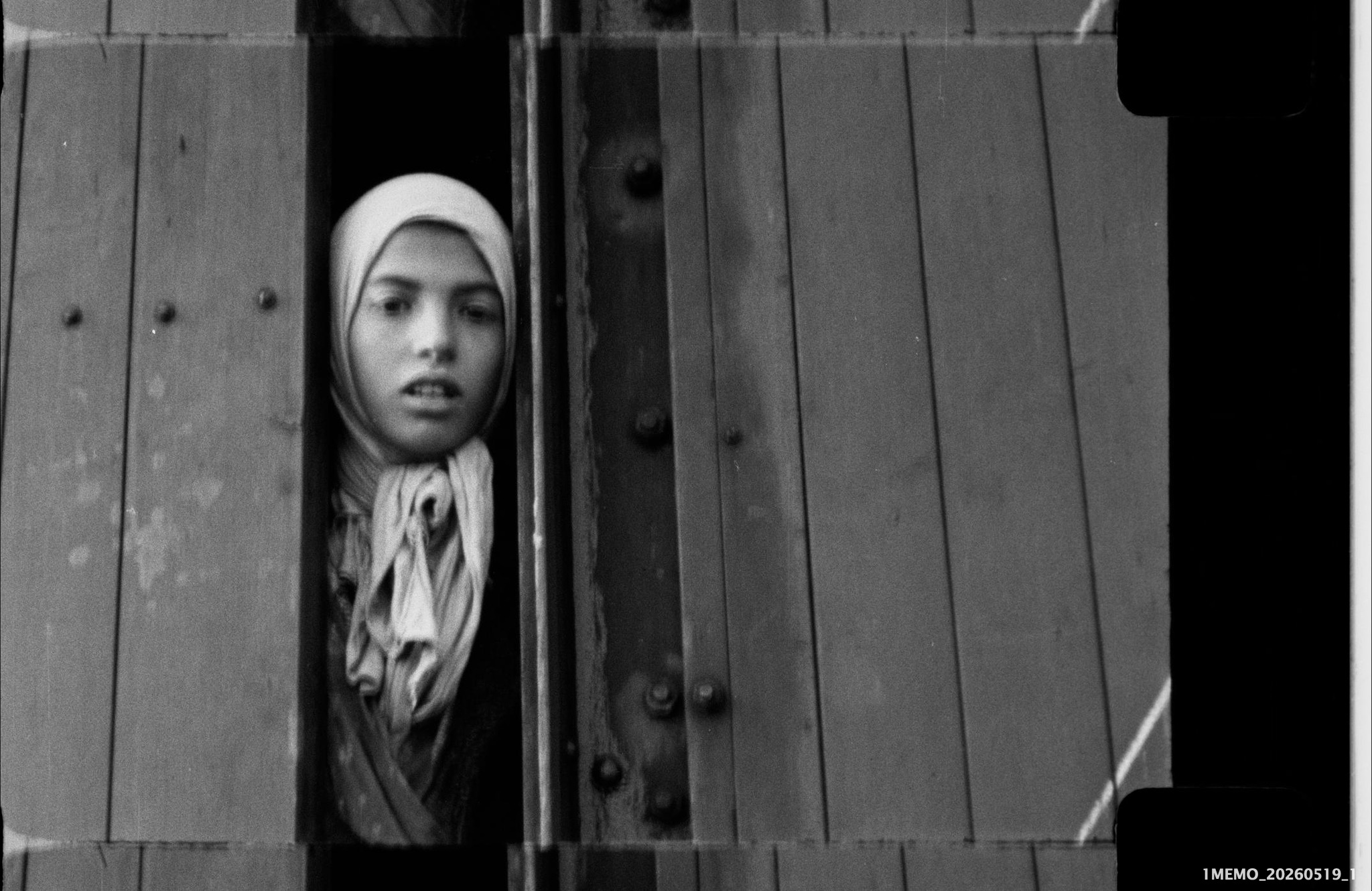
Settela Steinbach — The Girl with the Headscarf • 1MEMO_20260519_1 • Settela•Com • Frame from camera original film reel of the Westerborkfilm (1).

On May 19, 1944, at the Westerbork transit camp, a glimpse of Sinti girl Settela Steinbach wearing a headscarf appears between the sliding doors of a cattle car awaiting deportation to Auschwitz (1,2,3).
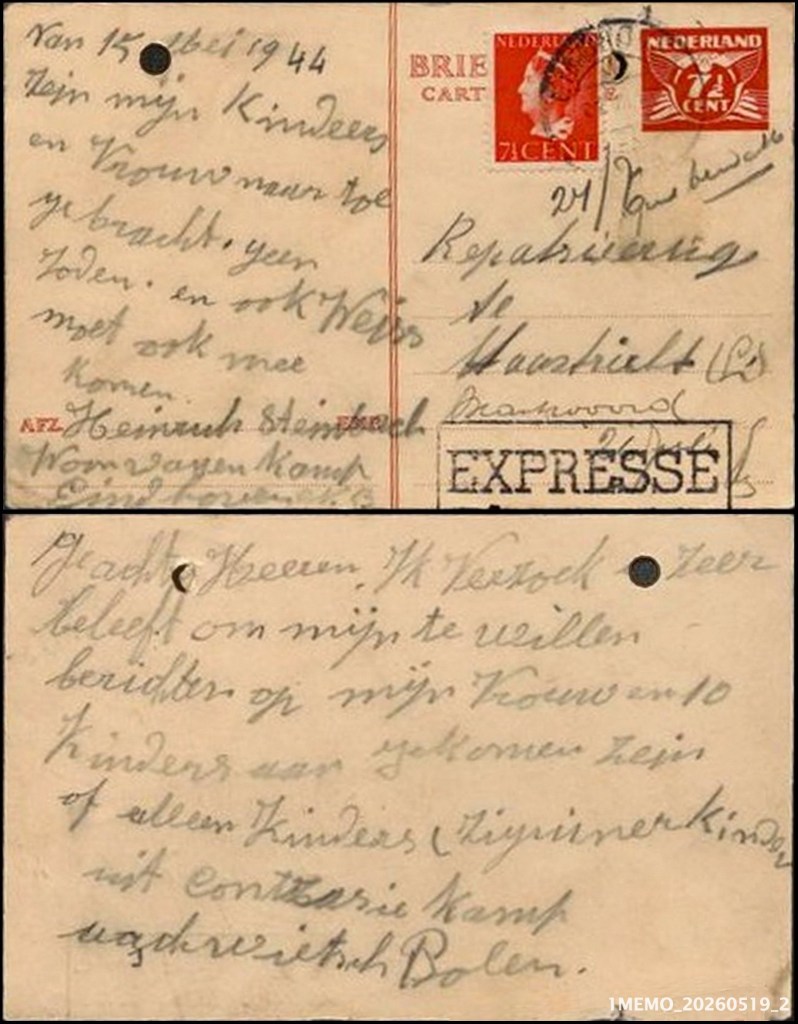
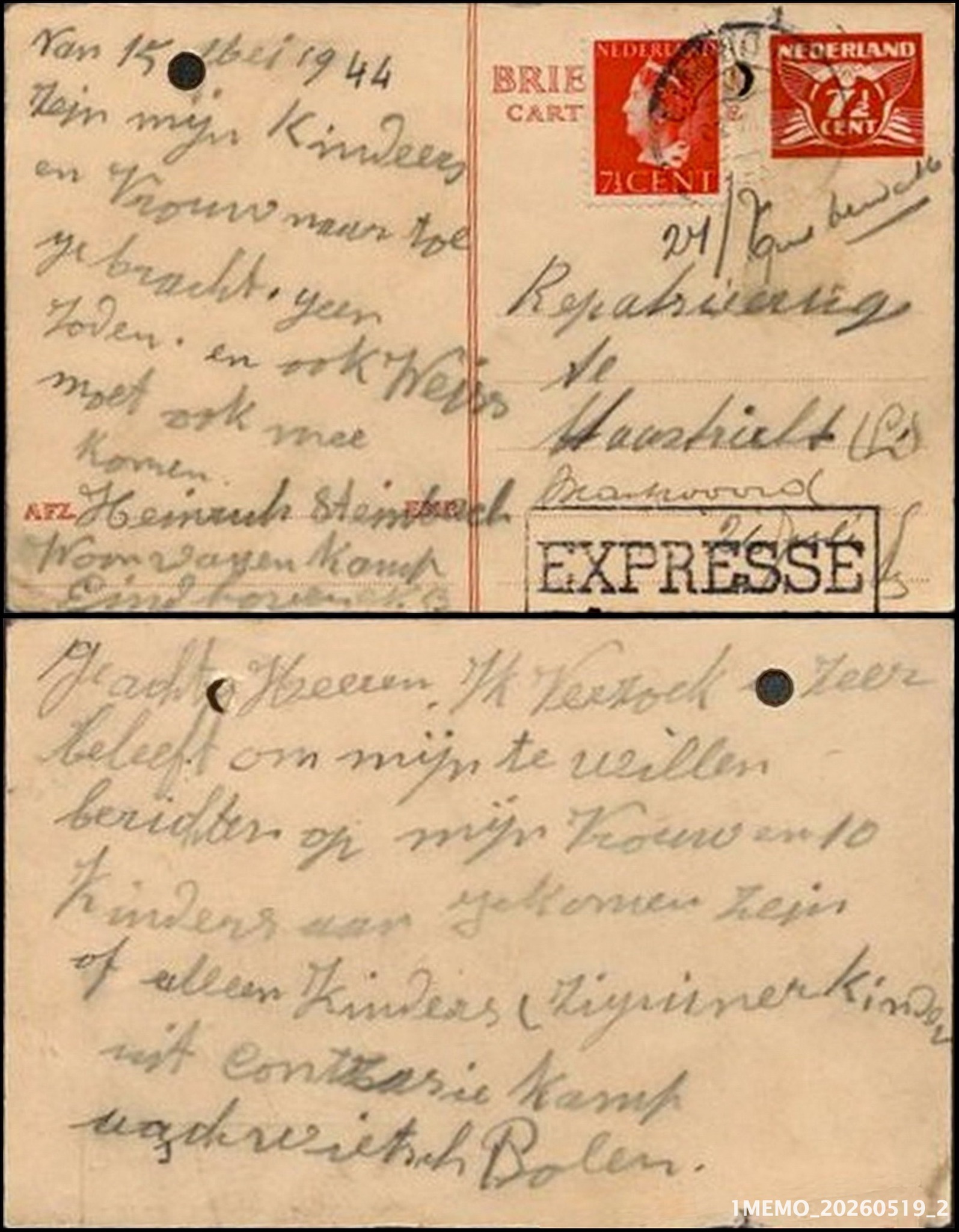
In May 1945, her father, Moeselman Steinbach, wrote to “Repatriation” in the Netherlands: “…I very politely request you to inform me whether my wife and 10 children have arrived, or only children (Gypsy children) from the Auschwitz concentration camp in Poland.” (4).

The 9-year-old dutch Sinti-girl Anna Maria ‘Settela’ Steinbach peeks outside , at the last moment just before the sliding door is closed , standing inside a cattle car with 74 people on May 19 , 1944 in the Westerbork transit camp in Holland , when this deportation train leaves for Auschwitz-Birkenau – where Settela is murdered a few months later in one of the gas chambers (5).

While Settela peeks outside , her mother cries behind her in that cattle car : “Get out of there, or soon your head gets in between!”

She is wearing a headscarf made from a torn sheet because the Nazis shaved her head upon arrival at Westerbork transit camp on May 16, 1944, following the “Gypsy raid” carried out that same day at the Zwaaikom caravan site in Eindhoven, the Netherlands (6).

Settela Film • 20220630

Settela was filmed only a few seconds by the Jewish prisoner filmmaker Rudolf Breslauer as part of a documentary film being made in 1944 on the Westerbork camp .
Those seconds , also in slow-motion are shown in the 2022 Settela Film • 20220630 (7)

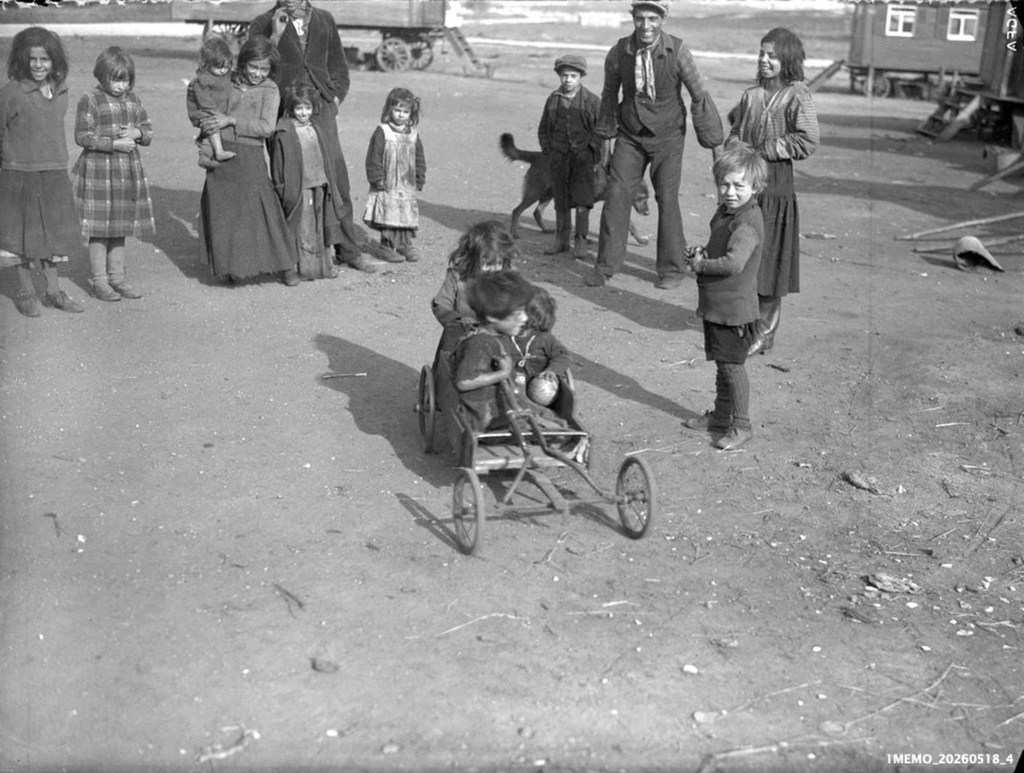
The toddler Settela in the arms of her older sister Elisabeth Steinbach at the Heksenberg Sinti caravan site in 1935 • Photo Jan de Jong • 1MEMO_20260518_4

Anna Maria (‘Settela’) Steinbach was born 23 December 1934 in Buchten, Netherlands, and photographed at age ~1 , in the arms of her older sister Elisabeth Steinbach, with others of the Steinbach family, and other families, at the nearby Sinti caravan site ‘Heksenberg’, October 1935, by photographer Jan de Jong (8) • 1MEMO_20260518_4

Settela was deported together with her brothers and sisters (Willy “Celestinus”, Willem, Elisabeth, Johanna, Philibert, Florentina, Willem, Anna), and mother Toetela (Emilia) Steinbach (born 23 March 1902 in Antwerp, Belgium), with other Steinbach and other nomad families – all together ca 245 Sinti and Roma and ca 450 Jews – on May 19th 1944 from the dutch Camp Westerbork to the Auschwitz and Bergen-Belsen camps (5,6).

Toetela’s eldest child Moekela (Magdalena; born 14 Sep 1922) had gone to Belgium and had been deported earlier – 15 Jan 1944 – with her 6 months old baby Jeanette – Toetela’s granddaughter – on the Z-Transport from transit camp Kazerne Dossin in Mechelen to Auschwitz, were they were murdered on arrival.

Settela’s father Heinrich (‘Moeselman’) Steinbach (born Nov 11, 1901 in Gründorf in Germany) died alone of grief June 6, 1946 in Maastricht in the Netherlands – his wife and 10 children had not survived the camps.


To : “Repatriation” in Maastricht (Netherlands) — “Dear Sirs, I very politely request you to inform me whether my wife and 10 children have arrived, or only children (Gypsy children) from the Auschwitz concentration camp in Poland.
From May 15, 1944, my children and wife were taken there; no Jews. And Weiss had to come along too. — Heinrich Steinbach. Caravan site Eindhoven , North Brabant” • 1MEMO_20260519_2 • Settela•Com

One year earlier , May 22, 1945, two weeks after the liberation of Holland, Heinrich Steinbach — living at the caravan site in Eindhoven (North Brabant, Netherlands) — inquires about the fate of his wife and ten children on a postcard written to the “Repatriation” in Maastricht (Netherlands). The text on the postcard reads — translated from dutch (4) :

“Dear Sirs, I very politely request you to inform me whether my wife and 10 children have arrived, or only children (Gypsy children) from the Auschwitz concentration camp in Poland.

From May 15, 1944, my children and wife were taken there; no Jews. And Weiss had to come along too.

Heinrich Steinbach. Caravan site Eindhoven N.B.”

Notes

1 – Settela Steinbach in Westerbork Film 🎦 2021 | 20220302 | Michel van der Burg | Settela•Com | ISSN 2949-9313 (accessed 2026 May 18) URL: https://www.youtube.com/watch?v=ZiLNDziwEtc&t=1012s

2 – ANONYM | Girl with the headscarf … | 20210416 | Michel van der Burg | Settela•Com | ISSN 2949-9313 | URL https://settela.com/2021/04/16/anonym-girl-with-the-headscarf-20210416/

3 – ANONIEM | Meisje met hoofddoekje … | 20210417 | Michel van der Burg | Settela•Com | ISSN 2949-9313 | https://settela.com/2021/04/17/anoniem-meisje-met-hoofddoekje-20210417/

4 – May 1945 Postcard Heinrich Steinbach • 1MEMO_20260519_2 • Settela•Com | ISSN 2949-9313 | Source : Collectie HCL, archief Militair Gezag, Maastricht.
‘Moeselman’ Heinrich Steinbach — living at the caravan site in Eindhoven (North Brabant, Netherlands) — inquires about the fate of his wife and ten children on a postcard written to the “Repatriation” in Maastricht (Netherlands). The dutch text on the postcard reads :
“Geachte Heeren, Ik verzoek u zeer beleeft om mijn te willen berichten op mijn vrouw en 10 kinders aan gekomen zein of alleen kinders (zigeunerkinders) uit contrasie kamp uaschwietsch Polen.
Van 15 mei 1944 zein mijn kindeers en vrouw naar toe gebracht, geen joden. En ook Weiss moet ook mee komen. Heinrich Steinbach. Woonwagenkamp Eindhoven N.B.”

5 – Willy & Settela | Born Nomad | 20210519 | Michel van der Burg | Settela•Com | ISSN 2949-9313 (accessed 2026 May 18) URL: https://settela.com/2021/05/19/willy-settela-born-nomad/

6 – ‘Zigeunerrazzia’ 16 mei 1944. Peter Jorna. Stichting 18 September (Eindhoven) URL https://stichting18september.nl/zigeunertransport/

7 – Settela Film | 20220630 | Michel van der Burg | Settela•Com | ISSN 2949-9313 | URL https://settela.com/2022/06/30/settela-film-20220630/

8- Sinti Caravan Site • 20260518 | Michel van der Burg | Settela•Com | ISSN 2949-9313 | URL https://settela.com/2026/05/18

TAGS #Settela #girl #headscarf #Steinbach #Westerborkfilm #Westerbork #Breslauer #Roma #Sinti #gypsy #zigeuner #nomad #caravan #razzia #raid #Eindhoven #postcard #Holocaust #Porajmos #genocide #children #camp #deportation #Jew #Netherlands #railcar #train #station #transitcamp #UNESCO #film #letter #Heksenberg #Zwaaikom #Auschwitz #SettelaCom #MiraclesMedia #michelvanderburg

Citation info : Genocide • 20260519 | Michel van der Burg | Settela•Com | ISSN 2949-9313 | CC BY 4.0 | URL https://settela.com/2026/05/19

Liberation • 1MEMO_20260508

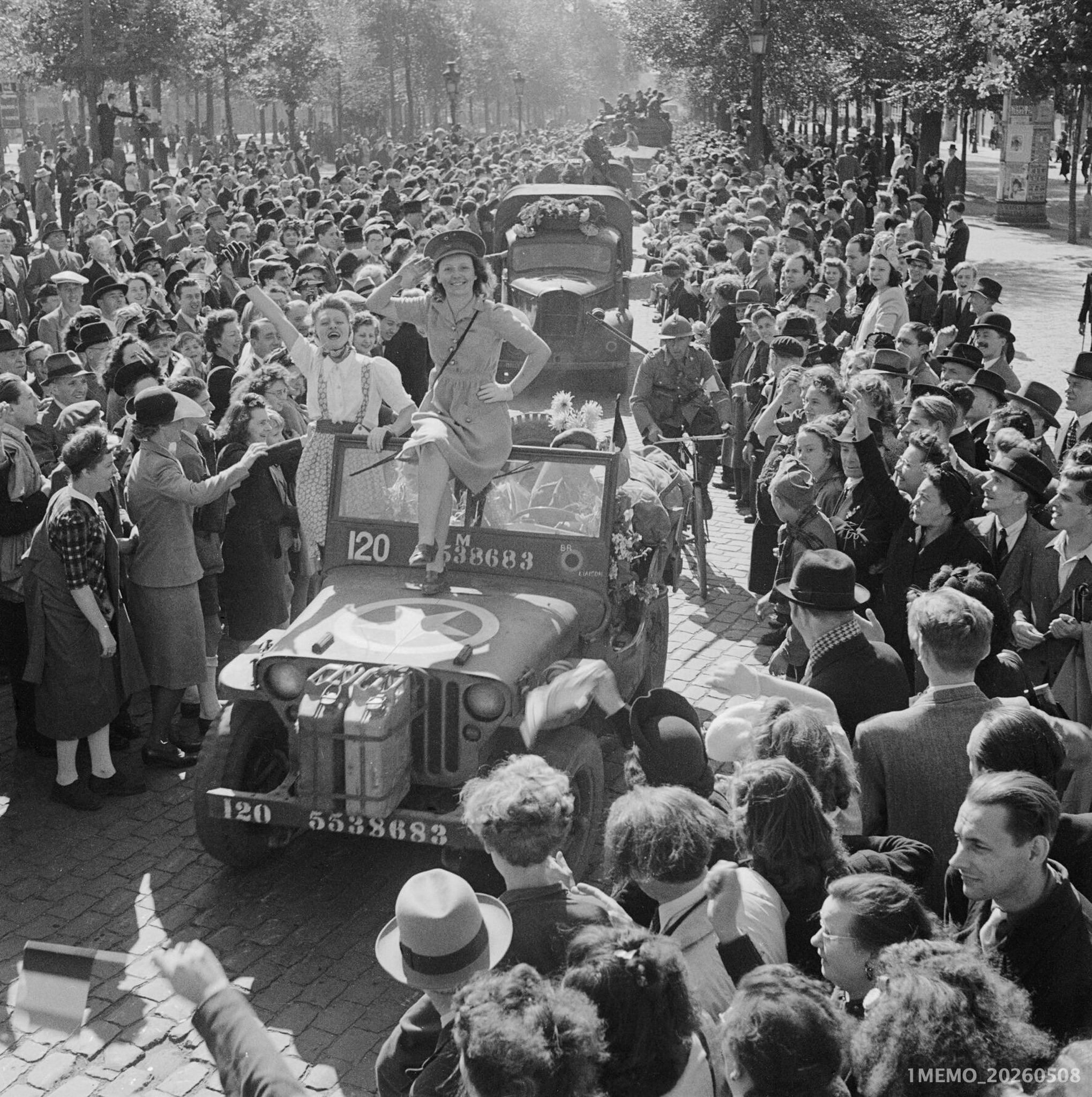
Liberation • 1MEMO_20260508 • Michel van der Burg • Miracles•Media • Cheering crowds greet British troops entering Brussels, 4 September 1944 . TakeNode 43cdc95e-4db6-44db-bd5b-fec92f198f86

Celebrating crowds, while the Allied troops drive the Germans out of the city, Sunday 3 September 1944 in Brussels, Belgium .

Source Image : BUM20200418_38 • Miracles.Media (BU483 , WikiMedia Commons)

Source Video : Brussels Liberated • @1MEMO_20200415 • Michel van der Burg • Miracles.Media • TakeNode 00e3f7fb-2455-4239-b1da-120f31e85fc3 • From : The Year 1944 United Newsreel ( 208 UN 1034 USHMM RG-60.3053 | Film ID: 2396 )
#liberation #celebration #occupation #street #crowd #dance #Brussels #Belgium #war #ww2 #MiraclesMedia #allies

Yodeling • Tyrolean Folksy Hootenanny 2026 #1 • Via Romea #53 • @1MEMO_20260327

Yodeling • Tyrolean Folksy Hootenanny 2026 #1 • Via Romea #53 • @1MEMO_20260327 • Michel van der Burg • Miracles•Media • TakeNode 2e07f99b-1bbc-48e9-aac6-02baec4a4339 •
Simple yodel song, celebrating spring at the Hoangascht – Hootenanny – along the Jakobsweg route — also the Via Romea here — in Gasthof Turmbichl, Vill, Tyrol, Austria, March 2026

Casual get-together of locals singing and playing folk & schlager music. for more of this Tyrolean folksy music , check it out at my channel, searching for ‘Hoangascht’ • https://www.youtube.com/@michelvanderburg/search?query=Hoangascht

Compilations
Viller Musikanten Hoangascht • @1MEMO 20180321 • https://youtu.be/2T8kc5vSGuM Recorded March 2016.

Inge’s Tyrolean Folk Music • @1MEMO 20250323 • https://youtu.be/6kUpDvVesKU

More Tyrol musical film work in the YouTube Playlist ‘Tyrol Music’ – https://youtube.com/playlist?list=PL_SggYHVHwj3eL6D8AzUm3o84OrU1JX_7

#music #folk #hoangascht #hootenanny #Vill #Innsbruck #Via #Romea #Tirolensis #pilgrim #route #path #Tyrol #Jakobsweg #Camino #Santiago #Alps #musicvideo #art