
Automated isolation, IsletPrep, and Visipaque-ViaSpan: the road to the LUMC's Clinical Islet Laboratory
by Michel van der Burg, Monday 20 July 2026
Synopsis
The LUMC Clinical Islet Transplant project’s 2000 series of human islet isolations marked the transition from manual to automated pancreatic digestion using the Ricordi method. This shift prompted the drafting of our core SOPs and the training of the required isolation team.
Islets purified with “IsletPrep” — a reformulated Iodixanol-UWS solution developed with Nycomed/Axis-Shield — showed outcomes equivalent to the 1999 manual-method series: high purity, no islet loss, and preserved integrity. As GMP production of IsletPrep would not be ready in time for the planned start of work in the GMP Facility, we validated a simpler alternative combining clinical-grade Visipaque and ViaSpan, which matched IsletPrep’s results in both human and porcine islet purification. This Visipaque-ViaSpan protocol became the standard, enabling the opening of the LUMC’s Clinical Islet Laboratory (Klinisch EilandLaboratorium) in April 2001.

Citation info : 2000 — Pioneering Automated Islet Isolation & Clinical Grade Purification in the LUMC • 1MEMO_20260720 • Michel van der Burg • Miracles•Media • URL https://michelvanderburg.com/2026/07/20
2000 — Pioneering Automated Islet Isolation & Clinical Grade Purification in the LUMC
Presentation : 2000 — Pioneering Automated Islet Isolation & Clinical Grade Purification in the LUMC • 1MEMO_20260720_1_Video • Michel van der Burg • TakeNode e0f677e3-689d-4697-bdad-e270eb949ee5
After the official start of the LUMC Clinical Islet Transplant Project on 22 February 1999, we began our first series of human islet isolations at the LUMC.
Our GMP facility was still under construction, so work began in our Surgery Laboratory, gaining hands-on experience with human islet isolation, the donor procedure, islet culture, and all other facets of operating an “islet bank” (1).
That first series of human islet isolations was performed using the manual pancreas digestion method and Iodixanol-UWS purification. The results were published in December 1999, presented at the AIDSPIT Workshop in January 2000, and recently posted on this site (1,2,3).
State-of-the-Art “Automated Method”
The second series of isolations was started using the advanced “automated method” for pancreatic digestion, as developed by Camillo Ricordi — first in David Scharp’s team in Paul Lacy’s laboratory in St. Louis, and eventually in Miami with Ramon Poo of BioRep Technologies, Inc (4,5,6).
In November 1999, after setting up the custom-made equipment from BioRep Technologies in the Surgery Laboratory, I began pilot work with a few human islet isolations using the automated method, to gain hands-on experience with its elaborate set-up of equipment.
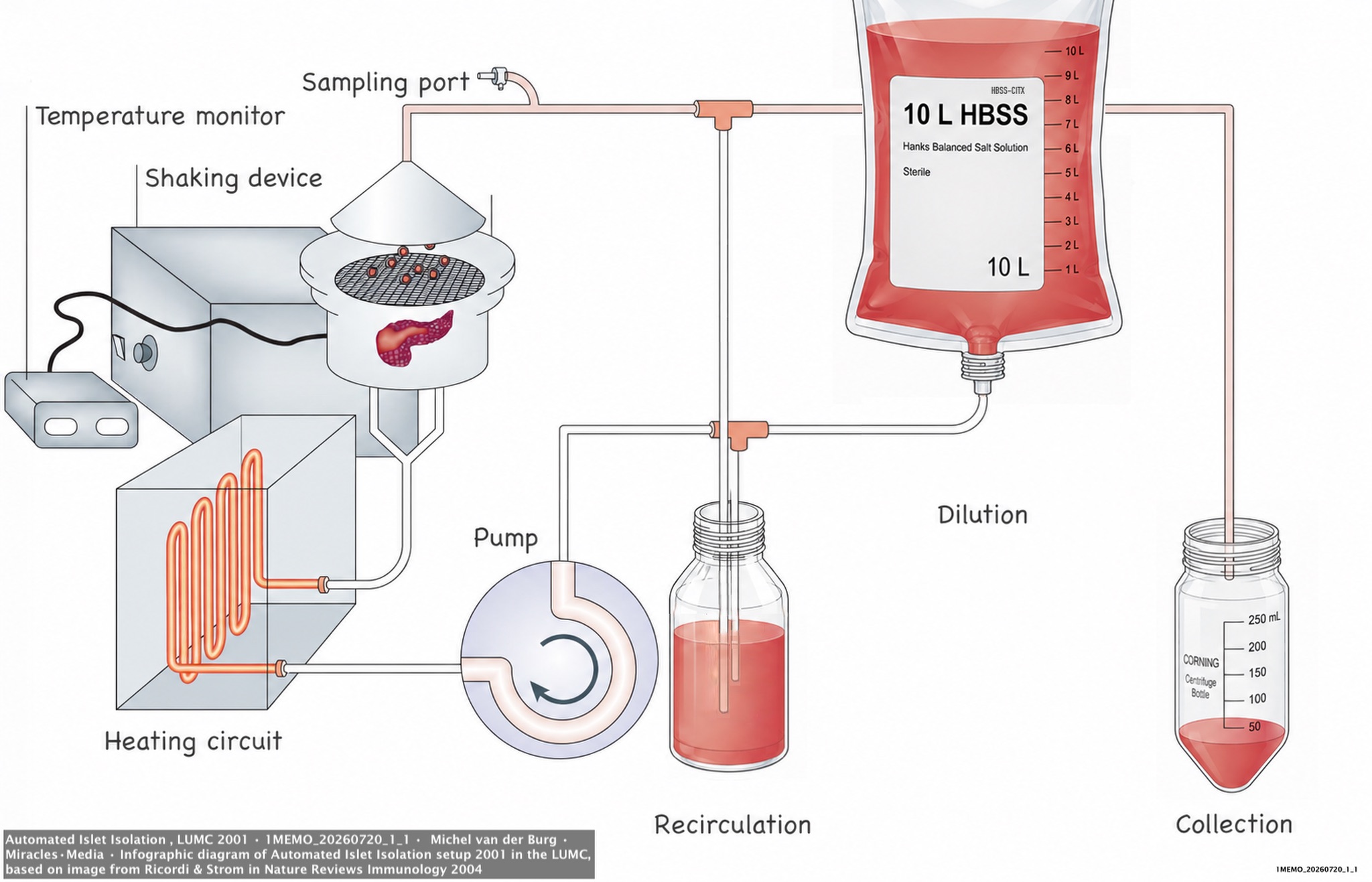
In this method, the pancreas sits in a steel digestion chamber together with glass beads (“knikkers”), behind a screen that allows only particles smaller than 0.5 mm to pass through. Collagenase solution (Liberase-HI in Hanks’ solution) is pumped through a heating coil, warmed to 37°C, and recirculated through the chamber, progressively breaking the gland down into its component pieces. After around 30 minutes, once most islets are free, recirculation and heating are stopped, and over the following 30 minutes a room-temperature Hanks’ solution (HBSS) is pumped through the chamber while the digest leaving it is collected — then held in cold UWS for 60 minutes on ice ahead of purification.
That experience allowed me to start writing our core SOPs (Standard Operating Procedures) — the step-by-step instructions on islet isolation and related procedures required to establish the islet bank in the GMP Facility of the LUMC, in what was then still a virtually unexplored, rapidly evolving field: translating cell research into Good Manufacturing Practice (GMP)-compliant cell therapy for patients.
Islet Isolation Team
Next, the islet isolation team was built. At least two professionals are needed to perform islet isolation with the Ricordi automated method in an experimental setting; in a GMP facility, a team of three qualified professionals — sterile and non-sterile operators, plus a data recorder — is typically required.
In April 2000, having finished the core SOPs, I began training the islet isolation team — transplantation research colleagues and students — on the new islet procedures and the use of SOPs that would soon be required in the GMP Facility.
Pre-Commercial IsletPrep Trial
In July 2000, this series of islet isolations with the automated method began with our Surgery islet isolation team, now using “IsletPrep” — our new Iodixanol-UWS islet purification solution.
This new solution had a slightly modified composition, in preparation for the planned commercial production of the solution as the GMP-certified, ready-made product “IsletPrep” (7).
Our original, standard protocol for preparing the Iodixanol-UWS density gradients used a Working Optiprep Solution (WOP) containing 30% (w/v) iodixanol in UWS, produced by mixing OptiPrep (60% w/v iodixanol in water) with an equal volume of double-strength UWS (UWS2x). That protocol was shared with other islet centers in 1997 and has been published in OptiPrep Application sheets since 1998 (7).
I was collaborating with OptiPrep Product Manager Bjørn Henriksen (Nycomed / Axis-Shield, Oslo, Norway) to explore modifications of our Iodixanol-UWS purification solution — avoiding the need for in-house production of double-strength UWS — to facilitate its implementation in clinical human islet transplantation, both in our center and at other islet centers worldwide.
The plan was to bring the Iodixanol-UWS density solution into commercial production as a GMP-certified, ready-made product coined “IsletPrep” — the WOP mixture of equal volumes of double-strength UWS (UWS2x) and OptiPrep, in 200 ml bottles, first produced as a small batch in the Pilot Plant of Nycomed / Axis-Shield. To facilitate pharmaceutical pilot production, I modified the formulation of UWS2x by: (i) leaving out components not required for the density solution (allopurinol, glutathione, and adenosine); (ii) replacing the proprietary Pentastarch with the hydroxyethyl starch supplied by Bjørn Henriksen (HES 200, Serum-Werk, Bernburg) for use in the commercial solution; and (iii) determining the amount of solid KOH (pellets) required to obtain the desired pH of 7.4 without the need for adjustment during preparation.
The IsletPrep solution was prepared in our LUMC laboratory that same month, July 2000, for purification using the modified Iodixanol-UWS gradients in the new series of automated islet isolations with our Surgery islet team.
That work is presented in the accompanying slideshow, with a PDF available below (9).
Donor pancreases for this series (marginal organs rejected for transplantation) were procured from multiorgan donors aged 15–68 years and cold-preserved with UWS for 4–18 hours before digestion.

Islet isolation outcomes with the automated method were similar to those in our previous series (1999) using the manual method and UWS for isolation.

IsletPrep purification outcomes likewise did not differ from the results using our standard Iodixanol-UWS gradients in the 1999 series: similarly high purity, no loss of islets, and preservation of islet integrity.

Against the digest (1412 ± 291 IEQs/g; 33 ± 5% mantle-islets; 157 ± 11 µm diameter), IsletPrep purification yielded 1251 ± 181 IEQs/g — a 106% recovery — 37 ± 14% mantle-islets, 202 ± 15 µm diameter, and 74 ± 5% purity, under the mild hyperosmotic conditions (~380 mOsm) and low endotoxin content characteristic of the IsletPrep gradient.
The innovative method we introduced — first performing a test purification during islet isolation on a fraction of the digested pancreatic tissue (digest), to predict the best density solution for a simple method of islet purification in centrifuge tubes — proved to be a good alternative to the more complex method of purification in conventional continuous gradients in the Cobe centrifuge.
In practice, a 5% aliquot of the digest was distributed across four to seven small tubes, each mixed with IsletPrep to form the bottom of a one-step gradient at densities ranging from 1075 to 1090 (optional 1072, or 1100) and topped with UWS; analysing the resulting interfaces and pellets after centrifugation predicted the optimal density for bulk purification, which averaged around 1090 g/L across our isolations. For bulk purification, the digest — in 200–450 ml UWS — was mixed with IsletPrep, distributed across 10–20 conical tubes, topped with UWS, and spun for 5 minutes at 500 g, 4°C, with purified islets collected from the interface.
After the successful pre-commercial test of IsletPrep, its full production seemed only a matter of time.
Visipaque-Viaspan Purification
By the end of 2000, our isolation team had gained sufficient experience with the automated method to transition to GMP-compliant production of islets in our new lab in the LUMC GMP Facility. However, GMP production of IsletPrep itself could not be arranged immediately.
Purification without IsletPrep — that is, without the double-strength UWS component — also seemed an option: simply mixing OptiPrep and UWS had already proven sufficient for purification in animal experimental work in 1998 (7), indicating that double-strength UWS (i.e. IsletPrep) might not be strictly necessary for our Iodixanol-UWS gradients.
OptiPrep was a research-grade solution of 60% iodixanol, but could be replaced by the clinical-grade Visipaque solution of 65% iodixanol. Simply mixing Visipaque (iodixanol) and ViaSpan (UWS) — both commercial, cGMP-certified solutions — would be an elegant alternative for our Iodixanol-UWS gradients.
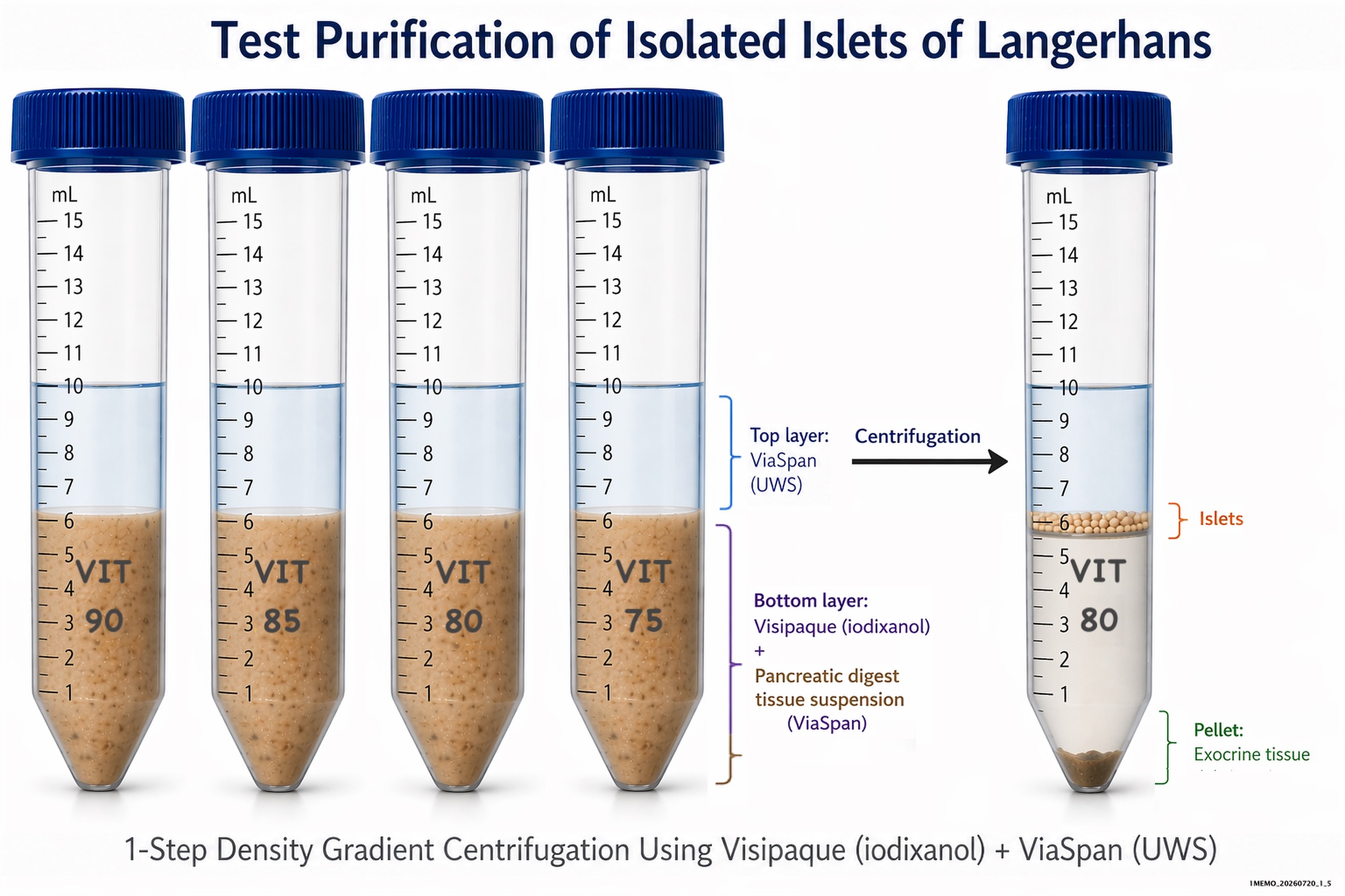
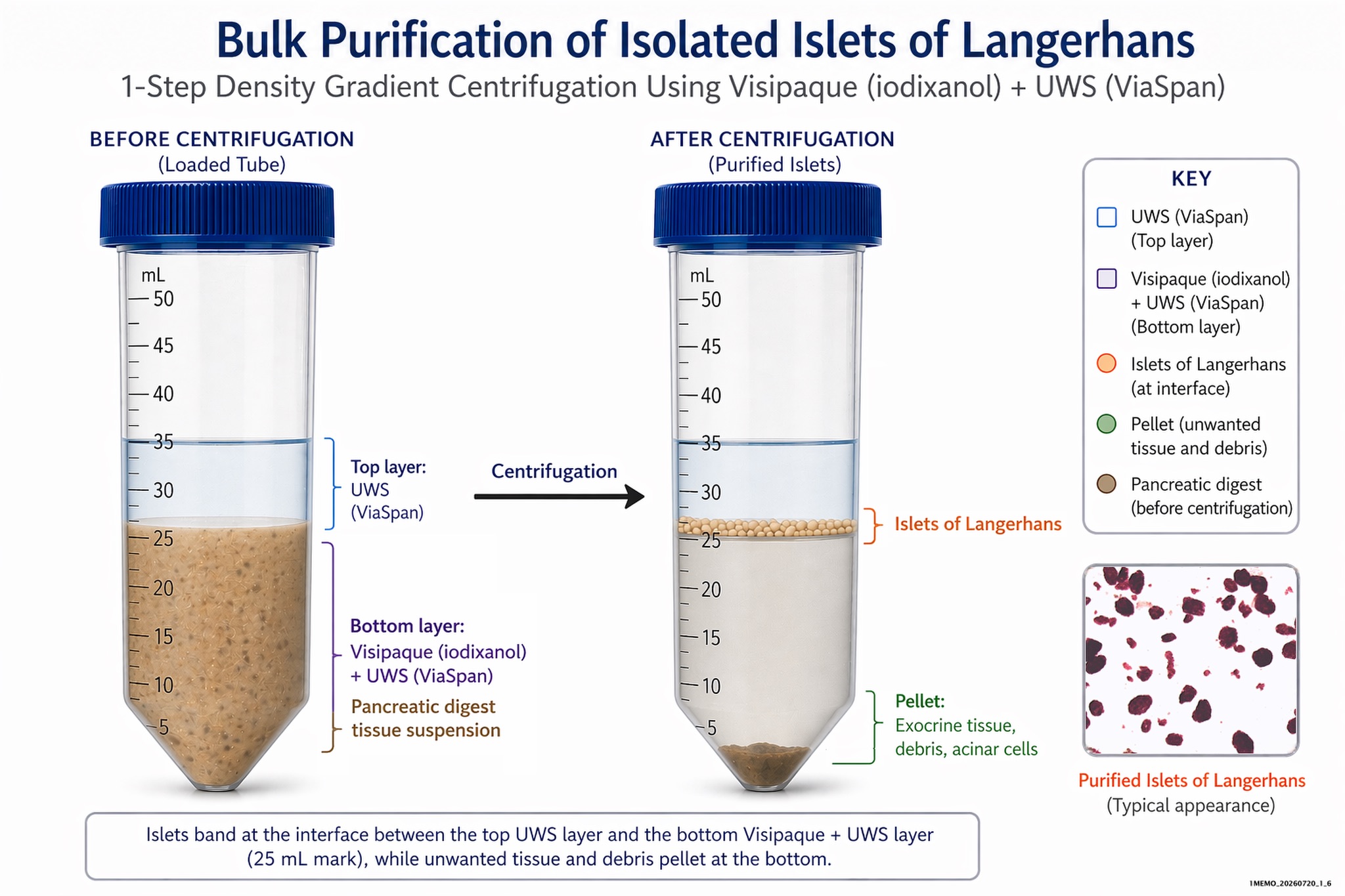
During the first months of 2001, the 2000 series of human islet isolations was completed in our research laboratory with a successful pilot of islet purification using Visipaque-ViaSpan, again demonstrating no loss of islets, preserved islet integrity, and purity above 70%. Test purification — following the same density-prediction approach used for IsletPrep — pointed to an optimal gradient density of ≤1085 in Visipaque-ViaSpan. Against the digest (1437 ± 15 IEQs/g; 18 ± 13% mantle-islets; 185 ± 16 µm diameter), bulk purification of the full batch with Visipaque-ViaSpan yielded 1681 ± 55 IEQs/g — a 118% recovery — 13 ± 3% mantle-islets, 184 ± 8 µm diameter, and 71 ± 16% purity, under mild hyperosmotic conditions (~315 mOsm, calculated) and a low endotoxin content.
Parallel pilot animal research in early 2001 also demonstrated that Visipaque-ViaSpan purification of porcine islets yielded the same recovery and purity as the standard OptiPrep-UWS gradient based on UWS2x — as had first been found in 1998, with the similar OptiPrep-ViaSpan purification solution (7).
With these good results, Visipaque-ViaSpan was adopted as the Standard Operating Procedure.
Opening Clinical Islet Laboratory — “Klinisch EilandLaboratorium”
With the Surgery islet team, the state-of-the-art islet isolation procedure, excellent purification results, and the Visipaque-ViaSpan SOP completing our GMP documentation (8), the following month — April 2001 — our “Klinisch EilandLaboratorium” (“Clinical Islet Laboratory”) was opened for GMP-compliant production and storage of islets, in what would become known as the Dutch “islet bank” at the LUMC…to be continued…
Notes
1) 1999 — Pioneering the LUMC Clinical Islet Transplant Project • 1MEMO_20260705 • Michel van der Burg • Miracles•Media • URL (1) michelvanderburg.com/2026/07/05 • URL (2) https://1memo.substack.com/p/1999-pioneering-the-lumc-clinical
2) Van der Burg MPM, Ringers J, Baranski A, Bouwman E, Terpstra OT. No loss of human (mantle-) islets by OptiPrep-UWS purification following isolation in UWS (Abstract). Acta Diabetol 36, 230 (1999). URL https://doi.org/10.1007/s005920050168 . PMID: 10664329 . Abstract available online (1).
3) Van der Burg MPM, Ringers J, Baranski A, Bouwman E, Terpstra OT. No loss of human (mantle-) islets by OptiPrep-UWS purification following isolation in UWS. 19th AIDSPIT Workshop of the European Association for the Study of Diabetes (EASD) in Igls (Austria) Jan 23–25, 2000. Oral presentation slideshow available online (1).
4) Piemonti L, Pileggi A. 25 YEARS OF THE RICORDI AUTOMATED METHOD FOR ISLET ISOLATION. CellR4 Repair Replace Regen Reprogram. 2013;1(1):8-22. PMID: 30505878; PMCID: PMC6267808. URL (1) https://www.cellr4.org/wp-content/uploads/sites/2/2013/06/Article-2013-1-e128.pdf URL (2) https://pmc.ncbi.nlm.nih.gov/articles/PMC6267808/
5) Who we are. Biorep. URL https://biorep.com/who-we-are/
6) Scharp DW, Arulmoli J, Morgan K, Sunshine H, Hao E. Advances in Human Islet Processing: Manufacturing Steps to Achieve Predictable Islet Outcomes from Research Pancreases. OBM Transplantation 2019; 3(1): 052; doi:10.21926/obm.transplant.1901052. URL https://www.lidsen.com/journals/transplantation/transplantation-03-01-052
7) Islet purification from bench to bedside • @1MEMO_20260623 • Michel van der Burg • Miracles.Media • URL michelvanderburg.com/2026/06/23/
8) IsletPrep based standard operating procedures (SOPs) were submitted for review with the 1st edition of the GMP Documentation for the LUMC Clinical Islet Laboratory (29 November 2000). The IsletPrep based SOPs were replaced with Visipaque-Viaspan based SOPs in the 1st edition (2001) GMP Documentation of the LUMC Clinical Islet Laboratory (KEL). Illustrated in presentation (9).
9) Presentation : 2000 — Pioneering Automated Islet Isolation & Clinical Grade Purification in the LUMC • 1MEMO_20260720_1 • Michel van der Burg • Miracles•Media • Automated isolation, IsletPrep, and Visipaque-ViaSpan: the road to the LUMC’s Clinical Islet Laboratory by Michel van der Burg • URL michelvanderburg.com/2026/07/20 • Video (1MEMO_20260720_1_Video) • Poster (1MEMO_20260720_1_Poster) • Handout (1MEMO_20260720_1_Handout)
Presentation : 2000 — Pioneering Automated Islet Isolation & Clinical Grade Purification in the LUMC • 1MEMO_20260720_1_Handout • Michel van der Burg • TakeNode ddda9083-ca1e-4b00-b29d-b1377a0f050e
Images (License TakeNode)
Presentation : 2000 — Pioneering Automated Islet Isolation & Clinical Grade Purification in the LUMC • 1MEMO_20260720_1_Poster • Michel van der Burg • TakeNode 42097357-1944-456b-b3a7-ce81ba03903b
Presentation : 2000 — Pioneering Automated Islet Isolation & Clinical Grade Purification in the LUMC • 1MEMO_20260720_1_Video • Michel van der Burg • TakeNode e0f677e3-689d-4697-bdad-e270eb949ee5
Presentation : 2000 — Pioneering Automated Islet Isolation & Clinical Grade Purification in the LUMC • 1MEMO_20260720_1_Handout • Michel van der Burg • TakeNode ddda9083-ca1e-4b00-b29d-b1377a0f050e
Automated Islet Isolation , LUMC 2001 • 1MEMO_20260720_1_1 • Michel van der Burg • Infographic diagram of Automated Islet Isolation setup 2001 in the LUMC, based on image from Ricordi & Strom in Nature Reviews Immunology 2004 • TakeNode 9c80e644-543c-4d2d-9775-1073465aeefa
IsletPrep-UWS , LUMC 2000 • 1MEMO_20260720_1_2 • Michel van der Burg • TakeNode 03a466fd-fa84-4044-a9ca-06116b5fb1ca
Test Purification Set IsletPrep , LUMC 2000 • 1MEMO_20260720_1_3 • Michel van der Burg • TakeNode 75bc6084-f93d-4e02-acbc-a541fb9b7233
Bulk Purification IsletPrep , LUMC 2000 • 1MEMO_20260720_1_4 • Michel van der Burg • TakeNode 09726d07-8cd5-44f2-a412-32f524f4825f
Test Purification Set Visipaque , LUMC 2001 • 1MEMO_20260720_1_5 • Michel van der Burg • TakeNode c79006b7-4752-4e49-9248-bdb134aa2fbc
Bulk Purification Visipaque , LUMC 2001 • 1MEMO_20260720_1_6 • Michel van der Burg • TakeNode d0ea62a3-580a-429a-a45d-6d912de4d2cd
Visipaque-ViaSpan SOPs • 1MEMO_20260720_1_7 • Michel van der Burg • Illustration of “Procedure report” pages on using Visipaque for “Test tubes” preparation (right) and “Purification” (middle) during human islet isolation, with the pancreatic digest in UWS (ViaSpan), from the 2001 standard operating procedures — the SOPs, now “Obsolete” (i.e. outdated) — from the GMP documentation for the Clinical Islet Laboratory (Klinisch Eilandlaboratorium) at LUMC (Leiden, Netherlands). Translated from Dutch by the author, Michel van der Burg • TakeNode 66f5207b-db1a-4166-bc22-0104ec509449
Acknowledgements — I thank Bjørn Henriksen (International Product Group Manager Density Gradient Media Nycomed / Axis-Shield PoC AS (Oslo, Norway) for our collaboration on our iodixanol and IsletPrep work ; Camillo Ricordi (Director of the Diabetes Research Institute, Miami) and Ramon Poo (BioRep Technologies, Miami) for their help in setting up automated islet isolation in our lab ; Amon Wafelman (deputy head of the Interdivisional GMP-Facility, Department of Clinical Pharmacy and Toxicology, LUMC) for collaboration on our SOPs and GMP setup of the clinical islet laboratory ; our Transplant Coordinators Marijke van Gurp and Ruth Dam (EuroTransplant/LUMC) and my co-workers of the Transplant section of the Surgery Department (LUMC) : surgeons Jan Ringers, André Baranski, Xandro Schaapherder for dedicated organ procurement, and the researchers Eelco Bouwman, Annemiek Töns (staff) and Josephine Rijkelijkhuizen, Gabe Bleeker (students) for our collaboration in the ‘islet team’.
This work was shared previously with the other islets centers, in personal communication in 2001 — in detail with Jonathan Lakey (Edmonton, Canada), and in summary with Daniel Brandhorst (Giessen, Germany), José Oberholzer (Geneva, Switzerland) — and with Sue Swift (Leicester, UK) in 2003.
#IsletPrep #UWS2x #islets #islet #Langerhans #isolation #automated #purification #isletbank #surgery #clinical #laboratory #launch #GMP #cleanroom #facility #Surgery #KEL #CITX #LUMC #Holland #Netherlands #Leiden #hospital #Eurotransplant #human #donor #Visipaque #optiprep #iodixanol #ViaSpan #UWS #density #gradient #pancreas #UW #university #Wisconsin #transplantation #diabetes #history #research #memoir #1memo #michelvanderburg #BioRep #CamilloRicordi #DRI #Miami #Nycomed #Axis #Klinisch #Eilandlaboratorium
Citation info : 2000 — Pioneering Automated Islet Isolation & Clinical Grade Purification in the LUMC • 1MEMO_20260720 • Michel van der Burg • Miracles•Media • URL https://michelvanderburg.com/2026/07/20

