

Attack on the train to Auschwitz. Discussion with Simon Gronowski.
19 April 2013, Belgium, Brussels, Rue du Commerce 51.
(Poster: David Goddevrind – diarama.be)
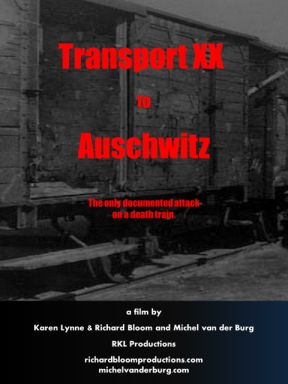
April 19, 2013 — Watch online free below our full documentary “Transport XX to Auschwitz”
– a film by Karen Lynne & Richard Bloom and Michel van der Burg.
The attack on this deportation train in Belgium – by three young men – the rescue, and the many escapes and escape attemps are documented in this film.
Today 70 years ago – on the night of April 19, 1943 – this remarkable heroic rescue occured in Belgium, were 17 people were liberated during an attack on the cattle car train ‘Transport XX’ – crammed with 1631 Jewish passengers, heading for Auschwitz – and another more than 200 others jumped out also.
As of April 19, 2015 the orginal version of the film is replaced above with a new – second – edition of the documentary with updated statistics.
For free watching this new (second) version of our film directly at YouTube follow one of these 2 links : youtu.be or youtube.com
During the Nazi occupation of Belgium 28 train convoys with over 25,000 Jews and 351 Roma left Mechelen towards the Auschwitz extermination camp.
On the night of April 19, 1943, the 20th transport headed East with 1631 Jewish passengers crammed into 40 cattle cars.
This ‘Transport XX’ left the Mechelen transit camp ‘Kazerne Dossin’ at 10 pm. and was attacked and stopped some 30 minutes later outside Brussels – near Boortmeerbeek.
Armed with only 1 pistol, pliers and an improvised red hurricane lamp the three young Belgians Robert Maistriau, Jean Franklemon, and Youra Livschitz – old schoolmates – stopped the train by putting the red lamp in the middle of rails. They were able to open one of the cattle cars and liberated 17 men and women. Another more than 200 prisoners escape from the train before the German border. Many were shot and 26 were killed. Eventually, half of them succeeded to escape.
The attack, rescue, and many escapes and escape attemps from this 20th deportation train in Belgium are documented in this newly released film “Transport XX to Auschwitz” by the first-hand accounts of one of the attackers, people that jumped from the train and survivors who returned from Auschwitz.
This attack by three young man, who follow their heart, is the only documented attack on a death train during the Shoah.
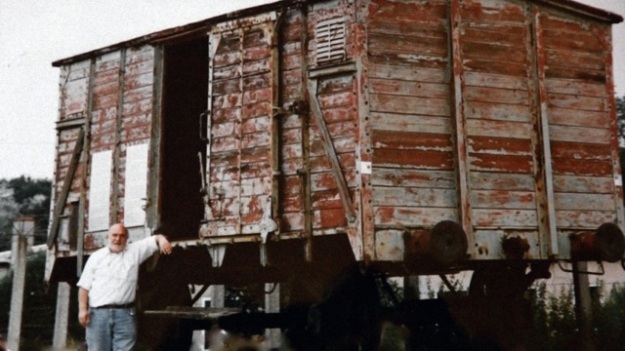
The film “Transport XX to Auschwitz” documents the attack and rescue story of one of the attackers, Robert Maistriau, and several escape attempts and escapes of the deportees: Régine Krochmal, Louis de Groot and his brother, the 11 year old Simon Gronowski, Lilly Wolkenfeld Schwartz and her friends, Gunther and Marie Mendel, Willy Berler, Louis Micheels who as doctor in charge of patients decided not trying to escape – and others…
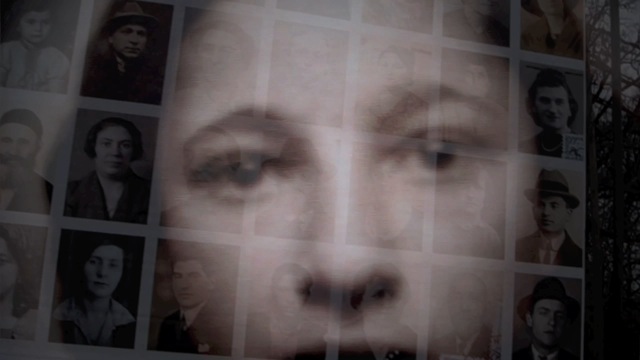
Régine Krochmal had been active in the resistance and was a nurse. She had to escort together with a doctor the more dead then alive deportees in the ‘hospital’ car. Just before she went into the car she was warned by the Jewish camp doctor of the Dossin barracks, who gave her a knife with the words: “Cut the bars, jump, because they will burn you“.
Régine, had to fight off the accompanying doctor in her car who was trying to prevent her from sawing through the bars of the small vent in order to escape. She jumped out the very same moment the train was attacked and stopped.
Then when the train stops, the attacker Robert Maistriau cuts the barbed wire on the sliding door of one of the cars, opens the door and calls “Fliehen Sie, Fliehen Sie!” At first people are confused and scared – but then 17 people jumped out and escaped, while the Germans were shooting. He next starts working on a second car, but the train began moving…
Transport XX to Auschwitz – trailer
In every car the Germans had appointed one prisoner responsible for preventing and reporting attempts to escapes. Louis de Groot – was one of these appointed ‘guards’ and was told “When anybody escapes, or you let anybody escape, everybody is killed!“. He, however, calmed down the scared people in his car. “They did not want to let me out of that – they were so afraid – that I – that we will be killed. So, I say ‘no – I arrange it for you’. I was quite an acrobat. So, we broke open that little air thing…“. He, together with some others managed to break open the little ventilation window. Louis then took a girl with him when he jumped – together with his brother Abraham and two boys.
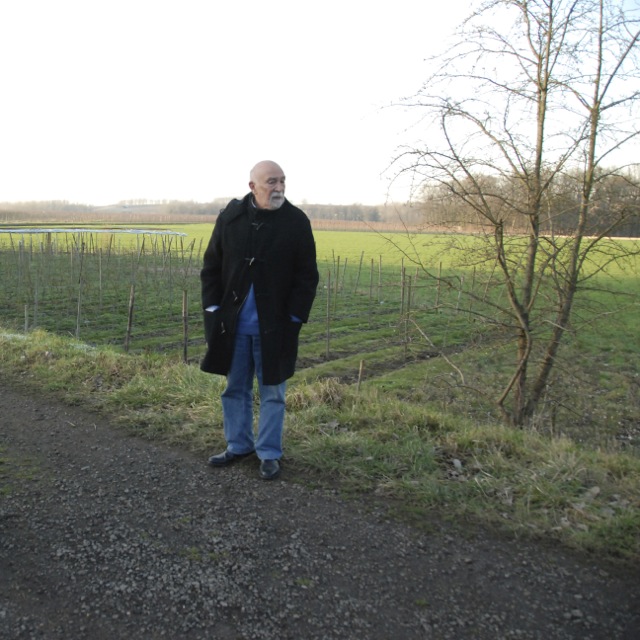
Simon Gronowski was only 11 years old when he was helped by his mother to jump from the train, and survived – unlike his mother who was gassed at Auschwitz. Simon was ‘lucky’. He was taken care of by the Belgian gendarme Jean Aerts and his wife, and not betrayed. That salvation was no exception: almost all refugees from the deportation train survived with the help of the Belgian population. Simon Gronowski was the youngest person to ever escape from a death train.
Lilly Wolkenfeld Schwartz had to push her Belgian friend Lilian to jump from the train. The train was moving fast when guys in the compartment of Lilly and her friends Bella and Lilian managed to open the doors. Bella and a lot of other people jumped, but Lilian said “…I can’t“. So Lilly pushed her to jump, and jumped after her. Lilly: “…and as I jumped I had a bullet here, which I found out later…”
Both Gunther Mendel and Marie (Neufeld) Mendel too managed to escape via the little ventilation window and jumped. Gunther: “I went out foot first…you have to throw yourself backwards, because the train was doing maybe 30-40 miles an hour..“. Marie: “..I jumped out – I let myself out – and I lost a shoe…”
Louis Micheels had thought of escaping, but as he was responsible for the seriously ill patients in the hospital car – then thought “how can I, as a doctor in charge of patients in this transport, how can I desert and escape?“. Upon arrival in Auschwitz however “my patients were dragged out, thrown on the truck like they were cattle, dead cattle..”
When Willy Berler was about to jump off the train, he saw that the unfortunate man who had jumped before him, was stuck to the train with his head crushed like a melon. Willy did not jump. “If I had known …. about Auschwitz …. I would have jumped.“
These are remarkable stories of the heroic rescue, escapes, and escape attempts from Transport XX to Auschwitz, which occurred on April 19, 1943 – the first night of Passover – when, at the same time, also the Warsaw Ghetto uprising began, some 720 miles away.
During the Shoah, the Nazis, in their quest for the ‘final solution’ of the Jewish question, utilized thousands of such trains from Germany and the occupied countries to transport 3,000,000 Jews to the concentration and death camps.
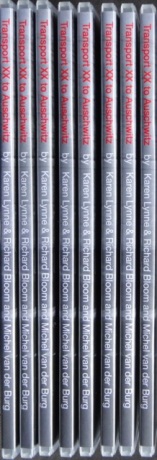
This documentary is available – distributed for free – for Jewish and other film festivals as well as holocaust education programs.- T
For more info contact: Richard Bloom (Richard Bloom Productions – USA) or Michel van der Burg (michelvanderburg.com)
Currently (as of Jan. 2013) the film is available for viewing in the world holocaust museums and centers:

Premiere Saturday October 27 , 2012 — The film “Transport XX to Auschwitz” premiered at the Fort Lauderdale International Film Festival (FLIFF) 2012 – screened first 27 October at the main film festival theatre Cinema Paradiso in Fort Lauderdale, and again in November 3rd in Sunrise, Florida.
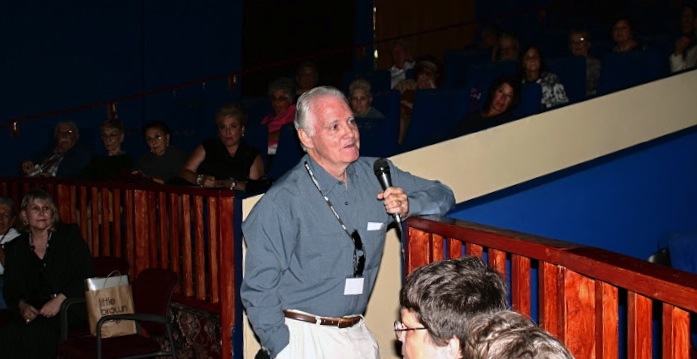
April 2013 — Early this month screenings at Jewish community centers followed in commemorations of Yom HaShoah – Holocaust Remembrance Day – in Florida and the Greater Washington area
April 2014 — Screening “Transport XX to Auschwitz ” April 2, 2014 with guest speaker Richard Bloom in Temple Anshei Shalom – Delray’s Vibrant Synagogue of the Future – Florida , US

April 2014 – Screening at the Jewish Heritage Festival – News Journal Center – Daytona Beach, Florida
May 2014 – Festival of Tolerance in Zagreb, Croatia, May 18-24, Cinema Tuškanac – European Theater Premiere. Screening with both Croatian subtitles and English subtitles. The audience gave the film a very good average grade of 4.3 (out of 5).

Jan 2015 – Brussels, Belgium. On January 31, the historic Atelier Marcel Hastir hosted the special screening (and Belgium premiere) of the documentary « Transport XX to Auschwitz » for International Holocaust Remembrance Day – 70 years after the liberation of Auschwitz concentration camp on January 27, 1945. The screening was introduced by filmmaker Michel van der Burg with a few words on the history of this special place – the Atelier Marcel Hastir – and the important role of the Atelier in the planning of the attack on the 20th train to Auschwitz.
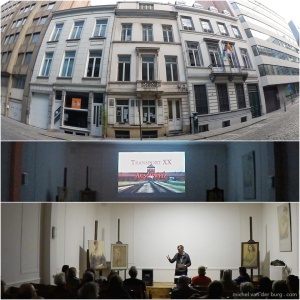
After the screening in a discussion lead by Laura Muris (Atelier Marcel Hastir), Michel van der Burg talked with the audience about the film, about these people’s stories, and also the many new stories that emerged since the film came out – more on this site via this link.
March 2015 – JIFF , Australia – The Holocaust Film Series 2015 of the Jewish International Film Festival in Australia hosted the Australian premiere Sunday March 15, 2015 simultaneously in both Sydney (Event Cinemas, Bondi Junction) and Melbourne (Classic Cinemas). In both cities the film was shown a second time – in Sydney March 24 , and in Melbourne March 19, 2015. The audience feedback was overwhelming.

April 2015 – Screening on April 12, 2015 at Young Israel of Hollywood, Fort Lauderdale, Florida , USA with guest speakers Philippe Renette (Belgium) and filmmaker Richard Bloom (USA) to lead a discussion and Q&A after the film screening. The event – as part of the Holocaust Remembrance Week – was hosted by The Foundation for Holocaust Education Projects & Young Israel of Hollywood-Fort Lauderdale. More info on this site. This screening was in the news before in the Joyce Kaufman talk show on the 850 WFTL Florida radio station on March 25, 2015 (see report on this site).

April 2015 – Atelier Marcel Hastir (Brussels, Belgium) showings on demand on a large-screen display from April 11 to April 19 2015 on weekend days 14-20h with a Q&A by the team of the Atelier. More info on this site.
September 2017 – Screening for new volunteers of ‘ASF België / Belgique‘ September 2017 in Brussels, Belgium. The Belgian ASF is part of the international network of Aktion Sühnezeichen Friedensdienste – in english called : ‘Action Reconciliation Service for Peace‘. The Belgian ASF one year ‘Service for Peace’ volunteers work a year in both social projects with the elderly, migrants, people with disabilities, and socially vulnerable children , and also historical and educational projects, in eg. museums and memorials , like Kazerne Dossin.

Further details on this site via this link.
Richard Bloom (Richard Bloom Productions – USA)
Michel van der Burg (michelvanderburg.com)
Following the news of the film other stories are emerging.
When Rachelle Bashe was a child, she dreamed about her father’s escape from a train carrying Belgian Jews to Auschwitz. Bashe, 77, of Boynton Beach was reminded of her dreams when a reporter called to talk about the documentary film “Transport XX to Auschwitz.” The film will be screened at the Fort Lauderdale International Film Festival later this month and in early November.
“It’s just unbelievable,” an emotional Bashe said when she realized that her father was one of the more than 200 persons on the 20th train convoy who escaped on the night of April 19, 1943 during a daring attack by three Resistance fighters carrying a red railroad lamp, a pair of pliers and a pistol.
Bashe said her mother told her that her father escaped from a train but never returned home. She eventually learned that he was captured later, survived three concentration camps and died in 1945 during a death march. “It does help in a way that I am realizing that what is in my subconscious is not really a dream or a nightmare,” Bashe said.
April 28, 2014 – Isabella Weinreb Castegnier was three-months pregnant that night on April 1943 in Belgium, when she jumped from the fast moving 20th Train heading for Auschwitz. Isabella escaped with a broken wrist and bruises all over her body, but otherwise without major injuries. Her daughter Viviane – meaning “full of life”, and named so for her will to live and hold tight in her mother’s womb – was born six months later on October 30, 1943.
Last month, Viviane first learned about our documentary “Transport XX to Auschwitz” and e-mailed me…”I couldn’t believe while searching online that I would find an actual movie made, telling the story of this famous, unique escape from a death-train!” After watching the documentary, she wrote to me “it was so well-made…I even wished it were longer”…Viviane also shared with me that at one point in the film, she got tears in her eyes, as her mother’s face appeared in a flash on the screen, while Lilly (Wolkenfeld Schwartz) – her mother’s friend was telling the story…”and Bella jumped” … this was so unexpected, she said “it took me by surprise!”
One year ago – on Holocaust Remembrance Day, April 7, 2013 – her mother passed away at the age of 93. Today, 71 years after that unique escape, on Holocaust Remembrance Day 2014, and her mother’s yahrzeit, Viviane shares her story here on this site. Continue reading >
…that night of April 19th, 1943 in Belgium , Elias Gnazik helped jump the pregnant Isabella Weinreb from the fast moving 20th train heading for Auschwitz. Viviane – meaning ‘full of life’ – was born 6 months later…
Full story announced in post Oct 2017

Viviane’s Story – Escape from Transport XX…Born 6 Months Later by Viviane Yarom-Castegnier & Michel van der Burg
Published April 19, 2019
e-Book (ePub) ISBN 9789493147003
Miracles.Media
NEWS
The greatest escape / film ‘Transport XX to Auschwitz’ by Richard Bloom, Karen Lynne and Michel van der Burg
THE BULLETIN issue 16 – Apr 20, 2012 – by Sarah Ehrlich and Edmund Day photos by Dieter Telemans
Escaping the train to Auschwitz
BBC News – 19 April 2013 – By Althea Williams and Sarah Ehrlich
This day in Jewish history / Daring escape from an Auschwitz-bound train
HAARETZ – Apr.19, 2013 – By David B. Green
The Survivor Mitzvah Project
Films
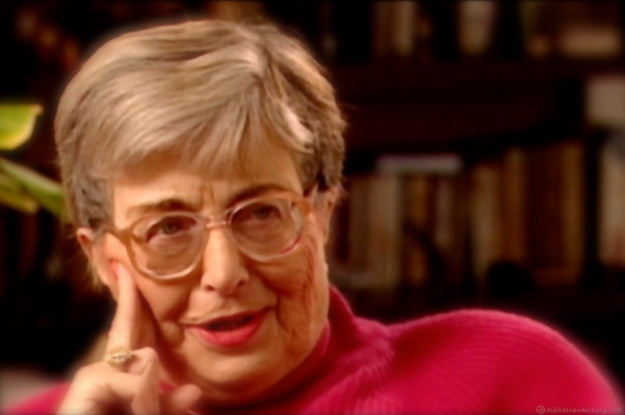
Jan 30, 2014 – Lilly (Wolkenfeld) Schwartz passed away this week.
Aug 30, 2014 – The “Transport XX to Auschwitz” film is now included – for future screenings – in the collections of the Atelier Marcel Hastir (Rue du Commerce 51, Brussels, Belgium) and the Fondation Robert Maistriau (Belgium/Congo)
Atelier Marcel Hastir
Fondation Robert Maistriau
December 2014 – Bulletin ATELIER MARCEL HASTIR – Belgian Theater Premiere – Saturday 31 jan 2015 – Screening Film “Transport XX to Auschwitz” – ATELIER MARCEL HASTIR, Rue du Commerce 51, 1000 Bruxelles – Métro Trône , Belgium – see post Dec 16th on this site
March 25, 2015 – The Florida radio talk show host Joyce Kaufman and holocaust education director Avi Mizrachi discussed the upcoming special screening of the film “Transport XX to Auschwitz” – a transcription (in part) and podcast link are available on this site via this link.
April 19, 2015. A new edition of our documentary “Transport XX to Auschwitz” is now publicly available online. This new – 2nd – edition with the YouTube title Transport XX to Auschwitz – current version has the latest statistics on the escapes and other updates available. This second edition is now embedded above in this post , and replaces the first edition posted here exactly two years ago, on April 19, 2013.
May 2017. Wikipedia NL “Twintigste treinkonvooi” now shows Trailer Transport XX to Auschwitz (2012)
Updates
– post updated April 20 by adding News section and news items
– Aug 2013 : USHMM updated per august 2013 the catalog info of the DVD “Transport XX to Auschwitz” in their DVD collection
– Aug 2013 : added – a recently acquired – photo of Richard Bloom speaking at the premiere of the film at the Cinema Paradiso in Florida
– Jan 2014 : added News item – the Survivor Mitzvah Project – Films
– Jan 30, 2014 : added News item – obituary Lilly (Wolkenfeld) Schwartz
– April 2014 : added news screenings & reaction / story Isabella Weinreb (“Bella”) and daughter Viviane
– May 2014 : added news European Theater Premiere at Festival of Tolerance in Zagreb, Croatia
– August 2014 : news section : collections Atelier Marcel Hastir / Fondation Robert Maistriau
– December 2014 : added news Belgian Theater Premiere in Atelier Marcel Hastir bulletin – Film 31 Jan 2015 « Transport XX to Auschwitz »
– April 2015 : added news screenings in Australia (Holocaust Film Series) and Atelier Marcel Hastir in Belgium
– April 2015 : new edition (2nd ed) of our documentary embedded and links added / news of screening Florida (April 12) and showings on demand in Atelier Marcel Hastir (April 11-19) added / in News section added Florida radio talk Joyce Kaufman and publication of the 2nd edition of our documentary April 19, 2015
– November 2015 : new link to collection Kazerne Dossin
– July/August 2016 : 2012 news item (THE BULLETIN) and July 2016 Media collection Yad Vashem’s International School for Holocaust Studies
– May 2017 : added News item Dutch Wikipedia NL “Twintigste treinkonvooi” now shows Trailer Transport XX to Auschwitz (2012)
– October 2017 : 3 minor text updates (in the first line of the introduction, below the embedded film, and in the first line of ‘Film festivals & holocaust education programs‘ section to underline that our full documentary is (and always has been) distributed for free , and via this post available for free online watching.
Any offering you may perhaps find elsewhere on the internet for watching ‘a paid version’ of the ‘full movie’ is criminal use by others.
– October 2017 – news screening for new volunteers of ‘ASF België / Belgique‘ September 2017 in Brussels, Belgium.
– Jan 16, 2019 – Updated and added details , in section ‘New Stories … reactions’ mostly.
– Nov 8, 2019 – Update DVD available in world holocaust museums and centers / Viviane’s Story e-Book (ePub) ISBN 9789493147003 published April 19th 2019
In any war, children are the most tragic victims. The recent images reaching us every day from Syria and other places in the world prove this once more. World War II was not different.

War children Simon Gronowski and Koenraad Tinel
Both the lawyer Simon Gronowski and the artist Koenraad Tinel have spent their childhood during the Second World War. The first born in a Jewish family in Belgium, and the second born in a Belgian (Flemish) family of ‘flamingant’ nazi collaborators.
The two men met early past year at the initiative of Sacha Rangoni, a 16 year old boy and member (monitor) of the UPJB, the Union of Progressive Jews of Belgium at a meeting of the UPJB early last year.
They have recently become close friends, and together made a special book – a genuine plea for humanity.
The story and budding friendship of these two ‘children’ who survived the horrors of this dark chapter in our history was first told in the last year’s documentary “Oorlogskinderen” (War children) from Marianne Soetewey.
Simon Gronowski and Koenraad Tinel are nine and six years, respectively, as the Second World War broke out, and experienced because of their different origins the war completely different.
Simon Gronowski grew up in Brussels (Belgium) in a Jewish family and ends up together with his mother and sister in 1943 in the Dossin barracks in Mechelen (Belgium). From there starts the transport to Auschwitz. Simon at the age of eleven years can narrowly escape from this 20th convoy by jumping from the train. His mother and sister did not return from Auschwitz. His father died shortly after the war sick and broken by sorrow.
The sixteen years old Sacha Rangoni first learns the story of the artist Koenraad Tinel while watching his theatre show “Scheisseimer” (‘shit-bucket’) where Koenraad Tinel told with the help of his ink drawings his fate as a son and brother of Nazi collaborators.
Koenraad Tinel grew up in a family of hard-core nazi-minded Flamingants (Flemish nationalists) . His father encouraged his older brothers to join the Waffen-SS and work as a camp guard in the Dossin barracks. At the end of the war he fled with his family to Germany, for fear of the possible consequences of the Nazi sympathies of his father Tinel.
Sacha then organised a meeting between Koenraad Tinel and Simon Gronowski…
These children of war, Simon and Koen, have long felt the burden of the past. Until after nearly 70 years this special event in their lives, brought them together. This unlikely encounter has born a steadfast friendship – and is testified also now in the soon to be released book they made, called “Enfin libérés” (Finally liberated).
Neither victim nor guilty, finally liberated – “Ni victime, ni coupable, enfin libérés”
“Neither victim nor guilty, finally liberated” is the translation of the full title of the French edition of this book “Ni victime, ni coupable, enfin libérés” – a testimony of this healing friendship depicted by Koenraad Tinel’s drawings, put into words by Simon Gronowski and Filip Rogiers, and put into perspective in an essay by historian and writer David Van Reybrouck. The book’s release is expected April 18th, 2013 by the publisher “La Renaissance du Livre“.
Reportage “Quai des Belges : Enfin libérés”
On the occasion of this upcoming book release – is shown today on Belgian TV (ARTE Belgique) both a rerun of the 2012 documentary ‘War children’ (Oorlogskinderen), and also a brand new reportage, called “Quai des Belges : Enfin libérés” (filmed by A. Bourgeois and P. Navez) of the interview of Sacha Rangoni and Simon Gronowski that took place early this month in Kazerne Dossin (Kazerne Dossin – Memorial, Museum and Documentation Centre on Holocaust and Human Rights in Mechelen, Belgium) together with Herman Van Goethem, historian and conservator of the museum, and the historian and writer David van Reybrouck.
Broadcast and online video excerpt
Broadcasting on Belgian TV is both today (13/03) via ARTE Belgique in the Quai des Belges Magazine, and later again on 23/04 via the Belgian VRT ‘Canvas’ channel and on 25/04 via the RTBF ‘la deux’ channel.
Online video “Quai des Belges : Enfin libérés”
Online is a 3 min excerpt (Video: A. Bourgeois and P. Navez) of this new interview of Sacha Rangoni and Simon Gronowski that took place early this month in Kazerne Dossin (Kazerne Dossin – Memorial, Museum and Documentation Centre on Holocaust and Human Rights in Mechelen, Belgium).
Sources used for this post:
Personal communication (unpublished reports) – Simon Gronowski and Koenraad Tinel
UPJB – article – ni victime ni coupable enfin libérés
cobra.be – documentaire oorlogskinderen
ARTE belgique – Quai des Belges – Oorlogskinderen
Théâtre Les Tanneurs – “Scheisseimer”
Quai des Belges / Vlaamse Kaai – Magazine
Les enfants de la guerre: interview exclusive (11/03 2013 | P. Navez & C. Bouniton)
Quai des Belges: Direct link to Interview Simon Gronowski (video excerpt)
Notes
First published March 13, 2013
First update March 15
– changed introductory lines
– removed redundant text, and made other minor corrections
Update May 9
– section below on ‘Books available now..’
– section below ‘Report book presentation’
Books available now (update May, 2013):
Dutch version of the book
Eindelijk bevrijd. Geen schuld, geen slachtoffer.
Simon Gronowski / Koenraad Tinel / David Van Reybrouck
Hannibal publisher (www.uitgeverijkannibaal.be)
French version of the book
Ni victime, ni coupable. Enfin libérés.
Simon Gronowski / Koenraad Tinel / David Van Reybrouck
Publisher “La Renaissance du Livre” (www.renaissancedulivre.be)
Book presentation 30 April 2013 in the Filigranes library Brussels
New on this site a photo report of the book presentation on 30 April 2013 in the Filigranes library in Brussels by Herman Van Goethem (Conservator Kazerne Dossin) and the authors Simon Gronowski and Koenraad Tinel.
English text below | texte Français ci-dessous
Deze opname van de vertoning van de Transport XX one-minute film in Paradiso in Amsterdam vorig jaar (Nov. 28, 2010) werd vandaag online gezet.*
Amsterdam – Paradiso Nov. 28, 2010 – The One Minutes – Waar Geschiedenis begint…
Waar Geschiedenis Begint …
Op zondag 28 november 2010 presenteerde het Nationaal Historisch Museum en The One Minutes de “Waar Geschiedenis Begint” show in Paradiso, Amsterdam. Geschiedenisfilms van één minuut passeerden de revue … Gastheer is kunstenaar en theatermaker Steven de Jong. Meerdere schermen tegenover elkaar in Paradiso zorgden voor goed zicht op de vertoning.
Waar begint geschiedenis?
Het Nationaal Historisch Museum en The One Minutes vroegen filmmakers en studenten van Nederlandse Kunstopleidingen om een one minute video te maken over waar hun geschiedenis begint. Bijvoorbeeld bij de naam van hun grootmoeder, de straat waarin ze wonen of beelden van verlies, liefde, trouw en inzicht.
Over “Transport XX”
Deze korte! documentaire is een video impressie (28 februari 2009) van de confrontatie van voorbijgangers met de TRANSPORT XX installatie in Brussel: met fotografische portretten van 1200 van de 1631 joodse gevangenen die gedeporteerd werden met het 20ste trein konvooi naar Auschwitz in 1943.
Op 19 april 1943 om 10 uur ‘s avonds vertrekt het 20ste trein-konvooi van de Kazerne Dossin in Mechelen (België) met 40 beestenwagons volgepropt met 1631 joodse mannen, vrouwen en kinderen richting Auschwitz (Polen). De in België gevangen genomen joden waren voor meer dan 90% ‘vreemdelingen’ (zonder de Belgische nationaliteit), die toen de oorlog uitbrak of al (vele) jaren eerder uit voornamelijk Oost Europa, Duitsland en Holland naar België waren gevlucht. Een half uur na het vertrek van dit transport XX slagen de drie Brusselse jongemannen Youra Livschitz, Jean Franklemon en Robert Maistriau er in de trein te stoppen tussen station Boortmeerbeek en Haacht, vervolgens met een nijptang een wagon te openen, en 17 gevangenen te bevrijden. Later voordat de trein de Duitse grens bereikt besluiten nog eens meer dan 200 gevangenen een ontsnappingspoging te wagen en ook uit de wagons te springen. Totaal probeerden 233 mensen te ontsnappen, en slaagden 118 mensen daar in. Helaas werden er ook 26 mensen gedood en 89 anderen weer opgepakt en weer gevangen gezet of op latere treinen naar Auschwitz gezet. Van de mensen die met deze trein op 22 April in Auschwitz aankwamen overleefden er slechts 153 dit concentratiekamp.
Dit was voor zover bekend de enige aanval op een dodentrein tijdens de Holocaust.
Credits
De Kazerne Dossin digitaliseerde de foto’s van de Dossin gevangenen, die meestal afkomstig zijn uit het Belgische Algemeen Rijksarchief – Dossiers Vreemdelingen Politie.
De TRANSPORT XX installatie in Brussel werd van 27 januari tot 15 maart 2009 georganiseerd door het BELvue Museum in samenwerking met JMDV/Kazerne Dossin.
De portretten werden buiten gepresenteerd langs het “Park van Brussel” (Warandepark) tegenover het Koninklijk Paleis.
Dit project werd voor het eerst gepresenteerd aan de internationale pers op vrijdag 20 april 2007 bij de Kazerne Dossin.
Dank je wel: Marjan Verplancke en andere medewerkers van Kazerne Dossin (JMDV) in Mechelen, België en het project “Geef ze een gezicht” – waarmee Kazerne Dossin tracht om zoveel mogelijk portretten van gedeporteerden samen te brengen, om hen hun gezicht terug te geven, en de herinnering levend te houden.
Deze ‘one minute cut’ is een bewerking van de eerder in 2009 op youtube/channel012 verschenen video “TRANSPORT XX – installation Brussels”. Speciaal voor het One Minutes festival werd de oorspronkelijke film van ca. 3 minuten (2 min 50 sec) ingekort tot 1 minuut. Vanwege het speciale ‘format’ van de ‘The One Minutes’ zijn in deze 1-minuut versie de titel en credits achterwege gelaten in het beeldmateriaal, en werd de titel pas bij vertoning door de organisatie toegevoegd.
© 2009-2011 michelvanderburg — all rights reserved
Extra info onderaan post
This recording of the Transport XX one-minute film presentation last year (Nov. 28, 2010) in Paradiso in Amsterdam was uploaded today.
Amsterdam – Paradiso Nov. 28, 2010 – The One Minutes – Where history starts …
November 28, 2010 the Dutch Museum of National History and The One Minutes presented a selection of videos about Dutch History in Paradiso, Amsterdam. Artists and art students were asked to make a one minute video about where history starts. The videos were shown at the ‘Waar Geschiedenis Begint Show’ (Where history starts). Special host is artist and theater director Steven de Jong. Multiple screens at opposite sides in Paradiso offered a good view for everyone on the show.
“Transport XX”
This short! documentary is a video impression (February 28th, 2009) of the confrontation of passers-by with the TRANSPORT XX installation in Brussels, that presented photographic portraits of 1,200 of the 1,631 Jewish prisoners deported with the 20th train convoy to Auschwitz in 1943.
On April 19, 1943 at 10 p.m. the 20th train convoy departed the Dossin barracks (Kazerne Dossin) in Mechelen (Belgium) with 40 cattle cars crammed with 1631 Jewish men, women and children for Auschwitz (Poland). The in Belgium captured Jews were over 90% ‘foreigners’ (with no Belgian nationality) who either when war broke out or (many) years earlier had fled from mainly Eastern Europe, Germany and Holland to Belgium. Half an hour after the departure of this transport XX three young Belgians from Brussels, Youra Livschitz, Jean Franklemon and Robert Maistriau stopped the train between Boortmeerbeek and Haacht, opened one of the cars and liberated 17 prisoners. Later before the train reaches the German border over 200 other prisoners decide to attempt to escape and also jump out of the cars. In total 233 people attempted to escape, and 188 did succeed. Unfortunately also 26 were killed and 89 others recaptured and interned or put on future trains to Auschwitz. This 20th transport arrived at Auschwitz on April 22. Only 153 of those on board survived this death camp.
This was the only documented attack on a death train during the Shoah.
Credits
The Kazerne Dossin digitalised the photo’s of the Dossin prisoners, that mostly are from the “National State Archives of Belgium. Ministry of Justice, Public Safety Office, Foreigner’s Police, individual files”
The TRANSPORT XX installation in Brussels was organised from 27 January to 15 March 2009 by the BELvue Museum in collaboration with the JMDR / Kazerne Dossin. The photographic portraits were displayed outside in the Royal park in Brussels (opposite the Royal Palace).
Thank you: Marjan Verplancke and other co-workers of the Jewish Museum of Deportation and Resistance (JMDR) in Mechelen (Malines, Belgium) and project “Give them a Face”.
With the ‘Give Them a Face’ project the Kazerne Dossin aims to bring together as many portraits of deportees from the Dossin barracks in Mechelen as possible and give them back their face – and the memory alive.
This ‘one minute cut’ is a reworking of the video “TRANSPORT XX – installation Brussels” presented earlier in 2009 at youtube/channel012. For this special ‘The One Minute’ edition, the original film of around 3 minutes was edited to a 1-minute cut.
Because of the special format of the ‘The One Minutes’ the credits and title were omitted from the actual footage, the title was added by the organisation at display.
© 2009-2011 michelvanderburg — all rights reserved
Extra info at bottom of this post
Amsterdam – Paradiso Nov. 28, 2010 – Le ‘One Minutes’ – Où l’histoire commence …
TRANSPORT XX — Une Minute à Paradiso, Amsterdam
Ce enregistrement du Transport XX ‘one minute’ film presentation l’année dernière (Nov. 28, 2010) à Paradiso (Amsterdam) a été téléchargé aujourd’hui.
Cette ‘Une Minute film’ à Paradiso est une remaniement spéciales de la vidéo originale de près de 3 minutes intitulé “TRANSPORT XX – installation Brussels” publié plus tôt en 2009 à youtube/channel012.
L’installation “Transport XX” – une série de portraits photos des juifs qui devaient être emmenés de Malines à Auschwitz le 19 avril 1943 – etait organisée par le BELvue Musée à Bruxelles de 27 janvier au 15 mars 2009 le long du Parc Royal juste en face du Palais Royal de Bruxelles.
Merci bien Marjan Verplancke et des autres collègues de la Kazerne Dossin à Malines (la Belgique) et le projet ‘Donnez-leur un visage’.
Kazerne Dossin a digitalisé des photos de déportés de Dossin – la plupart proviennent des Dossiers de la Police des Étrangers (Archives Générales du Royaume).
Avec le projet ‘Donnez-leur un visage’ Kazerne Dossin vise à réunir le maximum de portraits de déportés afin de leur rendre un visage.
Vidéo © 2009-2011 michelvanderburg — tous drois réservés

Waar Geschiedenis Begint | 20111214

INNL | jijmaaktgeschiedenis.nu | 20111214

The One Minutes | 20111214
Paradiso, Amsterdam URL http://www.paradiso.nl/
Nationaal Historisch Museum | Museum of National History – http://www.innl.nl/
Waar Geschiedenis Begint URL http://www.innl.nl/page/5858/nl
The One Minutes URL http://www.theoneminutes.org/
Kazerne Dossin URL http://www.kazernedossin.eu/
National State Archives of Belgium | Belgische Algemeen Rijksarchief – Dossiers Vreemdelingen Politie URL http://www.arch.be/
BELvue Museum http://www.belvue.be/
YouTube – channel012 URL https://www.youtube.com/channel012
20120109 update french text
20120124 update extra info bottom of post
Posted by michelvanderburg – Wednesday, December 14, 2011
Republished 20220621 by Michel van der Burg | michelvanderburg•com , from imichel•com | imichel•blogspot•com | 20111214
*Note 20220621 – Update video edition : 20200607 | Transport XX in Paradiso | The One Minutes Collection
TAGS #1minute #Amsterdam #Auschwitz #Belgium #Brussels #convoy #deportation #holocaust #INNL #Jew #KazerneDossin #Malines #Mechelen #Paradiso #TheOneMinutes #TransportXX #republish #imichel #imichelcom #blogspot #blogger #1Memo #michelvanderburg
Dutch text below (texte Français ci-dessous) This recording of the Transport XX one-minute film presentation last year (Nov. 28, 2010) in Paradiso in Amsterdam was uploaded today.
Amsterdam – Paradiso Nov. 28, 2010 – The One Minutes – Where history starts …
November 28, 2010 the Dutch Museum of National History and The One Minutes presented a selection of videos about Dutch History in Paradiso, Amsterdam. Artists and art students were asked to make a one minute video about where history starts. The videos were shown at the ‘Waar Geschiedenis Begint Show’ (Where history starts). Special host is artist and theater director Steven de Jong. Multiple screens at opposite sides in Paradiso offered a good view for everyone on the show.
Trailer – ‘Where History Starts Show’
“Transport XX”
This short! documentary is a video impression (February 28th, 2009) of the confrontation of passers-by with the TRANSPORT XX installation in Brussels, that presented photographic portraits of 1,200 of the 1,631 Jewish prisoners deported with the 20th train convoy to Auschwitz in 1943.
Below the original 1 minute film Transport XX – face to face
On April 19, 1943 at 10 p.m. the 20th train convoy departed the Dossin barracks (Kazerne Dossin) in Mechelen (Belgium) with 40 cattle cars crammed with 1631 Jewish men, women and children for Auschwitz (Poland). The in Belgium captured Jews were over 90% ‘foreigners’ (with no Belgian nationality) who either when war broke out or (many) years earlier had fled from mainly Eastern Europe, Germany and Holland to Belgium. Half an hour after the departure of this transport XX three young Belgians from Brussels, Youra Livschitz, Jean Franklemon and Robert Maistriau stopped the train between Boortmeerbeek and Haacht, opened one of the cars and liberated 17 prisoners. Later before the train reaches the German border over 200 other prisoners decide to attempt to escape and also jump out of the cars. In total 233 people attempted to escape, and 188 did succeed. Unfortunately also 26 were killed and 89 others recaptured and interned or put on future trains to Auschwitz. This 20th transport arrived at Auschwitz on April 22. Only 153 of those on board survived this death camp.
This was the only documented attack on a death train during the Shoah. Continue reading “Transport XX – One Minute in Paradiso, Amsterdam”
Transport XX — face to face | 2010 edition | 20200609 release*
SlideShow showing some 40 frames (with sound) from the video “Transport XX face to face” (Note 20220616 : video no longer available).
Below some frames from this video.
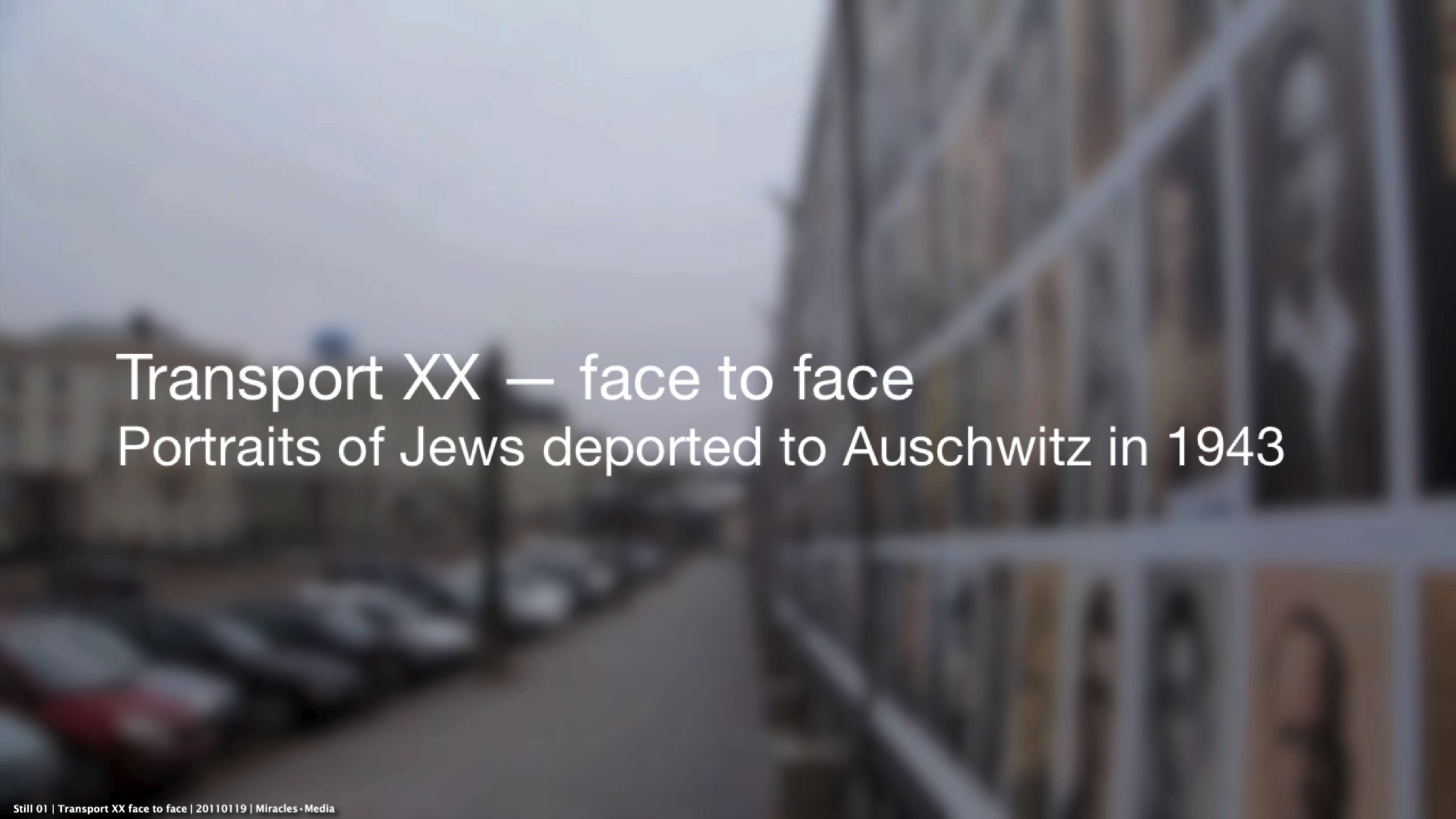
Still 01 | Transport XX face to face | 20110119
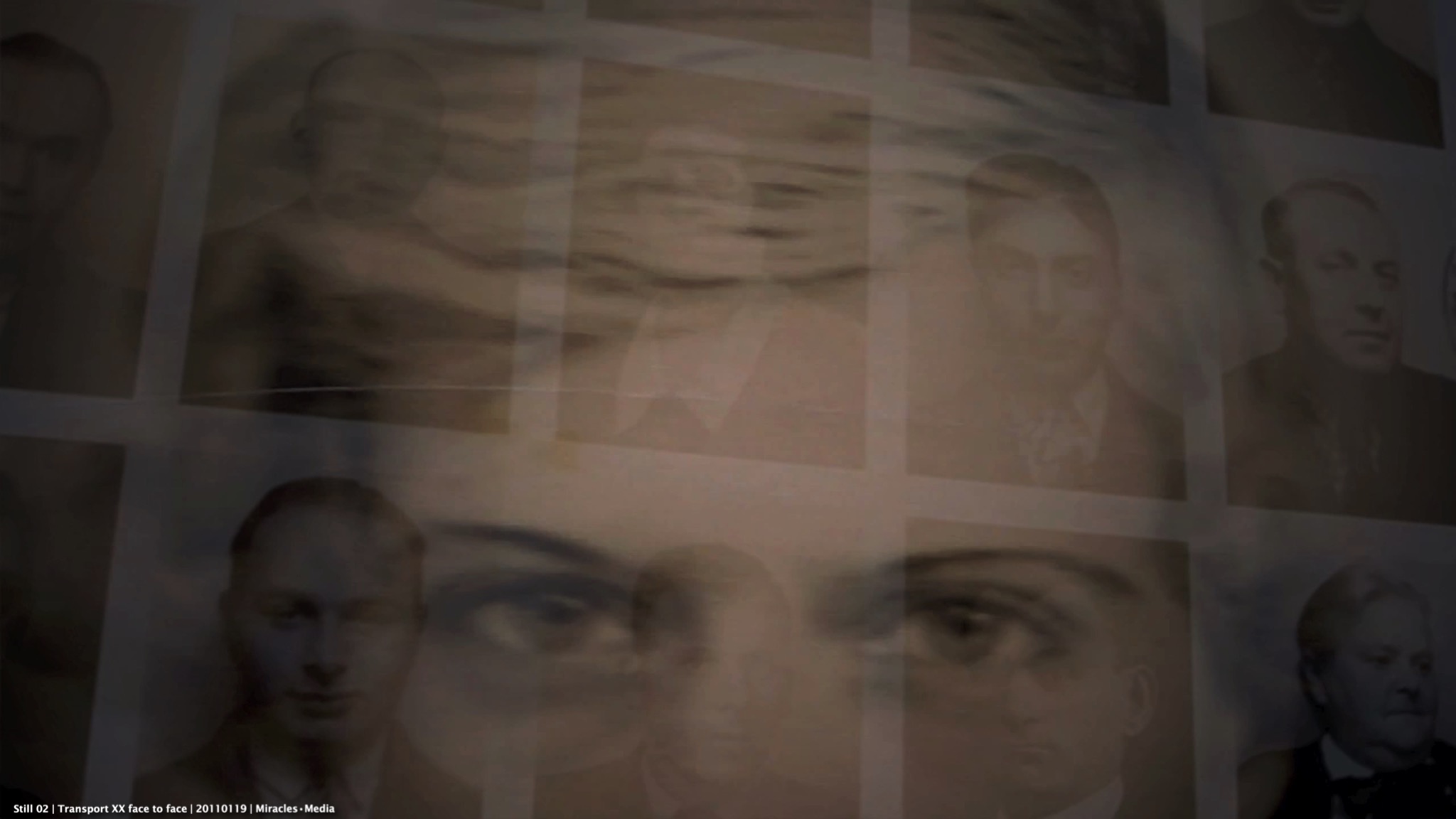
Still 02 | Transport XX face to face | 20110119

Still 03 | Transport XX face to face | 20110119

Still 11 | Transport XX face to face | 20110119

Still 40 | Transport XX face to face | 20110119
About this video
A short evocation of the TRANSPORT XX Installation in Brussels 2009, that confronted passers-by with 1200 portraits of Jews (from Belgium, Holland, and other countries) deported on this 20th train convoy from Belgium to Auschwitz on 19 April 1943. Many deportees managed to escape, among others when three young men stopped the convoy that night …
A first edition of the film was published (see below) as “TRANSPORT XX – installation Brussels” via youtube.com/channel012.
Thank you: Marjan Verplancke and other co-workers of the Kazerne Dossin / Jewish Museum of Deportation and Resistance in Mechelen (Belgium) and project “Give them a Face”. The Kazerne Dossin – kazernedossin.eu – digitalized the photo’s of the Dossin prisoners, that mostly are from the “National State Archives of Belgium. Ministry of Justice, Public Safety Office, Foreigner’s Police, individual files” URL arch.be/ .
With the ‘Give Them a Face’ project the Kazerne Dossin aims to bring together as many portraits of deportees from the Dossin barracks in Mechelen as possible and give them back their face – and the memory alive.
Notes (3)
1) Making of the film: Note that this movie originally started as pure registration – in a few ‘long takes’ – of these quite overwhelming visual impressions from my first encounter with this installation (not yet aware actually of the factual history of these portraits). Only the next day, after completing the capturing of 4 long takes while walking back and forth the rows of portraits – did I read the caption halfway the installation, and first became aware of the background, more or less: that is, the history and ‘identity’ of the portraits and this ‘transport’. This prompted the idea for this visual account with the superimposed montage of the imagery of two of the takes, combined with the ambient sound (with of the lowest levels of wind noise) of a third take.
2) A first edition of this film (“TRANSPORT XX – installation Brussels”) was published on 19 april 2009 via “channel012” at YouTube- and that version was also added in 2009 to the collection of the Dossin Barracks / Jewish Museum of Deportation and Resistance (Mechelen, Belgium).
3) This ‘final cut’ now named “Transport XX face to face” has some editing corrections and a new title and credits. This edition was first published October 2010 in the 7th round of the New Arrivals 2010 / 2011 of the dutch broadcaster ‘NTR’. New Arrivals | KORT! ntr: (no longer available via this link)
http://www.kortefilmonline.ntr.nl/page/detail/newarrivals/video/788830/transport-xx—face-to-face
(Also uploaded via Vimeo 2 days ago)
Update 20111215 credits / link info
Posted by michelvanderburg – Wednesday, January 19, 2011
Comment :
Dear Michel,
thanks for your good work. I wanted to point you a small but significant detail: transport XX was the 1rst time where a special wagon (Sonderwagen) was added with 19 resistants and “jumpers” (18 men & 1 women) from previous transports. The wagon was located just before the last wagon with the guards. It is possible that they were marked with red paint on the back of their clothes in order to destroy them automatically on arrival at Auschwitz. The pictures of these 19 prisonners was excluded from the mural exposition outside Dossin Kaserne. In my opinion their pictures should be added as it is our duty to honor their memory.
Alain Blitz – Kibbutz Hasolelim, Israel – granson of Chaskel Feiwel Blitz, N0. 9 on the Sonderwagen of Transport XX
Wednesday, 13 April 2011 at 14:24:00 CEST
Republished 20220621 by Michel van der Burg | michelvanderburg•com , from imichel•com | imichel•blogspot•com | 20110119
*Note Update 20220621 Transport XX — face to face | 2010 edition | 20200609 release
TAGS #Auschwitz #Belgium #Brussels #convoy #deportation #escape #holocaust #Jew #JMDR #Jood #Kazerne Dossin #Malines #Mechelen #shoah #train #Transport XX #republish #imichel #imichelcom #blogspot #blogger #1Memo #michelvanderburg
Vlog – The One Minutes – De Waar Geschiedenis Begint Show | imichel•com | 20101130
Paradiso Nov. 28, 2010: (English below) : The One Minutes – De Waar Geschiedenis Begint Show
Op zondag 28 november 2010 presenteerde het Nationaal Historisch Museum en The One Minutes de Waar Geschiedenis Begint-show in Paradiso, Amsterdam. Geschiedenisfilms van één minuut passeerden de revue …
Hier een video log
Meerdere schermen tegenover elkaar in Paradiso zorgden voor goed zicht op de vertoning.
Transport XX – video upload Dec 14, 2011 *
Deze korte! documentaire is een video impressie (28 februari 2009) van de confrontatie van voorbijgangers met de TRANSPORT XX installatie in Brussel: 1200 fotografische portretten van joden gedeporteerd naar Auschwitz in 1943.
Op 19 april 1943 deporteerde het 20ste treinkonvooi 1631 joodse gevangenen van de Kazerne Dossin in Mechelen (België) naar Auschwitz-Birkenau (Polen).
Deze in België gevangen genomen joden waren afkomstig uit België en ook Nederland en andere Europese landen.
Een op de zeven van de gedeporteerden wist te ontsnappen; ondermeer door de verzetsactie van de drie Brusselse jongemannen – Youra Livschitz, Jean Franklemon and Robert Maistriau – die het konvooi ‘s nachts tot staan brachten na Boortmeerbeek – niet ver van Mechelen.
Deze ‘one minute cut’ is een bewerking van de eerder in 2009 op youtube/channel012 verschenen video “TRANSPORT XX – installation Brussels”. Speciaal voor het One Minutes festival werd de oorspronkelijke film van ca. 3 minuten (2 min 50 sec) ingekort tot 1 minuut.
Credits
Dank je wel: Marjan Verplancke en andere medewerkers van het Joods Museum van Deportatie en Verzet in Mechelen, België (Kazerne Dossin) en het project “Give them a Face”.
Vanwege het speciale ‘format’ van de ‘The One Minutes’ zijn in deze 1-minuut versie de titel en credits achterwege gelaten in het beeldmateriaal (de film zelf), en wordt de titel pas bij vertoning toegevoegd.
De Kazerne Dossin digitaliseerde de foto’s van Dossin gevangenen, die meestal afkomstig zijn uit het Belgische Algemeen Rijksarchief – Dossiers Vreemdelingen Politie.
Met het project “Geef ze een gezicht” tracht Kazerne Dossin om zoveel mogelijk portretten van gedeporteerden samen te brengen, om hen hun gezicht terug te geven, en de herinnering levend te houden.
Links zoz
“The One Minutes – Where history starts show”
November 28, 2010 the dutch Museum of National History and The One Minutes presented a fine selection of videos about Dutch History in Paradiso, Amsterdam.
Below a video log
Multiple screens at opposite sides in Paradiso offered a good view for everyone on the show.
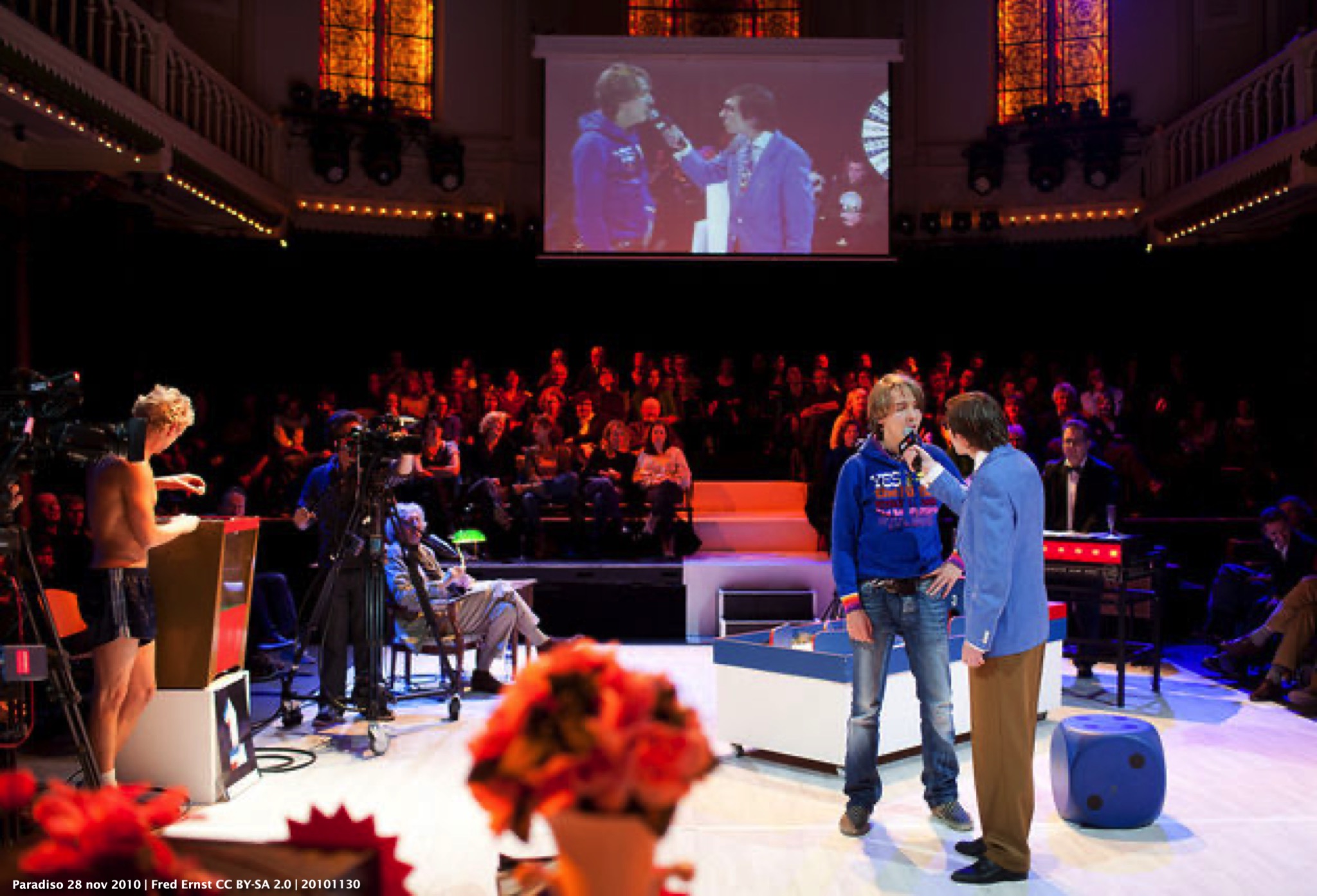
Paradiso 28 nov 2010 | Fred Ernst CC BY-SA 2.0 | 20101130
Transport XX – update with video upload Dec 14, 2011*
This short! documentary is a video impression (February 28th, 2009) of the confrontation of passers-by with the TRANSPORT XX installation in Brussels, that presented 1200 photographic portraits of Jews deported to Auschwitz in 1943. On 19 April 1943 the 20th train convoy deported 1,631 Jews from the Dossin Barracks in Mechelen (Belgium) to Auschwitz (Poland). These in Belgium captured Jews were orginally from both Belgium, Holland and other European countries.
One out of seven of these deportees managed to escape, among others by the act of resistance of the three young men — Youra Livschitz, Jean Franklemon and Robert Maistriau — who stopped the convoy that night after Boortmeerbeek (near Mechelen).
This ‘one minute cut’ is a reworking of the video “TRANSPORT XX – installation Brussels” presented earlier in 2009 at youtube/channel012. For this special ‘The One Minute’ edition, the original film of around 3 minutes was edited to a 1-minute cut.
Credits
Thank you: Marjan Verplancke and other co-workers of the Jewish Museum of Deportation and Resistance (JMDR) in Mechelen (Malines, Belgium) and project “Give them a Face”.
Because of the special format of the ‘The One Minutes’ the credits and title were omitted from the actual video, the title however will be shown at display.
The Kazerne Dossin digitalized the photo’s of the Dossin prisoners, that mostly are from the “National State Archives of Belgium. Ministry of Justice, Public Safety Office, Foreigner’s Police, individual files”.
With the ‘Give Them a Face’ project the Kazerne Dossin aims to bring together as many portraits of deportees from the Dossin barracks in Mechelen as possible and give them back their face – and the memory alive.
(updated 20220621)
Transport XX in Paradiso | The One Minutes Collection | 20200607 URL https://youtu.be/KuyQzLXQo3g
Transport XX Face to Face | 20200110 | Michel van der Burg | michelvanderburg•com – URL https://michelvanderburg.com/2020/01/10/transport-xx-face-to-face/
TRANSPORT XX — installation Brussels | 20090419 | Michel van der Burg | michelvanderburg•com – URL https://michelvanderburg.com/2009/04/19/transport-xx-installation-brussels-imichelcom-20090419/
The One Minutes URL http://www.theoneminutes.org/about
Program Filmfestival URL (no longer available) http://www.theoneminutes.org/a641…Waar-begint-geschiedenis
Nationaal Historisch Museum and INNL website is no longer existing , more info here URL https://nl.wikipedia.org/wiki/Nationaal_Historisch_Museum_(Nederland)
Nationaal Historisch Museum – the INNL youtube channel URL https://www.youtube.com/user/GeschiedenisINNL
INNL video ‘The One Minutes – De Waar Geschiedenis Begint Show’ URL https://youtu.be/HSfzpSzElyA
Paradiso
http://www.paradiso.nl/web/Agenda-Item/THE-ONE-MINUTES-WAAR-GESCHIEDENIS-BEGINT.htm
Joods Museum van Deportatie en Verzet | now Kazerne Dossin URL https://kazernedossin.eu/en/
Kazerne Dossin – kazernedossin.eu/
Belgische Algemeen Rijksarchief – Dossiers Vreemdelingen Politie | National State Archives of Belgium – arch.be/
New Arrivals | KORT! ntr: (no longer available via this link)
http://www.kortefilmonline.ntr.nl/page/detail/newarrivals/video/788830/transport-xx—face-to-face
YouTube – Channel012 URL youtube.com/channel012
YouTube – iClip channel (archived now) – youtube.com/iclip
Vimeo (2012) https://vimeo.com/michelvanderburg/txx1minute
Dec 14, 2011 updated with Transport XX oneminute youtube upload*
Dec 15, 2011 credits / link info updated

The One Minutes – De Waar Geschiedenis Begint Show | Logo | 20101130

Nationaal Historisch Museum | INNL | 20101130
The One Minutes | 20101130
Posted by michelvanderburg – Tuesday, November 30, 2010
Republished 20220621 by Michel van der Burg | michelvanderburg•com , from imichel•com | imichel•blogspot•com | 20101130
*Note 20220621 – The “Transport XX” video upload of Dec 14, 2011 (on the Youtube/iClip channel – a second channel now archived) is replaced here by the 2020 edition : Transport XX in Paradiso | The One Minutes Collection | 20200607 URL https://youtu.be/KuyQzLXQo3g
TAGS #1minute #Amsterdam #Brussels #Bruxelles #documentary #festival #history #holocaust #INNL #JMDR #KazerneDossin #Mechelen #NationaalHistorischMuseum #shoah #theoneminutes #TransportXX #republish #imichel #imichelcom #blogspot #blogger #1Memo #michelvanderburg
