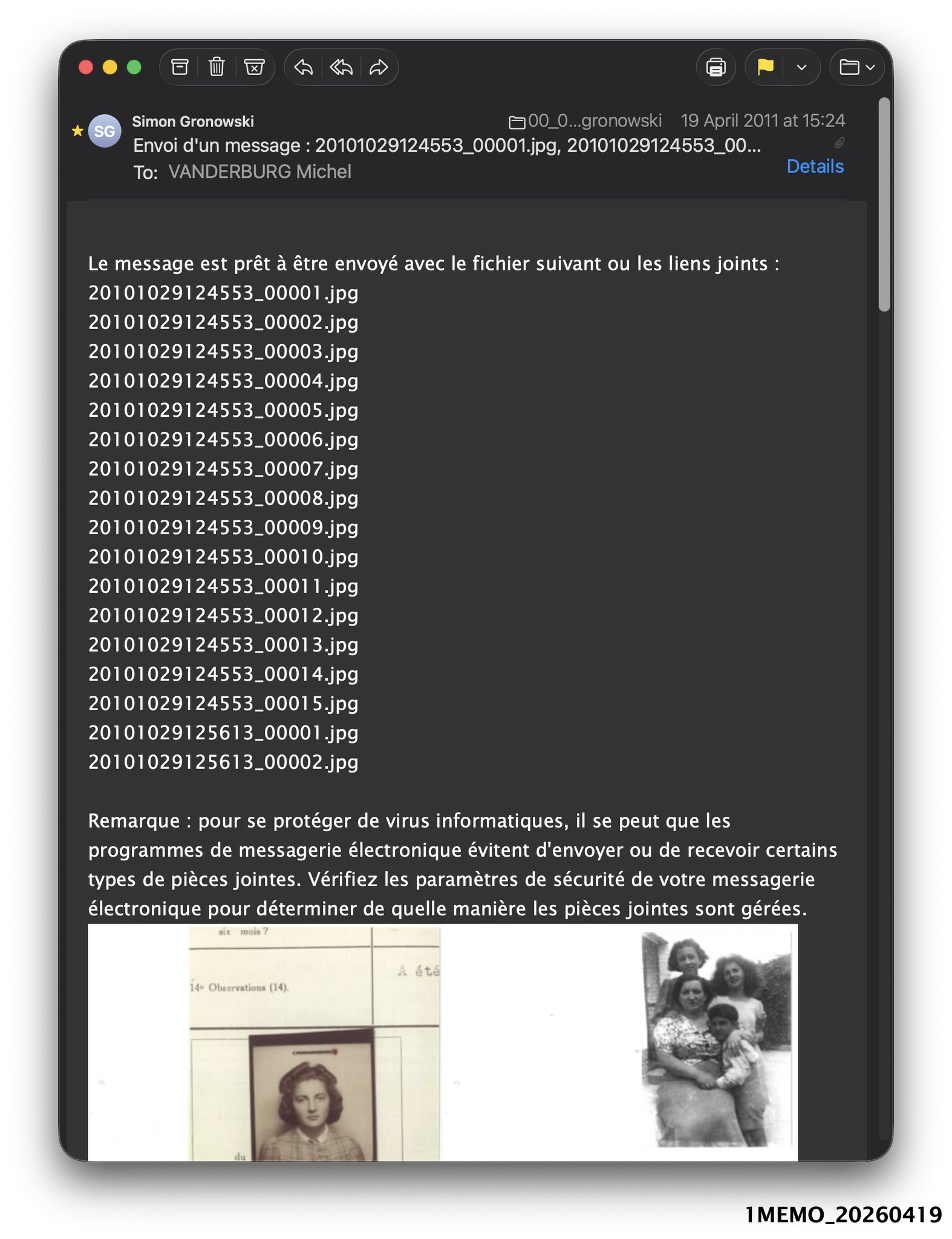
You’ve Got Mail • Transport XX • 1MEMO_20260419 • Michel van der Burg • Miracles•Media • Today 15 years ago, on April 19, 2011 , Simon Gronowski mailed me photo’s in preparation for our 1st interview scheduled April 21, 2011 at his office in Brussels, working on our documentary film Transport XX to Auschwitz.
#24 Most Viewed Today on YouTube • TRANSPORT XX – installation Brussels
My ‘Channel 012’ ranked the #24 Most Viewed Today YouTube channel in the Netherlands on the first day after uploading the captivating video Transport XX . The next day again it reached #23 Most Viewed Today.
Channel012 ranking was #68 in Most Viewed (This Week) , a week after uploading Transport XX.
Google purchased YouTube late 2006. I started late 2007, with a first upload. Between ~ 2007-2011 channel pages were equipped with view counters, bulletin boards, and were awarded badges for various rank-based achievements, such as ” “#68 – Most Viewed (This Week)”. The term “gurus” on YouTube referred to a specific category of content creators who focused on education. This category helped establish YouTube as a platform for influencers. You could change your account type to eg. Director, Comedian, Musician.
The film was uploaded close to midnight April 19th, 2009, registered by YouTube as April 20th, 2009. This short documentary is a video impression (2009) of the confrontation of passers-by with the TRANSPORT XX installation in Brussels, that presented photographic portraits of 1,200 of the 1,631 Jewish prisoners deported with the 20th train convoy to Auschwitz , the night of April 19th in 1943. Half an hour after the departure of this transport XX three young Belgians from Brussels, Youra Livschitz, Jean Franklemon and Robert Maistriau stopped the train between Boortmeerbeek and Haacht, opened one of the cars and liberated 17 prisoners. Later before the train reaches the German border over 200 other prisoners decide to attempt to escape and also jump out of the cars. This was the only documented attack on a death train during the Holocaust.
A 1minute edition of Transport XX premiered in the Paradiso theater in Amsterdam Nov. 28, 2010 – in The One Minutes – Where history starts …film festival . Here the registration : Transport XX in Paradiso | The One Minutes Collection | 20200607 | URL https://youtu.be/KuyQzLXQo3g
A behind the scenes film of the making of this film was published last year : Flow | Miracles Moment #1 | 20240513 | URL https://youtu.be/iwQQLvGtUm0
Citation info : Youtube Creator Top 25 Award • Transport XX • Michel van der Burg • Miracles•Media • 20251021 • TakeNode 39bdf260-095a-4749-acd7-e18adc9108c5 / 9f425f47-55b0-4637-9c1c-019879110895
Still from the film Street Art Simon (1). Detail from the first scene of the street art mural created by the Liège artist HYER , depicting the story of Simon Gronowski in the Garden of Remembrance of the S2J School Center in Liège, Belgium.
This scene shows the moment that Simon jumps, solo, when pushed to freedom by his mother, Chana Kaplan, who is standing in the opening of the sliding door of the freight car of Transport XX — the 20th deportation train heading to Auschwitz on the night of the 19th April 1943 at Cuttecoven (Kuttekoven) in Belgium, some 50 km (30 miles) before the border with Germany .
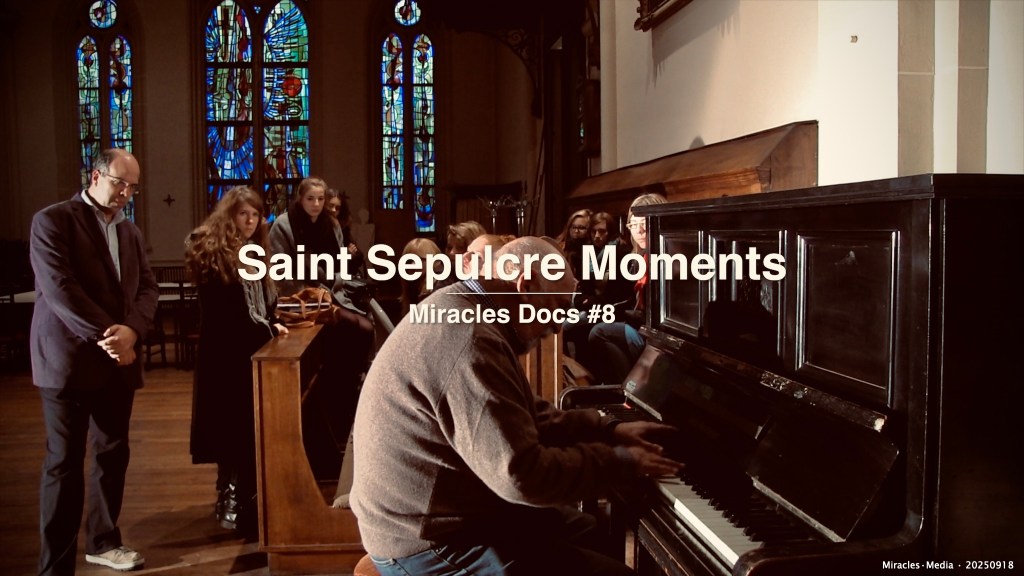
Moments from a vibrant testimony and jazz by Simon Gronowski at the Saint-Sépulcre school in Liège, Belgium, 19 november 2013.
The Institut Saint-Sépulcre (now S2J School Center) hosted 3 sessions with Simon Gronowski that day for different age groups, including adults in the evening — and, in between, an intimate jazz moment was created in the surreal ambience of the school’s chapel.
Thanks to friends Philippe Renette (co-producer), Simon Gronowski, Koenraad Tinel (Photo Dieter Telemans featured in Die Welt , Saturday 16th Nov 2013 – Feinde wie wir, by Felix Stephan) and Patrick (assisting with sound), staff Marc Belleflamme and André Hérin, and teachers Christine Marchal, Ingrid Lothe, others, and the Saint-Sépulcre students. Special thanks to the students Hélène, Charline, Tristan, Kimberley, Elodie, Farah, Esther, Estelle, Laetitia, Catherine, Tracy, and Pauline for making possible the unique events that month in 2013 for this Miracles film project.
Filmed by Michel van der Burg at the Station Liège-Guillemins, and Institut Saint-Sépulcre , Liège, Belgium, 19 november 2013.
French talks with English subtitles in open captions (OC).
Miracles Docs #8 :
The first French edition was published in 2022 as Simon Stompin’ at the Saint Sépulcre | Miracles•Media | 20221119 | ISAN 0000-0007-329C-0008-C-0000-0001-0 .
The here presented, second, edition is titled ‘Saint Sepulcre Moments’ and has open captions (burned in) showing English subtitles.
Citation info : Saint Sepulcre Moments | Miracles Docs #8 | Miracles•Media | 20250918 | ISAN 0000-0007-329C-0008-C-0000-0000-1 | TakeNode 3cb541dc-0806-4a0e-bafb-7cbf4387f6ca
Ward Adriaens (Mechelen, Belgium) passed away suddenly on the evening of November 15th, 2024. A wonderful man, a freethinker, author, with a passion for living history, especially the resistance, partisans, in World War II, and the founding director in 1995 of the Jewish Museum of Deportation and Resistance (JMDR) that opened its doors in 1996. In 2012 the JMDR became the Kazerne Dossin museum, with Ward Adriaens as honorary curator. In 2005 Ward Adriaens launched the Give Them a Face archival project. The portraits of all Jewish, Roma and Sinti deportees which passed through the SS-Sammellager Mecheln (Dossin barracks, transit camp, Mechelen) in 1942-1944, were scanned to create the “Give Them a Face” portrait collection. All around 20,000 photos in the Give Them a Face portrait collection are now part of the commemoration wall – a permanent exhibition – at the Kazerne Dossin museum.
In 2009 , I first encountered the Transport XX installation in Brussels, and met Ward Adriaens’ team of the Give Them a Face project in the Jewish Museum of Deportation and Resistance in Mechelen, Belgium (1,2).
Next , Ward Adriaens participated in our 2012 documentary Transport XX to Auschwitz (3).
Recently, May 2024, Ward Adriaens’ opening speech at the TRANSPORT XX installation in Mechelen in 2007, was posted in the ‘Miracles’ project at Miracles•Media (4).
Quote
“…Let us clearly understand that this is the fundamental basis of racism: persecuted because we have a mother. We all have parents and many amongst us have children. In order to protect them it is essential that we do not give an inch to racism. Everyone of us will come under threat should the policy makers be influenced by racism…”
3. Ward Adriaens’ interview by the dutch reporters Piet de Blaauw & Aart Zeeman (Dutch NCRV-Netwerk broadcast, 13 April 2005, NL1) from the documentary ‘Transport XX to Auschwitz’ – a film by Karen Lynne & Richard Bloom and Michel van der Burg • In : Documentary film “Transport XX to Auschwitz” • Miracles•Media • 20130419 • URL (retrieved 20241119) https://michelvanderburg.com/2013/04/19/transport-xx-to-auschwitz/
After running through the woods all night, after his escape from Transport XX, the 11-year-old Simon Gronowski went to this house – a simple house, he trusted – at early dawn on Tuesday April 20th 1943. At the time, the number 14 in the Langstraat street [now renumbered 42] in Berlingen, Belgium.
Mrs Reynders answered the door when Simon rang the bell, and was the first to help Simon to get back to Brussels.
Photo (edited) by Michel van der Burg, taken close to midnight on May 20, 2011.