
Category: english
Régine Krochmal – a tribute (with english translation and subtitles)
Tribute to Régine Krochmal, with translation (subtitles) of her speech at the Transport XX commemoration in Boortmeerbeek on May 15, 2011
[ on tablets like the iPad and phones watch subtitles here at YouTube ].
“Never forget that nothing is so powerful as life! Life gives us gifts continually: Our heart to love – our soul to find true joy – and our conscience to increase our joy, by flexibility of our heart. Each of us should let his inner wealth flourish. Like Robert Maistriau, Youra Livschitz and Jean Franklemon have done. For which we are grateful to them, to this day.”
In the video “Régine Krochmal” that was published the day Régine Krochmal died – May 11, 2012 – subtitles with an English translation have been added today. Continue reading “Régine Krochmal – a tribute (with english translation and subtitles)”
We have the right to escape
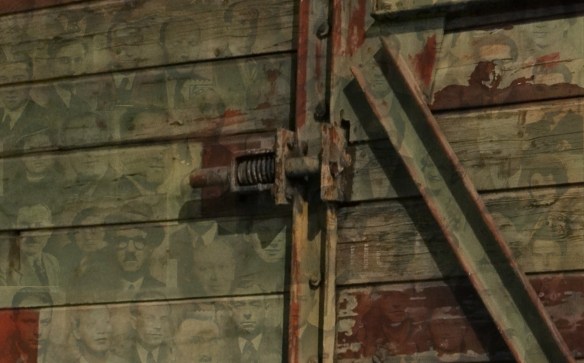
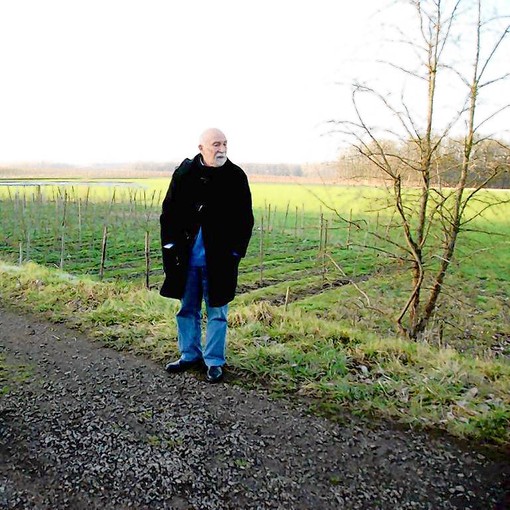
photo mvdb20110422_transport-XX
“Rescue during the Holocaust” is the theme this year of the International Holocaust Remembrance Day – Jan 27, 2013 – and an important theme in the work of historian Tanja von Fransecky.
Tanja von Fransecky has done research over the past years in France, Belgium, Holland, and Israel on the rescue, escape attempts, and escapes from the deportation trains during the Holocaust.
It is a relatively unknown chapter of the Jewish resistance during the Holocaust, that many deportees from death trains fled, and often were rescued by others – neighbors – at the risk of their own life.
Tanja von Fransecky’s work is news this weekend in the latest edition (Jan 26) of the “Süddeutsche Zeitung” – the largest German national newspaper – in the report by Stephan Stracke, entitled: “Wir haben das Recht zu flüchten” – translated here as “We have the right to escape”.
Below my summary of this article on Tanja von Fransecky’s work (with some additions by myself) Continue reading “We have the right to escape”
A Story of Transport XX – April 19, 1943 – by Audrey Rogers Furfaro
April 2008 * – As you or your friends celebrate Passover this April 19th, I hope you will remember another April 19th. This one was in 1943 and it was also the first night of Passover.

On that night, a 14-year old boy and his parents were loaded onto a cattle car that headed for Auschwitz. This is the story of that night.
The boy was born in Vienna, Austria, to middle-class Jewish parents; his mother was also born in Vienna and his father in Poland. They led an uneventful life until Hitler came to power. Following Kristallnacht in 1938, they fled to Antwerp, Belgium, and eventually settled in Brussels. In February 1943, the family was denounced. The boy and his parents were arrested and sent to Malines, a deportation camp in Belgium where the Nazis would collect Jews until they had enough for a transport to Auschwitz. For two months they waited; they were barely fed and the boy’s father was severely beaten up by a German guard in front of the boy for a minor infraction.
On the night of April 19, 1943, the family was part of Convoy XX – 1,631 Jews being shipped by cattle car to Auschwitz. They were numbers 722, 723, and 724 on the Nazis’ inventory of this shipment. A Nazi officer gave the boy’s father a white flag and a whistle, and told him that he was in charge of the particular car in which they were being loaded. He was told that if anyone tried to escape he was to alert the Nazis; if he did not the family would be killed. The father decided that the family would have to jump from the train because he would not turn in his fellow Jews.
In events that are stranger than life, on the train were some Dutch acrobats, who with the use of an old man’s cane, managed to open the latched window of the train. As the train barreled toward the German border, the family prepared to jump. The man pushed his wife from the train, and the boy watched as his mother appeared to roll toward the train’s wheels.
The boy was next. He did not want to be pushed, so he jumped on his own and scrambled up the track’s embankment. As he stood up at the top of the embankment, he felt a needle-like pain in his upper chest. He saw blood and realized he has been shot. Putting a handkerchief on the wound, he went searching for his parents, amidst the dead bodies of others who had been shot jumping from the train.
The boy wandered around in the dark, hurt and scared and eventually found his mother, but he did not want to tell her he was shot. Later that night they found the father, who had been shot in the leg. The family sought refuge in a nearby barn, where the boy finally told his mother he had been shot by a bullet that glanced his chest.
In the morning, the boy, who could speak Flemish better than his parents, approached the farmhouse owner and sold his parent’s wedding rings for aid. The farmer gave the family money, helped clean them up, and drove them to the train station where the family intended to take the train back to Brussels.
The parents sensed danger and they decided to separate. They told the boy to get off the train at the next stop, hoping that by being alone, he would not be caught. Without knowing if he would ever see his parents again, and unable to say any farewells, the boy got off the train. By now his gunshot wound was extremely painful, so alone and not knowing what to do, the boy approached a Belgian policeman. He told him that he was a 14-year-old Jew who had been shot escaping from the train to Auschwitz. The police officer took pity on the boy, brought him to the police station, and called a doctor who treated the gunshot wound. The officer gave the boy some money, and directed him toward the safest way back to Brussels, where he was reunited with his parents.
The boy was my father, Robert Rogers. He and my grandparents, Bertha and Eddy Rottenberg, went into hiding until they were finally liberated in September 1944. In 1949, they emigrated to the United States, a country they embraced with gratitude. They have all since passed away, and only two things remain of that night. One is the shirt my father was wearing, which my grandmother kept until she died. I have it now, and you can still see the neatly sewn up bullet holes and the very faintest trace of blood. The other is the memory of what happened 65 years ago that has seared through two generations of my family.
Audrey Rogers Furfaro
Chappaqua, NY
Houppertingen
A new finding – published at the current 236 exhibition in Brussels – is the location were the family escaped – they were numbers 722, 723, and 724. The Rottenberg family jumped close to Houppertingen, just before the site Simon Gronowski jumped, before Borgloon. That map is showing in a recent video of the vernisage of the ‘236’ project:
236 Land(es)capes 20th convoy | 20230126
More on the Brussels’ 236 exhibition here
https://michelvanderburg.com/2023/01/21/escape-landscapes-from-the-20th-convoy-236-photo-exhibition/
* Notes
Published Nov. 12, 2012 on this site (michelvanderburg.com) – updated Nov. 14, 2012 – and next updated and a photo-set of Robert’s shirt added Nov. 23, 2012 by Michel van der Burg / Audrey Rogers Furfaro. Photo’s taken Nov. 19, 2012 by Audrey Rogers Furfaro and edited by Michel van der Burg (michelvanderburg.com). Detail of the neatly sewn up bullet holes is shown in the bottom-right image.
In 2008 the story was first posted (with minor differences) in the “peepleofthebook” blog as “A Story of the Warsaw Ghetto, April 19, 1943 by Audrey Rogers Fufaro, 2G“
Robert Maistriau cuts the wire on a second car
Nov. 23, 2012 by Michel van der Burg– Note that during a daring attack on this ‘Transport XX to Auschwitz‘ by the three young Belgians — Robert Maistriau, Jean Franklemon, and Youra Livschitz — Maistriau succeeds in opening one car with the circa 50 prisoners with numbers 736-788. Maistriau next tried to open a second car and cut the barbed wire securing the door before the train began moving again, and he had to cease his efforts to open this car too.
That car may well have been a neighbouring car with Robert and his parents – with transport numbers 722, 723, and 724.
20230409 Update
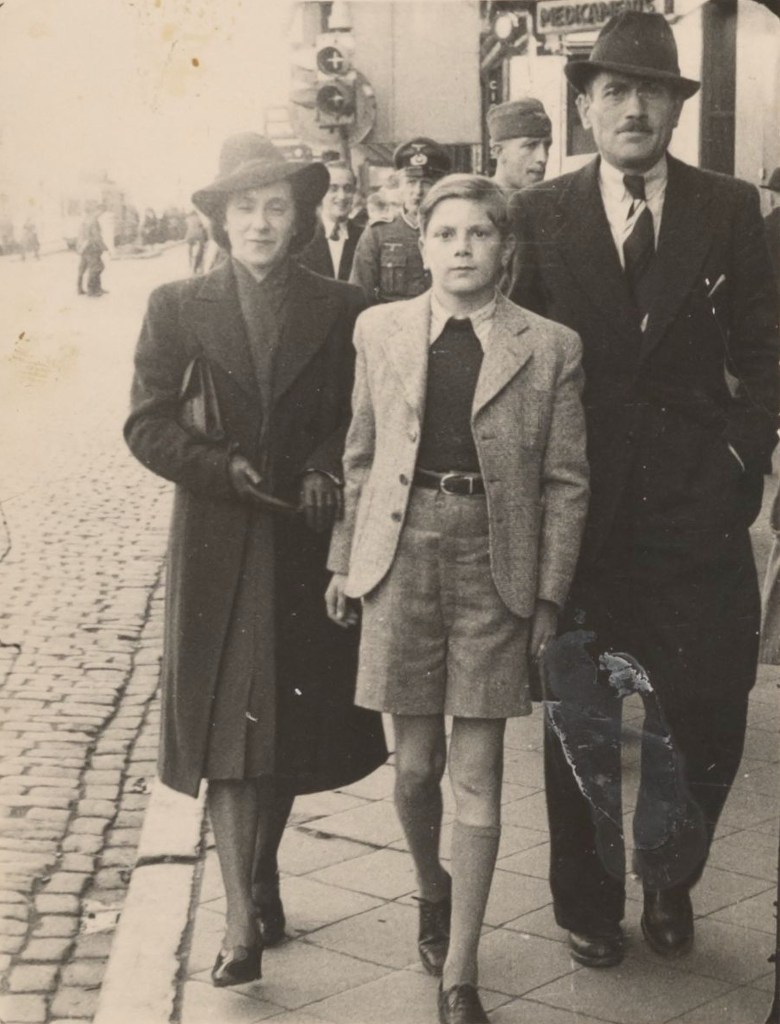
Added portrait of Bobby and his parents in Bruxelles, 1941.
Info added : The Rottenberg family jumped close to Houppertingen ( source : vernisage – map of the ‘236’ project )
Link 2009 post “TRANSPORT XX — installation Brussels”
 Here a short-cut to a 2009 post imported just now from the older blogging site imichel.com : TRANSPORT XX — installation Brussels — Portraits of Jews deported to Auschwitz in 1943
Film tells story of daring attack on train to Auschwitz – Jewish Journal
News by Jewish Journal reporter David Schwartz (October 24, 2012) from the Fort Lauderdale International Film Festival (FLIFF) .
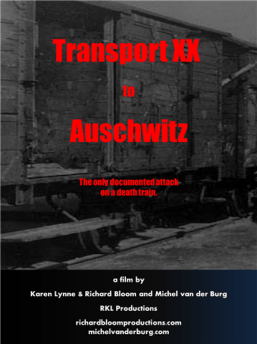
‘Transport XX to Auschwitz‘ film tells story of daring attack on train to Auschwitz.
When Rachelle Bashe was a child, she dreamed about her father’s escape from a train carrying Belgian Jews to Auschwitz. Bashe, 77, of Boynton Beach was reminded of her dreams when a reporter called to talk about the documentary film “Transport XX to Auschwitz.” The film will be screened at the Fort Lauderdale International Film Festival later this month and in early November.
“It’s just unbelievable,” an emotional Bashe said when she realized that her father was one of the more than 200 persons on the 20th train convoy who escaped on the night of April 19, 1943 during a daring attack by three Resistance fighters carrying a red railroad lamp, a pair of pliers and a pistol.
Bashe said her mother told her that her father escaped from a train but never returned home. She eventually learned that he was captured later, survived three concentration camps and died in 1945 during a death march. “It does help in a way that I am realizing that what is in my subconscious is not really a dream or a nightmare,” Bashe said.
Richard Bloom, the film’s director and a Palm Beach Gardens resident, said the story of the attack on the train is well known only in Belgium and the Netherlands.
Bloom said he learned about the attack when he was doing research on events in which Jews fought back against their captors. “It was a little footnote,” he said. “I kind of filed it away in my mind.”
Only one of the three attackers and a few escapees were alive when Bloom and Dutch producer Michel van der Burg started work on the film, which took three years to complete. Simon Gronowski, who jumped from the train as it approached a small hill, is one of the escapees interviewed in the film.
Others appear in interviews from the archives of the University of Southern California Shoah Foundation Institute for Visual History and Education.
In an email from Holland, Van der Burg said he learned about the attack on the train during a visit to Brussels in February 2009. While he was there, Van der Burg filmed people looking at a display of the portraits of 1,200 people who were on a train to Auschwitz.
When Van der Burg returned home, he created a short video and on the anniversary of the attack, put it on one of his You Tube channels. A special, one minute cut from the video was shown at a theater in Amsterdam two years ago.
After Bloom contacted Van der Burg for permission to use clips from the You Tube video in a documentary about the 20th train convoy, Van der Burg got interested in working on the film.
“I had to further study the Holocaust, and especially the Belgian holocaust,” Van der Burg said. He had no idea at the time that he would work for two years translating and editing interviews, creating subtitles, reporting and interviewing.
Interviews tell the stories of the attack and the escapes.
The filmmakers said the attack on convoy 20 is thought to be the only documented attack on trains that carried more than three million European Jews to concentration and extermination camps during the Shoah.
Trains from Mechelen, Belgium transported more than 25,000 Jews to Auschwitz-Birkenau between August 1942 and July 1944. Only about 1,200 survived.
The Fort Lauderdale International Film Festival will screen “Transport XX to Auschwitz” at 4 p.m. on Oct. 27 at the Cinema Paradiso, 111 Southeast Sixth St., Fort Lauderdale and at 3:15 p.m. on Nov. 3 at the Sunrise Civic Center Theater, 10610 W. Oakland Park Blvd., Sunrise.
For information and tickets, visit FLIFF.com or call 954-525-3456.
From the Florida Jewish Journal (South Florida Sun-Sentinel) | https://bit.ly/miraclesmedia20121024
Trailer Transport XX to Auschwitz
NL (dutch) – Film vertelt verhaal van gewaagde aanval op trein naar Auschwitz | DeWereldMorgen.be
Link to full post with all updates on Documentary film “Transport XX to Auschwitz”
Updates
March 2013 – the article is archived only partially (photo missing) at the Sun-Sentinel site
Jan. 16, 2019 – In recent years the SunSentinel site is unavailable in most European countries. Post now updated with full details of the David A. Schwartz 2012 report. Also added links to post Documentary film “Transport XX to Auschwitz”. Trailer now also embedded.
Link to new post on this site in dutch ‘Film vertelt verhaal van gewaagde aanval op trein naar Auschwitz’ , published before in my blog at the Belgian news paper DeWereldMorgen.be
May 7, 2024 – Obsolete link to Jewish Journal (Sun Sentinel) replaced with Wayback archive page link. Obsolete link story: http://www.sun-sentinel.com/florida-jewish-journal/news/palm-beach-county-news/fl-jjps-transportxx-1024-20121024,0,4541453.story
Link 2011 post “Transport XX – One Minute in Paradiso, Amsterdam”
Here a short-cut to a 2011 post imported just now from the older blogging site imichel.com : Transport XX – One Minute in Paradiso, Amsterdam
