“Rescue during the Holocaust” is the theme this year of the International Holocaust Remembrance Day – Jan 27, 2013 – and an important theme in the work of historian Tanja von Fransecky.
Tanja von Fransecky has done research over the past years in France, Belgium, Holland, and Israel on the rescue, escape attempts, and escapes from the deportation trains during the Holocaust.
It is a relatively unknown chapter of the Jewish resistance during the Holocaust, that many deportees from death trains fled, and often were rescued by others – neighbors – at the risk of their own life.
Tanja von Fransecky’s work is news this weekend in the latest edition (Jan 26) of the “Süddeutsche Zeitung” – the largest German national newspaper – in the report by Stephan Stracke, entitled: “Wir haben das Recht zu flüchten” – translated here as “We have the right to escape”.
Below my summary of this article on Tanja von Fransecky’s work (with some additions by myself) Continue reading “We have the right to escape”→
“Rescue during the Holocaust” is het thema dit jaar van de International Holocaust Remembrance Day – 27 Jan 2013 – en een belangrijk thema in het werk van geschiedkundige Tanja von Fransecky.
Tanja von Fransecky heeft de afgelopen jaren onderzoek verricht in Frankrijk, België, Nederland en Israel, naar de reddingsacties en vele vluchtpogingen en ontsnappingen uit de deportatietreinen tijdens de holocaust.
Het is een nog vrij onbekend hoofdstuk uit de geschiedenis van het Joods verzet tijdens de holocaust, dat veel gedeporteerden uit de doodstreinen gevlucht zijn, en vaak ook door anderen – omwonenden – met gevaar voor eigen leven gered zijn.
Tanja von Fransecky’s werk is nieuws dit weekend in de laatste editie (26 jan.) van de “Süddeutsche Zeitung” – het grootste Duitse nationale dagblad – in het artikel van Stephan Stracke, getiteld: „Wir haben das Recht zu flüchten“ – hier vertaald als “Wij hebben het recht te vluchten”.
Hieronder mijn samenvatting van dit artikel over Tanja von Fransecky’s werk (met enige eigen notities) Continue reading “Wij hebben het recht te vluchten”→
April 2008 * – As you or your friends celebrate Passover this April 19th, I hope you will remember another April 19th. This one was in 1943 and it was also the first night of Passover.
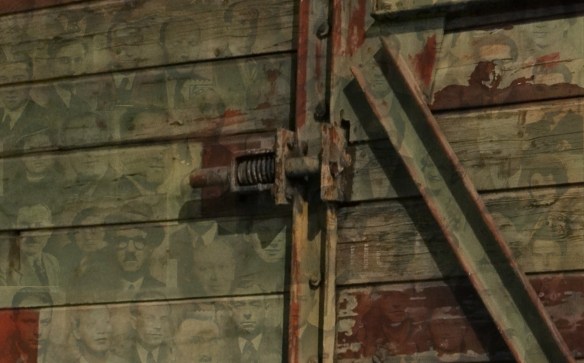
Shirt the 14 year old Robert was wearing when shot in his chest as he jumped April 19, 1943 from the 20th convoy – together with his parents Bertha and Eddy Rottenberg. Detail of the neatly sewn up bullet holes is shown in the bottom-right image. Photo’s taken Nov. 19, 2012 by Audrey Rogers Furfaro and edited by Michel van der Burg (michelvanderburg.com).
On that night, a 14-year old boy and his parents were loaded onto a cattle car that headed for Auschwitz. This is the story of that night.
The boy was born in Vienna, Austria, to middle-class Jewish parents; his mother was also born in Vienna and his father in Poland. They led an uneventful life until Hitler came to power. Following Kristallnacht in 1938, they fled to Antwerp, Belgium, and eventually settled in Brussels. In February 1943, the family was denounced. The boy and his parents were arrested and sent to Malines, a deportation camp in Belgium where the Nazis would collect Jews until they had enough for a transport to Auschwitz. For two months they waited; they were barely fed and the boy’s father was severely beaten up by a German guard in front of the boy for a minor infraction.
On the night of April 19, 1943, the family was part of Convoy XX – 1,631 Jews being shipped by cattle car to Auschwitz. They were numbers 722, 723, and 724 on the Nazis’ inventory of this shipment. A Nazi officer gave the boy’s father a white flag and a whistle, and told him that he was in charge of the particular car in which they were being loaded. He was told that if anyone tried to escape he was to alert the Nazis; if he did not the family would be killed. The father decided that the family would have to jump from the train because he would not turn in his fellow Jews.
In events that are stranger than life, on the train were some Dutch acrobats, who with the use of an old man’s cane, managed to open the latched window of the train. As the train barreled toward the German border, the family prepared to jump. The man pushed his wife from the train, and the boy watched as his mother appeared to roll toward the train’s wheels. The boy was next. He did not want to be pushed, so he jumped on his own and scrambled up the track’s embankment. As he stood up at the top of the embankment, he felt a needle-like pain in his upper chest. He saw blood and realized he has been shot. Putting a handkerchief on the wound, he went searching for his parents, amidst the dead bodies of others who had been shot jumping from the train.
The boy wandered around in the dark, hurt and scared and eventually found his mother, but he did not want to tell her he was shot. Later that night they found the father, who had been shot in the leg. The family sought refuge in a nearby barn, where the boy finally told his mother he had been shot by a bullet that glanced his chest.
In the morning, the boy, who could speak Flemish better than his parents, approached the farmhouse owner and sold his parent’s wedding rings for aid. The farmer gave the family money, helped clean them up, and drove them to the train station where the family intended to take the train back to Brussels. The parents sensed danger and they decided to separate. They told the boy to get off the train at the next stop, hoping that by being alone, he would not be caught. Without knowing if he would ever see his parents again, and unable to say any farewells, the boy got off the train. By now his gunshot wound was extremely painful, so alone and not knowing what to do, the boy approached a Belgian policeman. He told him that he was a 14-year-old Jew who had been shot escaping from the train to Auschwitz. The police officer took pity on the boy, brought him to the police station, and called a doctor who treated the gunshot wound. The officer gave the boy some money, and directed him toward the safest way back to Brussels, where he was reunited with his parents.
The boy was my father, Robert Rogers. He and my grandparents, Bertha and Eddy Rottenberg, went into hiding until they were finally liberated in September 1944. In 1949, they emigrated to the United States, a country they embraced with gratitude. They have all since passed away, and only two things remain of that night. One is the shirt my father was wearing, which my grandmother kept until she died. I have it now, and you can still see the neatly sewn up bullet holes and the very faintest trace of blood. The other is the memory of what happened 65 years ago that has seared through two generations of my family.
Audrey Rogers Furfaro Chappaqua, NY
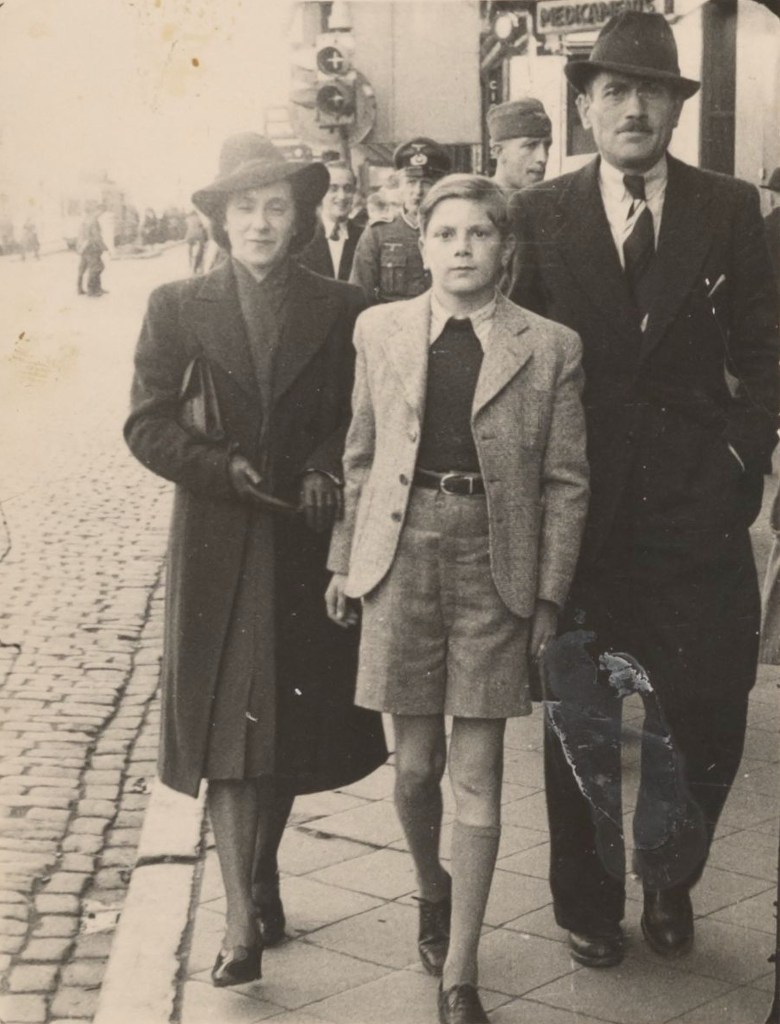
Bobby and his parents in Bruxelles, 1941 | 20230409 | Miracles•Media | Source : United States Holocaust Memorial Museum Collection, Gift of Audrey Rogers Furfaro and Scott Rogers | USHMM Rottenberg Brussel 1941 2018.661.1_001_006_0007.jpg
Houppertingen
A new finding – published at the current 236 exhibition in Brussels – is the location were the family escaped – they were numbers 722, 723, and 724. The Rottenberg family jumped close to Houppertingen, just before the site Simon Gronowski jumped, before Borgloon. That map is showing in a recent video of the vernisage of the ‘236’ project:
Published Nov. 12, 2012 on this site (michelvanderburg.com) – updated Nov. 14, 2012 – and next updated and a photo-set of Robert’s shirt added Nov. 23, 2012 by Michel van der Burg / Audrey Rogers Furfaro. Photo’s taken Nov. 19, 2012 by Audrey Rogers Furfaro and edited by Michel van der Burg (michelvanderburg.com). Detail of the neatly sewn up bullet holes is shown in the bottom-right image.
Nov. 23, 2012by Michel van der Burg– Note that during a daring attack on this ‘Transport XX to Auschwitz‘ by the three young Belgians — Robert Maistriau, Jean Franklemon, and Youra Livschitz — Maistriau succeeds in opening one car with the circa 50 prisoners with numbers 736-788. Maistriau next tried to open a second car and cut the barbed wire securing the door before the train began moving again, and he had to cease his efforts to open this car too. That car may well have been a neighbouring car with Robert and his parents – with transport numbers 722, 723, and 724.
20230409 Update
Added portrait of Bobby and his parents in Bruxelles, 1941.
Info added : The Rottenberg family jumped close to Houppertingen ( source : vernisage – map of the ‘236’ project )
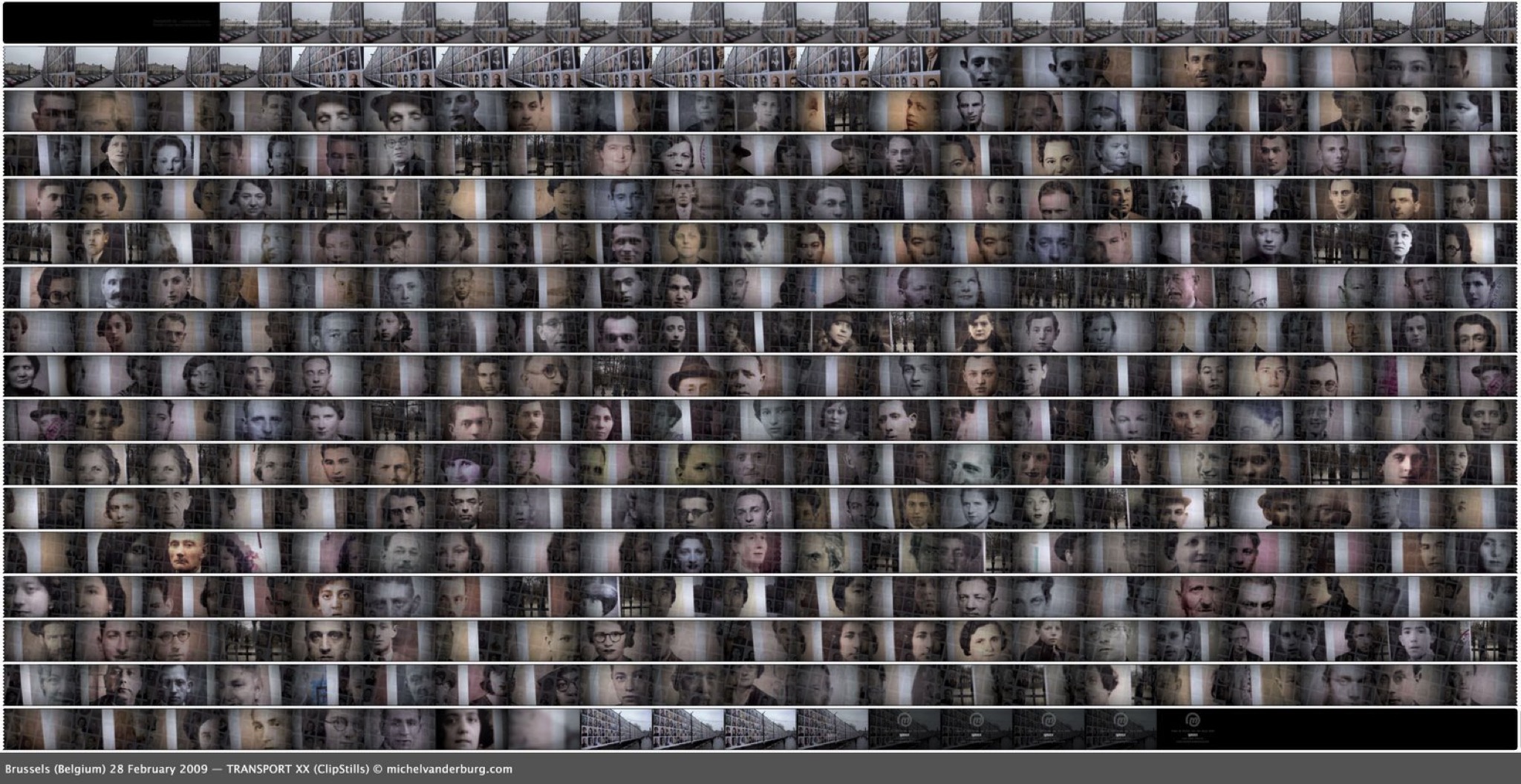
Storyboard TRANSPORT XX – installation Brussels | 20090419 | Michel van der Burg | michelvanderburg•com – CC BY SA 3.0 . Portraits of Jews deported to Auschwitz in 1943.
TRANSPORT XX — installation Brussels | 20090419
Video description
Nederlands (English – French/Français, see below):
TRANSPORT XX — installatie Brussel
Video impressie (28 februari 2009) van de confrontatie van voorbijgangers met de TRANSPORT XX installatie in Brussel: 1200 fotografische portretten van joden gedeporteerd van Mechelen (België) naar Auschwitz in 1943.
Vandaag precies 66 jaar geleden — op 19 april 1943 — deporteerde het TRANSPORT XX treinkonvooi 1631 gevangenen (voornamelijk joden) van de Kazerne Dossin in Mechelen (België) naar Auschwitz-Birkenau (Polen).
Een op de zeven van de gedeporteerden wist te ontsnappen; ondermeer door de verzetsactie van de drie Brusselse jongemannen — Youra Livschitz, Jean Franklemon and Robert Maistriau — die het konvooi ‘s nachts tot staan brachten na Boortmeerbeek — niet ver van Mechelen.
Het project TRANSPORT XX is een constructie waarin de portretten getoond worden van 1200 van de 1631 gevangenen van dit 20ste konvooi.
De TRANSPORT XX installatie in Brussel werd van 27 januari tot 15 maart 2009 georganiseerd door het BELvue Museum in samenwerking met JMDV/Kazerne Dossin (Meer info hieronder).
De fotografische portretten werden buiten gepresenteerd langs het “Park van Brussel” (Warandepark) tegenover het Koninklijk Paleis. Op deze wijze werden voorbijgangers geconfronteerd met de 1200 gezichten van de slachtoffers.
Met deze gebeurtenis werd tevens de bevrijding herdacht van Auschwitz-Birkenau op 27 januari 1945.
Meer info:
Dit project werd voor het eerst gepresenteerd aan de internationale pers op vrijdag 20 april 2007 bij de Kazerne Dossin / Joods Museum van Deportatie en Verzet (JMDV).
De Kazerne Dossin digitaliseerde de foto’s van Dossin gevangenen, die meestal afkomstig zijn uit het Belgische Algemeen Rijksarchief – Dossiers Vreemdelingen Politie.
Met het project “Geef ze een gezicht” tracht Kazerne Dossin om zoveel mogelijk portretten van gedeporteerden samen te brengen, om hen hun gezicht terug te geven, en de herinnering levend te houden.
English:
Video impression (February 28th, 2009) of the confrontation of passers-by with the TRANSPORT XX installation in Brussels, that presented 1200 photographic portraits of Jews deported from Malines (Belgium) to Auschwitz in 1943.
Today exactly 66 years ago — on 19 April 1943 — the TRANSPORT XX train convoy deported 1,631 prisoners (mainly Jews) from the Dossin Barracks in Malines (Belgium) to Auschwitz-Birkenau (Poland).
One out of seven of these deportees managed to escape, among others by the act of resistance of the three young men — Youra Livschitz, Jean Franklemon and Robert Maistriau — who stopped the convoy that night after Boortmeerbeek (near Malines).
The project TRANSPORT XX is a construction depicting the portraits of 1,200 of the 1,631 prisoners deported on this 20th convoy.
The TRANSPORT XX installation in Brussels was organised from 27 January to 15 March 2009 by the BELvue Museum in collaboration with the JMDR/Dossin Barracks (More info below).
The photographic portraits were displayed outside in the Royal park in Brussels (opposite the Royal Palace). In this way passers-by were confronted with 1,200 faces of the victims.
This event commemorated the release of Auschwitz-Birkenau (Poland) on 27 January 1945.
More info:
This project was first presented to the international press on Friday 20 April 2007 at the Dossin Barracks / Jewish Museum of Deportation and Resistance (JMDR).
The Kazerne Dossin digitalized the photo’s of the Dossin prisoners, that mostly are from the “National State Archives of Belgium. Ministry of Justice, Public Safety Office, Foreigner’s Police, individual files”.
With the ‘Give Them a Face’ project the Kazerne Dossin aims to bring together as many portraits of deportees from the Dossin barracks in Mechelen as possible and give them back their face – and the memory alive.
TRANSPORT XX — installation Bruxelles
Une vidéo de l’installation “Transport XX” – une série de portraits photos des juifs qui devaient être emmenés de Malines à Auschwitz le 19 avril 1943 (organisée par le BELvue Musée à Bruxelles – 27 janvier au 15 mars 2009 – le long du Parc Royal juste en face du Palais Royal de Bruxelles).
Merci bien Marjan Verplancke et des autres collègues de la Kazerne Dossin à Malines (la Belgique) et le projet ‘Donnez-leur un visage’.
Kazerne Dossin a digitalisé des photos de déportés de Dossin – la plupart proviennent des Dossiers de la Police des Étrangers (Archives Générales du Royaume).
Avec le projet ‘Donnez-leur un visage’ Kazerne Dossin vise à réunir le maximum de portraits de déportés afin de leur rendre un visage.
Info updated:
20090504
20101130 replaced ‘ClipStills’ by VideoframesWork™
20111215 credits / link info
20120109 french credits
Posted by michelvanderburg – Sunday, April 19, 2009
Republished 20220618 by Michel van der Burg | michelvanderburg•com , from imichel•com | imichel•blogspot•com | 20090419 . Note (20220618): The still image burned-in caption has text ‘ClipStills’ that was replaced in later years in post text by VideoframesWork , and elsewhere again later by the final choice ‘Storyboard’. Now replaced in text by Storyboard here too.
Credit 2022 format
TRANSPORT XX — installation Brussels | 20090419 | Michel van der Burg | michelvanderburg•com – CC BY SA 3.0