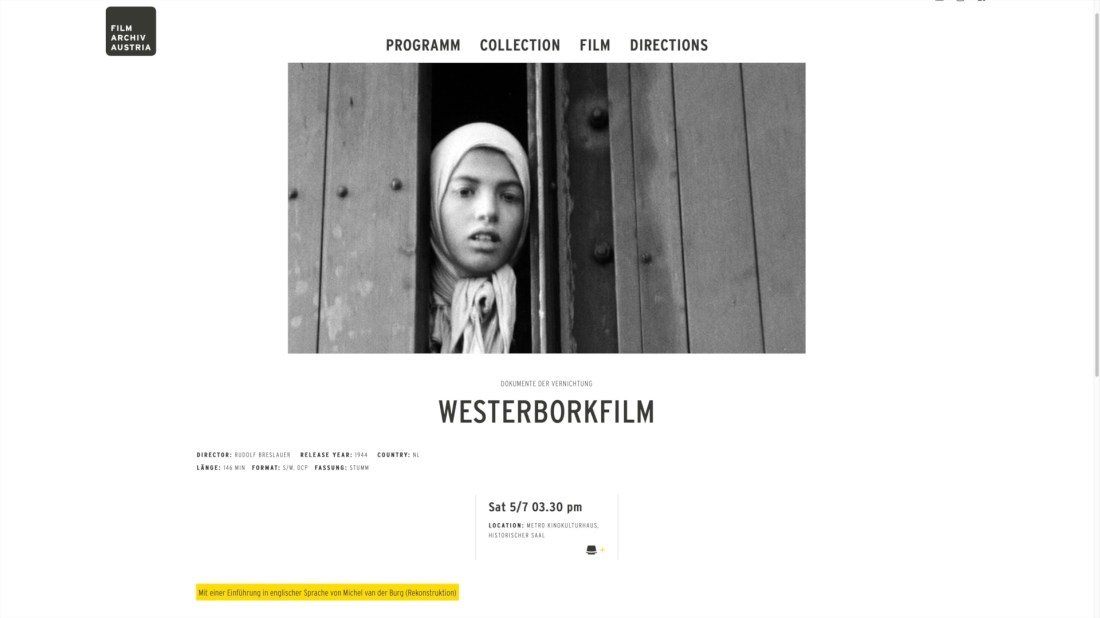
Westerborkfilm Introduction | 20220507 | Michel van der Burg | Settela•Com | Introduction by Michel van der Burg on the Westerborkfilm first showing May 7, 2022 in cinema METRO Kinokulturhaus , Vienna , Austria at the DOCUMENTS OF DESTRUCTION | DOKUMENTE DER VERNICHTUNG Symposium 6-7 May, 2022 curated by Florian Widegger. Presented by Filmarchiv Austria in cooperation with the Vienna Jewish Film Festival and the Mauthausen Memorial.
This introduction is now screening via YouTube , and embedded above.
Westerborkfilm with introduction – DOKUMENTE DER VERNICHTUNG Symposium 6-7 May, 2022 curated by Florian Widegger. Presented by Filmarchiv Austria in cooperation with the Vienna Jewish Film Festival and the Mauthausen Memorial
CREDITS & REFERENCES
Special thanks to Valentine Kuypers , curator at Sound and Vision, image researcher Gerard Nijssen, and the Westerbork Memorial Center researchers Bas Kortholt , Koert Broersma and Gerard Rossing. Aad Wagenaar, research journalist and author of book Settela.
Work on the 2021 Westerbork film edition has been a joint effort of four dutch organizations : the Dutch media archive Sound & Vision, Camp Westerbork Memorial Centre , the NIOD Institute for War, Holocaust and Genocide Studies, and the Jewish Cultural Quarter in Amsterdam.
The Westerbork film, May 7, 2022 at the symposium DOKUMENTE DER VERNICHTUNG of the Jüdischen Filmfestival Wien , the Mauthausen Memorial , and Filmarchiv Austria.
Settela, het meisje heeft haar naam terug (1995-2007) by Aad Wagenaar ISBN 9789089751898 / English translation by Janna Eliot ‘Settela’ (2005-2016) ISBN 978-0-9933898-2-5 .
Documentary film Settela, gezicht van het verleden by Cherry Duyns (VPRO, 1994).
De Westerborkfilm 📽️🎞️ | Nederlands Instituut voor Beeld & Geluid | YouTube Apr 8, 2021 URL https://youtu.be/8Y-A4BkWY18
Gerestaureerde filmbeelden Westerbork (1944) (May 18, 2021) Nederlands Instituut voor Beeld en Geluid | Youtube (accessed 2021 Jul 19) URL: https://youtu.be/-zCmr6PSNcI
Kamp Westerbork gefilmd (May 2021) Koert Broersma, Gerard Rossing (editor Gorcum B.V., Koninklijke van) ISBN 9789023257622.
‘Kamp Westerbork gefilmd’ by Koert Broersma and Gerard Rossing (editors Dirk Mulder and Ben Prinsen) ISBN 9023232658
Dawn Skorczewski & Bettine Siertsema (2018): ‘The kind of spirit that people still kept’: VHA testimonies of Amsterdam’s Diamond Jews, Holocaust Studies URL: https://doi.org/10.1080/17504902.2018.1516361
Diamantkinderen: Amsterdamse Diamantjoden en de Holocaust . Translated title of the contribution: Diamond Children: Amsterdam’s Diamond Jews and the Holocaust. Siertsema, Bettine (2020) Uitgeverij Verbum ISBN 9789493028340
Fabian Schmidt (2020): The Westerbork Film Revisited: Provenance, the Re-Use of Archive Material and Holocaust Remembrances, Historical Journal of Film, Radio and Television, URL : https://doi.org/10.1080/01439685.2020.1730033
Westerbork Film Scripts | 20220508 | Michel van der Burg | Settela•Com
Westerbork Film Correspondence | 20220509 | Michel van der Burg | Settela•Com
ANONYM | Girl with the headscarf … | 20210416 | Michel van der Burg | Settela•Com
Westerbork Film in ‘Proces Rauter’ 1948 | 20190520 | Michel van der Burg | Settela•Com
Westerbork Film 🎦 2021 | 20220302 | Michel van der Burg | Settela•Com | Display edition annotated online in CC.
Westerborkfilm Introduction | 20220507 | Michel van der Burg | Settela•Com | Introduction by Michel van der Burg on the Westerborkfilm screening in METRO Kinokulturhaus , Vienna , Austria at the DOCUMENTS OF DESTRUCTION | DOKUMENTE DER VERNICHTUNG Symposium 6-7 May, 2022 curated by Florian Widegger. Presented by Filmarchiv Austria in cooperation with the Vienna Jewish Film Festival and the Mauthausen Memorial.
Westerbork Film 🎦 2021 | The complete remastered edition of the Westerbork Film , here annotated online in CC – by Michel van der Burg as an ongoing integrating resource.
The original display edition of the restored Westerbork film was edited only for black bar removal conform 4:3 format and insertion of a title card intro and outro. Annotations are added as CC – closed captions.
Source : digital display edition of the restored Westerbork film compilation made available in Public Domain by Sound and Vision from May 18, 2021. Courtesy of Collection NIOD held at the Netherlands Institute for Sound and Vision. Source File : Westerbork (gerestaureerd) | Display edition. Retrieved (20210518) PID: URN:NBN:NL:IN:20-ZCRLTUSICOSDILNR .
Credit line :
Westerbork Film 🎦 2021 | 20220302 | Michel van der Burg | Settela•Com – CC BY 4.0
Description & Introduction film
The Westerbork Film – a silent film – is unique…the only authentic documentary footage filmed in a Nazi camp – a waiting room for death in the Netherlands for more than 100,000 Jews, and Roma, Sinti, and resistance workers. A documentary filmed spring 1944, in the Westerbork camp, by the German-Jewish camp prisoner Rudolf Werner Breslauer – the camp photographer, and commissioned by camp commander, SS-Obersturmbannführer, Albert Konrad Gemmeker.
The Westerbork camp was set up in 1939 before the war in Holland, by the Dutch government, as a central refugees camp for Jewish refugees from Nazi-Germany.
July 1942 , when the Nazi’s decided to start ‘Entjüdung’ of the Netherlands, they took over the camp for use as transit camp for deportation of mainly Jews, and Roma, Sinti, and resistance people to eastern Europe.
March 2, 1944 , SS leader Rauter in the Netherlands reports to Germany’s SS Reichsführer Himmler : the Netherlands are ‘Judenfrei’. March 5, 1944 the camp is ‘Arbeitslager’ – a work camp – when
Rudolf Breslauer starts filming the daily life of the Westerbork prisoners. After Breslauer films the deportation of Jews, Roma and Sinti to Bergen-Belsen and Auschwitz on May 19, 1944 the filming stops. The film is also not edited. In 1986 the dutch RVD Information Center makes a first montage in 4 acts of the footage into what is known now as the Westerborkfilm. In 2017 the film dossier – film and production documents – enter the UNESCO Memory of the World Register. Spring 2019 the Westerbork Film – full version (RVD) was published online and annotated – https://settela.com/2019/06/05/westerbork-film-full-version-rvd/ .
Spring 2019 the dutch Sound & Vision , EYE Filmmuseum and NIOD (former RIOD) started a major restauration project and search for all footage of the Westerbork film in all archives.
Two reels with original negative film were discovered by image researcher Gerard Nijssen.
All restored unique shots using both the camera original film and film copies (prints – when no original is known) were used for the new restored Westerbork film compilation made available as ‘display edition’ – with no title actually – by Sound and Vision | NIOD on May 18, 2021.
This newly restored 2021 version of the Westerbork film , 145 min long – was prepared for presentation here in 4:3 format (black bars removed) with a 6 seconds title card superimposed both at the start and the end of the film (superimposed on the originally 30 sec intro text and 17 sec outro text sections by Sound & Vision), in order not to change the length of the film – to allow exact reference to the original file’s timeline.
Westerbork Film 🎦 2021 | 20220302 was first uploaded March 2, 2022, and is now after annotation of the online film made public May 7, 2022 together with a short introductory film : Westerborkfilm Introduction | 20220507 | Michel van der Burg | Settela•Com | An introduction film by Michel van der Burg on the Westerbork film with a first showing May 7, 2022 in METRO Kinokulturhaus , Vienna , Austria at the DOCUMENTS OF DESTRUCTION | DOKUMENTE DER VERNICHTUNG Symposium 6-7 May, 2022 curated by Florian Widegger. Presented by Filmarchiv Austria in cooperation with the Vienna Jewish Film Festival and the Mauthausen Memorial.
Annotations
On YouTube called Chapters – there limited number due to limit number of characters in description
NOTE : for this shot right after the Degen toddlers, Breslauer had to move all the way back to last cars of the transport to Auschwitz – May 19, 1944 – E198 Roll 2/4
00:17:03 Outbound transport to Bergen-Belsen and Auschwitz – May 19, 1944 – Original Reel E198 Roll 2/4
00:17:49 Gemmeker group passing camera in the middle
00:17:55 Outbound transport to Bergen-Belsen and Auschwitz – May 19, 1944 – Original Reel E198 Roll 2/4
Original Reel E198 Roll 3/4
00:18:13 Outbound transport to Bergen-Belsen and Auschwitz – May 19, 1944 – Original Reel E198 Roll 3/4
00:18:51 On the right : SS-Obersturmführer Albert Gemmeker , Commander of Westerbork transit camp
00:18:56 Outbound transport to Bergen-Belsen and Auschwitz – May 19, 1944 – Original Reel E198 Roll 3/4
Special thanks to Valentine Kuypers , curator at Sound and Vision, image researcher Gerard Nijssen, and the Westerbork Memorial Center researchers Bas Kortholt , Koert Broersma and Gerard Rossing. Aad Wagenaar, research journalist and author of book Settela.
Work on the 2021 Westerbork film edition has been a joint effort of four dutch organizations : the Dutch media archive Sound & Vision, Camp Westerbork Memorial Centre , the NIOD Institute for War, Holocaust and Genocide Studies, and the Jewish Cultural Quarter in Amsterdam.
The Westerbork film, May 7, 2022 at the symposium DOKUMENTE DER VERNICHTUNG of the Jüdischen Filmfestival Wien , the Mauthausen Memorial , and Filmarchiv Austria.
Settela, het meisje heeft haar naam terug (1995-2007) by Aad Wagenaar ISBN 9789089751898 / English translation by Janna Eliot ‘Settela’ (2005-2016) ISBN 978-0-9933898-2-5 .
Documentary film Settela, gezicht van het verleden by Cherry Duyns (VPRO, 1994).
De Westerborkfilm 📽️🎞️ | Nederlands Instituut voor Beeld & Geluid | YouTube Apr 8, 2021 URL https://youtu.be/8Y-A4BkWY18
Gerestaureerde filmbeelden Westerbork (1944) (May 18, 2021) Nederlands Instituut voor Beeld en Geluid | Youtube (accessed 2021 Jul 19) URL: https://youtu.be/-zCmr6PSNcI
Kamp Westerbork gefilmd (May 2021) Koert Broersma, Gerard Rossing (editor Gorcum B.V., Koninklijke van) ISBN 9789023257622.
‘Kamp Westerbork gefilmd’ by Koert Broersma and Gerard Rossing (editors Dirk Mulder and Ben Prinsen) ISBN 9023232658
Dawn Skorczewski & Bettine Siertsema (2018): ‘The kind of spirit that people still kept’: VHA testimonies of Amsterdam’s Diamond Jews, Holocaust Studies URL: https://doi.org/10.1080/17504902.2018.1516361
Diamantkinderen: Amsterdamse Diamantjoden en de Holocaust . Translated title of the contribution: Diamond Children: Amsterdam’s Diamond Jews and the Holocaust. Siertsema, Bettine (2020) Uitgeverij Verbum ISBN 9789493028340
Fabian Schmidt (2020): The Westerbork Film Revisited: Provenance, the Re-Use of Archive Material and Holocaust Remembrances, Historical Journal of Film, Radio and Television, URL : https://doi.org/10.1080/01439685.2020.1730033
Westerbork Film Scripts | 20220508 | Michel van der Burg | Settela•Com
Westerbork Film Correspondence | 20220509 | Michel van der Burg | Settela•Com
ANONYM | Girl with the headscarf … | 20210416 | Michel van der Burg | Settela•Com
Westerbork Film in ‘Proces Rauter’ 1948 (20190520) Michel van der Burg | Settela•Com
Westerbork Film 🎦 2021 | 20220302 | Michel van der Burg | Settela•Com | Display edition film annotated online in CC
Westerborkfilm Introduction | 20220507 | Michel van der Burg | Settela•Com | Introduction by Michel van der Burg on the Westerborkfilm screening in METRO Kinokulturhaus , Vienna , Austria at the DOCUMENTS OF DESTRUCTION | DOKUMENTE DER VERNICHTUNG Symposium 6-7 May, 2022 curated by Florian Widegger. Presented by Filmarchiv Austria in cooperation with the Vienna Jewish Film Festival and the Mauthausen Memorial.
20220511 Info on order of shots added in post Westerbork Film Shots Order | 20220511 . Based on that info , here the Annotations list now has sub-headings like ‘Original Reel E325’ etc.
20220604 – Format changes credit line , references
Evrard Voorpijls – Belgian political prisoner , resistance fighter – told a grim story on Gestapo torture methods, during the Last Witnesses – “De Laatste Getuigen” – book (ISBN 9789054877370) presentation by Marc Van Roosbroeck (chairman of vzw “De werkgroep 10 december 2008”) on 20 May 2011 in Tongeren , Belgium.
Evrard Voorpijls (born 6 March 1923) died at the age of 89 (March 5, 2013) in the town he was born, in Maaseik, Belgium.
First post 20210520 – Updated film (for music copyright reasons dd 20210521 by shortened film edition, with replacement of the Belgian national anthem ‘La Brabançonne’ by an U.S. Navy performance of François Van Campenhout’s composition (public domain retrieved from commons.wikimedia.org) .
TRANSCRIPT
Ik ben aangehouden geworden, nieuwjaar 1944.
Ik werd overgebracht van Maaseik naar Hasselt, naar de gevangenis.
En de tweede dag dat ik in die gevangenis zat in Hasselt, heeft de Sicherheitsdienst die gehuisvest was op de Havermarkt te Hasselt, recht tegenover het gerechtshof …
Ik werd daar naartoe gebracht.
En met handen op de rug achter de stoel gebonden.
Scherp licht op mijn ogen gezet.
En ze hadden juist, de opdracht, wat ik deed in de weerstand.
Ik werd ondervraagd, en ik heb dat altijd doen afschreeuwen.
Ik werd beschuldigd, dat ik wapens en munitie van Wallonie naar Maaskant bracht.
Dat ik de sluikpers verspreidde – dat was in die tijd de ‘De Rode Vaan’.
Ik heb Russische en Franse krijgsgevangen – die ontvlucht waren – heb ik geholpen.
En eventueel zelfs piloten die ik aangewezen kreeg, dat ik die dan naar een weerstands-huis moest brengen, en van daaruit gingen ze dan terug naar Engeland, over Frankrijk en Spanje.
Ik heb het altijd afgeschreeuwd, waarvan ik beschuldigd werd.
En ik heb gezegd tegen de ondervragers:
Hoe kan ik dat gedaan hebben ?
Ik, als mijnwerker, want …
Als mijnwerker, was het geluk onder den oorlog – ge werd nooit naar Duitsland gevoerd, want ge werkte voor de Duitsers – daar werd wel sabotage gepleegd in de kolenmijnen.
Ze hebben mij geslagen en gestampt.
Totdat ik bewusteloos neerviel op de vloer.
Ik kreeg een kom water over mijn gezicht gesmeten.
Terug … ondervraagd , drie dagen aan één stuk.
Dan hebben ze me weer terug naar de gevangenis gebracht in Hasselt.
En de week daarna zijn we overgebracht worden, naar Antwerpen, naar de Begijnenstraat, naar de Wehrmacht gevangenis.
Daar ben ik dan ondervraagd geworden door de Gestapo in de Dellafaillelaan onder in de kelder.
Toen ze mij daar binnen brachten – zag ik bloedplekken op de muren.
Toen begon ik toch een beetje te bibberen, zal ik maar zeggen.
Maar van de ene kant – ik ben een stijfkop.
En dat ben ik nog – wat ik voor heb , dat moet gebeuren.
Ze hebben me weer ondervraagt .
Dezelfde vragen gesteld als in Hasselt.
Ik bleef altijd hetzelfde zeggen.
En te lange laatste, na 3-4 dagen ondervraging…
…hebben ze mij duimschroeven opgezet –
op deze vingers – want dat zijn de pijnlijkste vingers , als ge aan het werk zijt.
Nog niet bekennen – aandraaien , aandraaien, aandraaien – nog niet toegeven.
En toen, hebben ze tandenstokers onder mijn nagels geklopt.
Nog niet toegeven.
En toen, hebben ze ijskoud, die nagels uitgetrokken.
En als ge wilt – ge kunt het zien :
Ze zijn mismaakt – en met die handen kan ik niet veel doen.
Zelfs de grote tenen – hebben ze de nagels uitgetrokken.
Dat was hier bij de ondervraging door de Gestapo.
Marc Van Roosbroeck (voorzitter) : Dank u wel Evrard, voor deze zeer moedige getuigenis.
—
TRANSLATION (20210525) by Michel van der Burg
I have been apprehended, New Year 1944.
I was transferred from Maaseik to Hasselt, to prison.
The second day in that prison…
taken to the Sicherheitsdienst…
housed at the Havermarkt in Hasselt…
right in front of the court.
I was taken there.
And…with hands behind my back…
tied to a chair.
Bright light, put on my eyes.
They were right…about my assignment…
what I was doing in the resistance.
I was interrogated…
and that, I always have screamed away.
I was accused, of bringing weapons and ammunition,
from Wallonia to the Maaskant.
That I distributed the clandestine press…
that was ‘De Rode Vaan’ at the time.
I helped Russian and French prisoners of war, who had fled.
And, on occasion, even pilots that I was assigned.
I had to take them to a resistance house…
from which they went back to England – over France and Spain.
I have always denied their accusations.
And I said to the interrogators:
How could I have done that?
Me, as a miner, because…
As a miner…luck was…during the war…
you were never taken to Germany…
because, you worked for the Germans…
though, sabotage was committed there in the coal mines.
They hit and kicked me.
Until I fell unconscious on the floor.
I got a bowl of water thrown in my face.
Then, interrogated again, three days in a row.
Then, they brought me back to prison, in Hasselt.
And the week after, we were transferred…
to Antwerp, to the Begijnenstraat, to the Wehrmacht prison.
There, I was interrogated by the Gestapo…
in the Dellafaillelaan, in the basement.
When they brought me in there…
I saw blood stains on the walls.
Then, I started to shiver a bit…so to speak.
But on the other hand…I’m a pigheaded person.
And I still am : what I’m planning, that must be done.
They interrogated me again.
Asked the same questions as in Hasselt.
I always kept saying the same thing.
And finally, after 3-4 days of interrogation…
they put thumbscrews on me…
on these fingers…
because, those are the most painful fingers…
when you are at work.
Still don’t confess…
tighten, tighten, tighten…
still don’t give in.
And then, they knocked toothpicks under my fingernails.
Still don’t give in.
And then, they icily, pulled those nails out.
And if you like…
you can see it :
they are deformed…
and I can’t do much with those hands .
Even the big toes…they have pulled out the nails.
That was here at the Gestapo interrogation.
Marc Van Roosbroeck (chairman) : Thanks for this very courageous testimony.
Credits
Testimony by Evrard Voorpijls during the Last Witnesses – “De Laatste Getuigen” – book (ISBN 9789054877370) presentation by Marc Van Roosbroeck (chairman of vzw “De werkgroep 10 december 2008”) on 20 May 2011 in Tongeren , Belgium.
Transcript & Translation (20210525) by Michel van der Burg.
Gestapo Methods | Evrard Voorpijls | 20210520 2nd edition 20210521 | Michel van der Burg | Settela•Com
News
20210525 – English translation CC added in YouTube video. Both transcript (Flemish) and translation added in website post.
Little star Liesje Poons, 9 years-old, wins the first prize at the masquerade ball (bal masqué) organised by Stella Fontaine in 1932 at the Bellevue theater in Amsterdam, Holland.
A show with costumed children doing acts like imitating an indian, magician, Russian, and dancer Liesje Poons dancing on ‘Dass ist die Liebe der Matrose’. With dutch songs like, ‘In Holland staat een huis’, ‘Waarom zijn de bananen krom’.
Dutch diva Stella Fontaine (Saartje Kanes, 1889-1966) – born in a Jewish Amsterdam family – was a cabaret artist, imitator, actress and singer.
Liesje (Elisabeth Cornelia Poons) born 1 July 1922 in a Jewish Amsterdam family of artists – active in the world of theater and music – became a singer , performing eg. July 1940 in the Amsterdam Carré theater, and May 1943 in Leiden (newspaper Leidsche Courant May 8, 1943).
Elisabeth Cornelia (Liesje) Poons at the age of around 6 years, ca. 1928. Source : Joods Historisch Museum | JCK
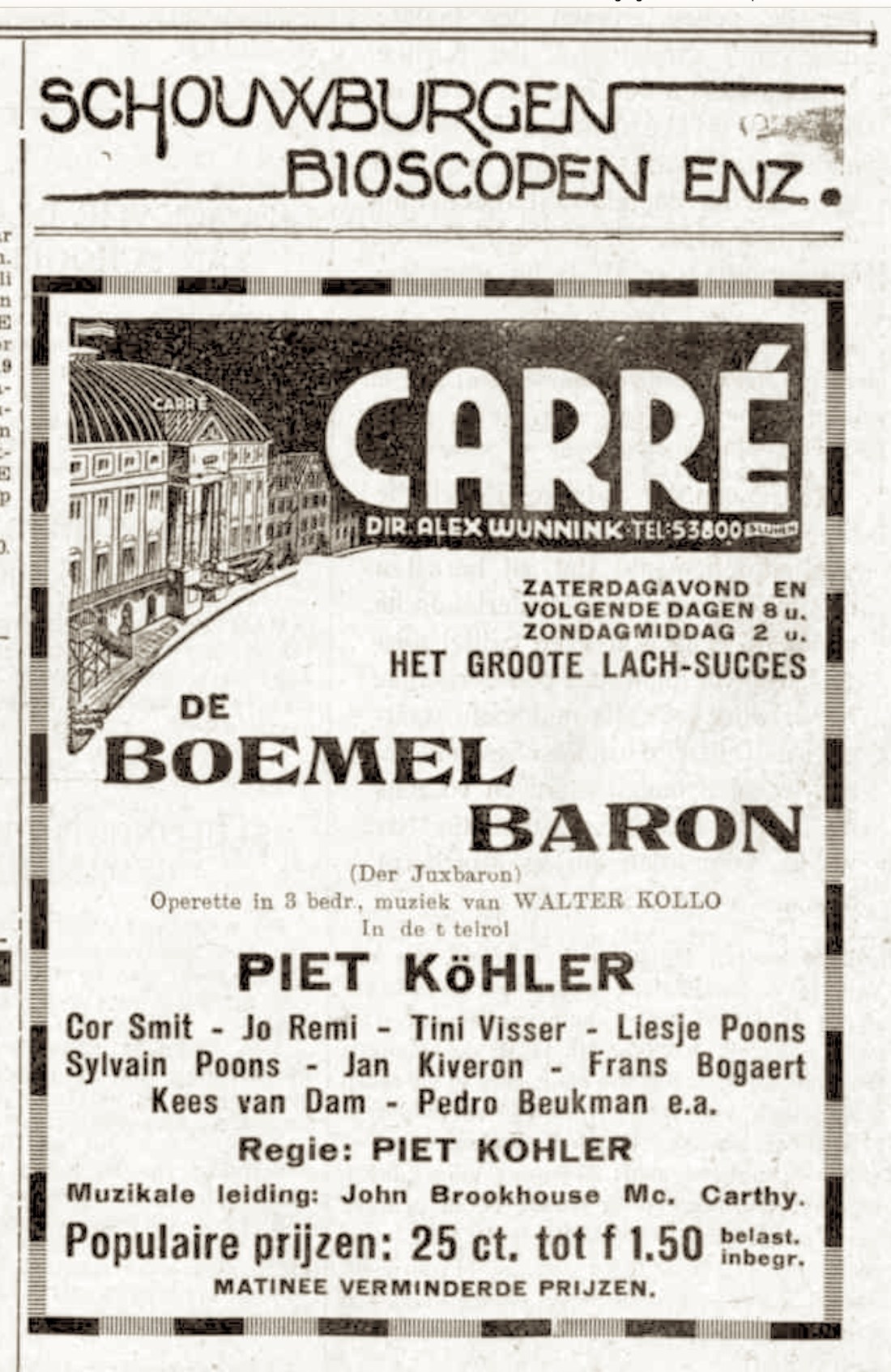
Newspaper advertisement with both Liesje Poons and her father Sylvain Poons performing in Operette in the Amsterdam Carré theater July 1940 :
De Boemel Baron CARRÉ Operette | Piet Köhler … Liesje Poons – Sylvain Poons ….
In Nieuwe Amsterdamsche Courant | Algemeen Handelsblad Saturday 6 July 1940
Source : National Library of the Netherlands – Koninklijke Bibliotheek. URL: http://resolver.kb.nl/resolve?urn=KBNRC01:000052467:mpeg21:pdf
Newspaper advertisement with Liesje Poons singing with Dance orchestra of Harry Pohl, May 1943 :
Leiden Stadsgehoorzaal theater Sunday 9 May | Dance orchestra Harrij Pohl with chansonnière Liesje Poons …
Source : Leidsche Courant May 8, 1943, page 3
URL: https://leiden.courant.nu/issue/LC/1943-05-08/edition/0/page/3?query=
Liesje Poons and father Sylvain Poons in Operette Boemelbaron. Source Nieuwe Amsterdamsche Courant | Algemeen Handelsblad Saturday 6 July 1940
Credits
Film source: Polygoontoon (Producer | March 7, 1932) courtesy of Netherlands Institute for Sound and Vision (Open Images).
Stella’s Stars in Amsterdam 1932 | 20210307 | Michel van der Burg | michelvanderburg•com | Miracles•Media | CC BY 4.0
Jewish Kid Monument ~
Walking today along the Maas River in Rotterdam , I bumped into this Jewish Children’s Monument, with the names I just learned of 686 Rotterdam’s Jewish children that were deported from here via the dutch transit camp Westerbork to the Nazi death camps Sobibór and Auschwitz-Birkenau of the Third Reich. In 2013 this special monument was unveiled for the murdered kids – only one girl survived – here near the former Loods 24 – the harbor warehouse number 24 , behind that still standing stone fence memorial (1992), were around 15000 Jews were gathered in 1942 and 1943 from Rotterdam city and nearby islands and sent on a journey to death.
Sculpture : Joods kindermonument (2013) by Wim Quist
Songs : Little Carillon Etude , Kim’s Variations I, and Bedtime by Michele Nobler | Artlist
Film : Jewish Kid Monument | 20210223 | Michel van der Burg | Settela•Com
Behind the scenes iphone shots by Sonja van der Burg of our filming Simon Gronowski for the documentary film project ‘Miracles’.
Simon Gronowski — once a little scout nicknamed “Bambi” (totem name early 1940s) — telling his story in ‘Simon reads his story’ at the public performance of authors during the event ‘Voices in the Museum’, interviewed by Marjan Verplancke, in the holocaust museum Kazerne Dossin in Mechelen, Belgium, December 2017.
Other ‘voices’ filmed that weekend: Nina Landau presenting her short film ‘Lon’ (to which I could gladly contribute a little something), and Esther Naschelski reading from her biography – as shown in the film ‘Esther’s Puzzle’ (link below) .
—
NL – Dutch :
‘Achter de schermen’ iphone shots door Sonja van der Burg tijdens onze filmopnames van Simon Gronowski voor het documentaire project ‘Miracles’.
Simon Gronowski – ooit een kleine verkenner met de bijnaam “Bambi” (totem naam begin jaren 40) – die zijn verhaal vertelt in ‘Simon leest zijn verhaal voor’ tijdens het publieke optreden van schrijvers, geïnterviewd door Marjan Verplancke, in het Kazerne Dossin museum op zondag 3 december 2017 , ter gelegenheid van het 5 jarig bestaan van het holocaust museum (als opvolger van het Joods Museum van Deportatie en Verzet) in Mechelen , België.
Andere ‘stemmen’ gefilmd dat publieksweekend: Nina Landau bij de vertoning van haar film ‘Lon’ (waar ik graag een kleinigheid aan kon bijdragen), en Esther Naschelski voorlezend uit haar biografie – zoals te zien in de film ‘Esther’s Puzzle’ (link hieronder).
Scout Bambi ~ Talk : Simon Gronowski at ‘Voices in the Museum’ with Marjan Verplancke | Kazerne Dossin – kazernedossin.eu ~ Film : 20201208 Sonja and Michel van der Burg | Miracles•Media
Righteous Medal ~ Medal of the Righteous Among the Nations – from the Yad Vashem holocaust center in Israel for the Righteous helping Jews during the Holocaust – with the inscription in French ” The grateful Jewish people” and the French translation of the Jewish saying “Whoever saves a single life, saves an entire universe”.
This medal was minted for Nelly Quintard, a widow in her fifties during the war, who hid the Frankenthal family (Abraham, Esther, and daughter Scheindel) in her home in Brussels, Belgium, from September ’42 until the end of the occupation.
Interview with Janiv Stamberger (researcher Kazerne Dossin / University of Antwerp) filmed by Michel van der Burg (michelvanderburg.com) on August 18, 2016 at the Wiki Loves Art event in Kazerne Dossin , Mechelen , Belgium.
Robert Maistriau’s memorabilia – Yad Vashem medal, pistol, small version lantern of Robert Maistriau in Kazerne Dossin , Mechelen , Belgium , August 18, 2016. Image Ref.: mvdb20160818_204617 by Michel van der Burg | michelvanderburg.com | Wikimedia CC BY-SA 4.0
A very special image (Image Ref.: mvdb20160818_204617) is that of Robert Maistriau’s medal together with his other memorabilia in the Kazerne Dossin Museum – a pistol, and a small replica version (gift from a friend) of the lantern used with the attack on the 20th death train (Transport XX) from Kazerne Dossin in Mechelen to Auschwitz .
Righteous Medal | 20200820 | Michel van der Burg | michelvanderburg.com | Miracles•Media