Old New Synagogue | 20160217 | 1-memo•com | Staronová synagoga (Alt Neu Shul) Europe’s oldest still active synagogue , once called New Synagogue , in the jewish quarter (Josefov) in Prague , Czech Republic , Friday afternoon March 30, 2012
The Vimeo original 1st edition (155724845) republished upscaled on Youtube and Instagram.
Transport XX Take 1 | 20160127 – 20220127 | Michel van der Burg | Miracles•Media | SILENT FILM : One long take – slowed down – of the TRANSPORT XX installation in Brussels, Feb 2009.
Details : For this film I have chosen the first take of my Feb 2009 video recordings that were used before in the making of the short film “TRANSPORT XX – installation Brussels” – a work published online Apr 19, 2009 at michelvanderburg•com .
The TRANSPORT XX installation in Brussels was organised from 27 January to 15 March 2009 by the BELvue Museum in collaboration with the JMDR / Dossin Barracks (Kazerne Dossin). The photographic portraits were displayed outside in the Royal park in Brussels (opposite the Royal Palace). In this way passers-by were confronted with 1,200 faces of the victims.
This event commemorated the release of Auschwitz-Birkenau (Poland) on 27 January 1945.
Remastered 2022 edition of post ① memo 20160127 ~ Transport XX Take 1.
For optimal clarity this one-take is a 10 times slowed down version. Note : stabilization was not used in this edit , to prevent zooming in , and loss of portraits at the edge of the image.
Corfu Jews Camp | 20220105 | 1-memo•com | The Old Fortress filmed Autumn 2021, Corfu, Greece. June 1944 the Nazis corralled approximately 1800 of the 2,000 Jews of Corfu in this Old Fortress for deportation to the Auschwitz Birkenau extermination camp. Approximately 200 Corfiot Jews, mostly women, managed to avoid the German roundup and escaped to villages in the island’s interior.
Expected soon : The Jews Of Corfu documentary by Mirjan Gjergjevica & Maria Boua | Mirjan Films @thejewsofcorfudoc
200K Views ! HAVA NAGILA – klezmer music band INEJNEM | 20211224
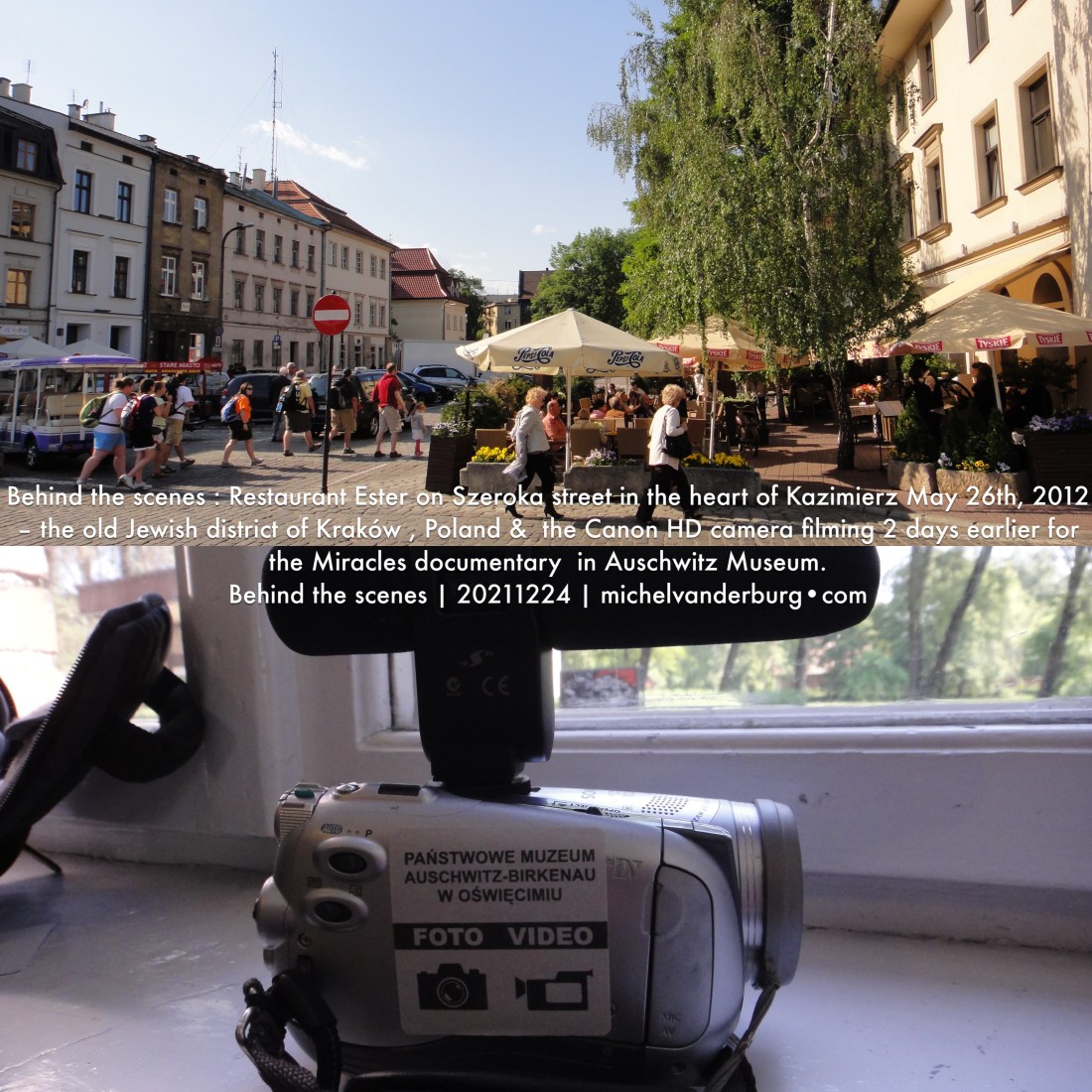
Today crossed 200K views on YouTube of “Hava Nagila” played May 26th, 2012 by the klezmer music band “INEJNEM” @Inejnem – inejnem.pl – in front of Restaurant Ester on Szeroka street in the heart of Kazimierz – the old Jewish district of Kraków , Poland.
Iryna Stefaniuk is singing, with Myroslav Bandrivskyy playing the clarinet, Jurij Bejchuk on guitar, and Jarosław „Filip” Filipiak on contrabass.
EN — Demo video (silent) showing use of the new captions (CC – closed captions) now available at the start of all scenes in the Westerbork Film on YouTube. Link to Westerbork Film also in the video.
NL – Demo video (zonder geluid) toont gebruik van de nieuwe ondertitels (CC – captions) nu beschikbaar bij aanvang van alle scènes in de Westerbork Film op YouTube. Link naar Westerbork Film ook in de video.
FR — Démo vidéo (muet) montrant l’utilisation des nouvelles légendes disponibles au début de toutes les scènes du ‘Westerbork Film’ sur YouTube. Lien vers Westerbork Film aussi dans la vidéo.
Scenes Westerbork Film | 20210811 | Michel van der Burg | Settela•Com
More on the film :
Westerbork Film | Full version RVD 1986 | 20190605 | Michel van der Burg | Settela•Com (accessed 2021 Aug 11) URL: https://wp.me/p91enH-1x
Jordaan Amsterdam 1931 * | 20210728 | Michel van der Burg | Settela•Com
Cinema news reel screened first in Holland in 1931 on the occasion of the upcoming renovation of the poor Jordaan district.
Daily life in the Jordaan district showing the Egelantiersstraat street and Prinsengracht canal with eg. a street sweeper near a city cleaning truck (I guess), bal playing kids, hand carts, horse-drawn wagons, a greengrocer, a woman with a tub cleaning a little cupboard or stove, kids play marbles, girls with breads, jump rope, a black doll, a scissors-grinder and inland ships in the Prinsengracht canal (near the corner Rozenstraat) with a tram car and the Westerkerk church in the background , and the Prinsengracht continuing on the left side of the church were Anne Frank’s family would start living some 10 years later.
Source film footage , Orion – Revue, cinema news reel 1931 “De Amsterdamsche Jordaan Wordt Gesaneerd” (Renovation of the Amsterdam Jordaan) – courtesy of Orion Filmfabriek, Den Haag (producer; Orion Filmfactory, The Hague) | Orion-Profilti | RVD Film- en Fotoarchief (1-3420) | Nederlands Instituut voor Beeld en Geluid (Sound and Vision).
Music : Clair du Lune (Debussy) by Ohad Ben Ari | Artlist
Note
* Update title July 30, 2021 : This title ‘Jordaan Amsterdam 1931’ replaces the inaccurate and misleading original title (burned in film) “Jordaan Jewish Quarter Amsterdam 1931”. Because though Jews were living there (like Anne Frank’s family 9-10 years later – the actual center of the Jews of Amsterdam the centuries old ‘Jodenbuurt’ (literally Jews quarter) is a district on the opposite side of the historic inner city.
Deportation 19 May 1944 from the dutch Westerbork transit camp, filmed by the German Jewish refugee and camp prisoner Rudolf Breslauer. Shortly thereafter 20 km north in the dutch town Assen, train cars are added from the Belgian Transport XXV (25) from transit camp Kazerne Dossin (Dossin barracks) in Mechelen, and the combined transport with Jews, Sinti and Roma, including Settela Steinbach, continues to the east…to the Bergen-Belsen and Auschwitz concentration camps.
Footage (original camera negative) filmed by Rudolf Breslauer 19 May 1944 in Camp Westerbork, Netherlands.
Film edited by Michel van der Burg (film grain noise reduction | reordering footage fragments | black bar removal) using as source : the digital display edition of the 2021 restored Westerbork film compilation – courtesy of the NIOD | Nederlands Instituut voor Beeld en Geluid (Sound and Vision) – based on the newly discovered original camera negative film (canister E198). File ref: BUM20210719_01_19440519
Deportation Westerbork Film | 20210719 | Michel van der Burg | Settela•Com
Background
First Westerbork Film (RVD)
The full version of the Westerbork Film (RVD edition) was first published spring 2019 ( settela.com//2019/06/05 ) – 75 years after the German-Jewish camp prisoner Rudolf Werner Breslauer filmed his last scene in the Westerbork transit camp – the deportation train to Bergen-Belsen and Auschwitz, May 19, 1944 (REF 1).
That Westerbork Film – the so-called RVD edition – is a montage of raw film footage made in 1986 by the Dutch National Centre for Information (the Rijksvoorlichtingsdienst, RVD) in 4 parts (Acte 1-4). Though authentic documentary footage – all the reels of film used in the 1986 edition Westerbork Film, actually, are film copies. The fate of the camera-original film was not known.
New restored Westerbork film – 2021 edition
The renewed interest for the Westerbork Film with the Unesco Memory of the World Registration sparkled also interest at the dutch NIOD Institute for War, Holocaust and Genocide Studies in the restoration of the Westerbork Film and a new survey of all available film footage archives spring 2019 let to the discovery – by the dutch image researcher, historian, Gerard Nijssen and co-workers of the Sound and Vision institute (Beeld en Geluid) of 2 canisters with ‘camera-original’ footage.
One of these canisters contains the original camera negative footage of all known fragments of the May 19, 1944 deportation – canister E198 (labeled : Negatief origineel – Westerbork – Transport – 64 meter).
This news and a glimpse of the new high quality ‘camera-original’ footage was aired January 20, 2020 by the national dutch broadcaster NOS (REF 2).
Conservator Valentine Kuypers (Sound and Vision) on the restoration
Part of the new restored film premiered online 18 April 2021 during the Mediacafé conference ‘Westerbork, caught on film’ hosted by Valentine Kuypers (conservator, Beeld en Geluid) and Bas Kortholt (Camp Westerbork Memorial Centre).
The new 2021 Westerbork film is a compilation of the best quality footage of all unique scenes found on all archive film reels, with digital scanning and conservative restoration aiming at stabilization of the images and removal only of dust, scratches, and splices without damaging film grain. No efforts were done to correct bouncing images (a camera defect) , or sharpen the images.
In addition – after the restoration – a display copy of the archive film was made and that copy has been further adjusted by color grading and retiming to mimic the original playback speed of 16 frames per second. (REF 3).
The full film of the restored Westerbork compilation was presented May 18, 2021 in Camp Westerbork Memorial Centre and made available online that day via Sound and Vision. Work on the 2021 Westerbork film edition has been a joint effort of four dutch organizations : the Dutch media archive, Sound and Vision, Camp Westerbork Memorial Centre , the NIOD Institute for War, Holocaust and Genocide Studies, and the Jewish Cultural Quarter in Amsterdam.
May 18, 2021 Sound and Vision also published via their YouTube channel (Nederlands Instituut voor Beeld en Geluid) the video ‘Gerestaureerde filmbeelden Westerbork (1944)’ – a 21 minute compilation of fragments of the new restored film footage of Westerbork, including half of the May 19, 1944 footage (REF 4).
New film findings in book “Kamp Westerbork gefilmd”
Dutch Westerbork film researchers Koert Broersma and Gerard Rossing also presented May 18, 2021 a new edition of their first in 1997 published book “Kamp Westerbork gefilmd”. For this new edition, the newly restored, cleaned and digitized version of the Westerbork Film allowed them to identify more passengers on the deportation train, including children who survived (REF 5, 6). In their book they noted that canister E198 – with the ‘camera-original’ footage of the May 19, 1944 deportation- unfortunately shows 3 splices – and showed an image of one of these splices.
Deportation Westerbork Film | Edition 2021
This film shows all the known footage filmed by Rudolf Breslauer 19 May 1944 of the deportation from Camp Westerbork from the newly discovered original camera negative film (canister E198) made available in the digital display edition of the 2021 restored Westerbork film compilation – courtesy of the NIOD | Nederlands Instituut voor Beeld en Geluid (Sound and Vision).
The film reel of canister E198 – though camera-original negative has 3 splices between film fragments not assembled in the order shot – i.e. starting with the deportation train leaving Westerbork.
The digital display edition of Sound and Vision shows no splices, but has 2 very short white transitions — and clearly no reordering was done for that archive film based copy.
In order to mimic the sequence of clips shot by Rudolf Breslauer, I reordered for the present film, those 4 fragments guided by both the route of one of the passengers, and the two white transitions in the digital display edition, as well as an image illustrating a splice shown by Koert Broersma and Gerard Rossing in their book “Kamp Westerbork gefilmd” .
The black bars of the widescreen source were trimmed, resulting in the standard format again.
Specialized software (Neat Video) was used for conservative reduction of film grain noise. No grading, sharpening etc was done.
In the film poster image, the train leaving Camp Westerbork – showing at the rear the freight car with vertical planks deporting 75 people including Settela Steinbach and her family to Auschwitz. That car actually is the fourth-last car of the train.
References
1. Westerbork Film | Full version RVD 1986 | 20190605 | Michel van der Burg | Settela•Com (accessed 2021 Jul 19) URL: https://wp.me/p91enH-1x
2. Nieuwe beelden van iconische Westerborkfilm gevonden (Jan 20, 2020) | NOS (accessed 2021 Jul 19) URL: https://bit.ly/3isIqTp
4. Gerestaureerde filmbeelden Westerbork (1944) (May 18, 2021) Nederlands Instituut voor Beeld en Geluid | Youtube (accessed 2021 Jul 19) URL: https://youtu.be/-zCmr6PSNcI
5. Kamp Westerbork gefilmd (May 2021) Koert Broersma, Gerard Rossing (editor Gorcum B.V., Koninklijke van) ISBN 9789023257622.
6. Children of the Holocaust Who Are Anonymous No More by Nina Siegal | The New York Times (May 18, 2021) (accessed 2021 Jul 19) URL: https://nyti.ms/2UQvAq5
July 19, 2021 – The current video is shown via Vimeo.
A higher quality file has been uploaded to youtube , but is currently blocked etc by two copyright claims – this will take me probably 1(-4) weeks to deal with.
Jul 25, 2021 – Started today two content ID disputes (YouTube edition) , currently under review | Both submitted on Jul 25, 2021.
Jul 26, 2021 – One claimant (restricting monitization) released their copyright claim on the youtube video.
Jul 27, 2021 – Claimant #2 released restrictions (blocking views) for the remaining time of the dispute review proces.
I now replaced the embedded Vimeo video with the YouTube edition.
Aug 18, 2021 – After reviewing my dispute, Claimant #2 has decided to release their copyright claim on the YouTube video “Deportation Westerbork Film | 20210719” . The video is finally screening on YouTube without restrictions.
Updates
20220604 – Format changes credit line , references