Primate Islet Isolation and Purification in Iodixanol-UWS • @1MEMO_20260425

Primate Islet Isolation and Purification in Iodixanol-UWS • @1MEMO_20260425

by Michel van der Burg , April 25th, 2026

Synopsis

In early 1999, a pilot study at the Biomedical Primate Research Centre in Holland successfully tested an innovative Iodixanol-UWS density gradient solution for isolating and purifying islets from four macaques, achieving 94% purity and 90% recovery. Viability of the purified islets was confirmed at 98% after one day in culture. The strict biosafety protocols required for this primate work provided valuable preparation for the subsequent launch of human islet isolations at Leiden University Medical Center. The protocol was further validated in a second series of eight rhesus islet isolations in 2000.

February 1999

In early February 1999, a few weeks before we received the green light for the official launch of the clinical islet transplantation project (1) in our Leiden University Medical Center (LUMC), I also started preparations to isolate non-human primate islets at the Biomedical Primate Research Centre in Holland.

At the time, we were already collaborating with researchers from the Biomedical Primate Research Centre for xenotransplantation of purified pig islets in macaque monkeys (2).

With our innovative purification solution — made from Iodixanol (the radio contrast agent Optiprep/Visipaque) , mixed with University of Wisconsin solution (UWS), the solution traditionally used for cold storage of human donor organs — we had successfully isolated and purified the islets of Langerhans from pig pancreases since 1996, and transplanted them into mice, rats, and cynomolgus macaque monkeys (2, 3, 4).

This Iodixanol-UWS purification solution had been successfully trialed on human donor islets during my 1998 visit to the Diabetes Research Institute (DRI) in Miami (5,6).

I had now been asked at our Surgery department (LUMC, Leiden, Holland) to examine whether this isolation method using Iodixanol-UWS can be used also in the non-human primate model , with a view to the application for a new research project on allo-transplantation of islets in Rhesus macaques, and in vitro research into the immunogenicity of these purified islets.

For these pilot experiments, the islets were isolated from donor pancreases procured by Michel van der Burg (me), and the transplant surgeons André Baranski, Jan Ringers, and Jan IJzermans, from one cynomolgus (Macaca fascicularis) and three rhesus macaques (Macaca mulatta), that were obtained during surgery upon euthanasia of these laboratory animals for the termination of unrelated experiments by other research groups at the Biomedical Primate Research Centre.

I had previously watched rhesus islet isolation at the DRI in Miami during that working visit in 1998. So , now before starting the isolations the first week of March 1999, I contacted the experienced DRI researcher Norma Kenyon for advise on the optimal donor age , and optimal amount of enzyme (Liberase-HI) for digestion of the pancreas in this species.

Following digestion of the pancreas with the Liberase-HI enzyme in Hanks’ balanced salt solution , the islets were isolated with our manual method in cold UWS (ViaSpan), and purified by centrifugation in the cold Iodixanol-UWS density gradient solution.

Excellent results were obtained in this pilot of 4 primate islet isolations .
Before the purification step , after digestion of the pancreas , the yield of isolated islets amounted to a mean 3697 islets / gram pancreas (IEQ; islet equivalents*).

After purification of these islets in our Iodixanol-UWS density gradient solution , virtually pure islets were obtained (a mean 94% purity) , with virtually no loss of islets (a mean 90 % recovery).

The purified islets were stored in suspension in culture medium up to 1 week after isolation. Both before culture and after 4 days culture, aliquots of the rhesus islets were prepared for analysis of the immunogenicity of the islets in a Mixed Lymphocyte Islet Culture (MLIC) by co-worker Krista Haanstra.

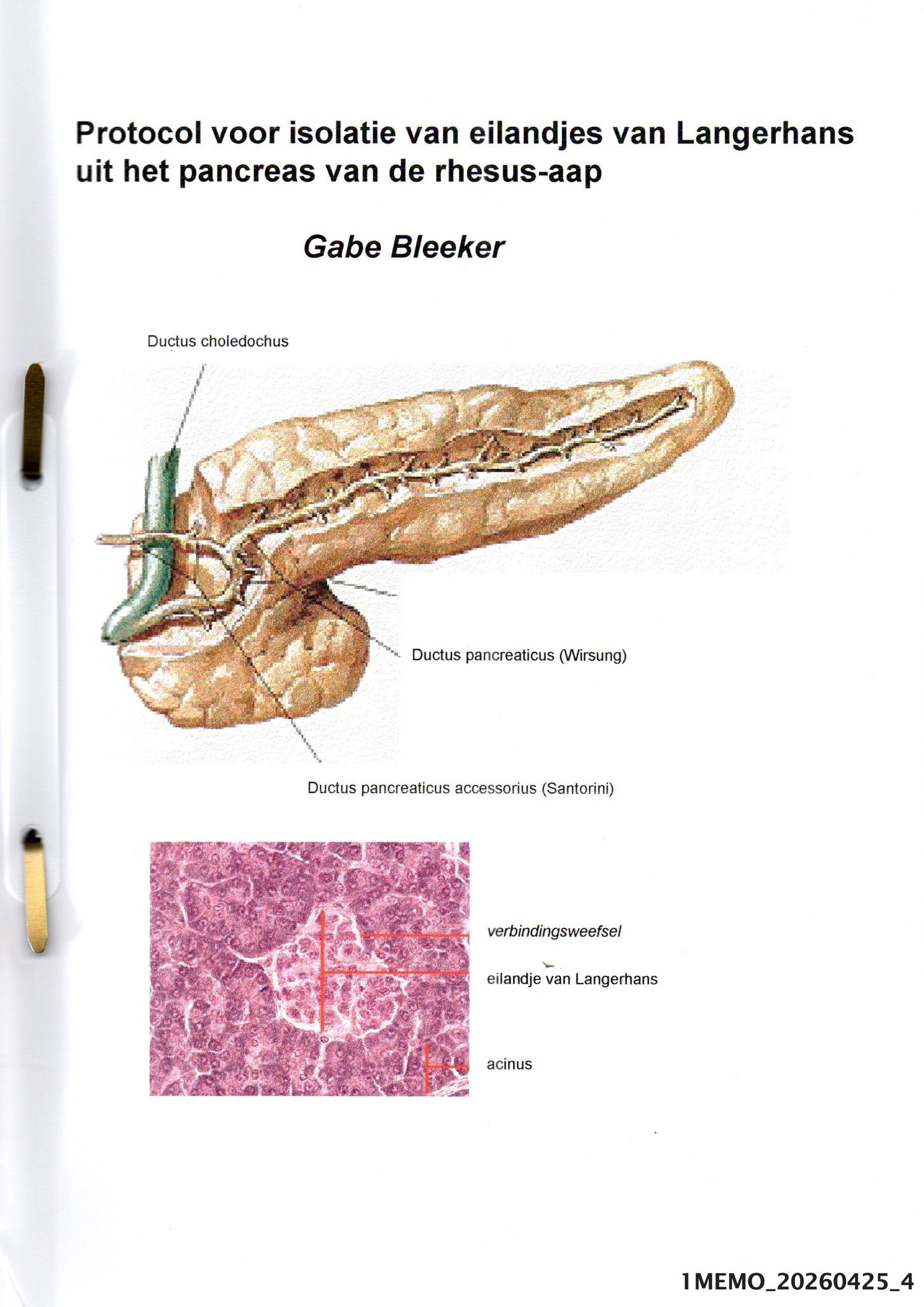
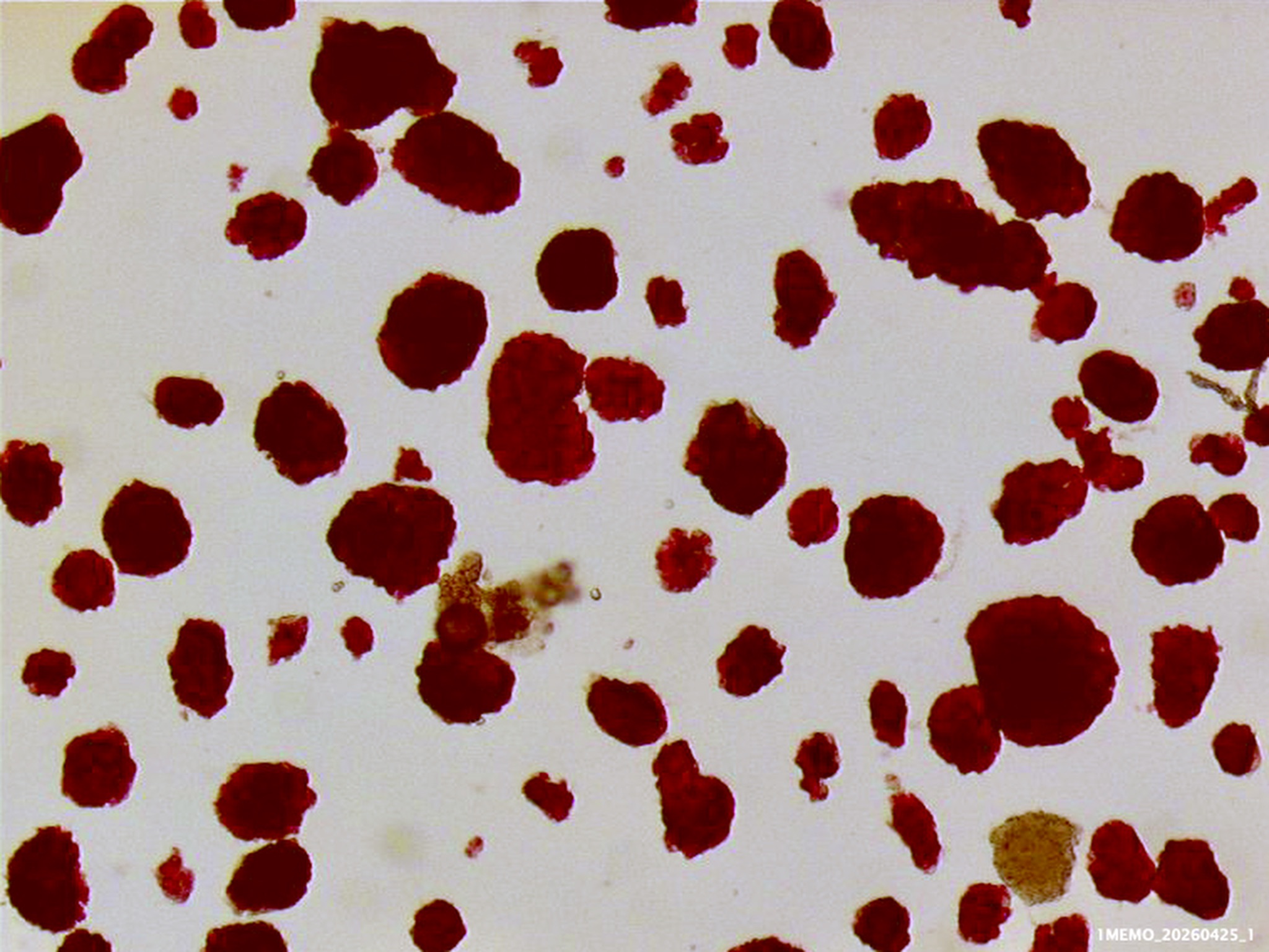
I photographed the isolated cynomolgus islets both before culture (stained red with dithizone), and after one day culture (not stained, in the petri dishes used for culture).
Cynomolgus monkey islets purified in Iodixanol-UWS • 1MEMO_20260425_1 • Michel van der Burg • Miracles•Media • TakeNode 893e099a-13b2-42cd-a3e9-17bcbe14d3d9 • Islets not cultured, identified by staining red with dithizone, after overnight preservation in cold UWS (due to logistics).

Cynomolgus monkey islets purified in Iodixanol-UWS • 1MEMO_20260425_2 • Michel van der Burg • Miracles•Media • TakeNode 606380dc-ae91-461e-ab6c-2c24186676de • Islets cultured one day at 37°C, not stained.

Survival of 98% of the islets after staying one day in suspension in a culture solution at 37°C demonstrated the excellent viability of these cynomolgus islets.


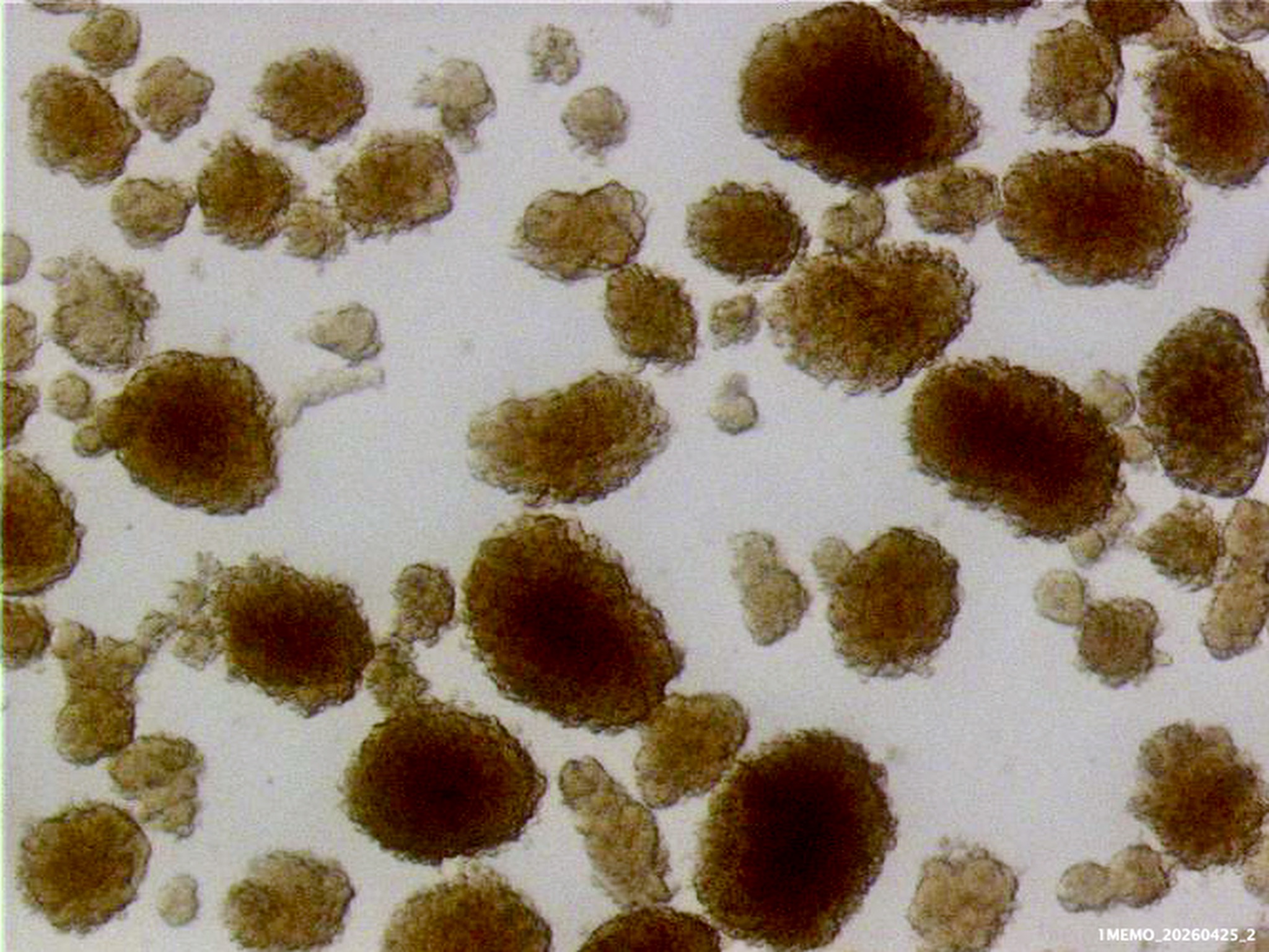
The viability was confirmed by staining these cultured islets with a mixture of two fluorescent dyes — acridine orange and propidium iodide (AO/PI). Fluorescence microscopy shows the live (green) cells , and few dead (red/yellow) cells in these islets.
Cynomolgus monkey islets purified in Iodixanol-UWS • 1MEMO_20260425_3 • Michel van der Burg • Miracles•Media • TakeNode 7666a0a1-7876-4c85-9bd6-30b4ae780028 • Islets cultured one day at 37°C. Fluorescence microscopy shows the live (green) and few dead (red/yellow) cells in these islets. Staining with a mixture of two fluorescent dyes —acridine orange and propidium iodide (AO/PI).

The strict biosafety and biosecurity precautions required for this work, especially due to the risk of infection via aerosols during trituration, sieving, and pouring of the large volumes of tissue and cell suspensions from these non-human primates, proved valuable preparation for the subsequent launch, later that month—March 1999—of human islet isolations from donor organs, in our provisional human islet laboratory at the Department of Surgery—pending the completion of the LUMC GMP facility with a cleanroom for our clinical islet laboratory, that I was preparing together with Amon Wafelman the executive head of the future GMP Facility.

I continued this project of rhesus islet isolation, purification and banking, with in vitro research into the immunogenicity of these purified islets, a year later (July-Dec 2000), coaching medical student Gabe Bleeker who corroborated the efficacy of our protocol in that second series of eight rhesus islet isolations (7). He would also assist me at the time in our islet laboratory with the automated ‘Ricordi’ method for human islet isolation, islet banking and quality control by transplants of aliquots of the human islets in nude mice.

Notes

* IEQ : One islet equivalent (IEQ), is defined as the volume of one islet with a 0.15 mm diameter. Because there a more smaller than large islets in the pancreas , the volume of islets is used to indicate islet yield, and expressedin number of ‘islet equivalents’.

1. Ekkelboom J. Hulp voor suikerzieke klieren. In: Volkskrant April 10th 1999 https://www.volkskrant.nl/wetenschap/hulp-voor-suikerzieke-klieren~b7046616

2) Successful Islet Transplantation After Purification in Iodixanol-UWS • IPITA 1999 Sydney • @1MEMO 20260326 • Michel van der Burg • Miracles.Media • URL michelvanderburg.com/2026/03/26/

3) Innovative Islet Purification in Iodixanol-UWS • IPITA 97 • Michel van der Burg • Miracles.Media • @1MEMO 20250128 • URL michelvanderburg.com/2025/01/28/

4) Iodixanol-UWS Purification for Porcine Islet Transplantation • AIDSPIT 1998 • Michel van der Burg • Miracles.Media • @1MEMO 20250131 • TakeNode 1f185515-7aeb-44ac-b721-2cec76df67b7 • URL michelvanderburg.com/2025/01/31/

5) Human Islet Isolation • DRI Miami 1998 • Michel van der Burg • Miracles.Media • @1MEMO 20250204 • TakeNode 86e4a319-a769-44d5-8fa5-de2ca90ab63c • URL michelvanderburg.com/2025/02/04/

6) Efficacy of the novel iodixanol-UWS density gradient for human islet purification • Igls Aidspit 1999 • Michel van der Burg • Miracles.Media • 20241202 • URL michelvanderburg.com/2024/12/02/

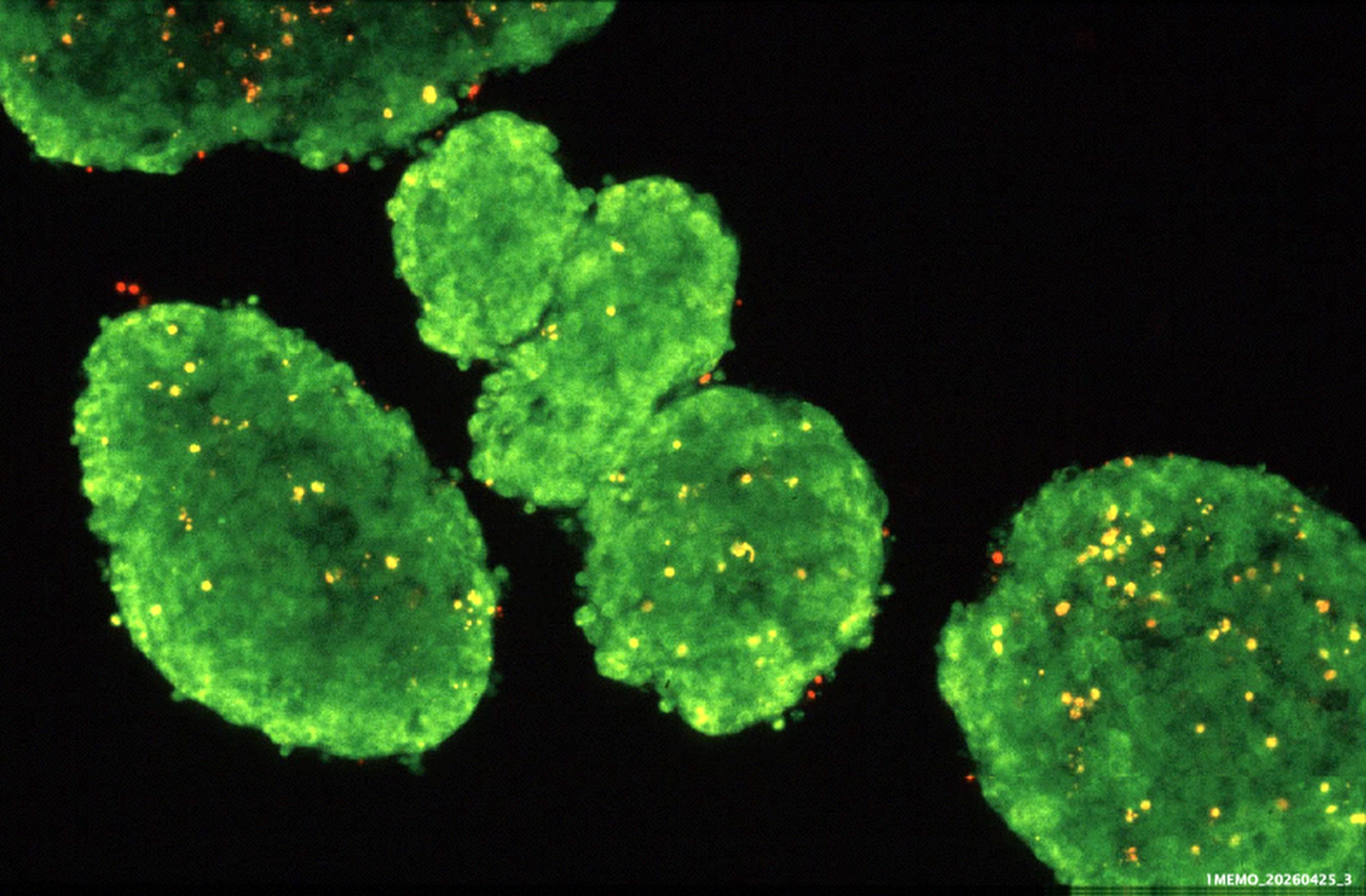
7) Protocol for the isolation of islets of Langerhans from the pancreas of the rhesus monkey (dutch : Protocol voor isolatie van eilandjes van Langerhans uit het pancreas van de rhesus-aap) • Studies on the isolation and immunogenicity/immunology of monkey (rhesus) islets • Gabe B. Bleeker (MSc student Medicine) at the Department of Surgery of the Leiden University and the BPRC – TNO centre.
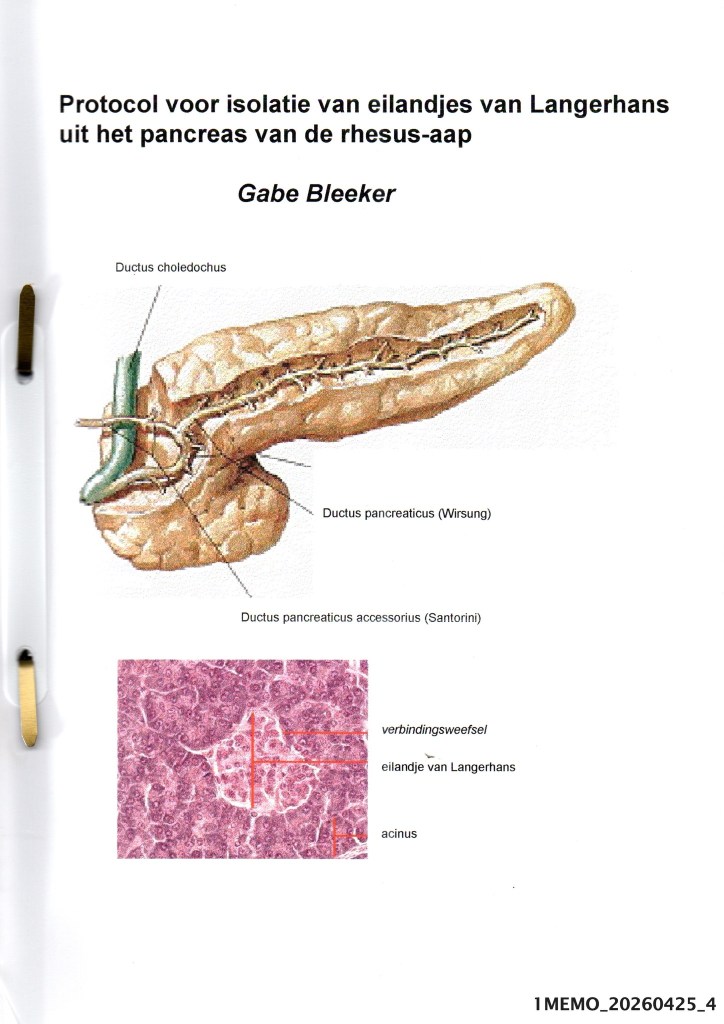

Cover Bleeker Report Rhesus Islet Isolation • 1MEMO_20260425_4 • Michel van der Burg • Miracles•Media • TakeNode 96bd9197-71a5-4c19-9540-264b1ba74be4 • Protocol for the isolation of islets of Langerhans from the pancreas of the rhesus monkey. Cover research report, MSc student Medicine, Gabe Bleeker (Dec 2000).

#islets #islet #Langerhans #isolation #purification #culture #isletbank #QC #immunogenicity #GMP #facility #LUMC #Holland #Netherlands #Leiden #hospital #primate #human #monkey #rhesus #cynomolgus #macaque #donor #surgery #clinical #laboratory #optiprep #iodixanol #ViaSpan #density #gradient #UWS #pancreas #MLIC #UW #university #Wisconsin #transplantation #xeno #mouse #diabetes #man #history #research #1memo #michelvanderburg #Bleeker #Ricordi #DRI #Miami

Citation info : Primate Islet Isolation and Purification in Iodixanol-UWS • @1MEMO_20260425 • Michel van der Burg • Miracles.Media • URL michelvanderburg.com/2026/04/25/
Iodixanol-UWS Purification and Culture of Pig Islets Xeno Transplants • Cell Transplant Society 1999 • @1MEMO 20250202


Iodixanol-UWS Purification and Culture of Pig Islets Xeno Transplants • Cell Transplant Society 1999 • Michel van der Burg • Miracles.Media • @1MEMO 20250202

Slideshow (digitally remastered) oral presentation Michel van der Burg, Cell Transplant Society congress 1999 in Montreux, Switzerland (1)

The Leiden Islet Laboratory developed a novel Iodixanol-UWS density gradient for purification of the islets of Langerhans from the pancreas in the difficult pig model.

Pig islet isolation from the pancreas of slaughterhouse sows was markedly improved by keeping the islets in the UW donor organ preservation solution (UWS) both during the isolation of islets (using the Liberase enzyme blend) and purification of the islets using our novel Iodixanol-UWS density gradient.

Xeno transplantation of these 1-day-cultured pig islets restored normal blood sugar levels in diabetic mice.

PDF slideshow oral presentation Michel van der Burg, Cell Transplant Society congress 1999 in Montreux, Switzerland

Iodixanol-UWS Purification and Culture of Pig Islets Xeno Transplants • Cell Transplant Society 1999 • Michel van der Burg • Miracles.Media • @1MEMO 20250202_2 • TakeNode 8bd79256-78b2-4d8e-8d48-6da41102dc2d • Download file available below 1MEMO_20250202_2

Notes

1) Van der Burg MPM, Rijkelijkhuizen JKRA, Zwaan RP, Bouwman E. Adult pig islet recovery during Liberase isolation, OptiPrep purification and culture for transplantation in nude mice. 4th International congress of the Cell Transplant Society, Montreux (Switzerland) March 21–24, 1999 .

2) Van der Burg MPM, Rijkelijkhuizen JKRA, Zwaan RP, Bouwman E. Adult pig islet recovery during Liberase isolation, OptiPrep purification and culture for transplantation in nude mice (Abstract). Cell Transplant 1999; 8: 185. Download abstract, available below 1MEMO_20250202_3

Citation info : Iodixanol-UWS Purification and Culture of Pig Islets Xeno Transplants • Cell Transplant Society 1999 • Michel van der Burg • Miracles.Media • @1MEMO 20250202 • TakeNode f9d1fdc5-21e4-4932-b995-4c97639945fe • URL michelvanderburg.com/2025/02/02/

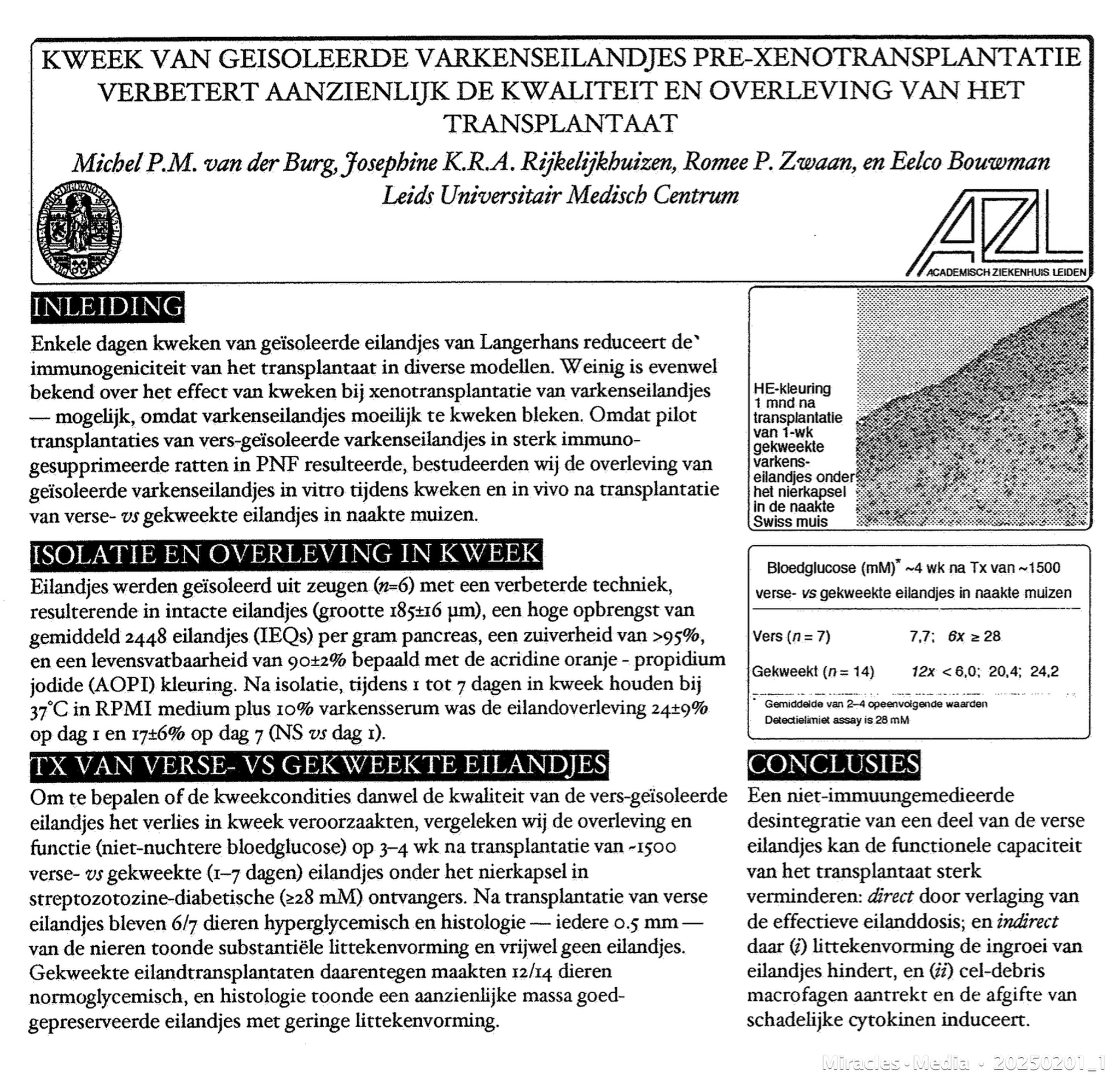
Fresh vs Cultured Pig Islets for Xenografts • NTV Bootcongres 1998 • @1MEMO 20250201

Fresh vs Cultured Pig Islets for Xenografts • NTV Bootcongres 1998 • Michel van der Burg • Miracles.Media • @1MEMO 20250201_1 • TakeNode 71d39e7e-ab5e-42b6-8cf2-a17d464ce132


Van der Burg MPM, Rijkelijkhuizen JKRA, Zwaan RP, Bouwman E. Culture of isolated pig islets pre-xenotransplantation greatly improves the quality and survival of the graft (Kweek van geïsoleerde varkenseilandjes pre-xenotransplantatie verbetert aanzienlijk de kwaliteit en overleving van het transplantaat). Tenth Congress of the Dutch Transplantation Society (Bootcongres 1998), Kerkrade (The Netherlands) April 21–23, 1998.

Download (pdf) NTV bulletin (abstract) & poster , file 1MEMO_20250201

EN – Abstract

PRE-TRANSPLANT SHORT-TERM CULTURE OF ISOLATED PIG ISLETS MARKEDLY IMPROVES THE QUALITY AND SURVIVAL OF THE XENOGRAFT
Van der Burg MPM,* Rijkelijkhuizen JKRA, Zwaan RP, and Bouwman E, Leiden University Medical Centre, Leiden, The Netherlands.

Pre-transplant culture of isolated islets reduces the graft’s immunogenicity in various models. Little is known, however, on the effect of culture in pig islet xenotransplantation — probably, because porcine islets have been found difficult to culture. Because pilot transplants of freshly-isolated pig islets in strongly immunosuppressed rats resulted in primary non function, we first studied 1-7 day culture of the isolated pig islets at 37°C in RPMI plus 10% porcine serum. Islets were isolated from large sows (n =6) by an improved method, resulting in intact islets (size 185±16 µm) and no loss during purification, yielding 2448 islets (IEQs)/g with a >95% purity and 90±2% viability as assessed by acridine orange – propidium iodide (AOPI) staining. During culture, however, islet recovery was 24±9% at day 1 and 17±6% at day 7 (NS vs day 1). In order to delineate whether the culture conditions or the quality of freshly isolated islets caused the islet loss during culture, we compared graft survival in nude mice at 1 mo after transplantation under the kidney capsule of ~2500 fresh islets in normoglycemic recipients or ~1000 cultured islets in STZ-diabetic (>20 mM) recipients. After transplanting fresh islets, histology of the kidneys — sectioned every 500 µm — demonstrated substantial scarring and (near-)absence of islets. Cultured islet transplants, by contrast, rendered 5/6 recipients normoglycemic, and showed a substantial mass of well-preserved islets with little scarring at the grafts’ site. Thus, viability by AOPI-staining of fresh islets poorly predicts the survival in vivo and in vitro. A non-immune mediated disintegration of part of the fresh islets may substantially reduce the functional capacity of the graft, both direct by lowering the effective islet dose, and indirect first because scarring may hamper the engraftment of viable tissue, and second because the cellular debris most probably will attract macrophages and induce the release of harmful cytokines.

Citation info : Fresh vs Cultured Pig Islets for Xenografts • NTV Bootcongres 1998 • Michel van der Burg • Miracles.Media • @1MEMO 20250201 • URL michelvanderburg.com/2025/02/01/

Viability of Fresh vs Cultured Pig Islets for Transplants • Cell Transplant Society 1999 Montreux • 20241204

Oral presentation Michel van der Burg, Cell Transplant Society congress 1999 in Montreux, Switzerland

A novel iodixanol density gradient for purification of pancreatic islets was developed in the difficult pig model of islet isolation. Viability of freshly isolated islets is not guaranteed.
After short-term storage of the islets in culture, pig islets restored normal blood sugar levels after xeno transplantation in diabetic mice.

1-Day Cultered Islets (extra slide) • @1MEMO 20241204_1

Slideshow (pdf)

Viability of Fresh vs Cultured Pig Islets for Transplants • Montreux Cell Transplant Society 1999 • Michel van der Burg • Miracles.Media • @1MEMO 20241204_2 • TakeNode e745d625-27c2-4eb8-b4c2-4300623c3303 • File 1MEMO_20241204_2

Rijkelijkhuizen JKRA, Bouwman E, Van der Burg MPM. Viability of fresh vs cultured pig islets for transplants. 4th International congress of the Cell Transplant Society, Montreux (Switzerland) March 21–24, 1999

Other Presentations in Montreux

Van der Burg MPM, Rijkelijkhuizen JKRA, Zwaan RP, Bouwman E. Adult pig islet recovery during Liberase isolation, OptiPrep purification and culture for transplantation in nude mice. 4th International congress of the Cell Transplant Society, Montreux (Switzerland) March 21–24, 1999 . The Sydney 1999 presentation of this work has been posted – @1MEMO 20241203

Van der Burg MPM, Ranuncoli A, Molano R, Kirlew T, Ringers J, Bouwman E, Terpstra OT, Ricordi C. Optiprep for human islet purification. 4th International congress of the Cell Transplant Society, Montreux (Switzerland) March 21–24, 1999 . The Igls 1999 presentation of this work has been posted – @1MEMO 20241202

Updates

Update 20260123 : Vimeo video replaced by YouTube copy

Citation info : Viability of Fresh vs Cultured Pig Islets for Transplants • Cell Transplant Society 1999 Montreux • Michel van der Burg • Miracles.Media • @1MEMO 20241204 • TakeNode 3ba1c894-eb71-4c3f-89aa-198c48cd480c • URL michelvanderburg.com/2024/12/04/

Polygoon Journalist Jo Levi • 20241107

The unique 1935 sound film of the Amsterdam’s Great Synagogue Choir (1,2,3) was made by the popular Polygoon journalist Jo Levi.

Wondering who Jo Levi was , I searched online, and found this picture below (20241107_1) with Jo Levi.
Jo Levi is the second man from the left in this postwar photo of Polygoon men, posted by former Polygoon editor Fredo Krooshof at Cinecentrum Hilversum (4).


Polygoon Men • Miracles•Media • 20241107_1 | Source Cinecentrum Hilversum : Left to Right : Cees v.d. Wilden – Dir. Polygoon Haarlem; Jo Levi – Red. Pol.jnl; Philip Bloemendal – Red. and comm. Pol.jnl; Man in the background – name unknown; Gé Bresser – Procurator Polygoon; RVD man – name unknown (4).

Jo Levi together with Philip Bloemendal directed the Dutch cinema news for Polygoon. Philip Bloemendal , nicknamed “The voice of the Netherlands” , was for 40 years (from 1946 to 1986) the Dutch cinema newsreel announcer, voice-over, and editor . His voice-overs are The Voice of the postwar Dutch Polygoon news reels.

“Where they are not, nothing is happening” was the motto (5) of the cameramen of the Polygoon newsreel company in Holland.

May 1931 , two dutch newsreel companies, Polygoon in the city of Haarlem, and Profilti in The Hague, were competing to have the premiere of the first Dutch cinema newsreel with sound.
Below a May 17, 1931 Polygoon interview (6) with former cyclist and sportsman W.W. van der Vet on the occasion of his 85th birthday (20241107_2).

Polygoon News Reel May 17, 1931 • Miracles•Media • 20241107_2 • TakeNode 1967b92c-e090-40b3-84fb-d713aebddcc2

The interviewer, most likely Jo Levi, looks at the camera for a moment , captured in this film still shown below ( 20241107_3).


Polygoon May 17, 1931 Interview • Miracles•Media • 20241107_3 . TakeNode 9d87a032-0112-4e8d-822e-d805c5fdc168

Notes

1. Amsterdam’s Choir of the Great Synagogue 1935 • Michel van der Burg • Miracles•Media • 20190830 • URL https://michelvanderburg.com/2019/08/30/amsterdams-choir-of-the-great-synagogue-1935/

2. 1935 Sound Film Amsterdam’s Great Synagogue Choir • Michel van der Burg • Miracles•Media • 20241025 • URL https://michelvanderburg.com/2024/10/25/1935-sound-film-amsterdams-great-synagogue-choir-20241025/

3. 1935 Sound Film Amsterdam’s Great Synagogue Choir • Michel van der Burg • Miracles•Media • 20241025 • URL https://michelvanderburg.substack.com/p/1935-sound-film-amsterdams-great

4. Cinecentrum Hilversum. URL https://www.cinecentrum-hilversum.nl (Retrieved Oct. 25, 2024).

5. Polygoon (newsreel). Wikipedia (Retrieved 20241107). URL https://en.wikipedia.org/wiki/Polygoon_(newsreel)

6. Opa Vet (sportopa) voor de microfoon. Published 17 May 1931. Polygoon Hollands Nieuws (producer) / Nederlands Instituut voor Beeld en Geluid (Open Beelden archive)

Citation info : Polygoon Journalist Jo Levi • Michel van der Burg • Miracles•Media • 20241107

1935 Sound Film Amsterdam’s Great Synagogue Choir • 20241025

Geluidsopname ter Groote Synagoge • NIW 15 Nov 1935 • Miracles•Media • 20241025

Friday, 15 Nov 1935 • NIW (1)

Sound recording at the Great Synagogue

The jubilee of the N.I.H.S., which has attracted interest in our community in many circles, has also attracted the attention of Polygoon, the well-known sound journalists. They wanted to record something specific of this jubilee and in honor of the jubilee on the sound film and insert it as part of the cinema newsreels this week.
Chief cantor I. E. Maroko and the synagogue choir, led by his well-known conductor S. H. Englander, were prepared to perform a synagogue song. And so the recording took place last Wednesday evening in the Great Synagogue. When we came to take a look at the Synagogue, which was already decorated for the occasion, at 8 o’clock, all preparations had been made. A number of lamps, together 25,000 candles strong, provided sufficient lighting. The choir sang Psalm 118, while Mr. Maroko sang the solos. The recording, which was made under the direction of the popular Polygoon man Jo Levi, and in which Max Tak was present, will certainly attract the interest of the cinema-loving public and for those who do not regularly go to the cinemas, we can certainly recommend a visit this time.”


This NIW 1935 news (1) describes the ‘sound film’ was made Wednesday 13 Nov 1935 under the direction of Polygoon man Jo Levi. Below the ‘sound film’ and first part of my description, as posted Aug 20, 2019 (2).

November 1935, on the occasion of the 300th anniversary of the NIHS Jewish Community of Amsterdam (orthodox Ashkenazi congregation started 1635) the dutch film factory Polygoon brought this unique cinema sound newsreel of the Amsterdam Choir of the Great Synagogue led by choirmaster Samuel Henri (Sam) Englander, with a solo perfomance by chazzan (cantor) Izrael Eljasz Maroko in the Great Synagogue (inauguration building 1671) – now home to the Jewish Historical Museum in Amsterdam, Holland (2).

Notes

1. Today I found this article on the Polygoon ‘sound recording’ (2) in the dutch weekly ‘Nieuw Israelietisch weekblad’ (Transl: New Israelite Weekly) of Friday, November 15, 1935. URL Delpher.nl (retrieved 20241025) .

Dutch transcript

Geluidsopname ter Groote Synagoge

Het jubileum der N.I.H.S., dat de belangstelling in vele kringen op onze gemeente heeft gevestigd, heeft ook de aandacht getrokken van Polygoon, de bekende geluidsjournalisten. Men wilde n.l. iets specifieks van dit jubileum en ter eere van het jubileum op de geluidsfilm vastleggen en dit deze week als onderdeel in de bioscoopjournaals inlasschen.
Oppervoorzanger I. E. Maroko en het sjoelkoor, onder leiding van zijn bekenden dirigent S. H. Englander, werden bereid gevonden om een synagogaal gezang ten gehoore te brengen. En zoo vond Woensdagavond j.I. de opname plaats in de Groote Synagoge. Toen wij om 8 uur een kijkje kwamen nemen in de reeds in feesttooi gestoken Synagoge, waren alle toebereidselen getroffen. Een aantal lampen, tezamen 25.000 kaarsen sterk, zorgde voor voldoende belichting.
Het koor zong Psalm 118, terwijl de heer Maroko de soli zong. De opname, welke onder leiding van den populairen Polygoonman Jo Levi geschiedde, werd vervaardigd en waarbij o.a. Max Tak tegenwoordig was, zal zeer zeker de belangstelling van het bioscoopminnend publiek trekken en zij, die niet geregeld in de cinema’s komen, kunnen wij ditmaal zeker een gang daarheen aanbevelen.

2. Amsterdam’s Choir of the Great Synagogue 1935 • Michel van der Burg • Miracles•Media • 20190830 • URL https://michelvanderburg.com/2019/08/30/amsterdams-choir-of-the-great-synagogue-1935/

Citation info : 1935 Sound Film Amsterdam’s Great Synagogue Choir • Michel van der Burg • Miracles•Media • 20241025

Tulips of blooming life and survival in Holland | 20231103

Tulips of blooming life and survival in Holland | 20231103 | Miracles•Media | Screenshot (Arte.tv) from Aux Pays-Bas, les tulipes de la prospérité / In den Niederlanden: Blühender Wohlstand

Excellent, to see the video work Tulip Bulbs War Food Holland 1944-1945 (Ref. 1) helping the ARTE European public service channel broadcasting next week all over Europe an excellent documentary about the cultural legacy of tulips in Holland , featured in the daily French/German TV show ‘Invitation au Voyage / Stadt Land Kunst.’

The French (FR) edition ‘Aux Pays-Bas, les tulipes de la prospérité’ is broadcast on Arte Tuesday 7 Nov. 2023 at 17:20 , and 8 Nov. at 8:40.
The German (DE) edition ‘In den Niederlanden: Blühender Wohlstand’ 7 Nov. 2023 at 13:25 and 8 Nov. at 08:10 .

The documentary is an Arte & Elephant Doc coproduction , directed by Anna-Gaëlle Brault.
In collaboration with Victoria Dehaut, documentalist, researcher (Elephant Adventures).

ARTE is a channel specialized in culture and known for its quality documentaries.

Arte.tv is streaming the docu online from 31/10/2023 to 05/01/2024 (Ref. 2, 3)

References

1. Tulip Bulbs War Food Holland 1944-1945 | 20201226 | Michel van der Burg | Settela•Com | ISSN 2949-9313 | URL https://settela.com/2020/12/26/tulip-bulbs-war-food-holland-1944-1945/

2. Invitation au voyage (FR) | URL https://www.arte.tv/fr/videos/109358-172-A/invitation-au-voyage/

3. Stadt Land Kunst (DE) | URL https://www.arte.tv/de/videos/109358-172-A/stadt-land-kunst/

Citation : Tulips of blooming life and survival in Holland | 20231103 | @michelvanderburg | Miracles•Media

TAGS #tulip #bulb #war #food #Holland #French #German #daily #TV #show #channel #Invitation #Voyage #Stadt #Land #Kunst #documentary #report #footage #Arte #broadcast #Elephant #Doc #coproduction #Europe #culture #share #collaboration #Hongerwinter #hunger #winter #portfolio #video #footage #SettelaCom #MiraclesMedia #1Memo #michelvanderburg