Deportation of Dutch Roma to Auschwitz – 19 May 1944 • 9-year-old Anna Maria (Settela) Steinbach was deported together with 244 other Roma from Westerbork to Auschwitz (1,2) • Source : Settela•Com • Collection Auschwitz Museum • URL https://fb.watch/Hgg5lusc-8/
The Auschwitz Museum acquired the short film ‘Settela’ from Settela•Com (1) in the Auschwitz Memorial Collection (3), and is succesfully screening the film each year since 2019 on the 19th May at the Auschwitz Memorial / Muzeum Auschwitz facebook page .
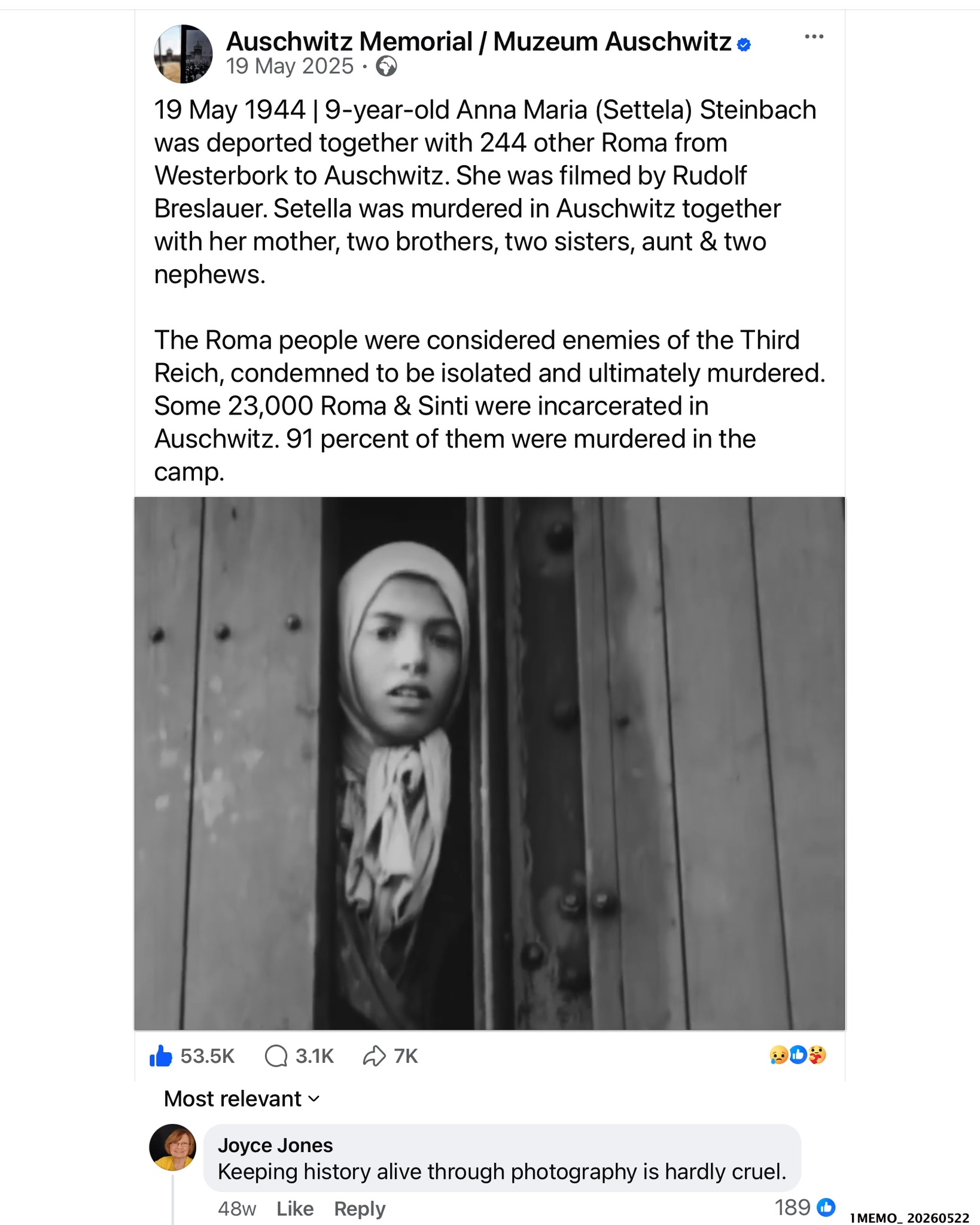
Last year’s post of the film ‘Settela’ , 19th May 2025 at the Auschwitz Memorial / Muzeum Auschwitz facebook page, accumulated by now one million views, and over 3000 comments (Image 1MEMO_20260522).
The film was created in an attempt to keep the scene on screen longer on the one hand, and to preserve the natural and historical original on the other. Thus a compilation was created, showing the same scene twice. The film ends with the original 3 seconds clip selected from the Westerbork film footage shot by Jewish prisoner Rudolf Breslauer (4), and the film starts with that same clip , digitally slowed down 10× in post-production.
This film was created and first online in 2017 (5) , and published (antedated) as the first post (1) shortly after the start May 19, 2019, of the online journal Settela•Communications — short Settela•Com (6).
More on the Roma in Auschwitz , online at the Auschwitz Museum (7).
Citation info : Settela Film Auschwitz Museum • 20260522 | Michel van der Burg | Settela•Com | ISSN 2949-9313 | CC BY 4.0 | URL https://settela.com/2026/05/22
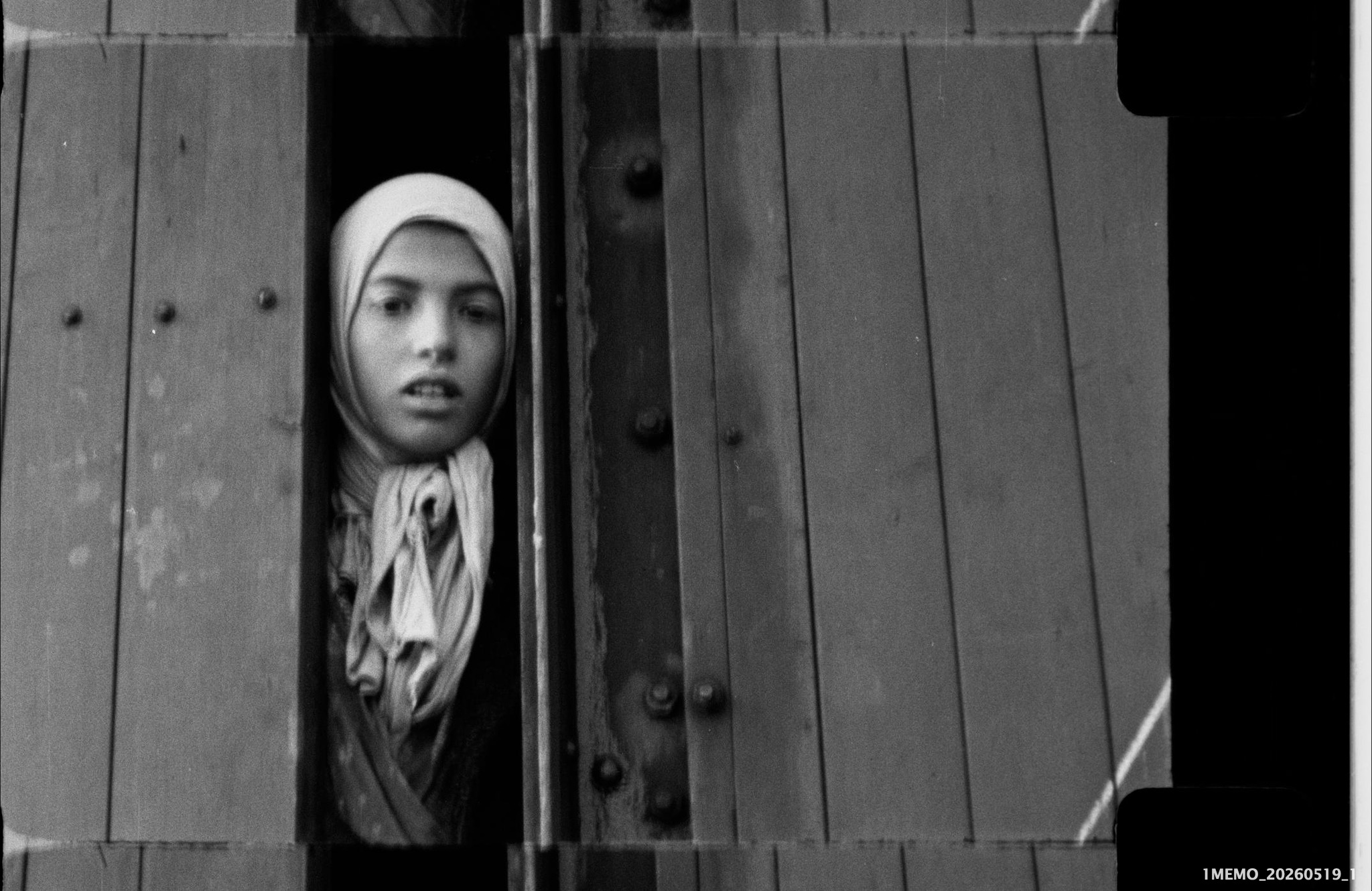
Settela Steinbach — The Girl with the Headscarf • 1MEMO_20260519_1 • Settela•Com • Frame from camera original film reel of the Westerborkfilm (1).
On May 19, 1944, at the Westerbork transit camp, a glimpse of Sinti girl Settela Steinbach wearing a headscarf appears between the sliding doors of a cattle car awaiting deportation to Auschwitz (1,2,3). In May 1945, her father, Moeselman Steinbach, wrote to “Repatriation” in the Netherlands: “…I very politely request you to inform me whether my wife and 10 children have arrived, or only children (Gypsy children) from the Auschwitz concentration camp in Poland.” (4).
The 9-year-old dutch Sinti-girl Anna Maria ‘Settela’ Steinbach peeks outside , at the last moment just before the sliding door is closed , standing inside a cattle car with 74 people on May 19 , 1944 in the Westerbork transit camp in Holland , when this deportation train leaves for Auschwitz-Birkenau – where Settela is murdered a few months later in one of the gas chambers (5).
While Settela peeks outside , her mother cries behind her in that cattle car : “Get out of there, or soon your head gets in between!”
She is wearing a headscarf made from a torn sheet because the Nazis shaved her head upon arrival at Westerbork transit camp on May 16, 1944, following the “Gypsy raid” carried out that same day at the Zwaaikom caravan site in Eindhoven, the Netherlands (6).
Settela Film • 20220630
Settela was filmed only a few seconds by the Jewish prisoner filmmaker Rudolf Breslauer as part of a documentary film being made in 1944 on the Westerbork camp .
Those seconds , also in slow-motion are shown in the 2022 Settela Film • 20220630 (7)
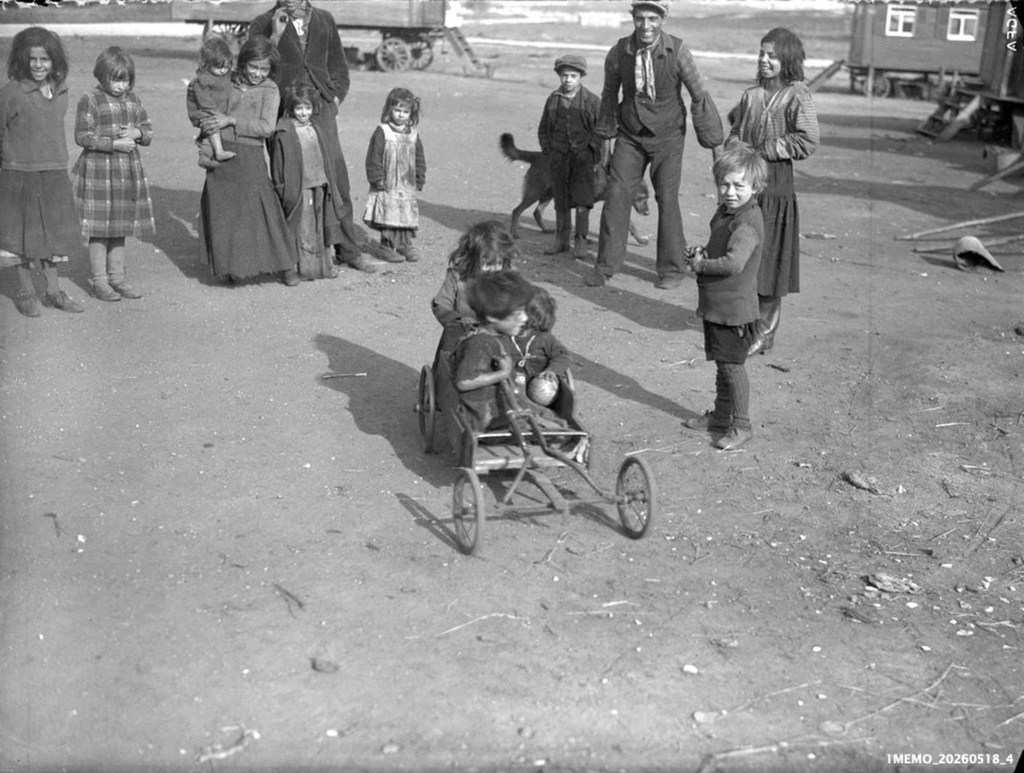
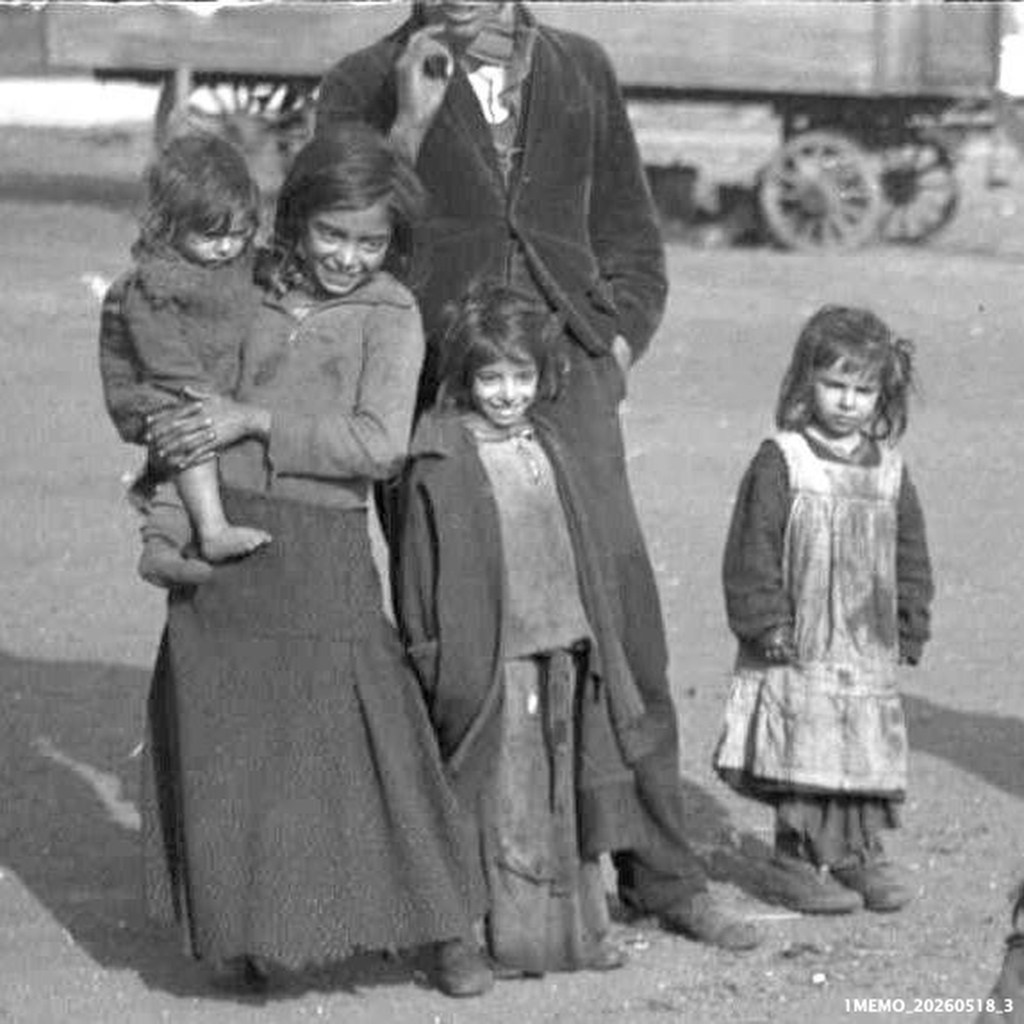
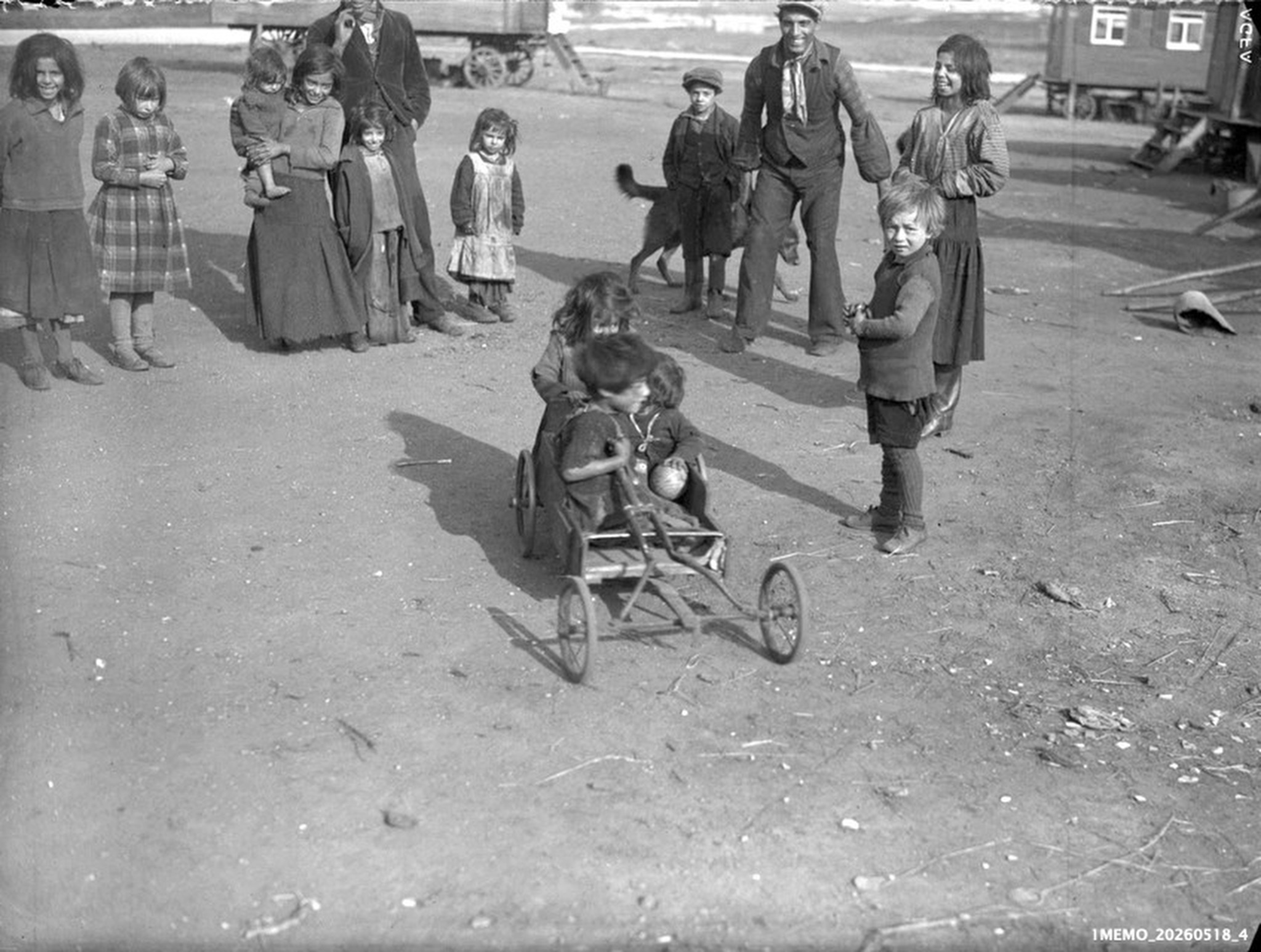
The toddler Settela in the arms of her older sister Elisabeth Steinbach at the Heksenberg Sinti caravan site in 1935 • Photo Jan de Jong • 1MEMO_20260518_4
Anna Maria (‘Settela’) Steinbach was born 23 December 1934 in Buchten, Netherlands, and photographed at age ~1 , in the arms of her older sister Elisabeth Steinbach, with others of the Steinbach family, and other families, at the nearby Sinti caravan site ‘Heksenberg’, October 1935, by photographer Jan de Jong (8) • 1MEMO_20260518_4
Settela was deported together with her brothers and sisters (Willy “Celestinus”, Willem, Elisabeth, Johanna, Philibert, Florentina, Willem, Anna), and mother Toetela (Emilia) Steinbach (born 23 March 1902 in Antwerp, Belgium), with other Steinbach and other nomad families – all together ca 245 Sinti and Roma and ca 450 Jews – on May 19th 1944 from the dutch Camp Westerbork to the Auschwitz and Bergen-Belsen camps (5,6).
Toetela’s eldest child Moekela (Magdalena; born 14 Sep 1922) had gone to Belgium and had been deported earlier – 15 Jan 1944 – with her 6 months old baby Jeanette – Toetela’s granddaughter – on the Z-Transport from transit camp Kazerne Dossin in Mechelen to Auschwitz, were they were murdered on arrival.
Settela’s father Heinrich (‘Moeselman’) Steinbach (born Nov 11, 1901 in Gründorf in Germany) died alone of grief June 6, 1946 in Maastricht in the Netherlands – his wife and 10 children had not survived the camps.
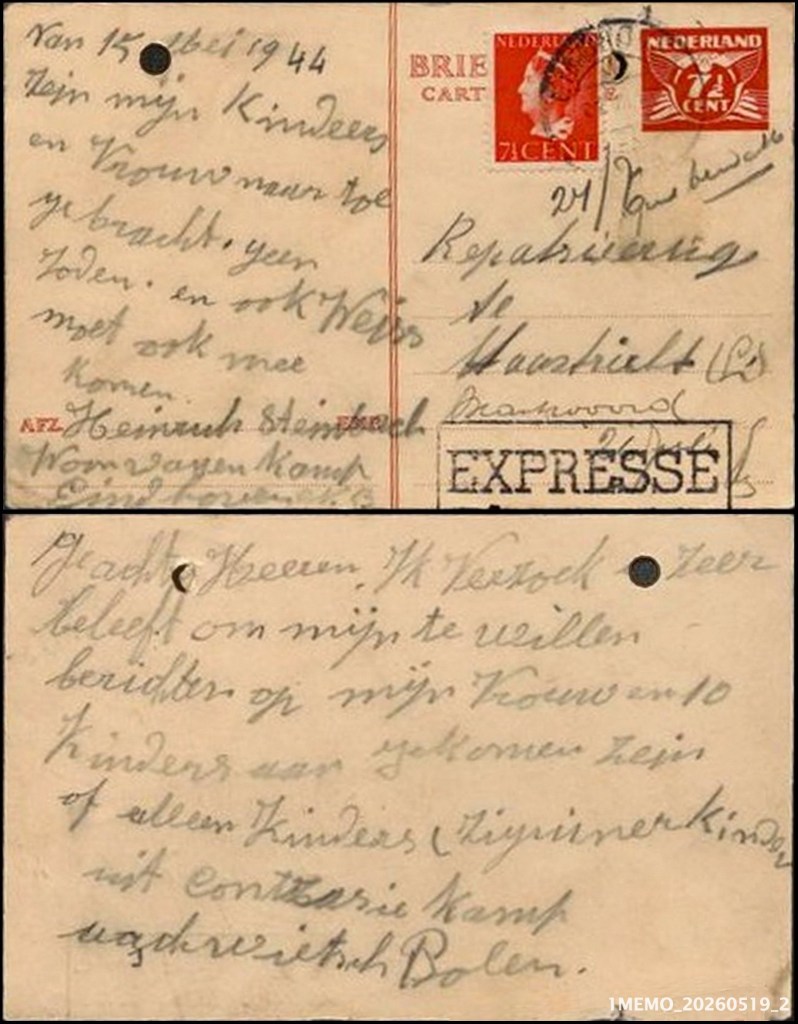
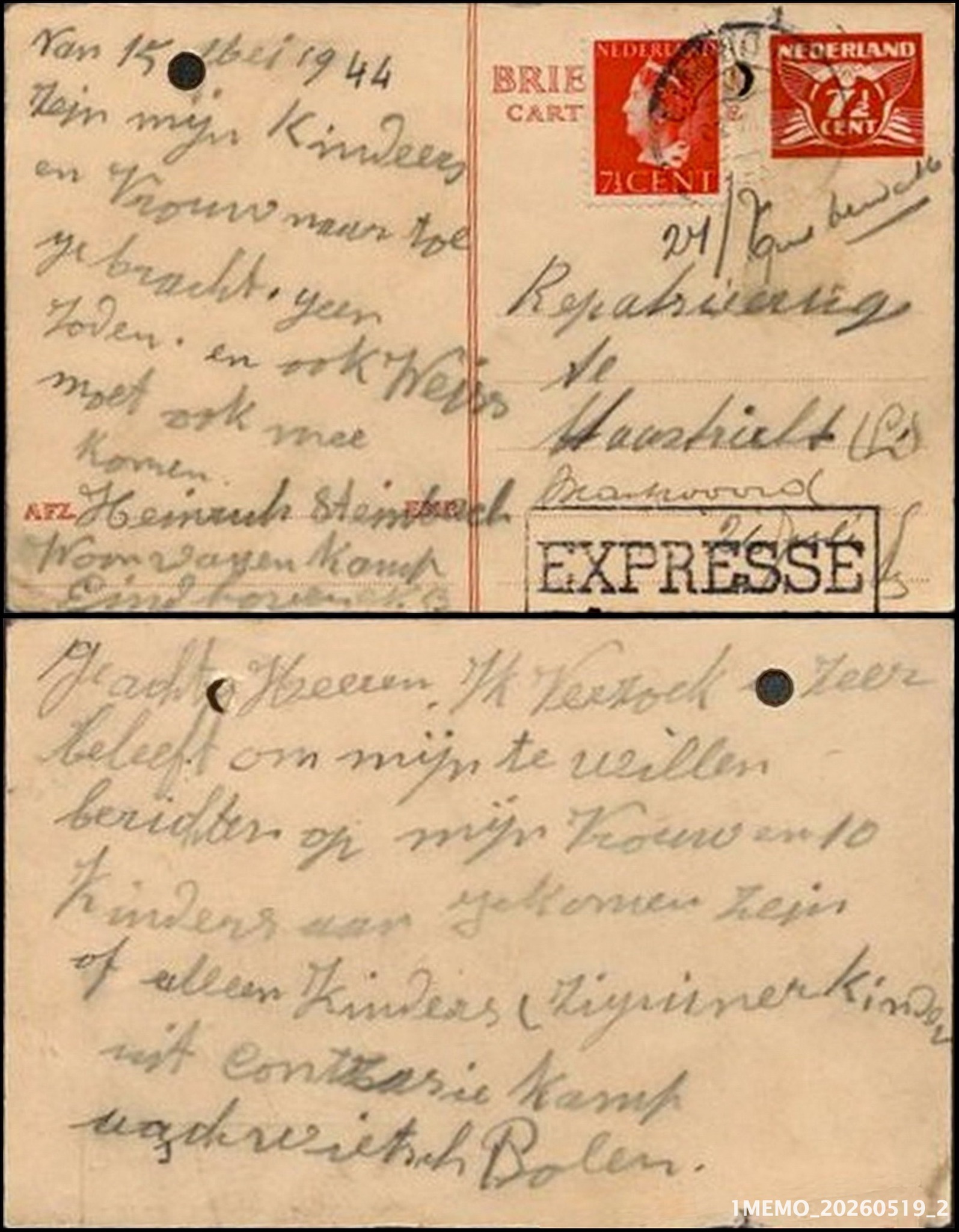
To : “Repatriation” in Maastricht (Netherlands) — “Dear Sirs, I very politely request you to inform me whether my wife and 10 children have arrived, or only children (Gypsy children) from the Auschwitz concentration camp in Poland. From May 15, 1944, my children and wife were taken there; no Jews. And Weiss had to come along too. — Heinrich Steinbach. Caravan site Eindhoven , North Brabant” • 1MEMO_20260519_2 • Settela•Com
One year earlier , May 22, 1945, two weeks after the liberation of Holland, Heinrich Steinbach — living at the caravan site in Eindhoven (North Brabant, Netherlands) — inquires about the fate of his wife and ten children on a postcard written to the “Repatriation” in Maastricht (Netherlands). The text on the postcard reads — translated from dutch (4) :
“Dear Sirs, I very politely request you to inform me whether my wife and 10 children have arrived, or only children (Gypsy children) from the Auschwitz concentration camp in Poland.
From May 15, 1944, my children and wife were taken there; no Jews. And Weiss had to come along too.
4 – May 1945 Postcard Heinrich Steinbach • 1MEMO_20260519_2 • Settela•Com | ISSN 2949-9313 | Source : Collectie HCL, archief Militair Gezag, Maastricht.
‘Moeselman’ Heinrich Steinbach — living at the caravan site in Eindhoven (North Brabant, Netherlands) — inquires about the fate of his wife and ten children on a postcard written to the “Repatriation” in Maastricht (Netherlands). The dutch text on the postcard reads :
“Geachte Heeren, Ik verzoek u zeer beleeft om mijn te willen berichten op mijn vrouw en 10 kinders aan gekomen zein of alleen kinders (zigeunerkinders) uit contrasie kamp uaschwietsch Polen.
Van 15 mei 1944 zein mijn kindeers en vrouw naar toe gebracht, geen joden. En ook Weiss moet ook mee komen. Heinrich Steinbach. Woonwagenkamp Eindhoven N.B.”
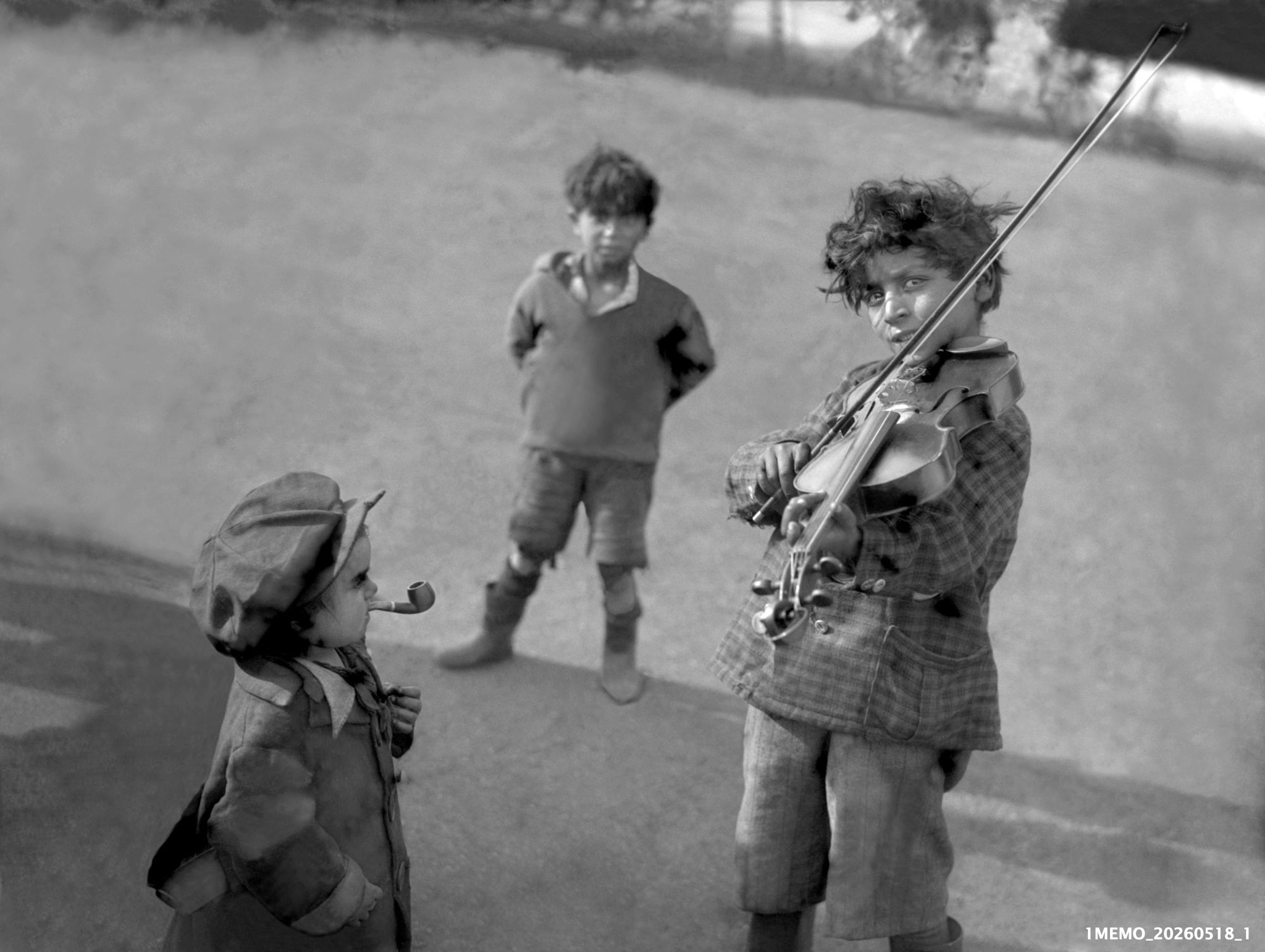
Willy Steinbach plays the violin at the Sinti caravan site Heksenberg in 1935 • Photo Jan de Jong • 1MEMO_20260518_1
In 1935 the nomadic Sinti families Steinbach — musicians — were photographed by Dutch photographer Jan de Jong at their caravan pitch on the heath around the Heksenberg hill in Brunssum, Limburg, Netherlands (1).
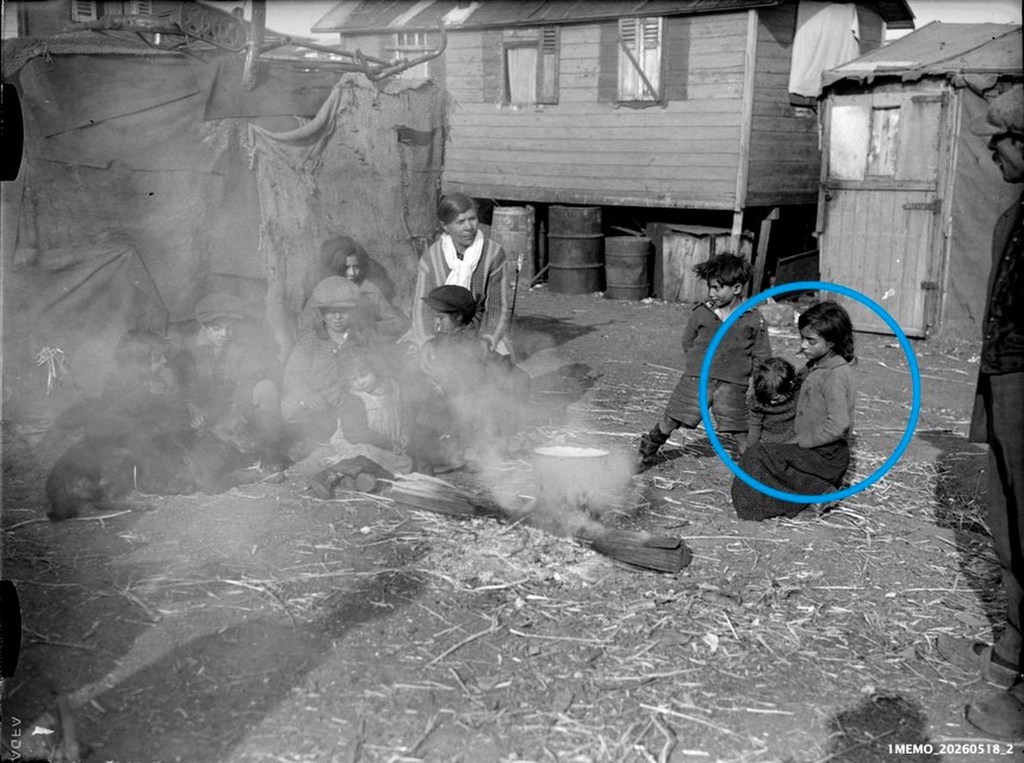
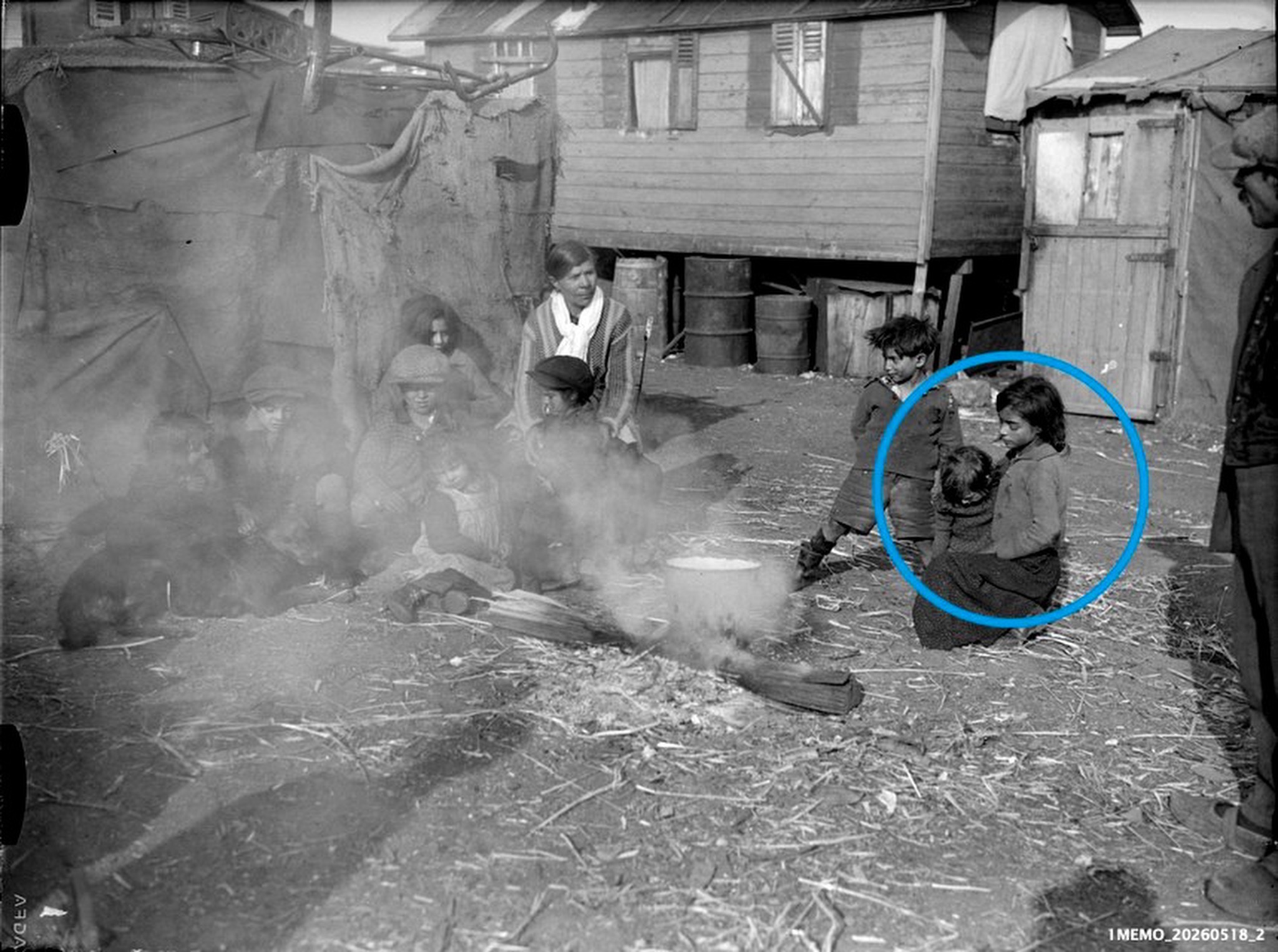
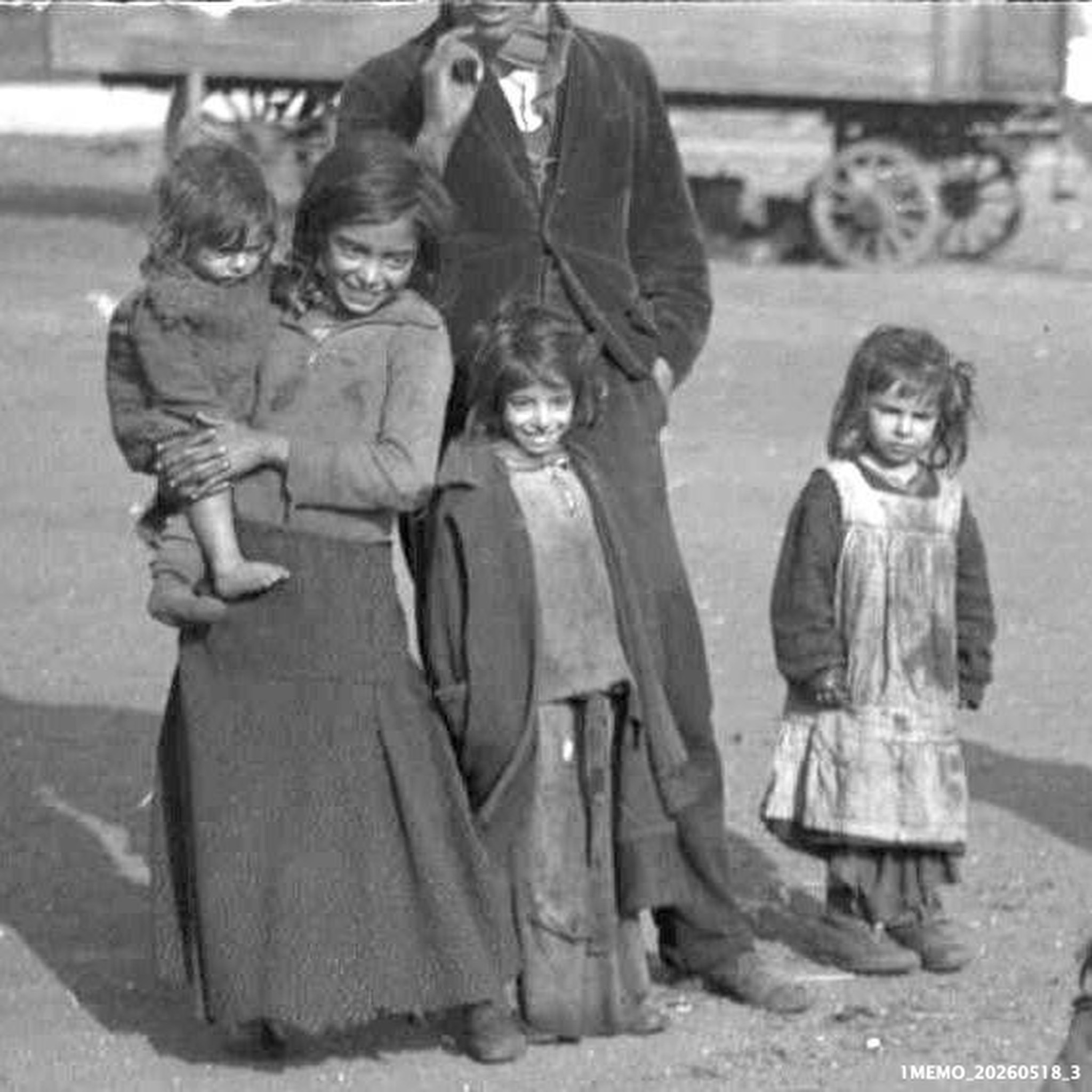
The boy with the violin is Willy Steinbach, an older brother of Settela Steinbach. The other 3 prints from the glass negatives that Jan de Jong made at the Heksenberg site in 1935 also show the Steinbach family, among others, with toddler Settela in the arms of her older sister Elisabeth Steinbach.
The toddler Settela in the arms of her older sister Elisabeth Steinbach (circled in blue) at the Heksenberg Sinti caravan site in 1935 • Photo Jan de Jong • 1MEMO_20260518_2
The toddler Settela in the arms of her older sister Elisabeth Steinbach at the Heksenberg Sinti caravan site in 1935 • Photo Jan de Jong • 1MEMO_20260518_3
The toddler Settela in the arms of her older sister Elisabeth Steinbach at the Heksenberg Sinti caravan site in 1935 • Photo Jan de Jong • 1MEMO_20260518_4
Settela Steinbach became known as the girl with the headscarf, featured a few seconds in the Westerbork film by Werner Rudolf Breslauer showing the deportation of the Steinbachs’ and other nomad families — all together ca 245 Sinti and Roma, and ca 450 Jews — on May 19th 1944 from the dutch transit camp Westerbork to Auschwitz (1,2).
Almost certainly, three Jewish people have been recognized in the unique Westerbork film from 1944 (1). This time it concerns the 9-year-old boy Israël Wijnschenk, his father Max Wijnschenk, and his grandmother Betje Kokernoot-van Furth, who all lived in Utrecht (Holland).
Last week, the Dutch public broadcaster NOS (2) reported the news from the Utrecht (Dutch) news site Nieuws030 (3) that it is very likely that three people were recognized again in this film made by the Jewish prisoner and filmmaker Rudolf Breslauer showing the deportation of Jews, Roma and Sinti by train in Camp Westerbork on May 19, 1944.
Image researcher Koen Hulsbos — who previously identified an Amsterdam couple in this deportation train (4) — thought he recognized the young Israël Wijnschenk, a pupil at the time of the Joodse (Jewish) School Utrecht, and presented this to Victor Frederik, researcher of the Joodse School (5,6). The boy, the man, and the woman seem to belong together, and were recognized from family photos, also by family members.
It is certain that Max and his wife Chel (not in the images) returned to Utrecht after the war, their children Israël and his sister Kitty were murdered. Grandma Betje was also gassed in Auschwitz.
A portrait of Israël Wijnschenk is shown at the site of Joods Monument (7).
According to the transport list, there were two other children in that wagon, Joseph Beugeltas (11 years old) and Manfred Studzinsky (7 years old). Joseph Beugeltas appeared to have blond hair, and could not have been it (6). To be completely sure, the researchers are still looking for a photo of Manfred Studzinsky, for comparison…
Ward Adriaens (Mechelen, Belgium) passed away suddenly on the evening of November 15th, 2024. A wonderful man, a freethinker, author, with a passion for living history, especially the resistance, partisans, in World War II, and the founding director in 1995 of the Jewish Museum of Deportation and Resistance (JMDR) that opened its doors in 1996. In 2012 the JMDR became the Kazerne Dossin museum, with Ward Adriaens as honorary curator. In 2005 Ward Adriaens launched the Give Them a Face archival project. The portraits of all Jewish, Roma and Sinti deportees which passed through the SS-Sammellager Mecheln (Dossin barracks, transit camp, Mechelen) in 1942-1944, were scanned to create the “Give Them a Face” portrait collection. All around 20,000 photos in the Give Them a Face portrait collection are now part of the commemoration wall – a permanent exhibition – at the Kazerne Dossin museum.
In 2009 , I first encountered the Transport XX installation in Brussels, and met Ward Adriaens’ team of the Give Them a Face project in the Jewish Museum of Deportation and Resistance in Mechelen, Belgium (1,2).
Next , Ward Adriaens participated in our 2012 documentary Transport XX to Auschwitz (3).
Recently, May 2024, Ward Adriaens’ opening speech at the TRANSPORT XX installation in Mechelen in 2007, was posted in the ‘Miracles’ project at Miracles•Media (4).
Quote
“…Let us clearly understand that this is the fundamental basis of racism: persecuted because we have a mother. We all have parents and many amongst us have children. In order to protect them it is essential that we do not give an inch to racism. Everyone of us will come under threat should the policy makers be influenced by racism…”
3. Ward Adriaens’ interview by the dutch reporters Piet de Blaauw & Aart Zeeman (Dutch NCRV-Netwerk broadcast, 13 April 2005, NL1) from the documentary ‘Transport XX to Auschwitz’ – a film by Karen Lynne & Richard Bloom and Michel van der Burg • In : Documentary film “Transport XX to Auschwitz” • Miracles•Media • 20130419 • URL (retrieved 20241119) https://michelvanderburg.com/2013/04/19/transport-xx-to-auschwitz/
Open Memory , Cologne, May 2010. Transport XX (left) and Transport Z (right) in front of the with Cologne Cathedral. Still : Open Memory | Miracles Docs #3 | Miracles•Media | 20240523
From May 8th to May 24th, 2010, the memorial installation “Open Memory” was on display in a prominent location in Köln (Cologne, Germany) — in front of the Hohenzollern Bridge, at the left bank of the Rhine river, parallel to the railway tracks of the Cologne Central Station (Köln Hauptbahnhof), with the Cologne Cathedral (Kölner Dom) in the background.
It consisted of 26 large canvases on which portraits of more than 1,500 people were depicted. This open-air exhibition was intended to commemorate three events that occurred during this period: the end of the Second World War in Europe on May 8th and 9th, 1945, the 70th anniversary of the attack by the German Wehrmacht on the Benelux countries and France, and the 70th anniversary of the deportation of the Sinti and Roma from Cologne and the Rhineland (Western Germany).
The Museum La Coupole had created six canvases with photographs or silhouettes of 351 Sinti and Roma from Northern France and Belgium, deported with “Transport Z” in January 1944 from Kazerne Dossin in Mechelen, Belgium to the Auschwitz-Birkenau extermination camp.
On 20 other canvases were the portraits of 1,200 Jewish people deported with “Transport XX” in April 1943 from Kazerne Dossin in Mechelen to Auschwitz. This exhibition was created by the Jewish Deportation and Resistance Museum (Kazerne Dossin) in Mechelen. “Transport XX” is the only deportation train in Europe that was stopped by a resistance group.
The exhibition lined the route Roma and Sinti from Köln had to take from May 1940 en route across the Rhine via the Hohenzollern Bridge to the Cologne Fair (Köln Messe) transit camp for deportation to the extermination camps. The route was marked May 6, 1990, by the artist Gunter Demnig (later known for his Stolperstein project) by printing the writing “May 1940 – 1000 Sinti and Roma” on the streets in Cologne, using a wheel for painting with white paint.
The Open Memory installation was presented by : the Jewish Deportation and Resistance Museum (Kazerne Dossin) in Mechelen, Belgium • La Coupole – History Centre in Wizernes, France • NS Documentation Center Cologne • AK Memorial Centers NRW • Yavne Memorial and Educational Center • EL-DE-Haus Cologne.
Film by : Michel van der Burg, thanks to an amateur (2010) slide presentation by A. Lototsky
Citation info : Open Memory | Miracles Docs #3 | Miracles•Media | 20240523 | ISAN 0000-0007-329C-0003-M-0000-0000-8 | TakeNode 4e398109-d461-4a41-84d7-8d74756c82d8
First Stolperstein. Installed on 16 Dec 1992 in front of the City Hall in Cologne , Germany.
Over the past 30 years the team of German artist Gunter Demnig installed over 100,000 Stumbling Stones – ‘Stolpersteine’ – across 26 countries in Europe – the world’s largest memorial.
Demnig’s Stolpersteine are small, cobblestone-sized brass memorials for the victims of National Socialism. Set into the pavement of sidewalks in front of the buildings where Nazi victims once lived or worked, they call attention both to the individual victim and the scope of the Nazi war crimes.
The very first Stolperstein, was installed on 16 December 1992 in front of Cologne City Hall , with Heinrich Himmler’s order for the initiation of deportations of all Roma (Gypsies) :
„Auf Befehl des Reichsführers SS vom 16.12.42 – Tgb. Nr. I 2652/42 Ad./RF/V. – sind Zigeunermischlinge, Rom-Zigeuner und nicht deutschblütige Angehörige zigeunerischer Sippen balkanischer Herkunft nach bestimmten Richtlinien auszuwählen und in einer Aktion von wenigen Wochen in ein Konzentrationslager einzuweisen. Dieser Personenkreis wird im nachstehenden kurz als ‚zigeunerische Personen‘ bezeichnet. Die Einweisung erfolgt ohne Rücksicht auf den Mischlingsgrad familienweise in das Konzentrationslager (Zigeunerlager) Auschwitz.“
Notes
Photo : First Stolperstein at the Cologne City Hall, Germany. Photo Jan. 1, 2008, by Willy Horsch, CC-BY .
Citation info : First Stolperstein | 20240520 | michelvanderburg•com