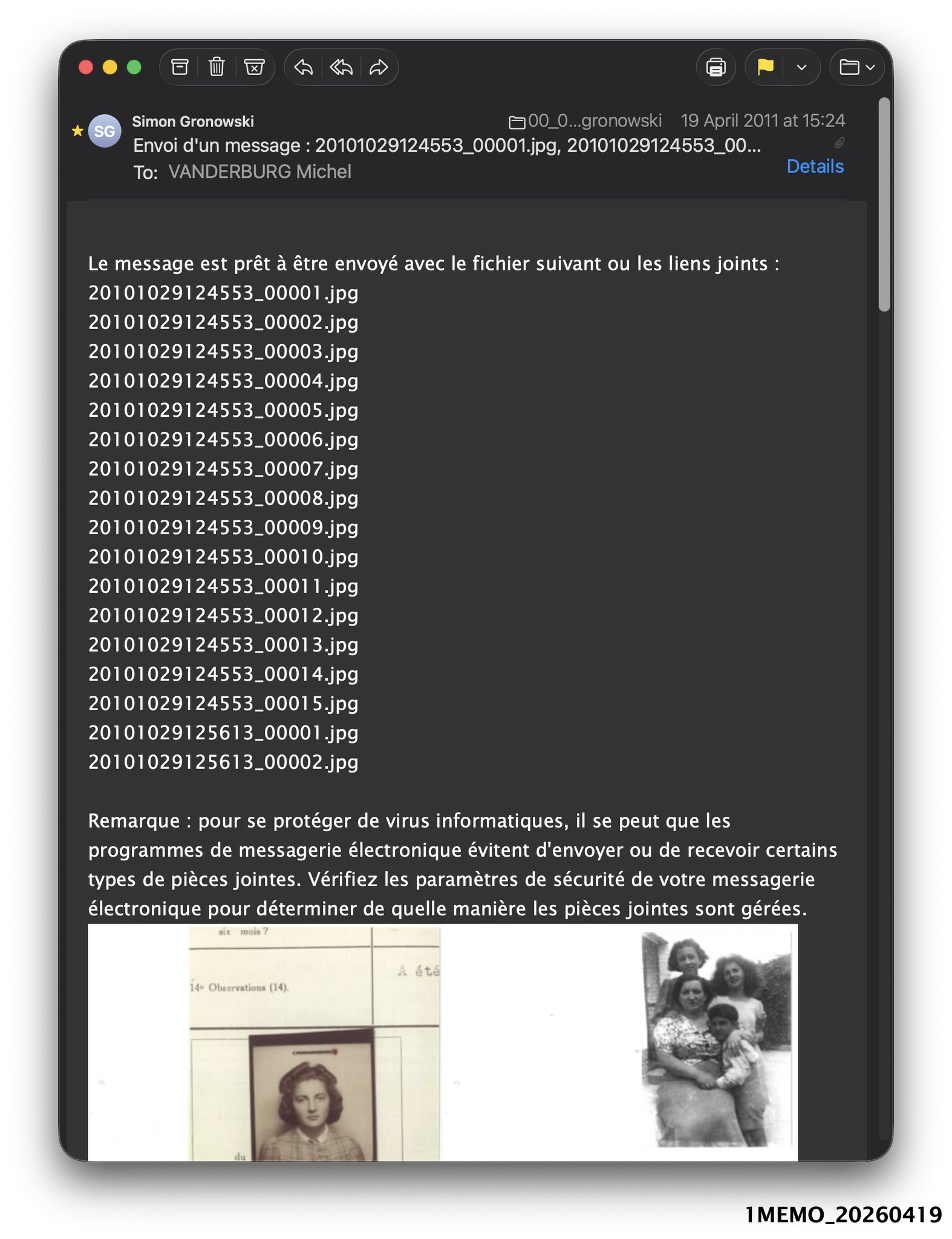
You’ve Got Mail • Transport XX • 1MEMO_20260419 • Michel van der Burg • Miracles•Media • Today 15 years ago, on April 19, 2011 , Simon Gronowski mailed me photo’s in preparation for our 1st interview scheduled April 21, 2011 at his office in Brussels, working on our documentary film Transport XX to Auschwitz.
#24 Most Viewed Today on YouTube • TRANSPORT XX – installation Brussels
My ‘Channel 012’ ranked the #24 Most Viewed Today YouTube channel in the Netherlands on the first day after uploading the captivating video Transport XX . The next day again it reached #23 Most Viewed Today.
Channel012 ranking was #68 in Most Viewed (This Week) , a week after uploading Transport XX.
Google purchased YouTube late 2006. I started late 2007, with a first upload. Between ~ 2007-2011 channel pages were equipped with view counters, bulletin boards, and were awarded badges for various rank-based achievements, such as ” “#68 – Most Viewed (This Week)”. The term “gurus” on YouTube referred to a specific category of content creators who focused on education. This category helped establish YouTube as a platform for influencers. You could change your account type to eg. Director, Comedian, Musician.
The film was uploaded close to midnight April 19th, 2009, registered by YouTube as April 20th, 2009. This short documentary is a video impression (2009) of the confrontation of passers-by with the TRANSPORT XX installation in Brussels, that presented photographic portraits of 1,200 of the 1,631 Jewish prisoners deported with the 20th train convoy to Auschwitz , the night of April 19th in 1943. Half an hour after the departure of this transport XX three young Belgians from Brussels, Youra Livschitz, Jean Franklemon and Robert Maistriau stopped the train between Boortmeerbeek and Haacht, opened one of the cars and liberated 17 prisoners. Later before the train reaches the German border over 200 other prisoners decide to attempt to escape and also jump out of the cars. This was the only documented attack on a death train during the Holocaust.
A 1minute edition of Transport XX premiered in the Paradiso theater in Amsterdam Nov. 28, 2010 – in The One Minutes – Where history starts …film festival . Here the registration : Transport XX in Paradiso | The One Minutes Collection | 20200607 | URL https://youtu.be/KuyQzLXQo3g
A behind the scenes film of the making of this film was published last year : Flow | Miracles Moment #1 | 20240513 | URL https://youtu.be/iwQQLvGtUm0
Citation info : Youtube Creator Top 25 Award • Transport XX • Michel van der Burg • Miracles•Media • 20251021 • TakeNode 39bdf260-095a-4749-acd7-e18adc9108c5 / 9f425f47-55b0-4637-9c1c-019879110895
Propaganda on the windows of the shop ‘Goedkoope Winkel’ (Cheap Shop) at Lange Elisabethstraat 2 in Utrecht, Holland, photographed by Wim Bruschwiler , ca 1943.
Nazi anti-semitic slogan ‘JOOD’ (Jew) on one window.
On the other window, the “V” symbol — standing for the English (Anti-Nazi) “Victory” slogan or the later Nazi edition “Victorie”.
On top of that window on the left a small pamphlet showing O…Z…O – W… – V…V – … … … … .
OZO originally was the anti-Nazi slogan ‘Oranje Zal Overwinnen’ (transl. : Holland Will Win). Here probably the Nazi version of OZO was posted (compare image in Notes 1) :
Orde Zal Overwinnen – Want – V=Victorie – Duitschland Wint Voor Europa! .
Translation :
Order Will Win – Because – V=Victory – Germany Wins For Europe!
Clandestine camera shot during World War 2 occupation of Holland from amateur film ‘Bezet Gebied’ (transl. ‘Occupied Territory’ by Ben Postema (Filmpost) of the shop ‘Goedkoope Winkel’ (Cheap Shop) at Lange Elisabethstraat 2 in Utrecht, Holland, the window of which is defaced with the anti-Semitic slogan ‘JOOD’ (Jew) , Aug 14, 1941.
Credits
Source: Bezet Gebied by Ben Postema (1941, Filmpost) courtesy of Netherlands Institute for Sound and Vision (Open Images).
Citation info : Slogan JOOD • Miracles•Media • 20250621 • License : Creative Commons CC BY SA • TakeNode 9e898c3a-04d9-4949-9b22-b6ab6f4f89db
Nelly Quintart – spelled as Quintard – engraved on the Wall of Honor , Belgium 1999 section, in the Garden of Righteous at Yad Vashem .
Yad Vashem recognized Nelly as Righteous Among the Nations on December 30, 1998, and honored her posthumously in 1999 with the Righteous title and medal.
Background
Belgian Resistance fighter Nelly Quintart has been hiding the Jewish Frankenthal family — Esther, Adolphe, and daughter Sally Frankenthal — at her place, 13 Rue Marie-Thérèse in Brussels, from September 1942 until the liberation in 1944.
Sally Frankenthal recommended to Yad Vashem in the late 1990s the ‘Righteous Among the Nations’ medal for ‘Nelly Quintard’, which Nelly received posthumously in 1999. The surname ‘Quintart’ was misspelled as ‘Quintard’ in Sally’s correspondence with Yad Vashem.
April 11, 2025. Installation stolperstein Sally Frankenthal, 11-13 Rue Marie-Thérèse, Brussels, Belgium.
Visitation Stones
As part of the closing ceremony, Bella Swiatlowski, coordinator Stolpersteine of the Association pour la Mémoire de la Shoah, invited all attendees to place a pebble around the stolperstein, a souvenir, showing respect.
Accordion music – Yiddish Partisan Song “Zog nit keyn mol” – by André Reinitz. Stolperstein handcrafted by Gunter Demnig’s team. Film by Michel van der Burg | Miracles•Media.
HERE WAS HIDDEN SALLY FRANKENTHAL BORN 1934 SEP 1942-1944 SURVIVOR
Installation stolperstein Sally Frankenthal, 11-13 Rue Marie-Thérèse, Brussels, 11 April 2025. Belgian Resistance fighter Nelly Quintart has been hiding the Jewish Frankenthal family — Esther, Adolphe, and daughter Sally Frankenthal — at her place, 13 Rue Marie-Thérèse in Brussels, from September 1942 until the liberation in 1944. Sally Frankenthal recommended to Yad Vashem in the late 1990s the ‘Righteous Among the Nations’ medal for ‘Nelly Quintard’, which Nelly received posthumously. The surname ‘Quintart’ was misspelled as ‘Quintard’ in Sally’s correspondence with Yad Vashem.
Together, the families of Sally Frankenthal and Nelly Quintart and researcher, filmmaker Michel van der Burg took the initiative June 2023 for this Stolperstein, a tribute to Sally Frankelthal, to recall passers-by to this story of Sally & Nelly, in front of the place where the house where Nelly Quintart hid the Frankenthal family used to stand – now a large new building at 11-13 Rue Marie-Thérèse in Brussels.
April 11, 2025 this beautiful and moving Stolperstein ceremony took place with music by André Reinitz on accordion, thanks to the Association pour la Mémoire de la Shoah joining our initiative July 2023 and making it happen, especially Marcel Zalc (president) and Bella Swiatlowski, coordinator Stolpersteine. Thank you municipal workers for placing this stolperstein. Film by Michel van der Burg | Miracles•Media.
A person is only forgotten when their name is forgotten.
From the Talmud
The story of Sally & Nelly is now integrated into the largest decentralized memorial in the world, thanks to the artist Gunter Demnig and his team…hand-stamping each letter into the brass of this stone.