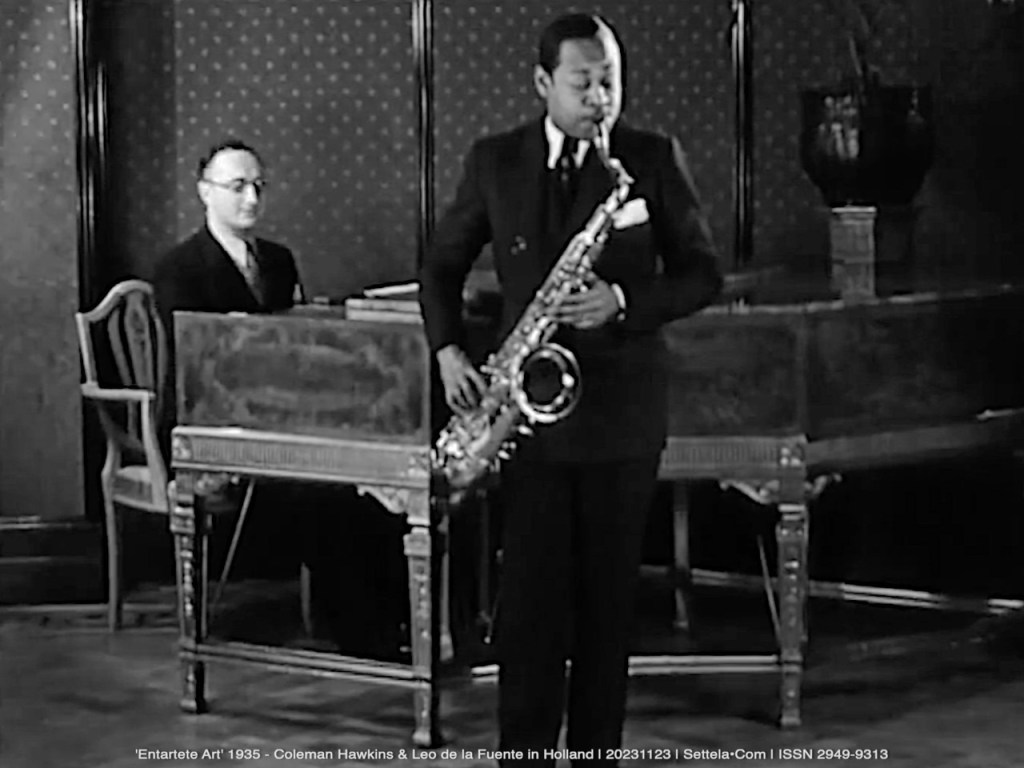
Cradle of Islet Transplants
The Laboratory of Cell Biology and Histology in Leiden (headed by Prof J.P. Scherft), was the cradle of our Islet Transplantation Lab, where we made a fresh start Summer 1986 (1), and presented our first poster the following year.
Poster
Our first year of research was presented in this poster (Image 20240829_1) at the Fall Meeting Friday, November 13, 1987 , of the Dutch Association for Calcium- and Bone-metabolism*, in Leiden, Holland (2) in that Cell Biology building of the University Hospital Leiden (‘Building 55’) where our Islet Lab was hosted for the first decade.
The poster shows the results of islet isolations from canine pancreas segments performed with a method developed for human islet isolation by the surgeon Derek Gray (Oxford, UK) with some modifications (3). Pancreas segments were harvested at surgery for our concommitant research on segmental pancreas transplantation in this pre-clinical model (4,5,6,7).
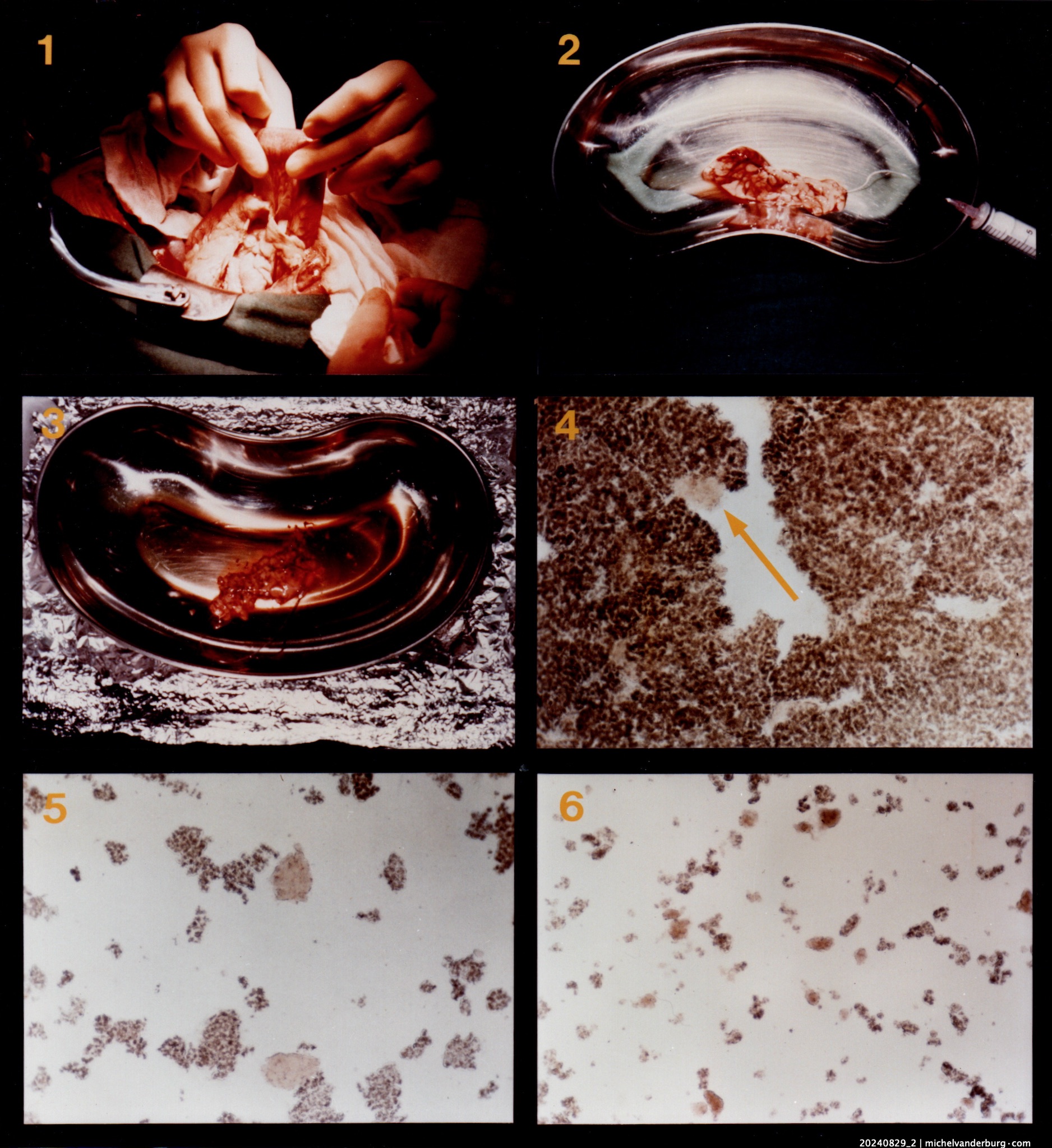
The photo collage (Image 20240829_2) also shown in the Methods section of the poster illustrates, resp. :
1) removal of a canine pancreatic segment at surgery;
2) distension of the gland by ductal injection of a collagenase solution;
3) the mucoid appearance after collagenase digestion of the connective tissue in the gland for 20-25 min at 39°C;
4) the digestion end-point, when gentle contusion of a sample of the tissue appears to liberate free islets from the surrounding exocrine tissue;
5) dispersion of the tissue with forceps and aspiration through needles;
6) microscopy of the suspension of purified islets (arrow denotes islet) contaminated with some exocine fragments , after sieving and Ficoll density gradient centrifugation to separate the islets from most of the exocrine fragments.
Figure 1 of the Results shows the relation between islet size and number of the isolated islets. Quantitation of the total volume of islets in the pancreas, and after islet isolation , demonstrated that on average 5-10% of the islets in the pancreas are isolated after purification. Figure 2 shows the timeline of insulin secretion by the isolated islets, in response to stimulation with glucose (sugar) during perifusion with a basic salts solution containing low -, high -, and low sugar levels, resp.

The posters were produced at the Cell Biology department using a pen plotter machine.
A corridor in the building with part of the gallery of posters was photographed at the meeting (Image 20240829_3).
Cell Biology – 40th anniversary, 1947-1987

The 40th anniversary of the Cell Biology Department was celebrated 13-14 November 1987 (with a banner and flags at the entrance of the building (Image 20240829_4) , with the science meeting Nov. 13th and a get-together with (former) co-workers, including Professor emiritus Pieter J. Gaillard, dutch pioneer of tissue culture and transplantation, and founder of the laboratory when appointed professor of Experimental Histology at the Leiden University, Friday, November 14, 1947 (8,9).
Professor Gaillard’s lab started in 1947 in the cellar of the Anatomical Laboratory, and moved in 1953-1954 to ‘Building 55’ of the University Hospital Leiden; shown above. The name was changed to Cell Biology and Histology, in 1964. Cell Biology is currently part of the Department Of Cell & Chemical Biology , and housed within the research building of the Leiden University Medical Centre.
I photographed the emiritus Gaillard receiving a ‘souvenir’ from Professor Scherft (Image 20240829_5) at the 40th anniversary of the Cell Biology Laboratory in Leiden (Holland), Nov. 14, 1987.

First clinical islet cell transplant
In 1944, during World War II, Gaillard and the Leiden surgeon P.J. Kooreman performed the first successfull clinical (allogeneic) transplant of (cultured) islet cells in Leiden.
Dutch newspapers reported (10), Gaillard had spoken at a meeting in 1949 organized by local hospitals in The Hague, Holland, on some of his early transplants in diabetic patients, with success in one patient during the war (Image 20240829_6) :
“Prof. Gaillard considers it too early to say much about the possibilities of this intervention. Although he could report that a female patient can be considered cured in nine months. A bombing took her life, so that further observation was cut off.” .
The Islet Transplant Registry listed the transplant as the 5th performed in the world (6).
Gaillard & Kooreman also performed a successful series of transplants of cultured parathyroid tissue , a firm base of what would become the focus of Gaillards research and the Cell Biology Laboratory , the hormonal regulation of bone metabolism (9,10,11,12).

Introduction of collagenase isolation of islets
Also, of note, is the first introduction of pancreatic islet isolation by collagenase digestion in 1965 by the polish researcher Stanislaw Moskalewski with the help of Gaillard working at the Cell Biology Laboratory (13) — the basis of large scale islet isolation and transplantation.
Notes
1) Leiden Islet Laboratory History • 20240803 | Michel van der Burg | michelvanderburg•com
2) Van der Burg MPM, Gooszen HG, Terpstra JL, Scherft JP, Frölich M, Lemkes HHPJ. Isolation of the islets of Langerhans from the canine pancreas. Fall meeting of the Dutch Association for Calcium and Bone Metabolism, Leiden (The Netherlands) November 13, 1987.
3) Gray DWR, McShane P, Grant A, Morris PJ. A Method for Isolation of Islets of Langerhans from the Human Pancreas. Diabetes 1 November 1984; 33 (11): 1055–1061. https://doi.org/10.2337/diab.33.11.1055
4) Gooszen HG. Canine segmental pancreatic autotransplantation. Analysis of the effects of ductobliteration. Thesis, Leiden, 1984
5) Van der Burg MPM, Gooszen HG, Guicherit OR, Jansen JBMJ, Frölich M, Haastert FA, Lamers CBHW. Contribution of partial pancreatectomy, systemic hormone delivery and duct obliteration to glucose regulation in canine pancreas: Importance in pancreas transplantation. Diabetes 1989; 38: 1082–1089.
6) Pancreatic islet transplantation (doctoral thesis, 1994) by Michel van der Burg. ISBN 9789080216402. Scholarly Publications repository of Leiden University. Persistent URL https://hdl.handle.net/1887/3486604
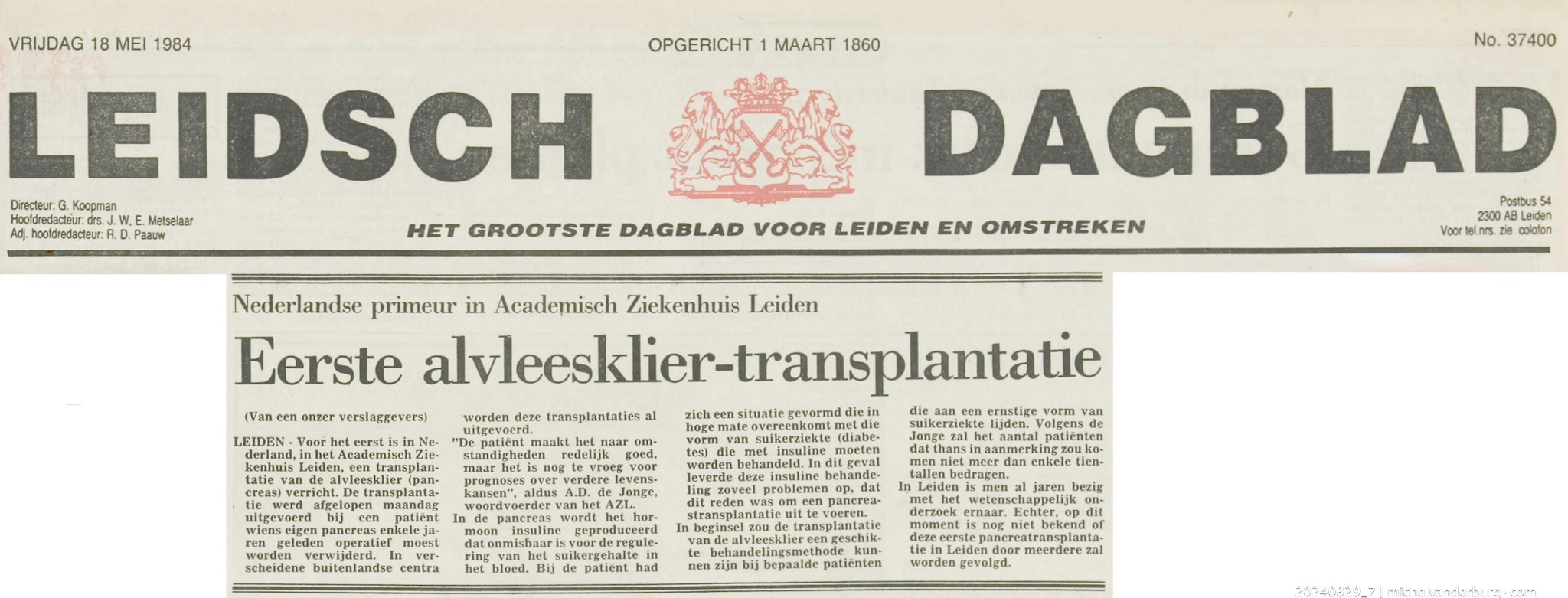
7) Eerste alvleesklier-transplantatie | Nederlandse primeur in Academisch Ziekenhuis Leiden. In : Leidsch Dagblad, May 18, 1984 | Dutch newspaper , URL https://leiden.courant.nu/issue/LD/1984-05-18/edition/0/page/1
8) Van CH0 naar CH40 met Ca2+ als katalysator. Scherft J.P. In : Laboratorium voor Celbiologie en Histologie 1947-1987 | Uitgave ter gelegenheid van het veertigjarig bestaan van het Laboratorium voor Celbiologie en Histologie van de Medische Faculteit te Leiden.
9) Enkele notities over het begin van de weefselkweek in Leiden. Gaillard P.J. In : Laboratorium voor Celbiologie en Histologie 1947-1987 | Uitgave ter gelegenheid van het veertigjarig bestaan van het Laboratorium voor Celbiologie en Histologie van de Medische Faculteit te Leiden.
10) Prof. dr P.J. Gaillard sprak over successen bij transplantatie-proeven. Nieuwe Leidsche Courant, Oct. 1, 1949. | Dutch newspaper , URL https://leiden.courant.nu/issue/NLC/1949-10-01/edition/null/page/2 | “Prof. Gaillard acht het nog te vroeg om over de mogelijkheden van deze ingreep veel te zeggen. Al kon hij mededelen, dat een vrouwelijke patiënt in negen maanden tijds als genezen beschouwd kan worden. Een bombardement benam haar het leven, zodat men van verdere observatie werd afgesneden”.
On 10 and 11 December 1944, Leiden was bombed by English RAF aircraft. The bombings missed their target. Residential areas near Leiden railway stations were hit, resulting in many civilian casualties. Info from Erfgoed Leiden URL https://www.erfgoedleiden.nl/nieuws/vondst-van-de-week/1092-vvdw-bombardementen-op-leiden
11) Een totaal nieuw terrein voor de chirurgie. Prof. Kooreman inaugureerde in Leiden. In : Nieuwe Leidsche Courant 20 jun. 1959, p. 3 | Dutch newspaper , URL URL https://leiden.courant.nu/issue/NLC/1959-06-20/edition/0/page/3
12) Jon van Rood: The pioneer and his personal view on the early developments of HLA and immunogenetics. Martine J. Jagera M.J, Brand A, Claas F.H.J. Transplant Immunology 52 (2019) 1–26
13) Beginning of pancreatic islet isolation by collagenase digestion (personal reminiscences). Stanislaw Moskalewski. Ann Transplant 1997; 2(3): 6-7. URL https://annalsoftransplantation.com/abstract/index/idArt/647800
* Strange to find the Dutch Association for Calcium and Bone Metabolism indicates online a start in 1990 – while I visited their fall meeting in 1987 (see also refs 8,9)
Update (20240912) correction text perifusion solution.
NB . the basic salts solution is a Krebs-Ringer solution, HEPES-buffered
Citation info : Cradle of Islet Transplants • 20240829 • Michel van der Burg • michelvanderburg•com