Discoveries Deportation Westerbork Film • 20250224

Discoveries Deportation Westerbork Film • 20250224 • The boy, the man, and the woman selected in this edited still of the linked video clip (15 s) URL https://youtube.com/clip/UgkxBw3eso6Bi3vIaR25h_bDWRHSx5EfMylN

Utrecht family identification , almost complete…

Almost certainly, three Jewish people have been recognized in the unique Westerbork film from 1944 (1). This time it concerns the 9-year-old boy Israël Wijnschenk, his father Max Wijnschenk, and his grandmother Betje Kokernoot-van Furth, who all lived in Utrecht (Holland).

Last week, the Dutch public broadcaster NOS (2) reported the news from the Utrecht (Dutch) news site Nieuws030 (3) that it is very likely that three people were recognized again in this film made by the Jewish prisoner and filmmaker Rudolf Breslauer showing the deportation of Jews, Roma and Sinti by train in Camp Westerbork on May 19, 1944.

Image researcher Koen Hulsbos — who previously identified an Amsterdam couple in this deportation train (4) — thought he recognized the young Israël Wijnschenk, a pupil at the time of the Joodse (Jewish) School Utrecht, and presented this to Victor Frederik, researcher of the Joodse School (5,6). The boy, the man, and the woman seem to belong together, and were recognized from family photos, also by family members.

It is certain that Max and his wife Chel (not in the images) returned to Utrecht after the war, their children Israël and his sister Kitty were murdered. Grandma Betje was also gassed in Auschwitz.

A portrait of Israël Wijnschenk is shown at the site of Joods Monument (7).

According to the transport list, there were two other children in that wagon, Joseph Beugeltas (11 years old) and Manfred Studzinsky (7 years old). Joseph Beugeltas appeared to have blond hair, and could not have been it (6). To be completely sure, the researchers are still looking for a photo of Manfred Studzinsky, for comparison…

Notes

1) Deportation Westerbork Film • Edition 2021 | 20210719 | Settela•Com | ISSN 2949-9313 | Footage filmed by Rudolf Breslauer in 1944, courtesy of NIOD | Sound and Vision . URL https://settela.com/2021/07/19/deportation-westerbork-film-20210719/

2) Utrechters ‘vrijwel zeker’ herkend op Westerborkfilm uit 1944. NOS Nieuws Feb 22, 2025. URL https://nos.nl/l/2556858

3) Nieuwe herkenningen in Westerborkfilm ‘bijna zeker’. Jim Terlingen | Nieuws030 . URL https://www.nieuws030.nl/hist030rie/drie-nieuwe-herkenningen-in-westerborkfilm-zo-goed-als-zeker/

4) Amsterdam couple found in Westerbork film • 20241223 | Settela•Com | ISSN 2949-9313 | URL https://settela.com/2024/12/23

5) Joodse school Utrecht. Website. URL https://joodseschoolutrecht.nl

6) Israël op Westerborkfilm? Victor Frederik- Web site Joodse school Utrecht. (Accessed 20250224). URL https://joodseschoolutrecht.nl/nl/Verhalen-over-leerlingen/Kitty-en-Israel-Wijnschenk/Israel-op-Westerborkfilm/

7) Portrait of Israël Wijnschenk. Site Joods Monument. URL https://www.joodsmonument.nl/nl/page/122045/israël-wijnschenk

Citation info : Discoveries Deportation Westerbork Film • 20250224 | Settela•Com | ISSN 2949-9313 | URL https://settela.com/2025/02/24/

Milan Papers • @1MEMO 20250205

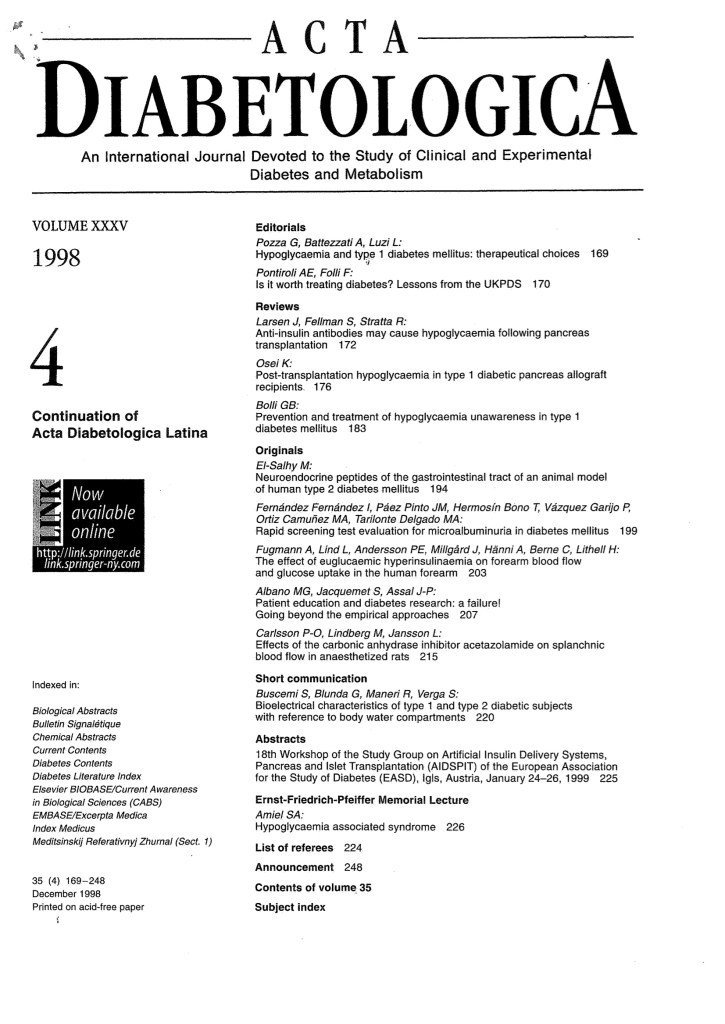
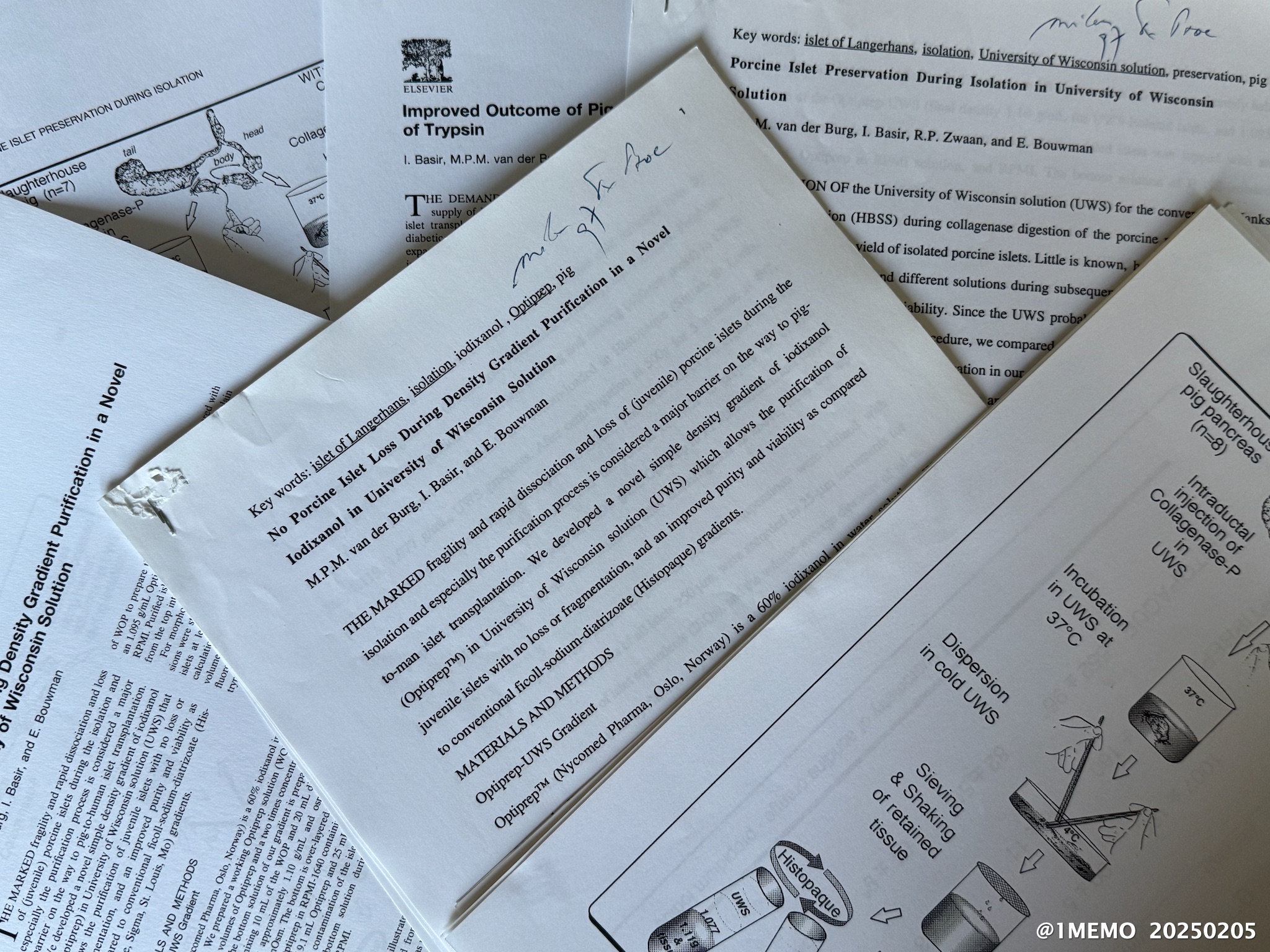
Manuscripts (Preprints) and Abstracts copies of the presentations at the IPITA 1997 meeting in Milan (Italy).

1) Van der Burg MPM, Basir I, Zwaan RP, Bouwman E. Porcine islet preservation during isolation in University of Wisconsin solution. Transplant Proc. 1998 Mar;30(2):360-1. doi: 10.1016/s0041-1345(97)01307-9. PMID: 9532079.

PMID_9532079_20250205_1 • Michel van der Burg • Miracles.Media • @1MEMO 20250205_1 • CC BY-NC-ND • TakeNode 406dbe1e-66e3-4edc-acb8-83fdc8ddc5c8

2) Van der Burg MPM, Basir I, Bouwman E. No porcine islet loss during density gradient purification in a novel iodixanol in University of Wisconsin solution. Transplant Proc. 1998 Mar;30(2):362-3. doi: 10.1016/s0041-1345(97)01308-0. PMID: 9532080.

PMID_9532080_20250205_2 • Michel van der Burg • Miracles.Media • @1MEMO 20250205_2 • CC BY-NC-ND • TakeNode c60e0743-946a-4950-b156-7e671593e482

3) Abstracts

Van der Burg MPM, Basir I, Bouwman E. No porcine islet loss during density gradient purification in a novel iodixanol in University of Wisconsin solution (Abstract). Acta Diabetol 1997; 34: 101.

Van der Burg MPM, Basir I, Zwaan RP, Bouwman E. Porcine islet preservation during isolation in University of Wisconsin solution (Abstract). Acta Diabetol 1997; 34: 136.

1MEMO_ 20250205_3 • Michel van der Burg • Miracles.Media • @1MEMO 20250205_3 • CC BY-NC-ND • TakeNode e5b1c598-fc48-4f2a-93ae-526cd4be082e

Citation info : Milan Papers • Michel van der Burg • Miracles.Media • @1MEMO 20250205 • URL michelvanderburg.com/2025/02/05/

Human Islet Isolation • DRI Miami 1998 • @1MEMO 20250204

Summer 1997, Onno Terpstra, the head of our Surgery Department, asked me to explore our options for starting clinical islet isolation and transplantation in our center – the Leiden University Medical Center (LUMC), and prepare a roadmap.

September 1997, at the IPITA congress in Milan (1) , I learned from Camillo Ricordi, the scientific director of the Diabetes Research Institute (DRI) in Miami – where many guest collaborators work – that visiting the DRI some weeks might be a good option to gain sufficient first work experience in his clinical islet transplantation group.

December 1997, with a ‘Roadmap’, I got the green light to start the operationalization of clinical islet transplantation in the LUMC, first with a working visit to Miami to study the state of the art ‘Ricordi’ method of human islet isolation, and then start the human islet isolation work in our Surgery lab in Leiden.

In 1990 I had already gained some initial research experience in our Leiden Islet Laboratory with a small number of isolations of islets from human donor organs, using our innovative method of density gradient purification based on the UW solution (2).

During the first three months of 1998 I worked intensively with my student colleague Josephine Rijkelijkhuizen so that she would be able to continue our xenotransplantation research project as independently as possible in our Surgery research team.

April 1998, after participating in the 1st Workshop on Clinical Islet Transplantation in New Orleans (3) – the ideal introduction – a fruitful working visit to the DRI in Miami followed (4,5), with intensive collaboration with the DRI team on, among other things, six human islet isolations, and also the simultaneously (parallel) conducted research into the purification of the human islets in our Iodixanol gradient in UW-Solution (6).

Here a slideshow illustrating this team up with the DRI team in Miami , working on human islet isolation and purification in the innovative Iodixanol-UWS gradient, April-May 1998.

Notes

1) Innovative Islet Purification in Iodixanol-UWS • IPITA 97 • Michel van der Burg • Miracles.Media • @1MEMO 20250128 • TakeNode • URL michelvanderburg.com/2025/01/28/

2) Percoll UWS Purification Pancreatic Islets • ESOT 1991 Talk • Michel van der Burg • Miracles.Media • @1MEMO 20250114 • URL michelvanderburg.com/2025/01/14/

3) Invited participant 1st Workshop on Clinical Islet Transplantation, New Orleans (LA, USA) April 17–19, 1998

4) Working visit April – May 1998 at the “fast track” center of the Diabetes Research Institute (Scientific director Prof. C. Ricordi, MD) of the University of Miami (Miami, FL, USA)

5) DRI Dream Team • Michel van der Burg • Miracles.Media • @1MEMO 20250105 • URL michelvanderburg.com/2025/01/05/

6) Human Islet Purification Miami 1998 • Michel van der Burg • Miracles.Media • 20181102 • URL michelvanderburg.com/2018/11/02/

Citation info : Human Islet Isolation • DRI Miami 1998 • Michel van der Burg • Miracles.Media • @1MEMO 20250204 • TakeNode 86e4a319-a769-44d5-8fa5-de2ca90ab63c • URL michelvanderburg.com/2025/02/04/

Optiprep For Human Islet Purification • Cell Transplant Society 1999 • @1MEMO 20250203

Optiprep For Human Islet Purification • Cell Transplant Society 1999 • Michel van der Burg • Miracles.Media • @1MEMO 20250203 • TakeNode bad757b8-674c-4371-938c-ac73287bc457

Poster (#57) presentation Michel van der Burg, Cell Transplant Society congress 1999 in Montreux, Switzerland (1,2)

Outcome of the first series of human islet purifications with the novel Iodixanol -UWS density gradient — developed in the Leiden Islet Laboratory of the LUMC — performed during my working visit April – May 1998 at the “fast track” center of the Diabetes Research Institute (Scientific director Prof. C. Ricordi, MD) of the University of Miami (Miami, FL, USA).

Notes

1) Van der Burg MPM, Ranuncoli A, Molano R, Kirlew T, Ringers J, Bouwman E, Terpstra OT, Ricordi C. Optiprep for human islet purification. 4th International congress of the Cell Transplant Society, Montreux (Switzerland) March 21–24, 1999 .

2) Van der Burg MPM, Ranuncoli A, Molano R, Kirlew T, Ringers J, Bouwman E, Terpstra OT, Ricordi C. Optiprep for human islet purification (Abstract). Cell Transplant 1999; 8: 184. Download abstract below 1MEMO_20250202_3

Citation info : Optiprep For Human Islet Purification • Cell Transplant Society 1999 • Michel van der Burg • Miracles.Media • @1MEMO 20250203 • URL michelvanderburg.com/2025/02/03/

Iodixanol-UWS Purification and Culture of Pig Islets Xeno Transplants • Cell Transplant Society 1999 • @1MEMO 20250202


Iodixanol-UWS Purification and Culture of Pig Islets Xeno Transplants • Cell Transplant Society 1999 • Michel van der Burg • Miracles.Media • @1MEMO 20250202

Slideshow (digitally remastered) oral presentation Michel van der Burg, Cell Transplant Society congress 1999 in Montreux, Switzerland (1)

The Leiden Islet Laboratory developed a novel Iodixanol-UWS density gradient for purification of the islets of Langerhans from the pancreas in the difficult pig model.

Pig islet isolation from the pancreas of slaughterhouse sows was markedly improved by keeping the islets in the UW donor organ preservation solution (UWS) both during the isolation of islets (using the Liberase enzyme blend) and purification of the islets using our novel Iodixanol-UWS density gradient.

Xeno transplantation of these 1-day-cultured pig islets restored normal blood sugar levels in diabetic mice.

PDF slideshow oral presentation Michel van der Burg, Cell Transplant Society congress 1999 in Montreux, Switzerland

Iodixanol-UWS Purification and Culture of Pig Islets Xeno Transplants • Cell Transplant Society 1999 • Michel van der Burg • Miracles.Media • @1MEMO 20250202_2 • TakeNode 8bd79256-78b2-4d8e-8d48-6da41102dc2d • Download file available below 1MEMO_20250202_2

Notes

1) Van der Burg MPM, Rijkelijkhuizen JKRA, Zwaan RP, Bouwman E. Adult pig islet recovery during Liberase isolation, OptiPrep purification and culture for transplantation in nude mice. 4th International congress of the Cell Transplant Society, Montreux (Switzerland) March 21–24, 1999 .

2) Van der Burg MPM, Rijkelijkhuizen JKRA, Zwaan RP, Bouwman E. Adult pig islet recovery during Liberase isolation, OptiPrep purification and culture for transplantation in nude mice (Abstract). Cell Transplant 1999; 8: 185. Download abstract, available below 1MEMO_20250202_3

Citation info : Iodixanol-UWS Purification and Culture of Pig Islets Xeno Transplants • Cell Transplant Society 1999 • Michel van der Burg • Miracles.Media • @1MEMO 20250202 • TakeNode f9d1fdc5-21e4-4932-b995-4c97639945fe • URL michelvanderburg.com/2025/02/02/

Fresh vs Cultured Pig Islets for Xenografts • NTV Bootcongres 1998 • @1MEMO 20250201

Fresh vs Cultured Pig Islets for Xenografts • NTV Bootcongres 1998 • Michel van der Burg • Miracles.Media • @1MEMO 20250201_1 • TakeNode 71d39e7e-ab5e-42b6-8cf2-a17d464ce132


Van der Burg MPM, Rijkelijkhuizen JKRA, Zwaan RP, Bouwman E. Culture of isolated pig islets pre-xenotransplantation greatly improves the quality and survival of the graft (Kweek van geïsoleerde varkenseilandjes pre-xenotransplantatie verbetert aanzienlijk de kwaliteit en overleving van het transplantaat). Tenth Congress of the Dutch Transplantation Society (Bootcongres 1998), Kerkrade (The Netherlands) April 21–23, 1998.

Download (pdf) NTV bulletin (abstract) & poster , file 1MEMO_20250201

EN – Abstract

PRE-TRANSPLANT SHORT-TERM CULTURE OF ISOLATED PIG ISLETS MARKEDLY IMPROVES THE QUALITY AND SURVIVAL OF THE XENOGRAFT
Van der Burg MPM,* Rijkelijkhuizen JKRA, Zwaan RP, and Bouwman E, Leiden University Medical Centre, Leiden, The Netherlands.

Pre-transplant culture of isolated islets reduces the graft’s immunogenicity in various models. Little is known, however, on the effect of culture in pig islet xenotransplantation — probably, because porcine islets have been found difficult to culture. Because pilot transplants of freshly-isolated pig islets in strongly immunosuppressed rats resulted in primary non function, we first studied 1-7 day culture of the isolated pig islets at 37°C in RPMI plus 10% porcine serum. Islets were isolated from large sows (n =6) by an improved method, resulting in intact islets (size 185±16 µm) and no loss during purification, yielding 2448 islets (IEQs)/g with a >95% purity and 90±2% viability as assessed by acridine orange – propidium iodide (AOPI) staining. During culture, however, islet recovery was 24±9% at day 1 and 17±6% at day 7 (NS vs day 1). In order to delineate whether the culture conditions or the quality of freshly isolated islets caused the islet loss during culture, we compared graft survival in nude mice at 1 mo after transplantation under the kidney capsule of ~2500 fresh islets in normoglycemic recipients or ~1000 cultured islets in STZ-diabetic (>20 mM) recipients. After transplanting fresh islets, histology of the kidneys — sectioned every 500 µm — demonstrated substantial scarring and (near-)absence of islets. Cultured islet transplants, by contrast, rendered 5/6 recipients normoglycemic, and showed a substantial mass of well-preserved islets with little scarring at the grafts’ site. Thus, viability by AOPI-staining of fresh islets poorly predicts the survival in vivo and in vitro. A non-immune mediated disintegration of part of the fresh islets may substantially reduce the functional capacity of the graft, both direct by lowering the effective islet dose, and indirect first because scarring may hamper the engraftment of viable tissue, and second because the cellular debris most probably will attract macrophages and induce the release of harmful cytokines.

Citation info : Fresh vs Cultured Pig Islets for Xenografts • NTV Bootcongres 1998 • Michel van der Burg • Miracles.Media • @1MEMO 20250201 • URL michelvanderburg.com/2025/02/01/