Leiden Islet Isolation Chamber • Michel van der Burg • Miracles.Media • @1MEMO 20250116 • TakeNode 398303fe-928a-4c53-839e-9dde0e7d8ec6
Following a working visit February ’92 studying pig islet isolation at the ‘Fondation Transplantation’ in Strasbourg -Hautepierre, France (1) , I designed this islet isolation chamber March 1992 for use in our Leiden Islet Laboratory , together with Gerard Verschagen , head of the precision mechanics workshop of the Laboratory of Physiology of the University Hospital Leiden (AZL , now LUMC), who manufactured this and other of our islet isolation devices.
The chamber was designed with support for use together with the Retsch Vibro Sieving Machine , purchased earlier for our Leiden Islet Laboratory, a vibrating sieving machine I had used in the 70s for isolation cell nuclei (2). The design was based on the Ricordi chamber published 4 years earlier (3).
The drawing was originally designed and produced on a Macintosh computer March 1992, using the MacDraw II application. That Mac file was remastered today in LibreOffice Vanilla, by straightening most of the lines that are slanted after opening in LibreOffice and correcting the font changes. So , not accurate now probably … just for illustration the history of progress in our Leiden Islet Laboratory, and love for art 😉
Notes
1) Xeno Islets • Michel van der Burg • Miracles.Media • @1MEMO 20250113 • URL michelvanderburg.com/2025/01/13/
2) Mennes AM, Bouman H, Van der Burg MPM, Libbenga KR. RNA synthesis in isolated tobacco callus nuclei, and the influence of phytohormones. Plant Sci Lett 1978; 13: 329– 339, ISSN 0304-4211, https://doi.org/10.1016/0304-4211(78)90210-9.
3) Piemonti L, Pileggi A. 25 Years Of The Ricordi Automated Method For Islet Isolation. CellR4 Repair Replace Regen Reprogram. 2013;1(1):e128. PMID: 30505878; PMCID: PMC6267808. URL https://www.cellr4.org/article/128
Citation info : Leiden Islet Isolation Chamber • Michel van der Burg • Miracles.Media • @1MEMO 20250116 • URL michelvanderburg.com/2025/01/16/
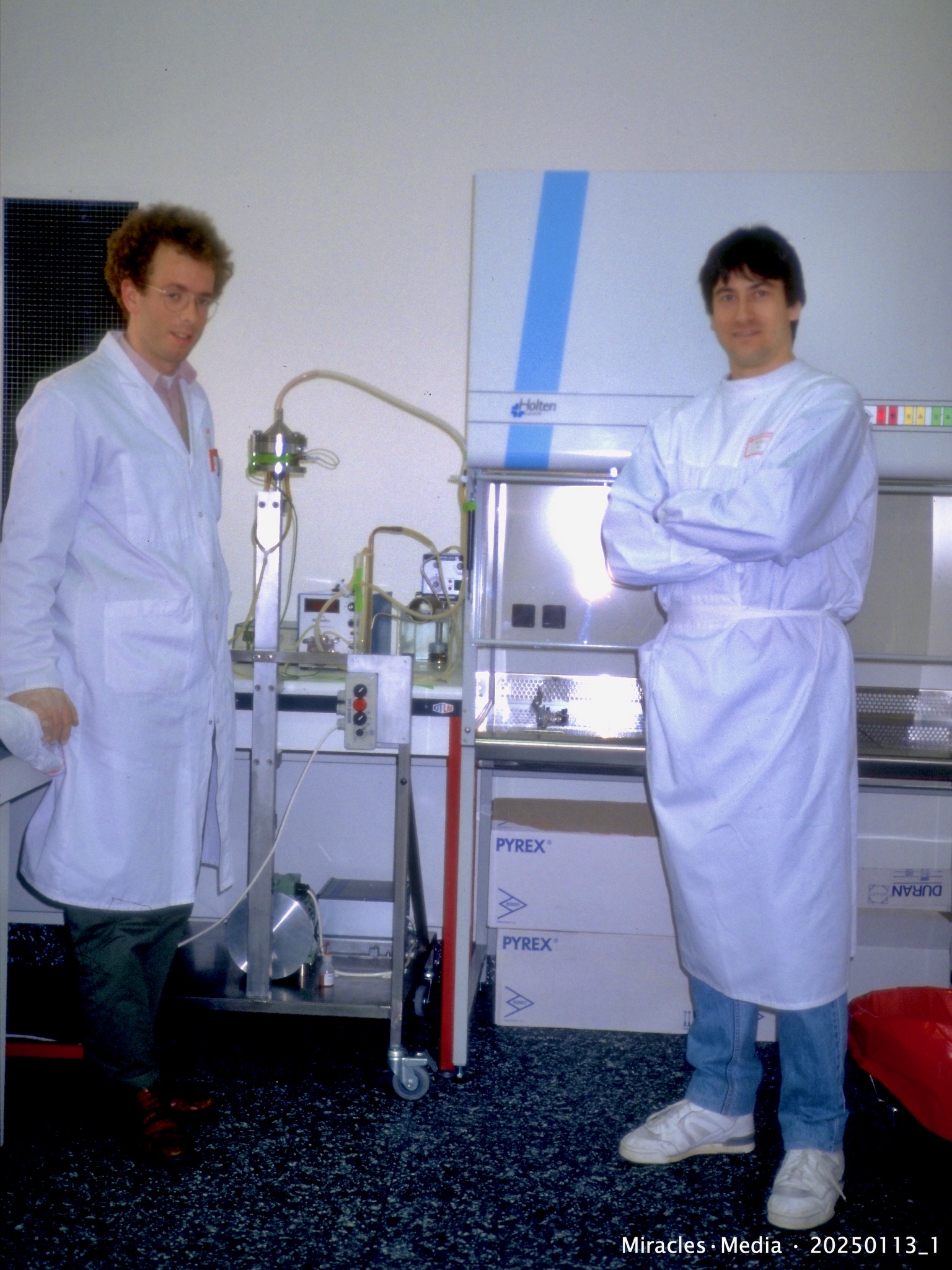
Pig Islet Isolation, Fondation Transplantation, Strasbourg 1992 • Michel van der Burg • Miracles.Media • @1MEMO 20250113_1 • TakeNode b1f66781-cf63-4e64-a7b3-24cbdf5c107f
For the xenotransplantation research we started in 1991 at our Leiden Surgery Department, I studied pig islet isolation during a working visit February 1992, at the ‘Fondation Transplantation’ in Strasbourg-Hautepierre, France — here watching our student Vincent Nieuwenhuijs (left) at work in the international team – with Agnaldo Soares I guess – using the Ricordi method for islet isolation — and presented the recent Leiden islet work (1).
Notes
1) Van der Burg MPM, Gooszen HG. Islet preservation using UW, and islet function after autotransplantation in dogs. Fondation Transplantation, CHU HautePierre Strasbourg (France) February 18, 1992.
Update 20250124 – Paper reference
Citation info : Xeno Islets • Michel van der Burg • Miracles.Media • @1MEMO 20250113 • URL michelvanderburg.com/2025/01/13/
No Title • Oil- Acrylic painting by Hans Dudart • Miracles.Media • @1MEMO 20250112_1 • TakeNode cbd20789-ebf5-4ede-925b-9b861c6719a4
Scan of print (10×15 cm; photo G.J. v.d. Poort) of oil- acrylic painting (60x50cm) by Hans Dudart.
Hans Dudart (1955-2003) worked as an artist in Holland, and as a valued co-worker in our Experimental Surgical Laboratory of the Leiden University Hospital (AZL, now LUMC) in Leiden, Holland. He died too soon from type 1 diabetes.
Citation info : No Title • Michel van der Burg • Miracles.Media • @1MEMO 20250112 • URL michelvanderburg.com/2025/01/12/
Sinclair’s ZX81 computer (1KB on-board memory , with a 64K memory expansion module inserted at the back) – my first PC – that I started using from 1983 for automation of work in our experimental pancreas and islet transplantation research project – for creating (‘coding’) and using the entire suit of apps, needed for the raw data processing and the (statistical and pharmacokinetic) analysis.
The hardware set-up included a TV (B/W) as monitor, (mono audio) tape recorder for data storage (apps), and a small thermal printer.
Citation info : ZX81 • Michel van der Burg • Miracles•Media • 20241018 • TakeNode 9c595df8-8091-497c-9c9c-ff85fe4de397 • URL michelvanderburg•com
Pancreatic Islet Transplantation • Isolation & Transplantation of Islets of Langerhans • 1988 to early 1990s • Islet Transplant Laboratory • Leiden University Hospital • 20240912_1 (Note 1)
Grants
In 1988, we started a project with unique integration of two important trends in research into the treatment of diabetes by transplantation at the Leiden University Hospital (AZL) in Leiden, with major grants from the dutch Ministry of Welfare, Health and Culture (WVC) and the dutch Diabetes Fund (Diabetes Fonds Nederland).
Grants diabetes research • Newspaper Leidsch Dagblad, June 24, 1988 (Note 2)
The generous grants were received — as reported June 24, 1988 in both the dutch newspaper Leidsch Dagblad (2) and in Cicero, the biweekly publication of the Leiden Medical Faculty and University Hospital (3), as a result of our preliminary research over the previous five years into improving the technique of pancreas transplantation, and more recently the development of a technique for isolating the Islets of Langerhans from the pancreas, which produce hormones such as insulin. The idea behind this is, that these isolated islets, after injection into the body, will restart and maintain insulin production.
Questions
What is the consequence of the loss of normal nerve connections to the islets during transplantation? What are the consequences of transplantation of only a segment of the pancreas, or islet transplantation, when fewer islets are available? What is the consequence after transplantation of the different insulin drainage route, where the insulin does not follow the normal path directly to the liver? To what extent do transplantation procedures disrupt the normal architecture and interactions of islets, the pancreas, and other parts of the gastro-intestinal system, and the blood sugar regulation in the body?
Project
With the hope of answering these questions, the grants supported an ambitious new project supervised by Hein Gooszen, integrating two concomitant PhD projects for detailed islet function studies in both experimental pancreas transplantation, by Onno Guicherit (4) , as well as islet isolation by Michel van der Burg (5) in the same model.
A special feature of the experimental design in this preclinical model is that the results of functional studies in the experimental animal can be compared with such functional studies with the isolated islets from the pancreas, where the direct effect on the islets is investigated during perifusion tests in our laboratory (6).
That same month, June 1988, we began research to improve the method of islet isolation in our laboratory, with the assistance of Jane Field, who had come over that month at our invitation from Minneapolis, where she was a key member of the Surgical Research lab, University of Minnesota (led by David Sutherland).
The introduction of this Minneapolis method for islet isolation significantly improved the yield of isolated islets in our Islet Transplant Lab.
New concept : University of Wisconsin solution (UWS) for islet isolation
Next , early 1989 , our Islet Transplant Lab took a major step forward in a new approach to isolation and purification of the islets by replacing the islet isolation solution (the general used basic physiological salt solution or tissue culture solution) with a novel organ preservation solution : the University of Wisconsin solution (UWS). The method of choice nowadays in clinical islet transplantation centers. More on this introduction of UWS will soon be posted here. A reprint of a first poster presented in Minneapolis, Sep. 1989, is now online here (7).
Program
June 1989 our Surgery Department (Leiden University) started an additional project, for ‘auto’ transplantation of isolated islets : Isolation of the islets from the canine pancreas and transplantation of the isolated islets ca 4 hours later in the same animal (8).
Thus, from 1989, we studied the insulin secretion of the isolated islets in perifusion experiments in the laboratory (‘in vitro’) in comparison with both the islet function ‘in vivo’ after transplantation of the isolated islets, and in the concomitant pancreas transplantation experiments — in support of our clinical pancreas transplantation program in Leiden.
Notes
1) Pancreatic Islet Transplantation • Isolation & Transplantation of Islets of Langerhans • 1988 to early 1990s • Islet Transplant Laboratory • Leiden University Hospital • 20240912_1 • michelvanderburg•com | TakeNode 5b5ca362-2adf-497a-b2be-a83e47617017 | Image edit based on : Pancreatic islet transplantation • Michel van der Burg • Miracles.Media • Thesis Repository Leiden University https://hdl.handle.net/1887/3486604
Captions in Note 9
2) Subsidie voor onderzoek suikerziekte. Leidsch Dagblad, June 24, 1988 (leiden.courant.nu) • 20240912_2 • michelvanderburg•com
3) Diabetesonderzoek | AZL krijgt grote subsidies voor diabetesonderzoek | by Sylvia van Leeuwen in Cicero, June 24th, 1988 (ISSN 0920-2900), the biweekly publication of the Academic Hospital and Leiden Medical Faculty | 20240912_3 • michelvanderburg•com | Download PDF article below : file 20240912_3_CICERO
4) Onno R. Guicherit. Long-term metabolic sequelae of beta cell mass reduction, systemic venous drainage and denervation of the canine pancreas : experimental studies in relation to clinical pancreas transplantation. (Doctoral Thesis, Faculty of Medicine, Leiden University Medical Center (LUMC) , Leiden University)(S.l.: s.n.), (ISBN print: 9789090072319, 9090072314), 1994: 149 p. URL WorldCat https://search.worldcat.org/en/title/69433794
5) Michael P.M. van der Burg. Pancreatic islet transplantation: studies on the technique and efficacy of islet isolation and transplantation. (Doctoral Thesis, Faculty of Medicine, Leiden University Medical Center (LUMC) , Leiden University), Boskoop: M.P.M. van der Burg | Miracles.Media (ISBN electronic, pdf, 9789080216402 ; ISBN print 9789080216419, 9080216410), 1994: 192 p. URL Thesis Repository Leiden University https://hdl.handle.net/1887/3486604
9) Pancreatic Islet Transplantation • Isolation & Transplantation of Islets of Langerhans 1988 to early 1990s • Islet Transplant Laboratory • Leiden University Hospital • 20240912_1 • michelvanderburg•com | TakeNode 5b5ca362-2adf-497a-b2be-a83e47617017 |
Captions Image 20240912_1 :
1. Paul Langerhans
2. Section of the normal dog pancreas showing islets stained reddish-brown (immunostained for insulin)
3. Michel van der Burg, watching the dog islet isolation procedure in the Minneapolis surgical research laboratory (University of Minnesota), September 1989, with Philippe Morel and Pericles Tzardis
4. Experimental Surgery Laboratory in Leiden, June 1988, with (left to right) Hein Gooszen, Jane Field (Minneapolis), and Onno Guicherit, starting the surgical procedure for canine islet isolation
5. The pancreas (segment) is removed
6. Islet Transplant Laboratory in Leiden, at the start of islet isolation, with infusion of the collagenase solution via the ducts in the dog pancreas (whole gland for islet transplantation) – collagenase leaking from the pancreas is recirculated using a roller pump
7. During collagenase digestion at 37-39°C the pancreas falls apart, shown here in a low magnification microscopy image of pancreatic exocrine tissue, and a free-ed small blood vessel
8. Dissociated pancreatic tissue, on ice
9. Tissue is further dispersed in the cold isolation solution (here RPMI tissue culture solution is used), by aspiration in a syringe, and sieved to remove undigested fragments, ducts and vessels ~ demonstrated here by Jane Field (Minneapolis), with the introduction of the Minneapolis isolation procedure, June 1988, in our Islet Transplant Laboratory in Leiden
10. Microscopy of tissue suspension, with a low purity of the islets (stained red by dithizone) obtained by density separation in Dextran gradients (in Hanks’ solution) after islet isolation in the RPMI tissue culture solution (dark-brown exocrine fragments remain unstained)
11. Pure islet suspension obtained by density separation in Percoll gradients (in University of Wisconsin solution) after islet isolation in the University of Wisconsin solution (islets are only slightly stained due to poor diffusion over the cell membrane in the preservation solution)
12. Section of highly purified islets obtained by Dextran density separation after isolation in the University of Wisconsin solution
13. Islets are autotransplanted by infusion in the spleen of the dog
14. Transplanted islet in section of the spleen of one of the dogs shortly after the onset of fasting hyperglycemia at three months posttransplant (immunostained for insulin), 1989
15. Highly purified human islets obtained by Percoll density separation after isolation in the University of Wisconsin solution (immunostained with gold for insulin; not counterstained), July 1990
Pancreatic islet transplantation • Michel van der Burg • Miracles.Media | QR code (link to Thesis Repository Leiden University) https://hdl.handle.net/1887/3486604
Citation info : Pancreas & Islet Transplantation Program • 20240912 | Michel van der Burg | michelvanderburg•com
Daniel Brandhorst at work in the Giessen islet transplant lab. Photo taken during my working visit June 20, 1996, at the laboratory of Experimental and Clinical Islet Transplantation, Third Medical Department of Internal Medicine (head: Prof. dr. R.G. Bretzel), Justus-Liebig-University Giessen, in Giessen, Germany.
Citation info : Giessen Islet Transplant Lab • 20240905 • Michel van der Burg • michelvanderburg•com • TakeNode a9a118ee-6413-4d4f-aa17-d207d7a90025