Silent film — Towards the end of World War I – in the summer 1918 , after the Allies defeated the Germans in the Second Battle of the Marne – large groups of Belgians and French refugees flee in front of the retreating enemy force to the neutral Netherlands.
The Dutch army and Red Cross prepared to receive a possible 100,000 evacuees in the border towns in the south of the Netherlands.
After wandering weeks in the north of France , and next crossing Belgium on foot, the first group of French refugees arrived at the Dutch border October 20, completely exhausted.
At the gate in the electric wire fence at the border to the Netherlands – the so-called ‘Death Wire’ (dutch : Dodendraad ) Dutch soldiers took them over from German escorts.
Some refugees had travelled by tram part of the route crossing Belgium to the belgian border town Molenbeersel.
At the dutch border the refugees were welcomed and ladies from relief committees provide the refugees with food and drinks on the road to Stramproy in the Netherlands.
Within days , thousands of French refugees arrive in the village of Stramproy and are transferred to the city of Weert .
On arrival in the city center of Weert the dutch army registered people and handed out soup and bread.
The weak, the sick, and maternity women were cared for by the Red Cross and taken to an aid post for further care.
The refugees were sheltered the night in buildings like convents and schools in Weert, before being housed elsewhere in the country the following days.
References
Source (video footage) : Belgische vluchtelingen 1e Wereldoorlog. Open Images | Beeld & Geluid (Sound &Vision).
Weert en het einde van W.O.-I. | Jan Henkens | Stichting Historisch Onderzoek Weert | URL http://www.showeert.nl
Forum Willy Brandt Berlin | 20230818 | Exhibition on this Nazi opponent, Governing Mayor of Berlin, Federal Chancellor, Nobel Peace Prize Laureate and one of the world’s leading politicians, 7 Sep 2013, near the Brandenburg Gate.
Citation : Forum Willy Brandt Berlin | 20230818 | Michel van der Burg | Miracles.Media TakeNode 60e650b3-e778-434e-bb62-ac688e197388
Metall-Parlament Berlin | 20230817 | Keine Altersarmut! No poverty in old age! Good Work • Good Pension • Education for All • Metal Parliament – Action, 7 Sep 2013, Brandenburg Gate – IG Metall Berlin-Brandenburg-Sachsen @igmbbs @michelvanderburg .
Citation : Metall-Parlament Berlin | 20230817 | Michel van der Burg | Miracles.Media TakeNode a4fc92db-0075-4f8f-afef-3e48f52ad18b
From 20 January 2023, the Jewish Museum of Belgium, in partnership with the Auschwitz Foundation, presents the exhibition entitled ‘236, Land(es)capes from the 20th Convoy’. It is set up in the museum’s project space and offers an artistic look at an exceptional and forgotten event in the Second World War.
The 20th convoy
At 10 p.m. on April 19, 1943, the 20th convoy departed from the Kazerne Dossin transit camp in Mechelen with 1,631 Jewish deportees in cattle cars, heading for Auschwitz. Thanks to resistance actions, both inside the wagons and from outside, 236 of these deportees managed to jump from that train, that was leading them to extermination. An unique event in Europe under the Nazi administration.
Jo Struyven, photographer
The work of the Belgian photographer Jo Struyven (°Sint-Truiden, 1961) takes us back to these acts of resistance – commemorating the 80th anniversary in 2023 – and gives us a glimpse of the landscapes in which this striking story took place. Taking the perspective of those who jumped off that train, an act for which many of them paid with their lives, Struyven creates a contemporary ‘memorial’ with 19 large ‘nocturnal’ black and white images, and one colour print.
Jo Struyven :
The 20th convoy, heading for the unspeakable “Auschwitz”, crossed the area where I grew up, barely 50 meters from my childhood bedroom — I found out 2 years ago after meeting Simon Gronowski. Ever since, I imagine the distress of the deportees. The destination was unknown to them. Some, sensing the worst, tried to escape it. I wanted to give an account of this border between life and death, between resignation and the impossibility of choosing, and the freedom regained with resistance to the oppressor’s plans.
Works presented by Jo Struyven
Land(es)capes from the 20th Convoy, 2020-2022, 19 black and white prints, 1 color print, 90×60 cm (Private collection – Belgium)
Jo Struyven, Land(es)capes from the 20th convoy 2020-2022, black and white print, 90x 60 cm, Wijchmaal (Private Collection, Belgium)Jo Struyven, Land(es)capes from the 20th Convoy 2020-2022, black and white print, 90x 60 cm, Bierbeek (Private Collection, Belgium)Jo Struyven, Land(es)capes from the 20th Convoy 2020-2022, black and white print, 90x 60 cm, Borgloon (Private Collection, Belgium)Jo Struyven, Land(es)capes from the 20th Convoy 2020-2022, black and white print, 90x 60 cm, Piringen (Private Collection, Belgium)Jo Struyven, Land(es)capes from the 20th Convoy 2020-2022, black and white print, 90x 60 cm, Botzelaer (Private Collection, Belgium)
Luc Tuymans, visual artist
In dialogue with Jo Struyven’s photographs, two works by Belgian visual artist Luc Tuymans (°Mortsel, 1958) evoke the destruction of the Jews and Roma of Europe. Die Wiedergutmachung (The Reparation) depicts body parts – left the eyes of gypsy children who had been experimented on by the Nazis. … images that in its incompleteness, reflect the inability to represent facts and memory .
Works presented by Luc Tuymans
Luc Tuymans, Our New Quarters, 1986, Oil on canvas, 80,5 x 120 cm (MMK – Germany) (Photo Ben Blackwell, courtesy David Zwirner, New York, London)Luc Tuymans, Die Wiedergutmachung, 1989, Oil on cardboard, mounted on plywood, Oil on canvas; diptych, 36,6 x 43 cm, 39,4 x 51,8 cm, courtesy: Private collection (Photo Studio Luc Tuymans)
Art after the Shoah
“Writing a poem after Auschwitz is barbaric”, wrote German philosopher Theodor W. Adorno in 1949. Through two contemporary perspectives from the visual arts, this exhibition seeks to address this question of the (im)possibility of art after the Shoah in a new way.
Testimonies & Catalogue
This exhibition will be accompanied by a catalogue book edited by Daniel Weyssow and Jo Struyven and published by the Auschwitz Foundation entitled Land(es)capes from the 20th Convoy (press release on April 19, 2023), as well as an educational space presenting the testimonies from interviews and archives of convoy escapees.
Info+ ( & Français | Nederlands)
236 Land(es)capes from the 20th Convoy Jo Struyven / Luc Tuymans Exhibition at the Jewish Museum of Belgium, in Brussels, Belgium 20 January – 14 August 2023 Brussels Website https://www.mjb-jmb.org
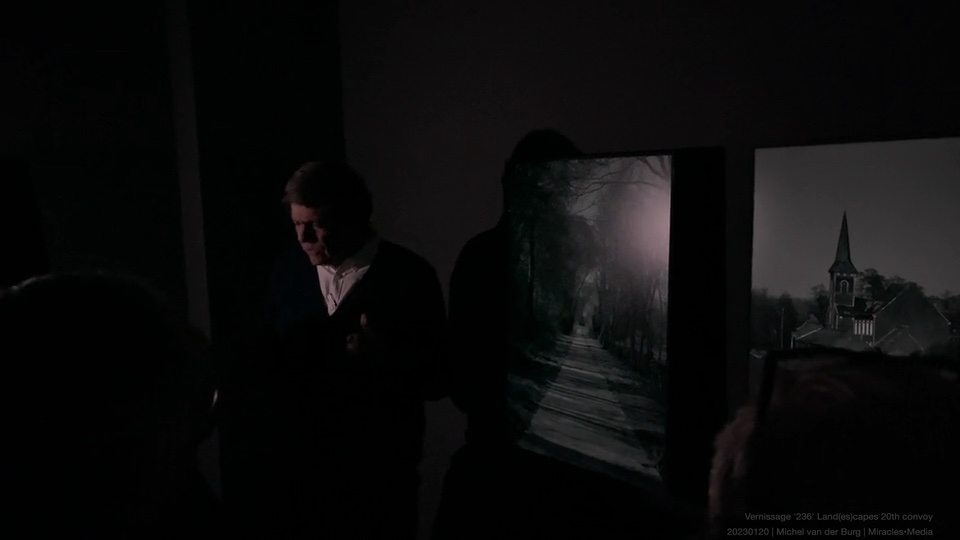
Video report : Vernissage ‘236’ Land(es)capes 20th convoy
Thursday January 19th, 2023, the vernissage of the photo exhibition 236 — Land(es)capes from the 20th Convoy was opened with speeches by Philippe Blondin, President of the Jewish Museum, and by Pierre-Yves Jeholet , Minister-President of the Government of the Federation Wallonia-Brussels. Next, the Belgian photographer Jo Struyven presented his work — escape landscape photographs glowing in the dark — like being lit by moonlight — as well as paintings contributed by Luc Tuymans in the project space. The exhibition runs from January 20 – August 14, 2023 in the Jewish Museum of Belgium, Brussels, Belgium. Video report (20230120) Michel van der Burg | Miracles•Media .
Jan 20, 2023 – VRT | Kristien Bonneure (Belgian Flemish Broadcast) 20 jan 2023
Photographer Jo Struyven presents a preview of his work last night , Thursday January 19th, 2023 at the vernissage of 236 — Land(es)capes from the 20th Convoy , an exhibition of works by Jo Struyven and Luc Tuymans in the Jewish Museum of Belgium, Brussels, Belgium, open from today for the public January 20 – August 14, 2023.
On April 19, 1943, the 20th transport left the Mechelen transit camp to deport 1,631 Jews to Auschwitz. Thanks to resistance actions, both inside and outside the wagons, 236 of these deportees managed to jump from the train that would lead them to destruction.
Photographer Jo Struyven revisits this unique act of resistance in Western Europe during the Nazi regime and shows us the landscapes in which this little-known story took place.
The vernissage was opened by Philippe Blondin, President of the Jewish Museum, and by Pierre-Yves Jeholet , Minister-President of the Government of the Federation Wallonia-Brussels.
Follow-up post tomorrow 20230121.
License info : Vernissage ‘236’ Land(es)capes 20th convoy | 20230120 | Michel van der Burg | Miracles•Media | TakeNode 5e71633a-0ff2-44bf-99dc-34f3db25bb26
Mobilization Holland 1939 | Dutch cinema news August 1939. Just before Hitler invades Poland (Sep 1, 1939), the Dutch government can no longer ignore the danger of war, and pre-mobilization August 24, 1939 of Dutch military is followed by mobilization August 28. Source : Polygoon Hollands Nieuws (Aug 1939) | Netherlands Institute for Sound and Vision ~ Film : Mobilization Holland 1939 | 20220307 | Michel van der Burg | Settela•Com
Holland On Standby 1938 | Dutch cinema news Sep. 1938 on the imminent international war situation with precautions by the Dutch army and people hoarding food in Holland. Source : Polygoon Hollands Nieuws (Image publ. 19 Sep 1938 ; Sound publ. 28 Aug 1939) | Netherlands Institute for Sound and Vision ~ Film : Holland On Standby 1938 | 20220306 | Michel van der Burg | Settela•Com