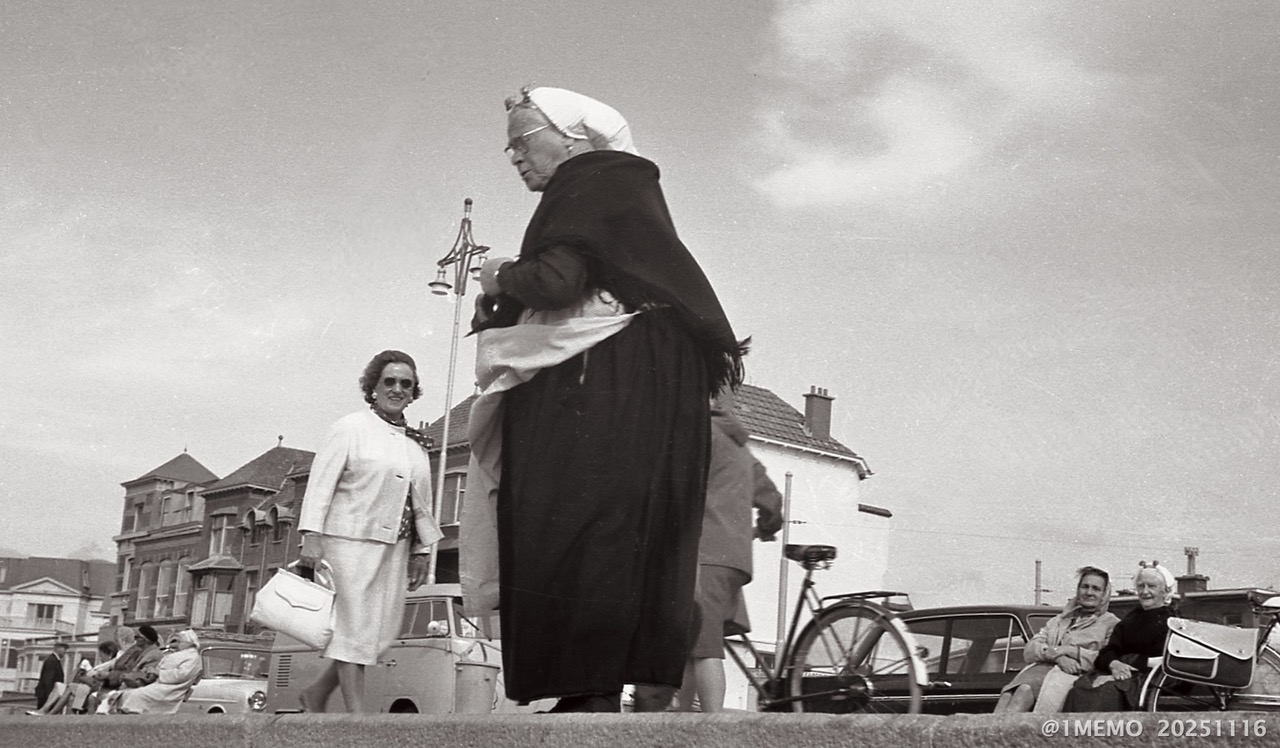
Woman in traditional Dutch costume in Scheveningen, Netherlands, 1966. The dark shawl in this black-and-white image (black I assume) is an adaptation of the dress worn during mourning.
Background
Summer of 1966 – at the age of 14– I took this candid paparazzi style close-up photo with the all-manual Voigtländer Vito camera below from the beach at the North Sea , looking up at daily life of these women wearing traditional Dutch costumes on the Boulevard in Scheveningen, Netherlands.
Citation info : Scheveningen Woman • Portrait #2 • Michel van der Burg • Miracles•Media • @1MEMO 20251116 • TakeNode 754ed9d9-ef57-47dc-868a-64f55f41ab4b
In 1940, the dutch teen idols Johnny and Jones, even though they were Jews, were able to continue performing under the Nazi occupation without too many problems. The Amsterdam duo sang jazzy Dutch songs with a mock American accent and a parody of current events.
Blackout means black!
July 1940 Johnny and Jones sang a parody on the Blackout , the dutch song ‘Maak het donker in het donker’ (make it dark in the dark).
Later during World War 2, in 1943, they were deported to the Nazi death camps. They died of exhaustion in the last days of the war in 1945 (see Notes).
Still image in film : Poster for the single ‘Maak het donker in het donker’.
Lyrics ‘Maak het donker in het donker’ | Johnny and Jones (1940)
De overheid heeft het publiek bevolen Als het donker is dan moet het donker zijn ! Er mag geen enkel licht naar buiten schijnen Doe verduisteringspapier voor je gordijn Anders staan ze ’s avonds aan je bel te bellen En dan komt de luchtbescherming je vertellen :
Refrein: Maak het donker, maak het donker in het donker Ook al gaan de sterren door met hun geflonker Ik loop langs de huizenkant Met mijn luchtbeschermingsband Een lantaren in mijn hand Om te kijken waar iets brandt Houdt dus rekening met de verduisteringswensen Maak het donker, reuze donker beste mensen ! Refrein
Het blokhoofd van blok zeven uit wijk negen Zag de dochter van het wijkhoofd uit blok tien Met een rood hoofd kwam hij blokhoofd negen tegen, Hij zei hoofd, heb jij het wijkhoofd ook gezien ? Ik heb in het hoofd gezet het wijkhoofd te gaan vragen , Of die wijkhoofd-(griet/strike?) mijn blokhoofdnaam wil dragen : Refrein
Van Zanten zag een meisje in het duister, Zij was slank gevormd en toch niet dik van lijn. Hij dacht, dit is de jonkvrouw mijner dromen, Binnenkort zal zij mevrouw Van Zanten zijn. In de duisternis vroeg hij haar om een kusje, Flip van Zanten zei zij toen, ik ben toch je zusje ! Refrein
Music : Maak het donker in het donker | Text & Music by Johnny and Jones (1940). Recorded in Vara-studio, Hilversum, 19 july 1940. DH2051. (Varagram 7175). | Wikimedia Commons
Film (image) : edited from Polygoon-Profilti cinema news reel week 36, September 1940 (under nazi rule) | Sound & Vision (Open Images).
Citation info : Blackout…Johnny and Jones 1940 | 20240118 | Miracles•Media | @michelvanderburg | TakeNode 17a685fd-9944-471b-992f-47be88ead857
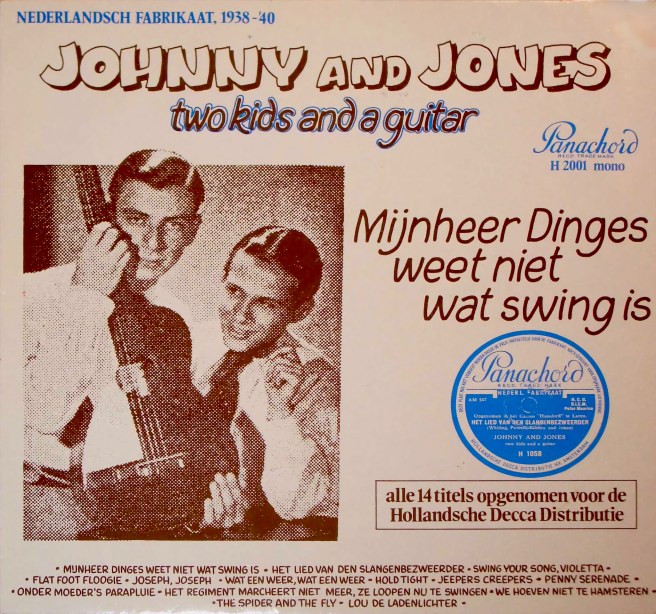
‘Swing’ by jazz duo Johnny and Jones in 1938 with their biggest hit , the dutch song “Mijnheer Dinges weet niet wat Swing is” …Mister Dingus doesn’t know what Swing and Hot (jazz) is…he’s a composer and teacher with a problem : his students skip class, he thinks jazz is banal.
“Two Kids and a Guitar”
The Amsterdam duo sang jazzy Dutch songs with a mock American accent and a parody of current events. They were the first teen idols in Holland and often on the dutch radio in the 1930s …before World War 2.
Nazi victims
Because of their Jewish origins, both ‘Johnny’ (Salomon Meijer Kannewasser, born 1916 and called Max) and his second cousin, partner, ‘Jones’ (Arnold Siméon van Wesel, born Amsterdam 1918 and called Nol) were arrested together with their wives in 1943, taken to the Westerbork transit camp, and deported Sep 4, 1944 first to the Theresienstadt camp, next the Auschwitz, Sachsenhausen, Ohrdruf and Bergen-Belsen camps. They died of exhaustion in the last days of the war in 1945.
Notes
Mijnheer Dinges weet niet wat Swing is | Two Kids and a Guitar | Johnny and Jones (1938). Lyrics from Joop de Leur. Recorded in Casino Hamdorf, Laren, Holland, November 1938. Label: Panachord (78 rpm). # H 1058 (Am 546-1). URL https://youtube.com/clip/UgkxMQtbdZ26fS4zcluq6fT7NlTbbpfuxpcx
Dinges, oh Dinges Dinges, oh Dinges Meneer Dinges die is dol op componeren Hij zit eeuwig met zijn neus in de muziek Jongelieden die bij hem piano leren Houden zich na de eerste les een tijdje ziek Want hun leraar heeft een kwaal Hij vindt jazzmuziek banaal Meneer Dinges weet niet wat swing is Hij weet niet wat saxofoon voor een ding is Omdat zijn radio kapot is Wat voor de buren een genot is Weet die Dinges niet wat swing of hot is Op een dag belde aan Dinges’ deur de wasman Die zei meneer er staat muziek op uw manchet Hou hem hier of stuur hem Theo Uden Marsman Maar meneer Dinges antwoordde toen zeer ontzet Man, ga uit mijn trapportaal In mijn huis geen jazz-schandaal Meneer Dinges weet niet wat swing is Hij weet niet wat saxofoon voor een ding is Omdat zijn radio kapot is Wat voor de buren een genot is Weet die Dinges niet wat swing of hot is Meneer Dinges maakte een grote ouverture Met een slotkoor, de finale stond in mol Toen het klaar was speelde Pietje van de buren De compositie dreunde in hot style door zijn bol Toen viel hij flauw op 1 crapaud (het kunnen er ook twee geweest zijn) En Johnny and Jones zongen door de radio Meneer Dinges weet niet wat swing is Hij weet niet wat saxofoon voor een ding is Omdat zijn radio kapot is Wat voor de buren een genot is Weet die Dinges niet wat swing of hot is Domme Dinges Oh, domme Dinges Weet jij nu nog niet wat jazz voor een ding is Als jij je goed wil amuseren Moet je de hi-de-ho studeren Meneer Dinges, probeer de swing ‘s Dinges, oh Dinges Dinges, oh Dinges.
Lezing Marc Michiels : De verzetsactie op het 20ste transport Mechelen-Auschwitz. Studiedag CegeSoma & Kazerne Dossin , 20 nov 2013, in Kazerne Dossin , Mechelen , Belgium.
Camera notities van Joods Verzet & Transport XX door Michel van der Burg. Ik was nog net op tijd voor deze lezing van Marc Michiels. De dag daarvoor filmde ik Simon Gronowski de hele dag en avond in Saint Sépulcre, Luik. Plan was om na overnachting in Luik , van daar uit naar de studiedag te gaan. Maar al onderweg in de auto toen ik borden Brussel zag herinnerde ik mij plots dat Simon Gronowski terloops iets gezegd had over ‘actie’ ‘morgen’ ‘Waterloo’ (dat drong niet tot me door toen tijdens filmen) en besloot ik dat op te zoeken in Brussel, nog net op tijd voor de speech van Amir Jafari, 12 jaar en Afghaanse vluchteling. Na maken van reportage daar in Brussel, besloten alsnog naar Kazerne Dossin te rijden voor rest van studiedag : de Afternoon Session …
Moderator Ward Adriaens – met bijdragen van Thierry Rozenblum, Herman Van Goethem, Laurence Schram, Marc Michiels, Arnaud Bozzini, en Rudi Van Doorslaer.
On 20 November 2013, roughly 70 years after the attack on the 20th Convoy from Mechelen to Auschwitz in Boortmeerbeek, Kazerne Dossin and Cegesoma jointly organized a study day about Jews and the Resistance. The symposium languages were Dutch and French.
License info: Jews and the Resistance | Marc Michiels | 20221120 | Michel van der Burg | michelvanderburg•com | TakeNode ID: 21438c65-6185-4efe-b3fb-9ce630db30b5
Quote | 20221103 | 1-memo•com | “Every day I make something. Then in the evening there’s something in the world that wasn’t there in the morning.
— Gemma Edelsteen | Marja Pinckaers
This echoes in my mind once in a while – part of the rationale for making daily 1-memo’s . First read these original Dutch* lines August 2014 — shortly after I carefully started publishing ‘① memo dailies’ June 2014 — in the Dutch paperback ’16 versie 61′ by Marja Pinckaers (publ. Aspekt ISBN 9789461535740 ).
Short review was posted August 2014 : 16versie61 Marja Pinckaers | 20140829 | 1-memo•com
Beta testing iA Presenter slide software prompted me trying this ‘text’ memo post.
*Original dutch text by Marja Pinckaers :
‘Elke dag maak ik wat. Dan is er ‘s avonds iets op de wereld wat er ‘s ochtends niet was. Of mischien toch, maar moest ik het nog zoeken en vond ik het. Uit.’
Netherlands’ Fight World War II | 20220303 | Settela•Com | Three years of the Netherlands’ fight against the axis 1940-1943
Film about the Dutch urge for freedom in the Second World War, which is said to be rooted in Dutch history. This is followed by images of the pre-war Netherlands with typical views (including the Rijksmuseum, the Night Watch (Nachtwacht), the Muntplein square in Amsterdam, the viaduct of the Hofplein line, new industrial residential areas, Amsterdam Airport (Schiphol), the Afsluitdijk dike, the Dutch East Indies, Curaçao and the Hague Peace Palace (Vredespaleis). A look back at the mobilization with Hr.Ms. Tromp, artillery and soldiers along the waterline. The German invasion including Rotterdam, Moerdijk bridges and Zeeland. HMS Queen Wilhelmina on arrival in England accompanied by baron C. de Vos van Steenwijk. A look at the contribution of the Dutch East Indies. Negotiation with Japanese envoy. Mobilization with images of new material. The declaration of war after the attack on Pearl Harbor. Bombardment of Catalinas on [Japanese submarine]. Glenn-Martin’s Bombardment of [Japanese Ships]. The Battle in the Java Sea. The Japanese invasion. Training center for Dutch people in Canada and England and the training of Dutch pilots in America. Images of the army in Suriname during the war with Marmon-Herrington tank. Training in the Netherlands Antilles. Convoy protection. Torpedo boat (TM-8) in view. Patrolling in the West Indies and the transfer by President Roosevelt of the submarine fighter Hr.Ms. Queen Wilhelmina to HMS Queen Wilhelmina on 30 July 1942. The merchant navy fleet of the Netherlands. Images from the occupied Netherlands.
World War II documentary produced in 1944 by the Netherlands Information Bureau (N.I.B.) – an Agency of the Netherlands Kingdom, in het Rockefeller Center in New York , USA . Propaganda – Dutch diplomacy – during World War II for international public (especially the USA) aiming at international cooperation in the fight against the Axis alliance – that is : against Germany, Italy, and Japan . Source : Collection Netherlands Institute of Military History (NIMH).
① memo 20170428 ~ Crescendo A Cappella — Al Kol Ele ~ The Crescendo Boortmeerbeek Choir sings “Al Kol Ele” a cappella during the Transport XX commemoration May 15 , 2011 in Boortmeerbeek , Belgium – Film : Michel van der Burg – michelvanderburg.com | 1-memo.com