Portrait pillars of the Monument Foundation (Stiftung Denkmal) participation in the Berlin 2013 theme year ‘Destroyed Diversity’ (Zerstörte Vielfalt) at the Berlin Holocaust Memorial, 7 Sep 2013, Berlin, Germany.
Here the portrait of Werner (1921-1942). Werner from Wedding (Berlin) was in love with his neighbor Dorothea. But he was Jewish. After the passage of the Nuremberg “Racial Laws” in the fall of 1935, relationships between Jews and “Aryans” were strictly forbidden. The two were cautious, but they were betrayed. The accusation: “racial defilement” (Rassenschande)! Werner spent 18 months in the Berlin-Tegel prison, then in “protective custody” in the Sachsenhausen concentration camp. He did not survive the camp (https://www.stiftung-denkmal.de/) .
Ward Adriaens (Mechelen, Belgium) passed away suddenly on the evening of November 15th, 2024. A wonderful man, a freethinker, author, with a passion for living history, especially the resistance, partisans, in World War II, and the founding director in 1995 of the Jewish Museum of Deportation and Resistance (JMDR) that opened its doors in 1996. In 2012 the JMDR became the Kazerne Dossin museum, with Ward Adriaens as honorary curator. In 2005 Ward Adriaens launched the Give Them a Face archival project. The portraits of all Jewish, Roma and Sinti deportees which passed through the SS-Sammellager Mecheln (Dossin barracks, transit camp, Mechelen) in 1942-1944, were scanned to create the “Give Them a Face” portrait collection. All around 20,000 photos in the Give Them a Face portrait collection are now part of the commemoration wall – a permanent exhibition – at the Kazerne Dossin museum.
In 2009 , I first encountered the Transport XX installation in Brussels, and met Ward Adriaens’ team of the Give Them a Face project in the Jewish Museum of Deportation and Resistance in Mechelen, Belgium (1,2).
Next , Ward Adriaens participated in our 2012 documentary Transport XX to Auschwitz (3).
Recently, May 2024, Ward Adriaens’ opening speech at the TRANSPORT XX installation in Mechelen in 2007, was posted in the ‘Miracles’ project at Miracles•Media (4).
Quote
“…Let us clearly understand that this is the fundamental basis of racism: persecuted because we have a mother. We all have parents and many amongst us have children. In order to protect them it is essential that we do not give an inch to racism. Everyone of us will come under threat should the policy makers be influenced by racism…”
3. Ward Adriaens’ interview by the dutch reporters Piet de Blaauw & Aart Zeeman (Dutch NCRV-Netwerk broadcast, 13 April 2005, NL1) from the documentary ‘Transport XX to Auschwitz’ – a film by Karen Lynne & Richard Bloom and Michel van der Burg • In : Documentary film “Transport XX to Auschwitz” • Miracles•Media • 20130419 • URL (retrieved 20241119) https://michelvanderburg.com/2013/04/19/transport-xx-to-auschwitz/
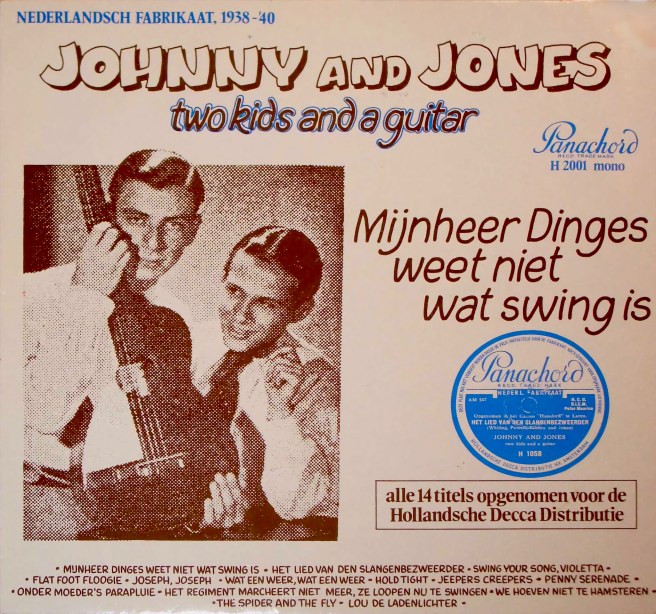
In 1940, the dutch teen idols Johnny and Jones, even though they were Jews, were able to continue performing under the Nazi occupation without too many problems. The Amsterdam duo sang jazzy Dutch songs with a mock American accent and a parody of current events.
Blackout means black!
July 1940 Johnny and Jones sang a parody on the Blackout , the dutch song ‘Maak het donker in het donker’ (make it dark in the dark).
Later during World War 2, in 1943, they were deported to the Nazi death camps. They died of exhaustion in the last days of the war in 1945 (see Notes).
Still image in film : Poster for the single ‘Maak het donker in het donker’.
Lyrics ‘Maak het donker in het donker’ | Johnny and Jones (1940)
De overheid heeft het publiek bevolen Als het donker is dan moet het donker zijn ! Er mag geen enkel licht naar buiten schijnen Doe verduisteringspapier voor je gordijn Anders staan ze ’s avonds aan je bel te bellen En dan komt de luchtbescherming je vertellen :
Refrein: Maak het donker, maak het donker in het donker Ook al gaan de sterren door met hun geflonker Ik loop langs de huizenkant Met mijn luchtbeschermingsband Een lantaren in mijn hand Om te kijken waar iets brandt Houdt dus rekening met de verduisteringswensen Maak het donker, reuze donker beste mensen ! Refrein
Het blokhoofd van blok zeven uit wijk negen Zag de dochter van het wijkhoofd uit blok tien Met een rood hoofd kwam hij blokhoofd negen tegen, Hij zei hoofd, heb jij het wijkhoofd ook gezien ? Ik heb in het hoofd gezet het wijkhoofd te gaan vragen , Of die wijkhoofd-(griet/strike?) mijn blokhoofdnaam wil dragen : Refrein
Van Zanten zag een meisje in het duister, Zij was slank gevormd en toch niet dik van lijn. Hij dacht, dit is de jonkvrouw mijner dromen, Binnenkort zal zij mevrouw Van Zanten zijn. In de duisternis vroeg hij haar om een kusje, Flip van Zanten zei zij toen, ik ben toch je zusje ! Refrein
Music : Maak het donker in het donker | Text & Music by Johnny and Jones (1940). Recorded in Vara-studio, Hilversum, 19 july 1940. DH2051. (Varagram 7175). | Wikimedia Commons
Film (image) : edited from Polygoon-Profilti cinema news reel week 36, September 1940 (under nazi rule) | Sound & Vision (Open Images).
Citation info : Blackout…Johnny and Jones 1940 | 20240118 | Miracles•Media | @michelvanderburg | TakeNode 17a685fd-9944-471b-992f-47be88ead857
‘Swing’ by jazz duo Johnny and Jones in 1938 with their biggest hit , the dutch song “Mijnheer Dinges weet niet wat Swing is” …Mister Dingus doesn’t know what Swing and Hot (jazz) is…he’s a composer and teacher with a problem : his students skip class, he thinks jazz is banal.
“Two Kids and a Guitar”
The Amsterdam duo sang jazzy Dutch songs with a mock American accent and a parody of current events. They were the first teen idols in Holland and often on the dutch radio in the 1930s …before World War 2.
Nazi victims
Because of their Jewish origins, both ‘Johnny’ (Salomon Meijer Kannewasser, born 1916 and called Max) and his second cousin, partner, ‘Jones’ (Arnold Siméon van Wesel, born Amsterdam 1918 and called Nol) were arrested together with their wives in 1943, taken to the Westerbork transit camp, and deported Sep 4, 1944 first to the Theresienstadt camp, next the Auschwitz, Sachsenhausen, Ohrdruf and Bergen-Belsen camps. They died of exhaustion in the last days of the war in 1945.
Notes
Mijnheer Dinges weet niet wat Swing is | Two Kids and a Guitar | Johnny and Jones (1938). Lyrics from Joop de Leur. Recorded in Casino Hamdorf, Laren, Holland, November 1938. Label: Panachord (78 rpm). # H 1058 (Am 546-1). URL https://youtube.com/clip/UgkxMQtbdZ26fS4zcluq6fT7NlTbbpfuxpcx
Dinges, oh Dinges Dinges, oh Dinges Meneer Dinges die is dol op componeren Hij zit eeuwig met zijn neus in de muziek Jongelieden die bij hem piano leren Houden zich na de eerste les een tijdje ziek Want hun leraar heeft een kwaal Hij vindt jazzmuziek banaal Meneer Dinges weet niet wat swing is Hij weet niet wat saxofoon voor een ding is Omdat zijn radio kapot is Wat voor de buren een genot is Weet die Dinges niet wat swing of hot is Op een dag belde aan Dinges’ deur de wasman Die zei meneer er staat muziek op uw manchet Hou hem hier of stuur hem Theo Uden Marsman Maar meneer Dinges antwoordde toen zeer ontzet Man, ga uit mijn trapportaal In mijn huis geen jazz-schandaal Meneer Dinges weet niet wat swing is Hij weet niet wat saxofoon voor een ding is Omdat zijn radio kapot is Wat voor de buren een genot is Weet die Dinges niet wat swing of hot is Meneer Dinges maakte een grote ouverture Met een slotkoor, de finale stond in mol Toen het klaar was speelde Pietje van de buren De compositie dreunde in hot style door zijn bol Toen viel hij flauw op 1 crapaud (het kunnen er ook twee geweest zijn) En Johnny and Jones zongen door de radio Meneer Dinges weet niet wat swing is Hij weet niet wat saxofoon voor een ding is Omdat zijn radio kapot is Wat voor de buren een genot is Weet die Dinges niet wat swing of hot is Domme Dinges Oh, domme Dinges Weet jij nu nog niet wat jazz voor een ding is Als jij je goed wil amuseren Moet je de hi-de-ho studeren Meneer Dinges, probeer de swing ‘s Dinges, oh Dinges Dinges, oh Dinges.
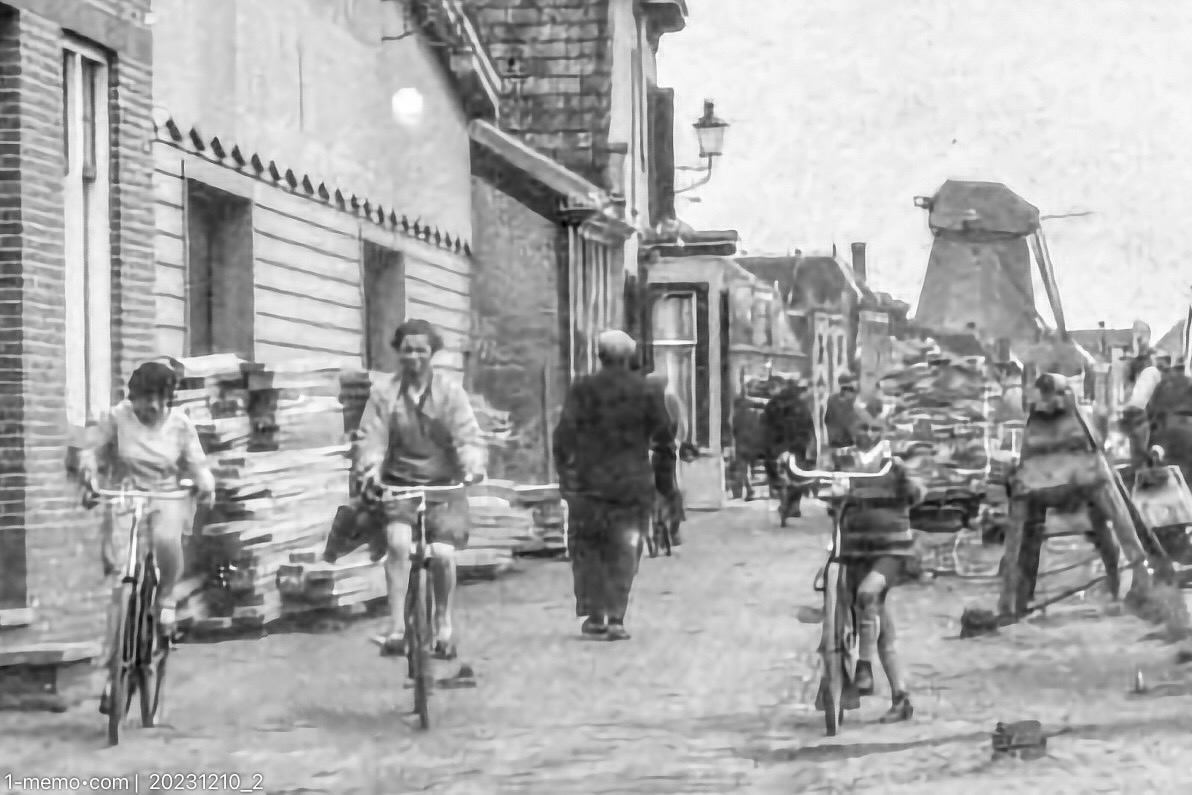
Girls’ Gym Suit 1930 Cycling in Waddinxveen along Gouwe River | 20231210_1 | 1-memo•com
– (nederlands beneden / dutch below) –
EN – Confusing in this historical picture…those bare female legs on the bicycle ! While looking for another picture of the De Schoone Haas windmill from the paper factory along the Gouwe in Waddinxveen, I found a photo in the archives of the SAMH museum in Gouda with the mention ‘Freight ship in front of the Alblas timber trade, windmill in the background, after 1905.’ — above (20231210_1) an edited version with sharpening, and brightness adjustments.
At first glance I miss the sawmill of Alblas, and next to it the Remonstrant church – of which I previously posted moving images (1). Watching that film again shows that both buildings are further back – the Remonstrant church probably because it was a clandestine church – and therefore kept out of sight here. The film also shows this second Alblas building, on the water and close to the sawmill. Not far from the De Schoone Haas paper-wind-mill there was another windmill – De Nijverheid, of which an overview photo was recently posted (2). That windmill – De Nijverheid – is recognized here in the background of the photo. The Schoone Haas windmill, which was closer to the Alblas company, appears to have disappeared at this time. The blades of the De Nijverheid windmill are missing here. The Dutch windmill database mentions (info from Jacob Stolp) that the sails of De Nijverheid were removed in 1929, and the mill was demolished in 1932 (3). So this photo was taken around 1930.
At image analysis for dating, those cyclists with bare legs are initially confusing in such a historical picture. Closer inspection reveals that posing is taking place: the cyclist on the right in the picture is perhaps a boy, and is still standing next to the bicycle, which suggests that the others have just started cycling, with the young woman (girl) on the left not yet sitting straight. Over the past month I saw a lot of photographic images of life and work along the Gouwe up to about 1920, and I almost always saw the women in skirts down to the ankles, some down to mid-calf (4).
Above is an enlargement of the cyclists (20231210_2). The woman on the bicycle in the middle wears unusual clothing with short legs with elastic on the thighs, and over that a cardigan and large (shoulder) bag. Such fashion was found in women’s magazines from around 1930…such as the Modern Gym Suit in the American magazine The Delineator Aug. 1931, for juniors (5), with option to purchase a Butterick sewing pattern. Below is a collage of clippings (edited image) from this magazine of the one-piece v-neck gym suit… “One just steps into it from the top and fastens it on the shoulders. Simple to make.”.
Modern Gym Suit | 20231210_3 | 1-memo•com | @michelvanderburg | Edited montage of cuttings from The Delineator Aug. 1931
Such a One-Piece Gym Suit is also recommended in the 1932 catalog of the American Sears Roebuck with: “You will now find this suit standard equipment in many colleges and high schools, also used by dancers …. ” (6).
Bloomer – Women’s Rights
The ‘Bloomer’ – usually larger, see also that page in the Sears Roebuck 1932 Catalog (6) – goes back – in longer versions – to the 1850s.
Bloomer ca 1852 | 20231210_4 | 1-memo•com | A Poser for a Bloomer. By J L (monogram) ca 1852. | Bodleian Libraries Oxford University | Wikimedia Commons. CC BY
Satirical cartoon : In a reversal of genders, a “bloomer” asks her fiancé’s shocked father for consent to marry his son (Ref 7).
In general, women’s sport and activewear has helped emancipation (8).
John Noble’s 1895 ‘New Convertible Costume’ | 20231210_5 | 1-memo•com | Los Angeles Herald, 1895
John Noble’s 1895 ‘New Convertible Costume’ … appropriate for walking, golfing and wheeling. In: Los Angeles Herald, 1895 | Source K. Jungnickel in The Sociological Review (Ref. 8).
Dutch :
NL – Verwarrend in dat historisch plaatje boven…die blote vrouwenbenen op de fiets! Op zoek naar nog een plaatje van windmolen De Schoone Haas van de papierfabriek langs de Gouwe in Waddinxveen, vond ik in het archief van het SAMH museum te Gouda een foto, met vermelding ‘Vrachtschip voor houthandel Alblas, op de achtergrond molen, na 1905.’ Hierboven (20231210_1) een bewerkte versie (met verscherping, en helderheid aanpassingen) van die foto.
Op het eerste gezicht mis ik in die foto de houtzagerij van Alblas , en daarnaast de Remonstrantse kerk – waarvan ik eerder film beeld gepost heb (1). Bij weer bekijken van die film blijkt dat die beide gebouwen meer naar achteren staan – de Remonstrantse kerk waarschijnlijk omdat het een schuilkerk was – en daarom dus wat uit het zicht. Voorts laat die film ook dit tweede Alblas gebouw zien, aan het water en dicht bij die zagerij. Niet ver van papiermolen De Schoone Haas heeft nog een windmolen gestaan – De Nijverheid, waarvan recent een overzichts-foto is gepost (2). Die molen – De Nijverheid – wordt hier in de foto herkend op de achtergrond. De Schoone Haas molen , die dichter bij Alblas stond, blijkt dus op dit tijdstip al verdwenen. De wieken van molen De Nijverheid ontbreken hier. De Nederlandse molen database vermeld (info van Jacob Stolp) dat de wieken van De Nijverheid werden verwijderd in 1929 , en de molen in 1932 werd afgebroken (3). Deze foto is dus rond 1930 gemaakt.
Bij de beeldanalyse voor de datering zijn die fietsers met blote benen in eerste instantie verwarrend in zo’n historisch plaatje. Nadere beschouwing van de uitvergroting hierboven van de fietsers (20231210_2) leert, dat er wordt geposeerd : de fietser rechts in beeld is misschien een jongen, en staat nog naast de fiets, wat suggereert dat de anderen zojuist zijn gaan fietsen, waarbij de jonge vrouw (meisje) links, nog niet recht zit.
De afgelopen maand zag ik veel fotografisch beeld van leven en werken langs de Gouwe tot ca 1920 , en zag ik de vrouwen vrijwel altijd in rokken tot de enkels, een enkeling tot halverwege de kuit (4).
De vrouw op de fiets in het midden draagt aparte kleding met korte pijpen met elastiek op de bovenbenen, en daarover een vest, en grote (schouder-) tas.
Dergelijke mode werd teruggevonden in vrouwenbladen van rond 1930…zoals dat Modern Gym Suit in het Amerikaanse blad The Delineator Aug. 1931 , voor jongeren … ‘Juniors’ (5), met optie om een Butterick naaipatroon aan te schaffen. Hierboven ( zie Modern Gym Suit | 20231210_3 ) een collage van knipsels uit dit blad, van het gympak uit één stuk met V-hals … ” je stapt er van boven in en sluit het op de schouders – simpel te maken. “
Zo’n One-piece Gym Suit wordt ook aangeprezen in de catalogus uit 1932 van het Amerikaanse Sears Roebuck met : “Tegenwoordig is dit standaarduitrusting op veel hogescholen en middelbare scholen, alsook bij dansers…”(6).
Bloomer – Vrouwenrechten
De ‘Bloomer’ – doorgaans ruimer , zie ook die pagina in de Sears Roebuck Catalogus 1932 (6) – gaat terug – in langere versies – tot de 1850s.
Zie boven (20231210_4) de spotprent uit een krant/magazine van ca 1852 ‘A Poser for a Bloomer’ . In een omgedraaide genderrol vraagt een ‘bloomer’ de geschokte vader van haar verloofde om toestemming om met zijn zoon te trouwen (Ref 7).
In het algemeen heeft sportkleding en activewear voor vrouwen, geholpen bij de emancipatie.
John Noble’s 1895 ‘New Convertible Costume’ (beeld : 20231210_5 ) … appropriate for walking, golfing and wheeling … Los Angeles Herald, 1895 (Ref. 8).
Refs
1. Alblas Hout – 1920s Waddinxveen Works – Gouwe River | 20231117 | Michel van der Burg | 1-memo•com 2. Windmills Hoop & Nijverheid ca 1898 in Waddinxveen Along the Gouwe River | 20231208 | 1-memo•com | @michelvanderburg 3. De Nijverheid, Waddinxveen. Ten Bruggencate-nr. 01213r. Nederlandse Molendatabase | URL https://www.molendatabase.nl/molens/ten-bruggencate-nr-01213-r 4. Markt – 1920s Gouda Works – Gouwe River | 20231127 | Michel van der Burg | 1-memo•com | URL https://1-memo.com/2023/11/27/markt-1920s-gouda-works-gouwe-river-20231127/ 5. The Modern Gym Suit – in the Junior assembly of smart new cloths – Delineator Vol. 119, No. 2 August, 1931 | University of Wisconsin Library | URL https://search.library.wisc.edu/digital/ANZCBWLRGZ4KWD8C/pages/APXEIY7ESINPKB8K 6. Gym suits, Sears Roebuck Catalog, 1932 in : The History of Fashion for Getting Physical | Summer Lee | The Vintage Woman Magazine | URL https://thevintagewomanmagazine.com/history-of-exercise-fashion/ 7. A Poser for a Bloomer. By J L (monogram) ca 1852. | Bodleian Libraries Oxford University | Wikimedia Commons. CC-BY. URL https://commons.wikimedia.org/w/index.php?curid=40711232 . Satirical cartoon about the Bloomerism movement. Girl in bloomers seeking consent to marry from her fiance’s father. Cutting from newspaper/magazine. Shelfmark: Fashion 19 (56) (subsection: Satire and reform movements: Bloomers and Bloomerism). 8. Jungnickel, K. (2023). Convertible, multiple and hidden: The inventive lives of women’s sport and activewear 1890–1940. The Sociological Review, 0(0). https://doi.org/10.1177/00380261231153754
Citation info : Girls’ Gym Suit 1930 Cycling along Gouwe River | 20231210 | 1-memo•com | @michelvanderburg
Images
1. Girls’ Gym Suit 1930 Cycling in Waddinxveen along Gouwe River | 20231210_1 | 1-memo•com | @michelvanderburg | TakeNode 9e5188f1-2ced-458a-817c-9e8bcc221b85
3. Modern Gym Suit | 20231210_3 | 1-memo•com | @michelvanderburg | Edited montage of cuttings from The Delineator Aug. 1931 (Ref. 5) | TakeNode a1543a33-f0b0-4ba4-9bb4-70978707575a
4. Bloomer ca 1852 | 20231210_4 | 1-memo•com | A Poser for a Bloomer. By J L (monogram) ca 1852. | Bodleian Libraries Oxford University | Wikimedia Commons. CC BY | Takenode e7f54d92-800e-4e06-be2f-b54c019bbecc
5. John Noble’s 1895 ‘New Convertible Costume’ | 20231210_5 | 1-memo•com | Los Angeles Herald, 1895 | TakeNode 34a18b6c-7562-4310-ba79-713dca5bb018
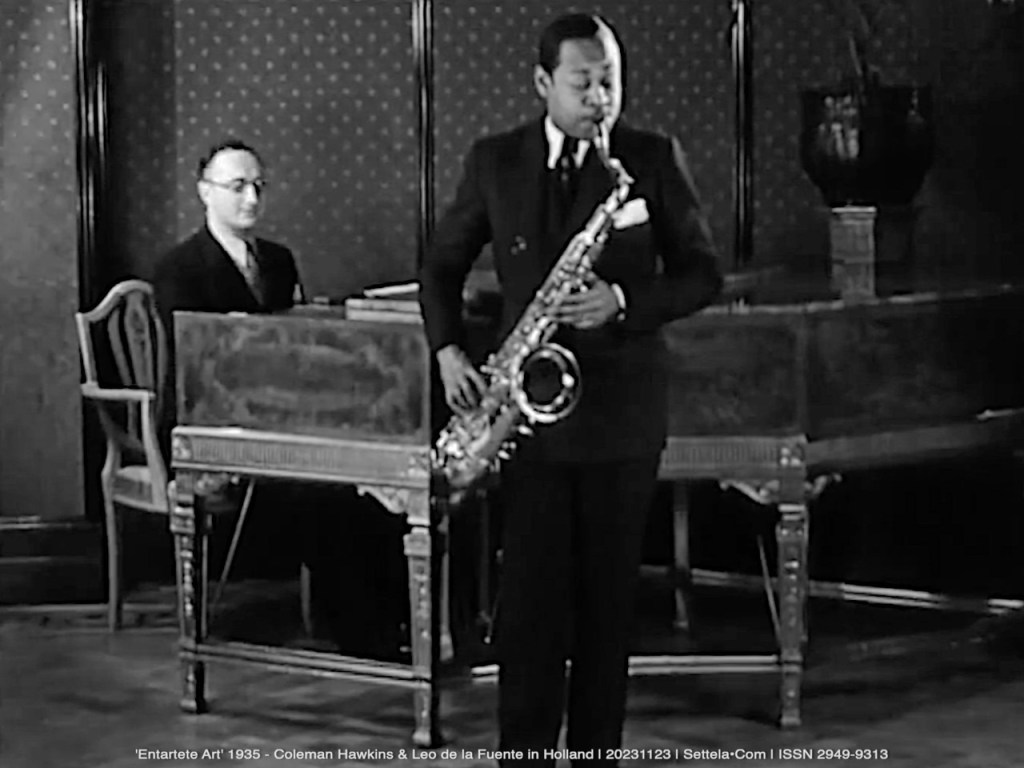
‘Entartete Art’ 1935 – Coleman Hawkins & Leo de la Fuente in Holland
American saxophonist Coleman Hawkins announces and plays – accompanied by Leo de la Fuente on piano – on his tenor saxophone ‘I wished that I were twins’.
In 1934, Coleman Hawkins left the Fletcher Henderson Orchestra and Amerika, moved to Europe, and joined the Jack Hylton Orchestra in England. Hylton and his band made regular ‘continental’ tours, and started another European tour January 1935 accompanied by Coleman Hawkins in Holland. At the end of January 1935 Hawkins joins the dutch band The Rambers … for 8 days … because Hawkins was denied entry to Germany because of his race, while Hylton and his band continued their tour without him and play for eight days at the Berlin Philharmonic Hall.
To end this special week with Hawkins well, the bandleader of The Ramblers – Theo Uden Masman – arranged with Decca for recordings 4 february 1935 in Pulchri Studio in The Hague, Holland, including this : I wish I were twins…that was also recorded on film by Polygoon (Polygoontoon) for the dutch cinema news for next week .
Coleman Hawkins is accomponied here on film by the dutch jazz pioneer Leo de la Fuente on piano , playing ‘I wished that I were twins’ . After the recordings, Hawkins moves further into Europe.
Leo – Leonard Henriques – de la Fuente, who was born Jewish in Amsterdam 28 March 1902, was deported by the nazi’s to Auschwitz on 2 November 1942, and died 30 April 1944 ‘somewhere in Mid Europe’.
Citation : ‘Entartete Art’ 1935 – Coleman Hawkins & Leo de la Fuente in Holland | 20231123 | Settela•Com | ISSN 2949-9313 | TakeNode 4f388407-5ccc-4816-aef6-6064fcee35b2
Short impression of Viviane telling her story April 2023 in Boortmeerbeek, Belgium, at the 80th anniversary of the attack on Transport XX near Boortmeerbeek — the Twentieth Train heading for Auschwitz, the night of April 19-20, 1943. Viviane escaped from Transport XX in the womb of her pregnant mother Isabella Weinreb-Castegnier who jumped from this death train, with the help of Elias Gnazik, shortly after the 2nd attack on this train near Bierbeek, Belgium. Viviane was born 6 months later October 30, 1943 in Brussels … and celebrates her 80th birthday today, October 30, 2023, in LA, USA 😉 Music : Al Kol Ele by Crescendo Boortmeerbeek Choir .
Full story available in free e-Book download :
Viviane Yarom-Castegnier & Michel van der Burg. Viviane’s Story: Escape from Transport XX… Born 6 Months Later [e-Book]. Boskoop, Miracles.Media, 2019. Distribution [ISBN (ePUB) : 978-94-93147-00-3 | ISBN (pdf) : 978-94-93147-01-0]. URL https://miracles.media/vivianesstory/
Citation : Viviane – 80 Years After Escape From Transport XX | 20231030 | Michel van der Burg | Miracles•Media | TakeNode 84175450-c147-4fd9-9039-8ca85995ff46