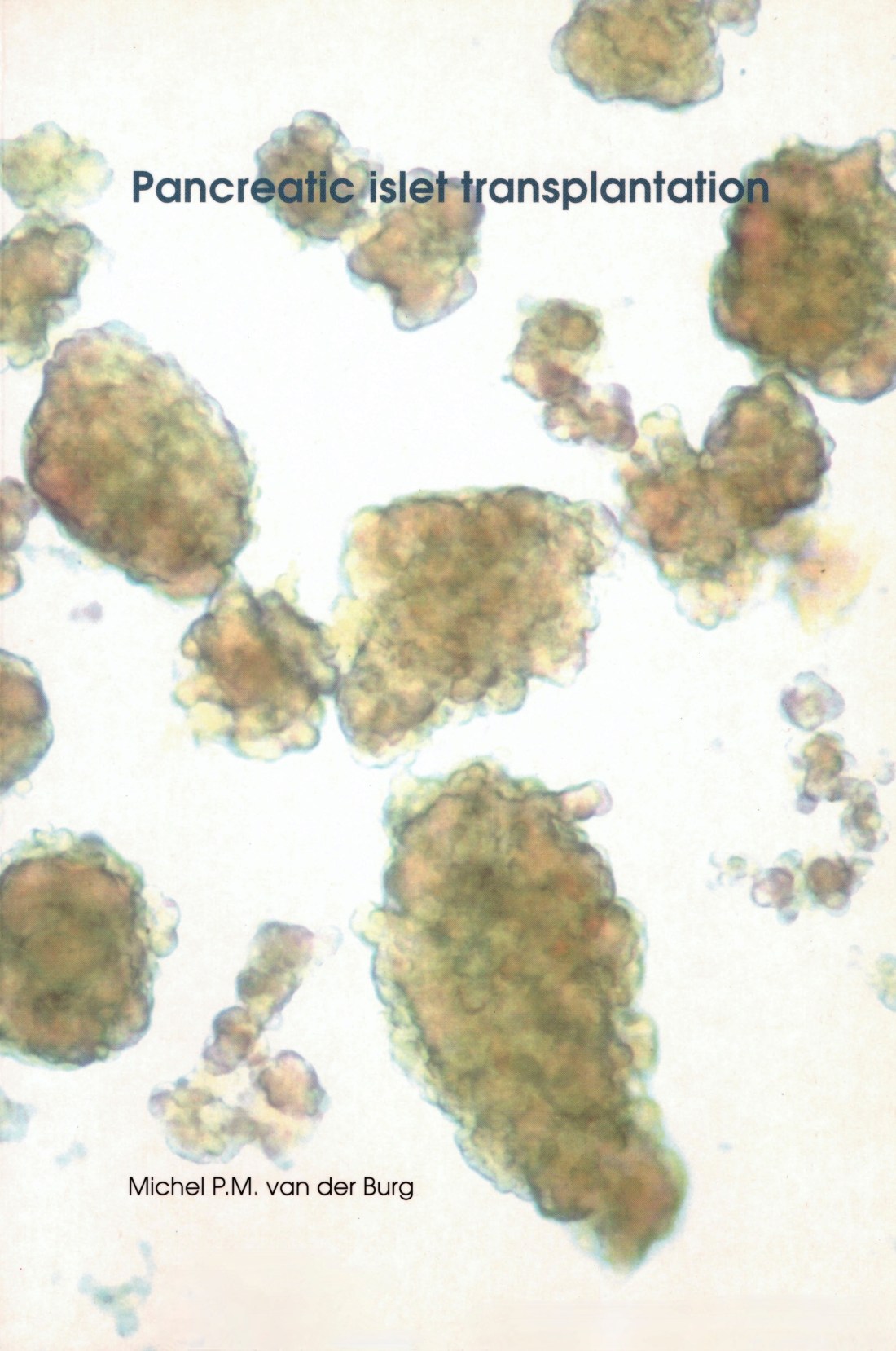
Cover | Pancreatic islet transplantation | ISBN 9789080216402 | 20221024 | Michel van der Burg | Miracles•Media | PUBLISHED ! Here the full cover with a French flap back-cover of the e-Book (pdf) edition of my doctoral thesis ‘Pancreatic islet transplantation’ – ISBN 9789080216402 – published and registered today, Oct 24th, 2022 . In short : Pancreatic islet isolation in the University of Wisconsin solution is a new concept introduced here … allowing transplantation of pure islets as an effective treatment in insulin-dependent diabetes. Distribution of the e-Book and full information follows this week.
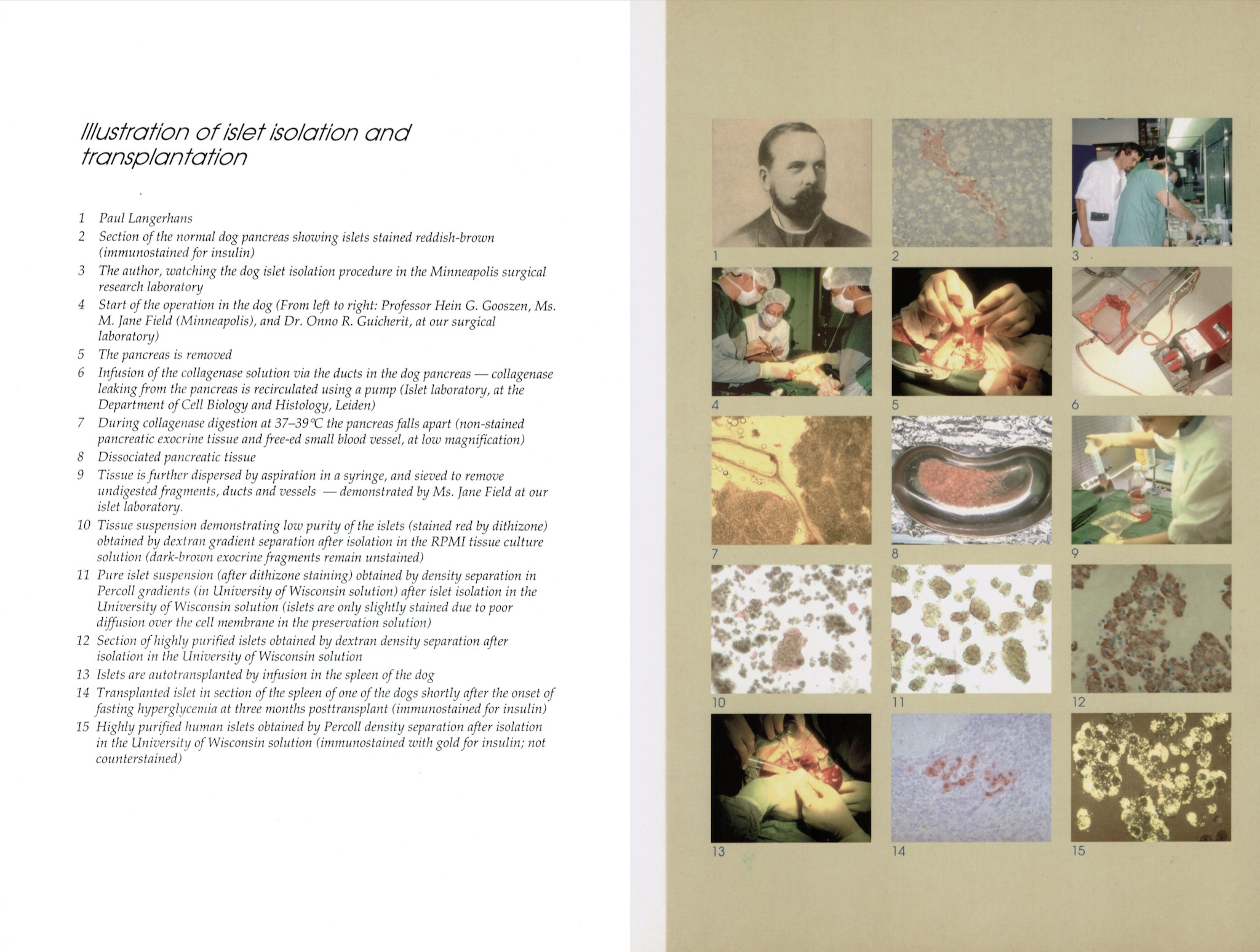
Blurb | Pancreatic islet transplantation | 20221023 | Michel van der Burg | Miracles•Media | French flap interior of paperback back cover with illustration of islet isolation and transplantation in the doctoral thesis Pancreatic islet transplantation – ISBN 9789080216402. Studies aiming at transplantation of the pancreatic Islets of Langerhans to prevent, postpone or ameliorate the long-term crippling complications of insulin-dependent diabetes mellitus (IDDM). Paperback published in 1994 ISBN 9789080216419 | 9080216410 , later this month published as eBook (pdf) ISBN 9789080216402.
Illustration of Islet Isolation and Transplantation
(Captions at last page of the dissertation)
1. Paul Langerhans
2. Section of the normal dog pancreas showing islets stained reddish-brown (immunostained for insulin)
3. The author, watching the dog islet isolation procedure in the Minneapolis surgical research laboratory
4. Start of the operation in the dog (From left to right: Professor Hein G. Gooszen, Ms. M. Jane Field (Minneapolis), and Dr. Onno R. Guicherit, at our surgical laboratory)
5. The pancreas is removed
6. Infusion of the collagenase solution via the ducts in the dog pancreas – collagenase leaking from the pancreas is recirculated using a pump (Islet laboratory, at the Department of Cell Biology and Histology, Leiden)
7. During collagenase digestion at 37-39°C the pancreas falls apart (non-stained pancreatic exocrine tissue and free-ed small blood vessel, at low magnification)
8. Dissociated pancreatic tissue
9. Tissue is further dispersed by aspiration in a syringe, and sieved to remove undigested fragments, ducts and vessels ~ demonstrated by Ms. Jane Field at our islet laboratory.
10. Tissue suspension demonstrating low purity of the islets (stained red by dithizone) obtained by dextran gradient separation after isolation in the RPMI tissue culture solution (dark-brown exocrine fragments remain unstained)
11. Pure islet suspension (after dithizone staining) obtained by density separation in Percoll gradients (in University of Wisconsin solution) after islet isolation in the University of Wisconsin solution (islets are only slightly stained due to poor diffusion over the cell membrane in the preservation solution)
12. Section of highly purified islets obtained by dextran density separation after isolation in the University of Wisconsin solution
13. Islets are autotransplanted by infusion in the spleen of the dog
14. Transplanted islet in section of the spleen of one of the dogs shortly after the onset of fasting hyperglycemia at three months posttransplant (immunostained for insulin)
15. Highly purified human islets obtained by Percoll density separation after isolation in the University of Wisconsin solution (immunostained with gold for insulin; not counterstained)
Reprint | 20221022 | Michel van der Burg | 1-memo•com | Silent film. Scanning for an ebook reprint – ISBN 9789080216402 – of the doctoral thesis Pancreatic islet transplantation. Studies on the isolation and transplantation of the pancreatic Islets of Langerhans to prevent, postpone or ameliorate the long-term crippling complications of insulin-dependent diabetes mellitus (IDDM). First published as a paperback in 1994 ISBN 9080216410 / 9789080216419 , and later this month published as eBook (pdf). TakeNode ID: 777e40a7-c148-4832-a24a-ff599c1845c5
Isolation of Islets of Langerhans for Transplantation in Type-1 Diabetic Patients.
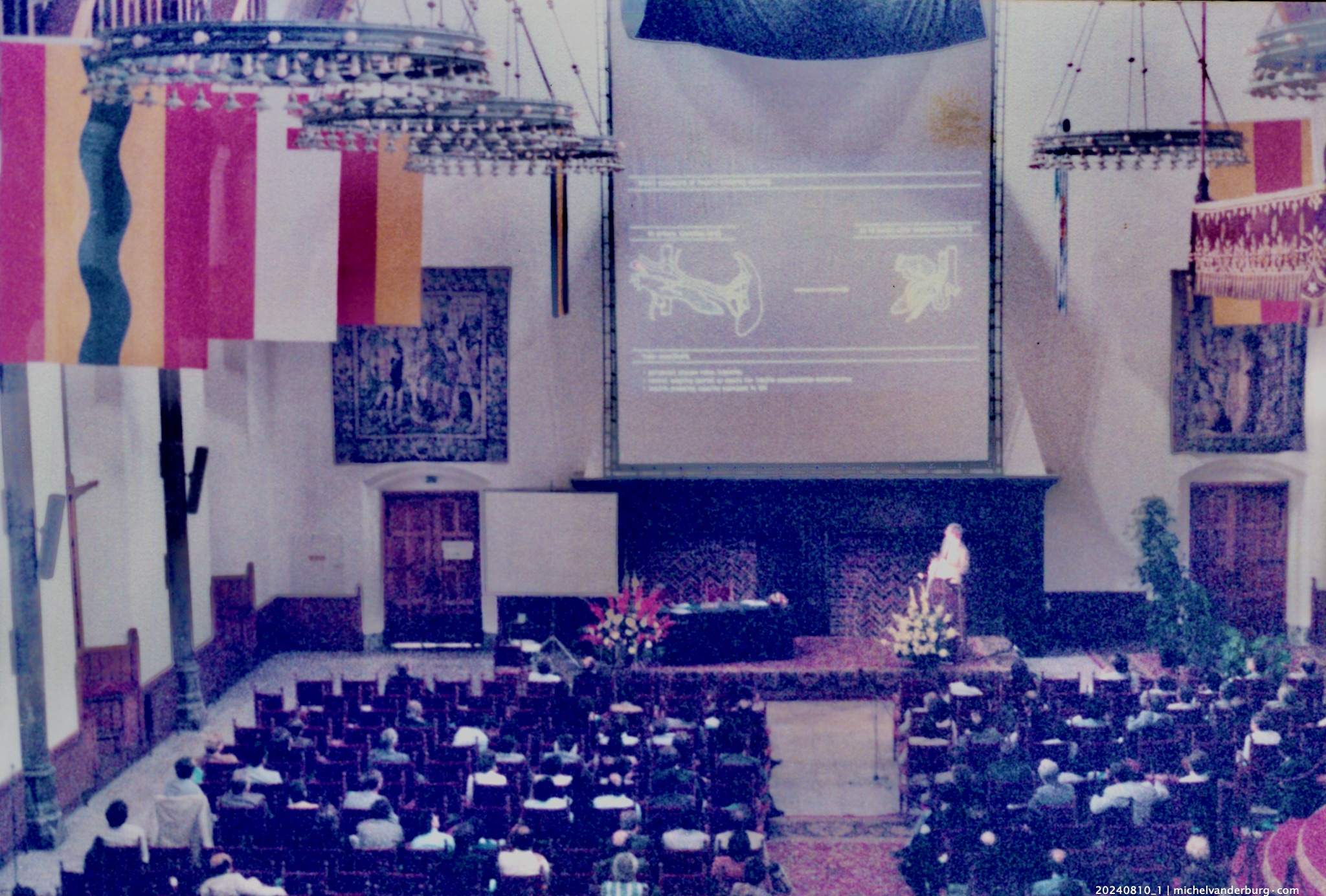
Here a film made of my ‘powerpoint’ presentation Feb 22, 2000 – on behalf of our Surgical Department – at the Opening Symposium of the Interdivisional GMP (‘Good Manufacturing Practice’) facility of the Leiden University Medical Centre – the LUMC in Leiden, Holland.
Background
I first started – with a background in biochemistry and philosophy – some 20 years earlier (from 1981) research at the Department of Surgery of the Leiden University Hospital (AZL) in the field of transplantation of the pancreas organ to cure diabetes.
Succesful Experiment Islet Transplantation
From 1986 my focus shifted to innovative procedures for the isolation out of the pancreas organ, of the ca 1 million islets of Langerhans – the insulin producing cell clumps with a size between ca 0.1 to 1 mm , that is 0.004 to 0,04 inch.
In 1989 we performed the first successful autologous transplantations in Holland (in collaboration with the Minneapolis Islet Lab with Jane Field and David Sutherland) – for the first time world-wide with pure islets using our novel procedure of using the organ preservation UW solution (University of Wisconsin / collaboration with dr Robert Carter , Du Pont, UK) during isolation in a pre-clinical large animal diabetes model – with long term transplant functioning with near-normal blood sugar regulation.
First series of human islet isolations , 1989-1990
Next in 1989-1990 we performed a first series of islet isolations from human donor pancreases using our novel techniques of isolation and purification in UW organ preservation solution – in association with a European Concerted Action for the Treatment of Diabetes – the Brussels headed (Daniel Pipeleers) ‘Multicenter program on the treatment of diabetes by islet cell transplantation’.
Exploring human islet work
Subsequently – after some years of exploring options for animal to human islet transplantation , using pig pancreas islets – so-called xenotransplantation – I was asked in 1997 to explore the requirements for operationalization of clinical islet transplantation in the LUMC. December 1997 our Surgical Department decided to go for it.
Establishing the human islet isolation laboratory in Leiden.
In 1998 after a month working in dr Camillo Ricordi’s Diabetes Research Institute in Miami, I started a large series of human islet isolation procedures in Leiden, and from september 1998 documenting the detailed GMP (‘Good Manufacturing Practice’) standard operating procedures, as well as ‘building’ our clinical islet isolation clean room with help from the Miami team in close cooperation with dr. Amon Wafelman (department of Clinical Pharmacy & Toxicology) managing the building of our brand new Interdivisional GMP-facility LUMC (IGFL) of six clean rooms and two chemical product laboratories – that was opened officially Feb 22, 2000 with the symposium, a film, and a tour in the GMP facility.
One year later the GMP islet facility was fully operational and summer 2001 we got a cautious green light (GMP license) for clinical transplantation of any high quality – approved – islet preparations.
Around the same time islet transplantation suddenly became very promising with ‘The Edmonton protocol’. However with the fast increase of logistic and financial demands, and reorganization between LUMC divisions it took till 2007 to finally start first transplants by an expanded islet team in the LUMC clinical islet center in Leiden.
Worldwide since 2000 several hundred people have received islet transplants that generally do not result in long term insulin independence , but do help sugar regulation in the transplant recipients.
Notes :
Links to some publications, news paper reports etc will follow later.
Updates:
Post updated with more details 20191215
Presentation ‘Isolation of Islets of Langerhans for Transplantation in Type-1 Diabetic Patients’ by Michel van der Burg, Feb 22, 2000 – Opening Symposium of the Interdivisional GMP facility of the Leiden University Medical Centre, Leiden, Netherlands. Film : 20191213 Michel van der Burg | miracles.media
Efficacy of the novel iodixanol-UWS density gradient for human islet purification
Slideshow (video) of my January 1999 oral presentation in Igls (Innsbruck), Austria, at the 18th Workshop of the AIDSPIT (Artificial Insulin Delivery Systems, Pancreas and Islet Transplantation) Study Group. (Now known as AIDPIT).
These results of this innovative islet purification method developed in our Leiden islet laboratory (LUMC) were the outcome of work I had done spring 1998 with the islet group of Camillo Ricordi in the “fast track” center for diabetes research at the Diabetes Research Institute in Miami , Florida, USA.
Original video title (file name) : 20181102 ~ Human Islet Purification Miami 1998
Updates:
20241202 – Text updated with extra info. Youtube video in post replaced by Vimeo edition. Copied 1-memo post to michelvanderburg.com .
20251101 – Vimeo video replaced with Youtube copy . Added @1MEMO in post title and citation info
Citation info : Human Islet Purification Miami 1998 • Michel van der Burg • Miracles.Media • @1MEMO 20181102 • URL michelvanderburg.com/2018/11/02/ • TakeNode 3f2ec4d2-afe0-4580-b055-92a2f231a4fa
Out Of Service | 20140911 | 1-memo•com | In the morning of 9/11 2001 logistics forced me to officially announce a temporarily – 1 week – ‘out of service’ of our Leiden islet isolation and transplant center. Our center was started earlier that summer of 2001 at the Leiden University Medical Center. So, I decided to have a short vacation abroad – heaven, after being on call 24/7 almost non stop for years. Later that day at home, I was downstairs watching TV — because upstairs near my workroom the central heating was being replaced – when I saw the CNN breaking news about the plane crashing into the World Trade Center. That day would become a landmark in history and the course of my life.
Background image : Microscopy picture I took of purified human Islets of Langerhans – tiny clumps (size around 1/10 mm or 1/25 inch) of 10s to 1000s of cells that produce hormones like insulin – these cells are just visible when you enlarge this 50x microscopy picture : as tiny translucent ‘balls’ or ‘spheres’. The red color is from a stain that binds to the insulin cells.
Iodixanol-UWS purified human islets, stained with dithizone. Original magnification 50x.
25 Years of the Ricordi Automated Method for Islet Isolation. Piemonti L, Pileggi A. in CellR4 2013; 1(1): e128. – URL https://www.cellr4.org/article/128
Credit : Out Of Service | 20140911 | 1-memo•com | TakeNode ID e22f209c-14da-40d8-b11a-74a29b1e80b4