Tuesday , November 19, 2013, Simon Gronowski arrives at Station Liège-Guillemins on his way to give a series of testimonies all day at the Saint Sépulcre school in Liège, Belgium. When he gets off on the platform, and teacher Philippe Renette and I – while filming – welcome him, Simon surprises us, showing me last Saturday’s news in the German national daily newspaper Die Welt (The World) at the front page of the weekly supplement Die Literarische Welt (The Literary World).
Unlikely Friends • Feinde Wie Wir
In the article ‘Feinde wie wir’ (Enemies like us) in the German newspaper Die Welt of November 16, 2013 (1), cultural journalist Felix Stephan reports on his conversation in Berlin with Simon Gronowski and Koenraad Tinel, which took place after their presentation there at the 13th International Literature Festival Berlin (2) of their book (3,4) ‘Enfin libérés’ / ‘Eindelijk bevrijd’ (Finally liberated) — the story of their history as children of war and the special friendship since their first meeting a year earlier, in 2012 (5).
The lead of the story reads as follows (my translation):
A story of reconciliation: Belgians Simon Gronowski and Koenraad Tinel were children during World War II: one a Jew whose family was murdered, the other the son of a committed Nazi. Decades later, they discover how close their lives were and send an emphatic message to Europe.
French, German, with English subtitles.
Enemies like us • Miracles•Media • 20250915_1 • TakeNode d6238cf6-2521-42fe-9323-a90d521a94f6
2. Finally Free after 70 years. Simon Gronowski and Koenraad Tinel (Belgium). internationales literaturfestival berlin (13.ilb), Sep 7, 2013.
3. Ni victime, ni coupable, enfin libérés. French edition (2013) by Simon Gronowski, Koenraad Tinel, David Van Reybrouck. Renaissance du livres ISBN 978-2507051051
4. Eindelijk bevrijd – geen schuld, geen slachtoffer. Dutch edition (2013) by Simon Gronowski, Koenraad Tinel, David Van Reybrouck. Hannibal ISBN 978-9491376405 . Reissue (2021) 978-9464366204
6. Enemies like us • Miracles•Media • 20250915_1 • TakeNode | Still (frame 340) Simon Gronowski shows Die Literarische Welt at Station Liège-Guillemins, Nov 19, 2013 , with a portrait photo of Simon Gronowski and Koenraad Tinel by Belgian photographer Dieter Telemans – https://www.dietertelemans.com
Citation info : News | Miracles Moment #5 | Miracles•Media | 20250915 | ISAN 0000-0007-36B4-0005-4-0000-0000-P | TakeNode 49f6c290-d00e-4969-9fec-fa1163517991
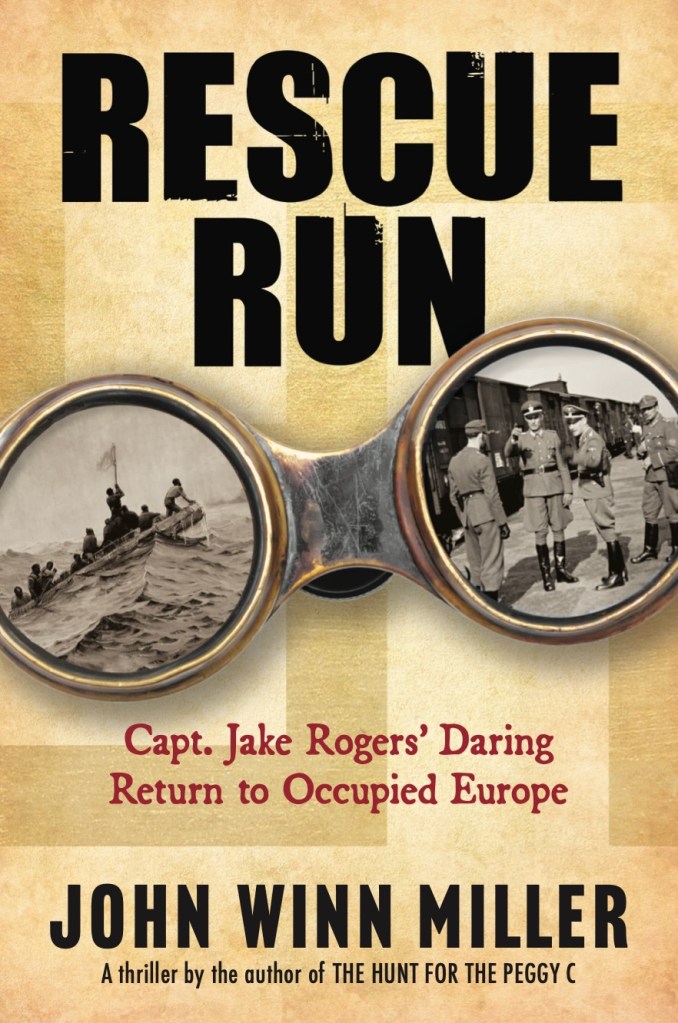
RESCUE RUN : Capt. Jake Rogers’ Daring Return to Occupied Europe • John Winn Miller
After escaping the treacherous waters of WWII, Captain Jake Rogers leads his crew on a daring mission across Nazi-occupied Europe to rescue the father of his beloved, entangled in a web of espionage, betrayal, and relentless pursuit.
Review of John Winn Miller’s novel ‘Rescue Run’
John Winn Miller, a veteran of investigative journalism for decades, masterfully weaves historical detail into his World War II novel Rescue Run. The story follows American ship’s captain Jake Rogers, who, after his U.S. Liberty ship carrying war supplies is wrecked in the North Atlantic, first lands in Ireland. He then sets out with a few of his loyal men on a perilous mission to rescue the father of Miriam Maduro, the love of his life, from the Westerbork transit camp in Nazi-occupied Holland.
A gruelling journey follows from Amsterdam across Nazi-occupied Europe to Spain – on foot, by train, and by boat – via a long series of hiding places, historical locations and events, aided by well-known and lesser-known resistance organisations and historical figures, besieged by con men, double agents, gangsters and pursued by a ruthless Dutch bounty hunter.
As a non-native English speaker, I initially struggled a bit with the first few chapters, particularly the maritime terms and rich language used in the sea adventure with the Liberty ship, besides the introduction of the many characters. However, once past those pages, the novel became a true page-turner. The gripping, almost cinematic narrative had me finishing the book in just two or three days, despite also spending some time online searching for even more historical context, for example when Rogers is helped by the Dutch resistance group ‘Groep 2000’ led by Jacoba van Tongeren, and when characters like Etty Hillesum and Audrey Hepburn appear in the story.
Blending Fiction and Nonfiction
I rarely read fiction these days — almost exclusively occupied with non-fiction — but John Miller’s work intrigued me. I was curious to see how he managed to incorporate the reality of Nazi-occupied Europe, and in particular the Westerbork transit camp, into fiction. The result is exceptional. The blend of fiction and nonfiction strengthens the narrative, bringing the past vividly to life. Miller also provides an extensive set of notes at the end of the book, offering in-depth background information on the events and historical figures featured in the story, detailing also what happened to them after the events of the novel.
I especially appreciate how John Winn Miller brings the wartime past to life in Rescue Run, with accuracy and rich detail, from multiple perspectives. His cinematic storytelling draws readers into a narrative that inspires further exploration of this history.
Michel van der Burg, filmmaker, editor of Settela•Com
Notes
Additional Information:
Title:Rescue Run: Capt. Jake Rogers’ Daring Return to Occupied Europe
John Winn Miller is an award-winning investigative reporter, foreign correspondent, editor, publisher, screenwriter, indie movie producer and novelist. | Photo Bancroft Press. | More info at Miller’s website URL https://www.johnwinnmiller.com
John Winn Miller
Though Rescue Run is a sequel to Miller’s first novel, The Hunt for the Peggy C, no prior knowledge of the first book is required. A summary of the prequel is included for new readers or those needing a refresher.
Westerbork Film Frame
This review was prompted by my contribution of a still (image below) from the Westerbork film for Rescue Run’s jacket/cover, in collaboration with designer Christine Van Bree , and author John Winn Miller. John kindly provided me with a link for a free download of the Advance Reader Copy on the BookSirens’ platform. Since I’m documenting the Westerbork film through the online magazine Settela•Com, I happily accepted BookSiren’s invitation to join the review team.
Deportation | 20240225 | Settela•Com | Commander Albert Gemmeker oversees the deportation of Jews, Sinti, and Roma from the Westerbork transit camp May 19, 1944 | Frame 7426 from Deportation Westerbork Film | 20210719 | Settela•Com | ISSN 2949 9313
Citation info : Review RESCUE RUN • 20240927 • Michel van der Burg • Settela•Com • ISSN 2949-9313
Today 80 years ago, Isabella Weinreb was three months pregnant with Viviane , when she jumped in the night of 19-20 April 1943, around 2AM from the 20th deportation train – Transport XX – from Mechelen direction Auschwitz.
Isabella escaped with a broken wrist , and knocked on the door of this St. Kamillus institute in Bierbeek, where she was helped further on her escape route back home in Brussels. Viviane was born 6 months later at in Brussels.
Viviane, who is now living in the USA, returned this week – on Holocaust Remembrance Day – to the place her mother escaped and saved both their lives, together with photographer Jo Struyven , author Nathalie Strubbe, and documentary filmmaker Michel van der Burg. During the St. Kamillus visit , reporter Tom de Leur made with photographer Dirk Vertommen an interview published April 19, 2023 in the flemish Belgian newspaper Nieuwsblad – https://m.nieuwsblad.be/cnt/dmf20230418_97055388 – “Vivianes moeder was zwanger van haar toen ze van de trein sprong die haar naar de gaskamers moest leiden”
Yesterday, April 19, 2023 , Viviane Yarom told her story of the escape from Transport XX, at the Study Day on the occasion of the 80th anniversary of the 20th convoy presented by the Jewish Museum of Belgium and The Auschwitz Foundation in the Jewish Museum of Belgium, in Brussels.
In the Jewish Museum of Belgium , the exhibition ‘236 – Land(es)capes from the 20th convoy’ by Jo Struyven and Luc Tuymans, runs until Mon 14 August.
April 19th also the catalog book by Jo Struyven and Daniel Weyssow (Auschwitz Foundation) was published , which includes dutch and french editions of “Escape from Transport XX…born 6 months later” translated from the original english text of a chapter in the ebook published April 19, 2019 : Viviane Yarom-Castegnier & Michel van der Burg. ‘Viviane’s Story: Escape from Transport XX… Born 6 Months Later’. Download available via Miracles.Media – https://miracles.media/vivianesstory/.
License info : Viviane’s Story in Belgian Newspaper | 20230420 | Miracles•Media | TakeNode 6394354b-afb1-46ac-b635-2f5d33c15c76
From 20 January 2023, the Jewish Museum of Belgium, in partnership with the Auschwitz Foundation, presents the exhibition entitled ‘236, Land(es)capes from the 20th Convoy’. It is set up in the museum’s project space and offers an artistic look at an exceptional and forgotten event in the Second World War.
The 20th convoy
At 10 p.m. on April 19, 1943, the 20th convoy departed from the Kazerne Dossin transit camp in Mechelen with 1,631 Jewish deportees in cattle cars, heading for Auschwitz. Thanks to resistance actions, both inside the wagons and from outside, 236 of these deportees managed to jump from that train, that was leading them to extermination. An unique event in Europe under the Nazi administration.
Jo Struyven, photographer
The work of the Belgian photographer Jo Struyven (°Sint-Truiden, 1961) takes us back to these acts of resistance – commemorating the 80th anniversary in 2023 – and gives us a glimpse of the landscapes in which this striking story took place. Taking the perspective of those who jumped off that train, an act for which many of them paid with their lives, Struyven creates a contemporary ‘memorial’ with 19 large ‘nocturnal’ black and white images, and one colour print.
Jo Struyven :
The 20th convoy, heading for the unspeakable “Auschwitz”, crossed the area where I grew up, barely 50 meters from my childhood bedroom — I found out 2 years ago after meeting Simon Gronowski. Ever since, I imagine the distress of the deportees. The destination was unknown to them. Some, sensing the worst, tried to escape it. I wanted to give an account of this border between life and death, between resignation and the impossibility of choosing, and the freedom regained with resistance to the oppressor’s plans.
Works presented by Jo Struyven
Land(es)capes from the 20th Convoy, 2020-2022, 19 black and white prints, 1 color print, 90×60 cm (Private collection – Belgium)
Jo Struyven, Land(es)capes from the 20th convoy 2020-2022, black and white print, 90x 60 cm, Wijchmaal (Private Collection, Belgium)Jo Struyven, Land(es)capes from the 20th Convoy 2020-2022, black and white print, 90x 60 cm, Bierbeek (Private Collection, Belgium)Jo Struyven, Land(es)capes from the 20th Convoy 2020-2022, black and white print, 90x 60 cm, Borgloon (Private Collection, Belgium)Jo Struyven, Land(es)capes from the 20th Convoy 2020-2022, black and white print, 90x 60 cm, Piringen (Private Collection, Belgium)Jo Struyven, Land(es)capes from the 20th Convoy 2020-2022, black and white print, 90x 60 cm, Botzelaer (Private Collection, Belgium)
Luc Tuymans, visual artist
In dialogue with Jo Struyven’s photographs, two works by Belgian visual artist Luc Tuymans (°Mortsel, 1958) evoke the destruction of the Jews and Roma of Europe. Die Wiedergutmachung (The Reparation) depicts body parts – left the eyes of gypsy children who had been experimented on by the Nazis. … images that in its incompleteness, reflect the inability to represent facts and memory .
Works presented by Luc Tuymans
Luc Tuymans, Our New Quarters, 1986, Oil on canvas, 80,5 x 120 cm (MMK – Germany) (Photo Ben Blackwell, courtesy David Zwirner, New York, London)Luc Tuymans, Die Wiedergutmachung, 1989, Oil on cardboard, mounted on plywood, Oil on canvas; diptych, 36,6 x 43 cm, 39,4 x 51,8 cm, courtesy: Private collection (Photo Studio Luc Tuymans)
Art after the Shoah
“Writing a poem after Auschwitz is barbaric”, wrote German philosopher Theodor W. Adorno in 1949. Through two contemporary perspectives from the visual arts, this exhibition seeks to address this question of the (im)possibility of art after the Shoah in a new way.
Testimonies & Catalogue
This exhibition will be accompanied by a catalogue book edited by Daniel Weyssow and Jo Struyven and published by the Auschwitz Foundation entitled Land(es)capes from the 20th Convoy (press release on April 19, 2023), as well as an educational space presenting the testimonies from interviews and archives of convoy escapees.
Info+ ( & Français | Nederlands)
236 Land(es)capes from the 20th Convoy Jo Struyven / Luc Tuymans Exhibition at the Jewish Museum of Belgium, in Brussels, Belgium 20 January – 14 August 2023 Brussels Website https://www.mjb-jmb.org
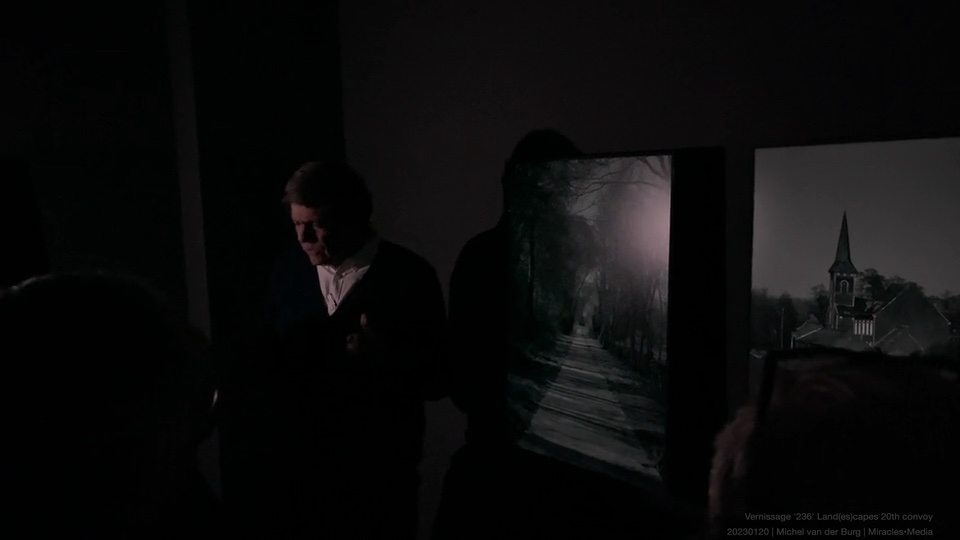
Video report : Vernissage ‘236’ Land(es)capes 20th convoy
Thursday January 19th, 2023, the vernissage of the photo exhibition 236 — Land(es)capes from the 20th Convoy was opened with speeches by Philippe Blondin, President of the Jewish Museum, and by Pierre-Yves Jeholet , Minister-President of the Government of the Federation Wallonia-Brussels. Next, the Belgian photographer Jo Struyven presented his work — escape landscape photographs glowing in the dark — like being lit by moonlight — as well as paintings contributed by Luc Tuymans in the project space. The exhibition runs from January 20 – August 14, 2023 in the Jewish Museum of Belgium, Brussels, Belgium. Video report (20230120) Michel van der Burg | Miracles•Media .
Jan 20, 2023 – VRT | Kristien Bonneure (Belgian Flemish Broadcast) 20 jan 2023
Photographer Jo Struyven presents a preview of his work last night , Thursday January 19th, 2023 at the vernissage of 236 — Land(es)capes from the 20th Convoy , an exhibition of works by Jo Struyven and Luc Tuymans in the Jewish Museum of Belgium, Brussels, Belgium, open from today for the public January 20 – August 14, 2023.
On April 19, 1943, the 20th transport left the Mechelen transit camp to deport 1,631 Jews to Auschwitz. Thanks to resistance actions, both inside and outside the wagons, 236 of these deportees managed to jump from the train that would lead them to destruction.
Photographer Jo Struyven revisits this unique act of resistance in Western Europe during the Nazi regime and shows us the landscapes in which this little-known story took place.
The vernissage was opened by Philippe Blondin, President of the Jewish Museum, and by Pierre-Yves Jeholet , Minister-President of the Government of the Federation Wallonia-Brussels.
Follow-up post tomorrow 20230121.
License info : Vernissage ‘236’ Land(es)capes 20th convoy | 20230120 | Michel van der Burg | Miracles•Media | TakeNode 5e71633a-0ff2-44bf-99dc-34f3db25bb26