Short impression (some clips) of my visit on Friday evening, April 11, 2025, to the Atelier Marcel Hastir in Brussels, at the start and closing of ‘Auschwitz, our story’— documentary and lecture by Herman Teerhöfer, with the participation of Natalia and Julia Kotarba of the Karski Quartet. Herman Teerhöfer of the Smolinski Foundation interviewed 91 Auschwitz survivors over the past fourteen years. Through his documentary Auschwitz, Our Story, he explains how they managed to survive Auschwitz spiritually, oscillating between hope and fear.
Citation info : Auschwitz Survivors In Brussels • Michel van der Burg • Miracles•Media • @1MEMO 20250418 • TakeNode 9eeb9646-f769-41d6-9b97-ccf27bf5c7a5
Almost certainly, three Jewish people have been recognized in the unique Westerbork film from 1944 (1). This time it concerns the 9-year-old boy Israël Wijnschenk, his father Max Wijnschenk, and his grandmother Betje Kokernoot-van Furth, who all lived in Utrecht (Holland).
Last week, the Dutch public broadcaster NOS (2) reported the news from the Utrecht (Dutch) news site Nieuws030 (3) that it is very likely that three people were recognized again in this film made by the Jewish prisoner and filmmaker Rudolf Breslauer showing the deportation of Jews, Roma and Sinti by train in Camp Westerbork on May 19, 1944.
Image researcher Koen Hulsbos — who previously identified an Amsterdam couple in this deportation train (4) — thought he recognized the young Israël Wijnschenk, a pupil at the time of the Joodse (Jewish) School Utrecht, and presented this to Victor Frederik, researcher of the Joodse School (5,6). The boy, the man, and the woman seem to belong together, and were recognized from family photos, also by family members.
It is certain that Max and his wife Chel (not in the images) returned to Utrecht after the war, their children Israël and his sister Kitty were murdered. Grandma Betje was also gassed in Auschwitz.
A portrait of Israël Wijnschenk is shown at the site of Joods Monument (7).
According to the transport list, there were two other children in that wagon, Joseph Beugeltas (11 years old) and Manfred Studzinsky (7 years old). Joseph Beugeltas appeared to have blond hair, and could not have been it (6). To be completely sure, the researchers are still looking for a photo of Manfred Studzinsky, for comparison…
Filmmaker Rudolf Breslauer also filmed two of his children in the Westerborkfilm…
Stefan (left) & Ursula Breslauer, children of Rudolf Breslauer, the filmmaker of the Westerbork film at the farm of Camp Westerbork in 1944 – identified by the dutch photographer Sake Elzinga, who received Breslauer’s family photo albums last year when the family of Ursula – the only survivor – visited an expo on Breslauer in the Westerbork museum in the Netherlands.
Camp commander (SS-Obersturmführer) Albert Gemmeker ordered the Westerbork film , made by the German Jewish prisoner, photographer, Rudolf Breslauer in the spring of 1944.
Today 80 years ago – March 5, 1944 – the camp is an ‘Arbeitslager’ – a work camp – when Rudolf Breslauer starts filming the daily life of the Westerbork prisoners — inside : in the barracks, for example a religious service, cabaret, workshops, factories, aircraft and battery recycling, medical care, and outside the barracks : construction of a greenhouse, a football match, women working out, chopping wood, incoming transports, and eventually also the departure of a deportation train. After Breslauer films the deportation of Jews, Roma and Sinti to Bergen-Belsen and Auschwitz on May 19, 1944 the filming stops. The haunting image of the 9-year-old dutch Sinti-girl Settela, standing in the closing doors of the goods train, and the unique footage of that deportation train that leaves the Westerbork camp, became iconic after the war.
Deportation Breslauer family
Werner Rudolf Breslauer , his wife Bella Weihsmann, sons Stefan and Max Michael (Mischa), and daughter Ursula were deported autumn 1944 from Westerbork to Theresienstadt and Auschwitz. Only Ursula survived.
Stefan & Ursula Breslauer in Westerborkfilm | 20240305 | Settela•Com | Frame 127475 from Westerbork Film 🎦 2021 | 20220302 | Settela•Com | ISSN 2949 9313 | Footage filmed by Rudolf Breslauer in 1944, courtesy of NIOD | Sound and Vision
Scene with Stefan & Ursula Breslauer, starting at 56:13 in the 1986 RVD edition of the Westerborkfilm: Stefan & Ursula Breslauer in Westerbork Film RVD | 20240305 | Settela•Com | URL https://youtube.com/clip/UgkxfNzA72JeGgVoOFp_VTI4EQQr3yTwXu6_
Settela Film | 20220630 | Michel van der Burg | Settela•Com
Deportation Westerbork Film | 20210719 | Michel van der Burg | Settela•Com
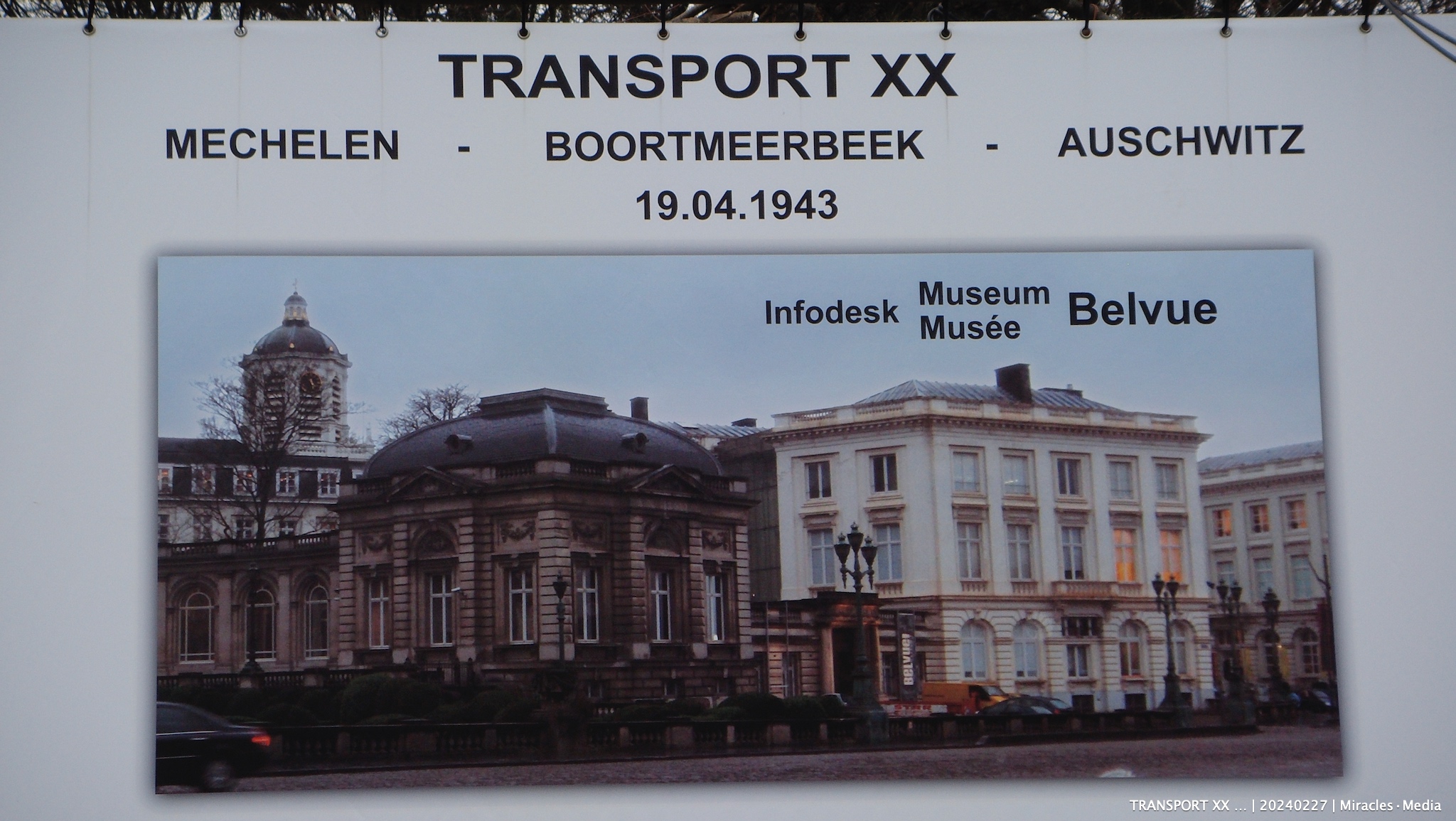
TRANSPORT XX — installation Brussels February 28th, 2009, Brussels. Day two, of my encounter with the TRANSPORT XX installation outside in the Royal park in Brussels, that presented 1200 photographic portraits of Jews deported from Malines (Belgium) to Auschwitz in 1943. One of the stills and establising video shots made that Saturday morning after finishing long take video recordings of the installation, during a walk from our hotel in the Leopold (European) Quarter via the Royal park direction the historic centre of Brussels. That weekend break in Brussels, today 15 years ago, turned out to be a turning point in my life. Two months later – April 19, 2009 – the film TRANSPORT XX — installation Brussels was published.
8. First Encounter TRANSPORT XX … | 20240227 | Michel van der Burg | Miracles•Media | URL https://michelvanderburg.com/2024/02/27 | TakeNode cf0dd64d-4512-4846-8bce-6b2d8cca24ef
9. Camera used for both photo and video (720p HD video) of the TRANSPORT XX installation in Brussels is the Sony DSC-T500 which has a CCD sensor – with global shutter – thus not affected by rolling shutter distortion while panning the installation.
Citation info : Encounter TRANSPORT XX … | 20240228 | Michel van der Burg | Miracles•Media | URL https://michelvanderburg.com/2024/02/28 | TakeNode a8317838-7470-4538-b788-40e6cc07b55a
February 28th, 2009, Brussels — my first encounter with the TRANSPORT XX installation in Brussels, that presented 1200 photographic portraits of Jews deported from Malines (Belgium) to Auschwitz in 1943. Turning point in my life. Two months later – April 19, 2009 – the film was published.
Citation info : First Encounter TRANSPORT XX … | 20240227 | Michel van der Burg | Miracles•Media | URL https://michelvanderburg.com/2024/02/27 | TakeNode cf0dd64d-4512-4846-8bce-6b2d8cca24ef