Cover image of the Hebrew edition על אנני לא מדברים – We don’t talk about Anny – by author Simone Korkus, published by Carmel , in a translation by Irish Bauman of the original Dutch book Het dienstmeisje van Degrelle (2017) .
Jul 22, 2022 , Israel. Book presentation this morning at Simone Korkus’ home, of the Hebrew edition על אנני לא מדברים – We don’t talk about Anny. Special event in honor of Hannah and Max Nadel, Henri and Madeleine Cornet, Elias and Hava Gnazik. Picture by Embassy of Belgium in Israel | Twitter
Anny
Anny (or Annie) is the war name – nom de guerre – of the Jewish Hannah Nadel who , during the Second World War, ends up as a maid in the Brussels house of the sister of Léon Degrelle — Belgium’s foremost Nazi collaborator — and in this way escapes the horrors of the persecution of the Jews. Simone Korkus brings this unlikely story to life, meets Hannah’s Belgian rescuers and shows how life in wartime contains many gray zones. While Simone Korkus reconstructs Hannah’s life in Brussels, she encounters family secrets and also runs into her own prejudices. For what is truth in the way we look at others and judge their behavior? And how does our memory distort traumas such as those after World War II?
Degrelle’s maid , has been published also in 2020 in a French edition La Servante de Degrelle.
Transport XX to Auschwitz | Viviane’s Story
Hannah Nadel-Gnazik is the daughter of Elias Gnazik who escaped from deportation with Transport XX to Auschwitz and helped jump Isabella Weinreb-Castegnier pregnant with Viviane who was born six months later – see e-book Viviane’s Story | Escape from Transport XX…Born 6 Months Later by Viviane Yarom-Castegnier & Michel van der Burg – With a Foreword by Simone Korkus | URL miracles•media/vivianesstory .
We don’t talk about Anny | Simone Korkus | 20220722 | miracles•media
Ever Changing Film | Behind the scenes Now Take a Bow Edition Sep 27 2010 | Project Jonathan Puckey & Roel Wouters and co-workers – nowtakeabow•nl – with music by Touki Delphine | 20220719 | 1-memo•com | Behind the scenes of the ever changing short film Now Take a Bow with online cutting room, crowdsourcing camera shots. Co-working around 00:16 GMT with A Free Dance’ scene online, playing a ‘leading role’ live recording some prerecorded ipod dance clips, for edition Mon 27 Sep 2010 030006 GMT of Now Take a Bow (shown partly in this film from 31 sec) by filmmakers Jonathan Puckey & Roel Wouters, Holland, Sep 27 2010. Celebrating the KORT! 10th anniversary (NTR) ….
the process is the product | Conditional Design Manifesto by Luna Maurer, Edo Paulus, Jonathan Puckey, Roel Wouters Links
studiomoniker•com
puckey•studio
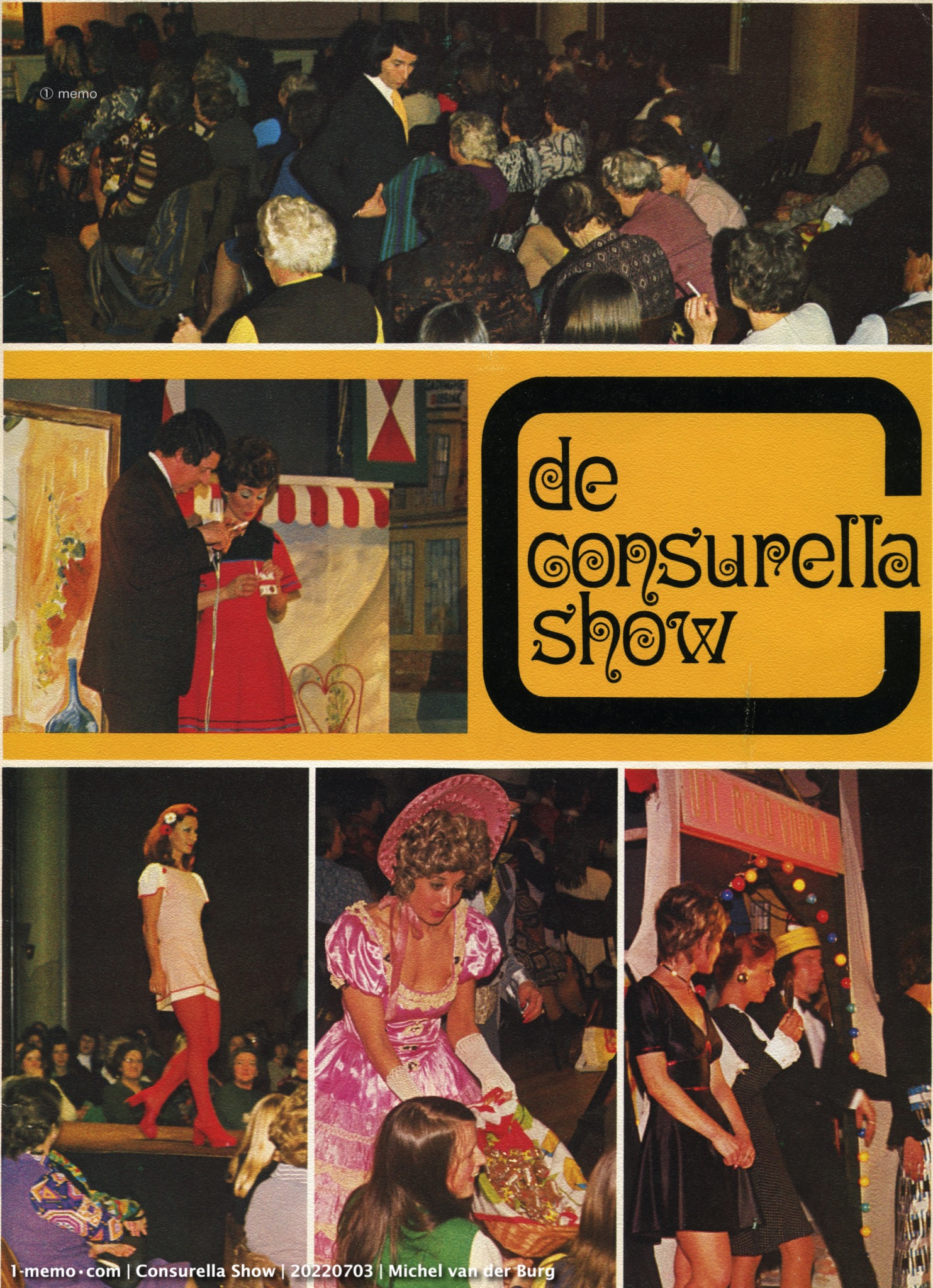
Consurella Show | 20220703 | Michel van der Burg | 1-memo.com | Brochure of the 1973 visual report I made in Dordrecht, Holland – my first assignment as a photographer – of the Consurella Show’s touring in Holland in 1973-1974.
My next assignment was the autonomous creation of images for a new show design with projection of the images as the decor in these live shows made up of real commercials supplemented with fake commercials. First 10 test shows (early 1973) had attracted ca 5000 visitors from Dutch housewives’ organizations. Another 50 shows were planned to tour in cities all over Holland Sep’73-May’74.
Early Nov ’73 I visited the new show using the slideshow decor of images I had made.
I was a Leiden University student Biochemistry at the time, and invested a new camera for this job – Asahi Pentax SLR camera.
New 2022 slow motion edition based on the newly found camera-original footage (the original negative film used in Breslauer’s camera May 19, 1944) as published last year in Deportation Westerbork Film | 20210719 (REF 1).
Before in 2017 a similar first slow-motion film was published (Settela | 20170721) (REF 2) that was using the ‘duplicate’ footage (not original footage) from the 1986 RVD film (REF 3).
The 9-year-old dutch Sinti-girl Anna Maria ‘Settela’ Steinbach peeks outside , at the last moment just before the sliding door is closed , standing inside a freight wagon with 74 people on May 19 , 1944 in the Westerbork concentration camp in Holland , when this deportation train leaves for Auschwitz-Birkenau – where Settela is murdered a few months later in one of the gas chambers. Here she wears a headscarf made from a torn sheet, because the Nazis had her head shaved , and while Settela peeks outside , her mother cries behind her in the car : “Get out of there, or soon your head gets in between!”
She was filmed by the Jewish prisoner filmmaker Rudolf Breslauer as part of a documentary film being made on the Westerbork camp (REF 4,5). More info in previous posts (REF 1–10).
This film starts with a slow-motion edition (15% original speed) , followed by the unedited 3-4 seconds clip taken from the 2021 Deportation Westerbork Film (REF 1) . Note : the images bounce occasionally , due to a technical artifact — a defect in Breslauer’s camera (REF 10).
Credit
Settela Film | 20220630 | Michel van der Burg | Settela•Com – CC BY 4.0
Settela | 20220629 | Settela•Com – CC BY 4.0 | Scan camera original negative film May 19, 1944 footage Westerbork Film
The 9-year-old dutch Sinti-girl Anna Maria ‘Settela’ Steinbach peeks outside , at the last moment just before the sliding door is closed , standing inside a freight wagon with 74 people on May 19 , 1944 in the Westerbork concentration camp in Holland , when this deportation train leaves for Auschwitz-Birkenau – where Settela is murdered a few months later in one of the gas chambers. Here she wears a headscarf made from a torn sheet, because the Nazis had her head shaved , and while Settela peeks outside , her mother cries behind her in the car : “Get out of there, or soon your head gets in between!”
She was filmed by the Jewish prisoner filmmaker Rudolf Breslauer as part of a documentary film being made on the Westerbork camp (REF 1). More info in references (REF 1, 2, 3, 4).
Credit
Still image from Westerbork Film 🎦 2021 | 20220302 | Settela•Com – CC BY 4.0
Falaise #55 | Happy ! | 20220605 | Michel van der Burg | 1-memo•com | Sunset reflection on the Falaises d’Ault – the Ault Chalk Cliffs on the Alabaster coast – Côte d’Albâtre – in France, May 2022. Music : Two Third by The Places | Artlist.
Breslauer films Settela after Degen kids | Excerpt (20220510) from Westerbork Film 🎦 2021 | Michel van der Burg | Settela•Com – Click image for video clip (Link in REF 10).
The original deportation footage of the annotated 2021 Westerbork film (REF 1) provides insight into Breslauer’s way of filming.
Focussing on film roll 2 of the deportation reel it is evident that Breslauer — right after filming the toddlers Marc and Stella Degen (REF 11) in 3rd class carriage I at the front of the train ( 00:16:49 ) — for his next shot ( 00:16:52 ) went all the way to the rear of the train for a close-up of the 9-year-old Settela Steinbach in cattle car number 16 — with Romani and Sinti people bound for Auschwitz (REF 6,12).
Further note that the first shot that day also focusses on a child, here in cattle car #7 with Jewish people (REF 6) bound for Auschwitz (00:20:18 start of roll 4/4 of reel E198).
The 2021 Westerbork film as mentioned in the recently presented Westerborkfilm Introduction (REF 2) is the outcome of a thorough search that started Spring 2019 for all available film cans in the Dutch media archives of Sound & Vision and the EYE Filmmuseum. All restored unique shots using both the camera original film and film copies (duplicates – when no original is known) were used for the new restored Westerbork film compilation made available as ‘display edition’.
Sound & Vision curator Valentine Kuypers reported in her dutch blog 12 May 2021 (REF 3) that a total of 23 film cans were found, including 2 cans with camera-original negative film – a discovery , because before only reels with film duplicates (copies) were known with only a few minutes section of original footage (see below). For the new 2021 Westerbork film “a compilation of unique scenes in the highest quality was made. Eight films from the archives of Sound & Vision and Eye were used for the compilation, consisting of: 16 mm original negative, duplicate negative, duplicate positive and original reversal film. ” [my translation].
Digital restoration with a conservative approach was used to stabilize and reframe the images , deflicker , and remove dust, scratches, and visible splices (REF 4). The display copy for distribution was color graded and adjusted for the correct playback speed.
Examination of the Westerbork Film for annotation showed the film starts with the two newly discovered camera-original reels E325 and E198, resp.
The first reel (E325) has sections of footage shot at various work sites of the Westerbork camp — starting 00:00:29 and ending at 00:14:22 — that can be traced back in the 1986 RVD Westerbork Film duplicates Act 2 and Act 3 , listed with numbers 5 , 17 , 12 , 5, 18, 9, 10, 9, 10, 19, 20 resp. in the post (REF 5) Westerbork Film – full version (RVD). The last scene on this reel E325 – a newly discovered clip of a few seconds – is showing a soldier standing guard at the camp entrance.
Dutch researchers Koert Broersma and Gerard Rossing reported in their new book on the film (REF 6) that the footage on both reels – although original – has been cut — with reel E325 showing 7 splices. I wasn’t able to discover splices, probably because of the digital restoration. The next reel E198, however, with the deportation footage, clearly does show 2 of the 3 spices reported by Broersma and Rossing — these show up as white transitions in this digital display edition around 0:16:22 – https://www.youtube.com/watch?v=ZiLNDziwEtc&t=982s – and 0:18:14 – https://www.youtube.com/watch?v=ZiLNDziwEtc&t=1094s – resp. The location of that 3rd splice that is no longer showing in this restored film could be traced with help of the image of that splice published in Broersma and Rossing ‘s book , page 110 (REF 6) – right after Gemmeker looking up , starting 00:20:18 — https://www.youtube.com/watch?v=ZiLNDziwEtc&t=1218s .
Since the splices between the film rolls on this reel could be identified here , the film roll numbers 1 to 4 are specified in the annotations.
The display edition of this deportation footage shows the order of the rolls found on reel E198. For the correct chronological order clearly rolls 1 and 4 have to change places, as shown before in the reconstruction Deportation Westerbork Film | 20210719 (REF 7).
The reels E325 and E198 with original film are followed by reels with restored duplicate films – omitting scenes already shown as original footage :
i) first, the 4 reels (acts) of the restored RVD film (REF 5);
ii) next, the so-called Unknown Westerbork Film Reel…F1014 (REF 8) starting with the Transport data animation at 02:03:31 ;
iii) and finally, the so-called Forgotten Westerbork Film Reel…F1015 (REF 9) starting at 02:11:53 with the Gevaert logo. Footage of the Religuous service on this F1015 reel was reported by Broersma and Rossing (REF 6) to be original film also .
CREDITS
Special thanks to researchers, authors, Koert Broersma, Gerard Rossing, and Aad Wagenaar, to curator Valentine Kuypers and her Sound & Vision colleagues Gerard Nijssen and others. The new Westerbork film project is a joint effort of four dutch organizations : the Dutch media archive Sound & Vision, Camp Westerbork Memorial Centre , the NIOD Institute for War, Holocaust and Genocide Studies, and the Jewish Cultural Quarter in Amsterdam.
Westerbork Film Shots Order | 20220511 | Michel van der Burg | Settela•Com – CC BY 4.0
12 – Settela, het meisje heeft haar naam terug (1995-2007) by Aad Wagenaar ISBN 9789089751898 / English translation by Janna Eliot ‘Settela’ (2005-2016) ISBN 978-0-9933898-2-5 .