The new 2021 Westerbork Film is missing part of the image in every frame …
The new high quality restored Westerbork film, presented first May 2021 by the Netherlands Institute for Sound & Vision and the NIOD Institute for War, Holocaust and Genocide Studies, has numerous advantages over the previous well known first edition of the Westerborkfilm made in 1986 in 4 acts by the dutch Rijksvoorlichtingsdienst (RVD ; the Dutch National Centre for Information) .
The full 1986 film including all 4 acts , was first published in 2019 at Settela•Com (Ref 1), with annotations for the various scenes. That 1986 Westerborkfilm however does not include all of the footage shot by Rudolf Breslauer, Spring 1944 in Camp Westerbork, in the Netherlands.
Footage not used in the 1986 Westerbork film compilation was presented in a series of posts published later in 2019 at Settela•Com.
Next, a film compilation of all that known footage was posted online as the WESTERBORK FILMS COLLECTION – UNESCO ALBUM (Ref 2). That film compilation was also made available for download 20 January 2020 by Michel van der Burg | Miracles.Media via the Open Images bank of Sound & Vision (Ref 3). That compilation was prepared without checking / deleting duplicate copies of footage, and thus contains redundant footage.
The 2021 restored Westerbork film is a major upgrade from the 1986 Westerborkfilm edition. Important advantages of the 2021 Westerbork film are , (i) new high quality 4K scans were made of the footage, (ii) containing a complete selection of all known footage, (iii) using only the best copies of all footage found in the archives, (iv) based on an extensive new inventory of all known archives, with the discovery of 2 canisters with ‘camera-original’ footage, and a hitherto unknown clip, and (v) with conservative, digital, restoration applied. Details on that new restored Westerbork film were discussed July 2021 with the co-publication of an important part of the 2021 Westerbork film : the new high quality deportation footage — a film compilation of scans of the newly discovered original camera negative film used by Rudolf Breslauer 19 May 1944 in Camp Westerbork, in the Netherlands (Ref 4).
The complete Westerbork Film 2021 was published too at Settela•Com on May 7, 2022 with all scenes annotated (Ref 5), together with a short introductory film : Westerborkfilm Introduction (Ref 6).
Note that additional digital restoration has been applied by Sound & Vision for the publicly made available so-called ‘display edition’ of this new 2021 Westerbork film according to Conservator Valentine Kuypers | Sound and Vision (Ref 7) – as discussed previously at Settela•Com (Ref 4).
Missing Part Images
It should be noted that the released 2021 ‘display edition’ of the Westerbork film – due to the applied image stabilization – does show less of the actual image in each frame as compared to the 1986 edition.
Below some examples illustrating the crop in the display edition.
2021 edition | not showing ‘nazi with bike’ | 20230519 | Settela•Com
2021 edition – not showing ‘nazi with bike’ in same scene, near identical frame — though he shows up in later frames a few seconds later, walking away ) – https://youtu.be/ZiLNDziwEtc?t=882
Settela’s car (not) showing 74p•
Next a comparison of the frame displaying “74 p.” (chalked on the car with Settela). The dot is shown in the 1986 film. That dot is missing in the 2021 film due to the cropped image resulting from the image stabilization.
Of note : first news clips presented by Sound & Vision announcing the new restored film , are apparently not based on the ‘display edition’, and do show that dot in the original 4K scan.
The full image — including the dot ’74 p.” — was shown in a first news item Sep 12, 2019 on the daily dutch ‘Nieuwsuur’ national news show , on colorized high quality deportation footage, that mentioning the new original footage. Item “Iconische beelden Tweede Wereldoorlog na 75 jaar in kleur” ; URL https://nos.nl/nieuwsuur/artikel/2301340-iconische-beelden-tweede-wereldoorlog-na-75-jaar-in-kleur
Jan 2020 Sound & Vision publicly showed and announced the newly discovered camera original footage via the daily dutch news show NOS (Ref 8) showing the images with no crop — including the dot ’74 p.” and presented an 8 min film compilation a few days later via their Vimeo channel also (at 0021) shwoing 74 Pers • (with dot) . URL https://vimeo.com/386667241
In 2021 Sound & Vision apparently started using the ‘display edition’ for publications on the new found original Westerbork deportation footage ; such as the YouTube uploads “De Westerborkfilm 📽️🎞️” (uploaded Apr 8, 2021) – https://youtu.be/8Y-A4BkWY18?t=2 , a video presented first I believe April 18, 2021 in an online Media Café event by Sound & Vision , and May 18, 2021 on the occasion of the public release of the restored film (Ref 9), in the 20 min presentation “Gerestaureerde filmbeelden Westerbork (1944)” of a compilation of selected images from the restored film – missing again the dot at 0:47 – https://youtu.be/-zCmr6PSNcI?t=47
Missing Image Westerbork Film 2021 | 20230519 | Michel van der Burg | Settela•Com | ISSN 2949-9313
References
1. Westerbork Film | Full version RVD 1986 | 20190605 | Michel van der Burg | Settela•Com | ISSN 2949-9313
2. WESTERBORK FILMS COLLECTION – UNESCO ALBUM | 20200120 | Michel van der Burg | Settela•Com | ISSN 2949-9313
3. WESTERBORK FILMS COLLECTION – UNESCO ALBUM (20200120) Michel van der Burg | Settela•Com | ISSN 2949-9313 | CC BY 4.0 | Open Images – URL https://www.openimages.eu/media/1223905
5. Westerbork Film 🎦 2021 | 20220302 | Michel van der Burg | Settela•Com | ISSN 2949-9313 | Display edition film annotated online in CC
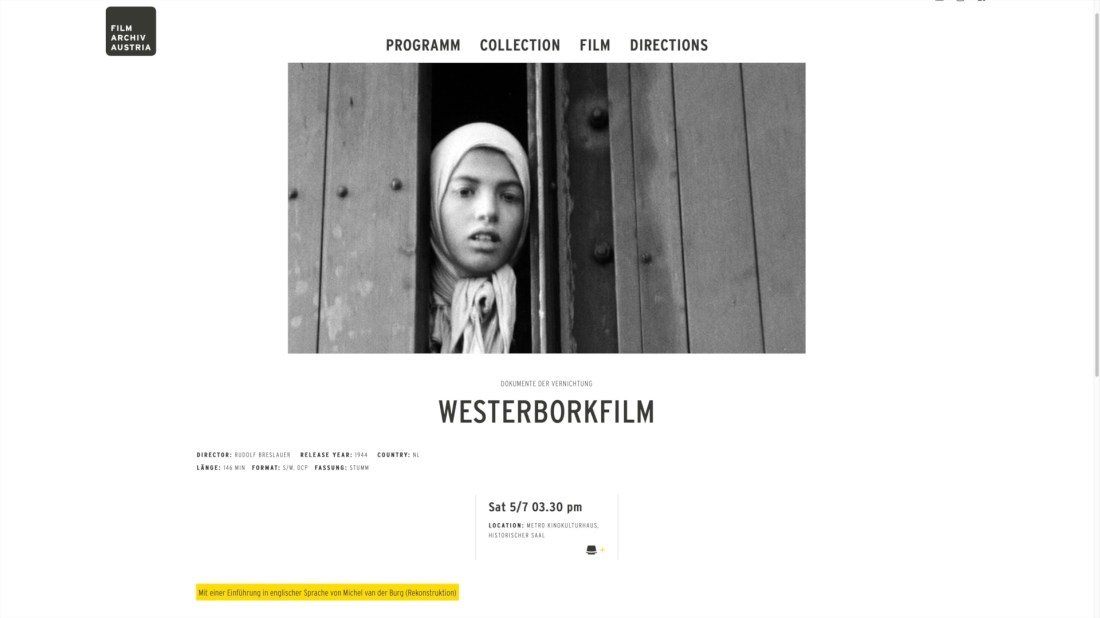
6. Westerborkfilm Introduction | 20220507 | Michel van der Burg | Settela•Com | ISSN 2949-9313 | Introduction by Michel van der Burg on the Westerborkfilm screening in METRO Kinokulturhaus , Vienna , Austria at the DOCUMENTS OF DESTRUCTION | DOKUMENTE DER VERNICHTUNG Symposium 6-7 May, 2022 curated by Florian Widegger. Presented by Filmarchiv Austria in cooperation with the Vienna Jewish Film Festival and the Mauthausen Memorial.
Breslauer films Settela after Degen kids | Excerpt (20220510) from Westerbork Film 🎦 2021 | Michel van der Burg | Settela•Com – Click image for video clip (Link in REF 10).
The original deportation footage of the annotated 2021 Westerbork film (REF 1) provides insight into Breslauer’s way of filming.
Focussing on film roll 2 of the deportation reel it is evident that Breslauer — right after filming the toddlers Marc and Stella Degen (REF 11) in 3rd class carriage I at the front of the train ( 00:16:49 ) — for his next shot ( 00:16:52 ) went all the way to the rear of the train for a close-up of the 9-year-old Settela Steinbach in cattle car number 16 — with Romani and Sinti people bound for Auschwitz (REF 6,12).
Further note that the first shot that day also focusses on a child, here in cattle car #7 with Jewish people (REF 6) bound for Auschwitz (00:20:18 start of roll 4/4 of reel E198).
The 2021 Westerbork film as mentioned in the recently presented Westerborkfilm Introduction (REF 2) is the outcome of a thorough search that started Spring 2019 for all available film cans in the Dutch media archives of Sound & Vision and the EYE Filmmuseum. All restored unique shots using both the camera original film and film copies (duplicates – when no original is known) were used for the new restored Westerbork film compilation made available as ‘display edition’.
Sound & Vision curator Valentine Kuypers reported in her dutch blog 12 May 2021 (REF 3) that a total of 23 film cans were found, including 2 cans with camera-original negative film – a discovery , because before only reels with film duplicates (copies) were known with only a few minutes section of original footage (see below). For the new 2021 Westerbork film “a compilation of unique scenes in the highest quality was made. Eight films from the archives of Sound & Vision and Eye were used for the compilation, consisting of: 16 mm original negative, duplicate negative, duplicate positive and original reversal film. ” [my translation].
Digital restoration with a conservative approach was used to stabilize and reframe the images , deflicker , and remove dust, scratches, and visible splices (REF 4). The display copy for distribution was color graded and adjusted for the correct playback speed.
Examination of the Westerbork Film for annotation showed the film starts with the two newly discovered camera-original reels E325 and E198, resp.
The first reel (E325) has sections of footage shot at various work sites of the Westerbork camp — starting 00:00:29 and ending at 00:14:22 — that can be traced back in the 1986 RVD Westerbork Film duplicates Act 2 and Act 3 , listed with numbers 5 , 17 , 12 , 5, 18, 9, 10, 9, 10, 19, 20 resp. in the post (REF 5) Westerbork Film – full version (RVD). The last scene on this reel E325 – a newly discovered clip of a few seconds – is showing a soldier standing guard at the camp entrance.
Dutch researchers Koert Broersma and Gerard Rossing reported in their new book on the film (REF 6) that the footage on both reels – although original – has been cut — with reel E325 showing 7 splices. I wasn’t able to discover splices, probably because of the digital restoration. The next reel E198, however, with the deportation footage, clearly does show 2 of the 3 spices reported by Broersma and Rossing — these show up as white transitions in this digital display edition around 0:16:22 – https://www.youtube.com/watch?v=ZiLNDziwEtc&t=982s – and 0:18:14 – https://www.youtube.com/watch?v=ZiLNDziwEtc&t=1094s – resp. The location of that 3rd splice that is no longer showing in this restored film could be traced with help of the image of that splice published in Broersma and Rossing ‘s book , page 110 (REF 6) – right after Gemmeker looking up , starting 00:20:18 — https://www.youtube.com/watch?v=ZiLNDziwEtc&t=1218s .
Since the splices between the film rolls on this reel could be identified here , the film roll numbers 1 to 4 are specified in the annotations.
The display edition of this deportation footage shows the order of the rolls found on reel E198. For the correct chronological order clearly rolls 1 and 4 have to change places, as shown before in the reconstruction Deportation Westerbork Film | 20210719 (REF 7).
The reels E325 and E198 with original film are followed by reels with restored duplicate films – omitting scenes already shown as original footage :
i) first, the 4 reels (acts) of the restored RVD film (REF 5);
ii) next, the so-called Unknown Westerbork Film Reel…F1014 (REF 8) starting with the Transport data animation at 02:03:31 ;
iii) and finally, the so-called Forgotten Westerbork Film Reel…F1015 (REF 9) starting at 02:11:53 with the Gevaert logo. Footage of the Religuous service on this F1015 reel was reported by Broersma and Rossing (REF 6) to be original film also .
CREDITS
Special thanks to researchers, authors, Koert Broersma, Gerard Rossing, and Aad Wagenaar, to curator Valentine Kuypers and her Sound & Vision colleagues Gerard Nijssen and others. The new Westerbork film project is a joint effort of four dutch organizations : the Dutch media archive Sound & Vision, Camp Westerbork Memorial Centre , the NIOD Institute for War, Holocaust and Genocide Studies, and the Jewish Cultural Quarter in Amsterdam.
Westerbork Film Shots Order | 20220511 | Michel van der Burg | Settela•Com – CC BY 4.0
12 – Settela, het meisje heeft haar naam terug (1995-2007) by Aad Wagenaar ISBN 9789089751898 / English translation by Janna Eliot ‘Settela’ (2005-2016) ISBN 978-0-9933898-2-5 .
Spring 1944 a film is being made in the Westerbork camp, ordered and produced by camp commander SS-Obersturmführer Albert Gemmeker. Cameraman is the German Jewish prisoner Rudolf Breslauer – the camp photographer. In addition film scripts were made, but the film was never really finished or edited.
Westerbork Film Dossier
In 2017 the film dossier – with the film footage and production documents – enters the UNESCO Memory of the World Register (REF 1) . The final part of the UNESCO registry (Le film de Westerbork – édité le 8 mai 2017 – ID code 2016-118 ) lists all the documents on the Westerbork Film at the NIOD Institute for War, Holocaust and Genocide Studies (REF 2).
That NIOD archive file — called (translated) : Directing, texts and correspondence of the film “Westerbork” has been scanned and made available online. The file contains film scripts, title cards, and the correspondence on the film.
Westerbork Film
May 7, 2022 the latest edition of the Westerbork Film – a compilation of digitally restored footage – was posted with annotations as optional closed captions – CC (REF 3). In addition a short film ‘Westerborkfilm Introduction’ was posted (REF 4) that addresses briefly the history, context, and contents of the film dossier, camp and film crew, postwar route of the film footage, including a glimpse of the film plan, title cards and correspondence.
Production documents
Before , the title cards (REF 5) and the film scripts (REF 6) were posted.
All other production documents – a file with correspondence between the camp and the outside world on obtaining camera’s , film and film processing – are detailed chronologically here in this short silent film “Westerbork Film Correspondence | 20220509” .
CREDITS
Source : NIOD Institute for War, Holocaust and Genocide Studies | 250i Westerbork, Judendurchgangslager | 854 Stukken over de Westerbork-film, 7 maart – 20 april 1944 en z.d. | File retrieved May 23, 2019 from Nationaal Archief (REF 10).
Westerbork Film Correspondence | 20220509 | Michel van der Burg | Settela•Com – CC BY 4.0
9 – Settela, het meisje heeft haar naam terug (1995-2007) by Aad Wagenaar ISBN 9789089751898 / English translation by Janna Eliot ‘Settela’ (2005-2016) ISBN 978-0-9933898-2-5 .
Westerbork Film Plan
Spring 1944 a film is being made in the Westerbork camp, ordered and produced by camp commander SS-Obersturmführer Albert Gemmeker. A Film Plan propasal – 1.5 page – is written by his personal assistant the German prisoner Dienstleiter Heinz Todtmann – a journalist before WW2. Cameraman is the German Jewish prisoner Rudolf Breslauer – the camp photographer – who may have contributed to this filmplan too. In addition to the film plan , more detailed scripts were made with camera instructions and edit instructions. The film was never really finished or edited.
Westerbork Films Dossier
In 2017 the complete film dossier enters the UNESCO Memory of the World Register — including the film footage, the scripts, the drawn title cards, and the camp correspondence on the film (REF 1) . The final part of the UNESCO registry (Le film de Westerbork – édité le 8 mai 2017 – ID code 2016-118 ) lists all the documents on the Westerbork Film at the NIOD Institute for War, Holocaust and Genocide Studies.
That NIOD archive file — called (translated) : Directing, texts and correspondence of the film “Westerbork” consists of a file containing the original screenplay or script for the film, title cards, notes, correspondence and administration . That entire file has been scanned (total of 60 black and white scans) and is available online.
Westerbork Film
May 7, 2022 the complete remastered 2021 edition of the Westerbork Film – a compilation of digitally restored footage – was posted with annotations as optional closed captions – CC (REF 2) .
Westerborkfilm Introduction
May 7, 2022 also a short film ‘Westerborkfilm Introduction’ was posted (REF 3) that addresses briefly the history, context, and contents of the film dossier, camp and film crew, postwar route of the film footage, including a glimpse of the film plan, title cards and correspondence.
Title Cards
The title cards were posted in detail May 2021 (REF 4).
Film Scripts
Likewise now the film scripts (REF 5) are detailed in this short silent film Westerbork Film Scripts | 20220508 .
9 – Settela, het meisje heeft haar naam terug (1995-2007) by Aad Wagenaar ISBN 9789089751898 / English translation by Janna Eliot ‘Settela’ (2005-2016) ISBN 978-0-9933898-2-5 .
Westerborkfilm Introduction | 20220507 | Michel van der Burg | Settela•Com | Introduction by Michel van der Burg on the Westerborkfilm first showing May 7, 2022 in cinema METRO Kinokulturhaus , Vienna , Austria at the DOCUMENTS OF DESTRUCTION | DOKUMENTE DER VERNICHTUNG Symposium 6-7 May, 2022 curated by Florian Widegger. Presented by Filmarchiv Austria in cooperation with the Vienna Jewish Film Festival and the Mauthausen Memorial.
This introduction is now screening via YouTube , and embedded above.
Westerborkfilm with introduction – DOKUMENTE DER VERNICHTUNG Symposium 6-7 May, 2022 curated by Florian Widegger. Presented by Filmarchiv Austria in cooperation with the Vienna Jewish Film Festival and the Mauthausen Memorial
CREDITS & REFERENCES
Special thanks to Valentine Kuypers , curator at Sound and Vision, image researcher Gerard Nijssen, and the Westerbork Memorial Center researchers Bas Kortholt , Koert Broersma and Gerard Rossing. Aad Wagenaar, research journalist and author of book Settela.
Work on the 2021 Westerbork film edition has been a joint effort of four dutch organizations : the Dutch media archive Sound & Vision, Camp Westerbork Memorial Centre , the NIOD Institute for War, Holocaust and Genocide Studies, and the Jewish Cultural Quarter in Amsterdam.
The Westerbork film, May 7, 2022 at the symposium DOKUMENTE DER VERNICHTUNG of the Jüdischen Filmfestival Wien , the Mauthausen Memorial , and Filmarchiv Austria.
Settela, het meisje heeft haar naam terug (1995-2007) by Aad Wagenaar ISBN 9789089751898 / English translation by Janna Eliot ‘Settela’ (2005-2016) ISBN 978-0-9933898-2-5 .
Documentary film Settela, gezicht van het verleden by Cherry Duyns (VPRO, 1994).
De Westerborkfilm 📽️🎞️ | Nederlands Instituut voor Beeld & Geluid | YouTube Apr 8, 2021 URL https://youtu.be/8Y-A4BkWY18
Gerestaureerde filmbeelden Westerbork (1944) (May 18, 2021) Nederlands Instituut voor Beeld en Geluid | Youtube (accessed 2021 Jul 19) URL: https://youtu.be/-zCmr6PSNcI
Kamp Westerbork gefilmd (May 2021) Koert Broersma, Gerard Rossing (editor Gorcum B.V., Koninklijke van) ISBN 9789023257622.
‘Kamp Westerbork gefilmd’ by Koert Broersma and Gerard Rossing (editors Dirk Mulder and Ben Prinsen) ISBN 9023232658
Dawn Skorczewski & Bettine Siertsema (2018): ‘The kind of spirit that people still kept’: VHA testimonies of Amsterdam’s Diamond Jews, Holocaust Studies URL: https://doi.org/10.1080/17504902.2018.1516361
Diamantkinderen: Amsterdamse Diamantjoden en de Holocaust . Translated title of the contribution: Diamond Children: Amsterdam’s Diamond Jews and the Holocaust. Siertsema, Bettine (2020) Uitgeverij Verbum ISBN 9789493028340
Fabian Schmidt (2020): The Westerbork Film Revisited: Provenance, the Re-Use of Archive Material and Holocaust Remembrances, Historical Journal of Film, Radio and Television, URL : https://doi.org/10.1080/01439685.2020.1730033
Westerbork Film Scripts | 20220508 | Michel van der Burg | Settela•Com
Westerbork Film Correspondence | 20220509 | Michel van der Burg | Settela•Com
ANONYM | Girl with the headscarf … | 20210416 | Michel van der Burg | Settela•Com
Westerbork Film in ‘Proces Rauter’ 1948 | 20190520 | Michel van der Burg | Settela•Com
Westerbork Film 🎦 2021 | 20220302 | Michel van der Burg | Settela•Com | Display edition annotated online in CC.
Westerborkfilm Introduction | 20220507 | Michel van der Burg | Settela•Com | Introduction by Michel van der Burg on the Westerborkfilm screening in METRO Kinokulturhaus , Vienna , Austria at the DOCUMENTS OF DESTRUCTION | DOKUMENTE DER VERNICHTUNG Symposium 6-7 May, 2022 curated by Florian Widegger. Presented by Filmarchiv Austria in cooperation with the Vienna Jewish Film Festival and the Mauthausen Memorial.
Westerbork Film 🎦 2021 | The complete remastered edition of the Westerbork Film , here annotated online in CC – by Michel van der Burg as an ongoing integrating resource.
The original display edition of the restored Westerbork film was edited only for black bar removal conform 4:3 format and insertion of a title card intro and outro. Annotations are added as CC – closed captions.
Source : digital display edition of the restored Westerbork film compilation made available in Public Domain by Sound and Vision from May 18, 2021. Courtesy of Collection NIOD held at the Netherlands Institute for Sound and Vision. Source File : Westerbork (gerestaureerd) | Display edition. Retrieved (20210518) PID: URN:NBN:NL:IN:20-ZCRLTUSICOSDILNR .
Credit line :
Westerbork Film 🎦 2021 | 20220302 | Michel van der Burg | Settela•Com – CC BY 4.0
Description & Introduction film
The Westerbork Film – a silent film – is unique…the only authentic documentary footage filmed in a Nazi camp – a waiting room for death in the Netherlands for more than 100,000 Jews, and Roma, Sinti, and resistance workers. A documentary filmed spring 1944, in the Westerbork camp, by the German-Jewish camp prisoner Rudolf Werner Breslauer – the camp photographer, and commissioned by camp commander, SS-Obersturmbannführer, Albert Konrad Gemmeker.
The Westerbork camp was set up in 1939 before the war in Holland, by the Dutch government, as a central refugees camp for Jewish refugees from Nazi-Germany.
July 1942 , when the Nazi’s decided to start ‘Entjüdung’ of the Netherlands, they took over the camp for use as transit camp for deportation of mainly Jews, and Roma, Sinti, and resistance people to eastern Europe.
March 2, 1944 , SS leader Rauter in the Netherlands reports to Germany’s SS Reichsführer Himmler : the Netherlands are ‘Judenfrei’. March 5, 1944 the camp is ‘Arbeitslager’ – a work camp – when
Rudolf Breslauer starts filming the daily life of the Westerbork prisoners. After Breslauer films the deportation of Jews, Roma and Sinti to Bergen-Belsen and Auschwitz on May 19, 1944 the filming stops. The film is also not edited. In 1986 the dutch RVD Information Center makes a first montage in 4 acts of the footage into what is known now as the Westerborkfilm. In 2017 the film dossier – film and production documents – enter the UNESCO Memory of the World Register. Spring 2019 the Westerbork Film – full version (RVD) was published online and annotated – https://settela.com/2019/06/05/westerbork-film-full-version-rvd/ .
Spring 2019 the dutch Sound & Vision , EYE Filmmuseum and NIOD (former RIOD) started a major restauration project and search for all footage of the Westerbork film in all archives.
Two reels with original negative film were discovered by image researcher Gerard Nijssen.
All restored unique shots using both the camera original film and film copies (prints – when no original is known) were used for the new restored Westerbork film compilation made available as ‘display edition’ – with no title actually – by Sound and Vision | NIOD on May 18, 2021.
This newly restored 2021 version of the Westerbork film , 145 min long – was prepared for presentation here in 4:3 format (black bars removed) with a 6 seconds title card superimposed both at the start and the end of the film (superimposed on the originally 30 sec intro text and 17 sec outro text sections by Sound & Vision), in order not to change the length of the film – to allow exact reference to the original file’s timeline.
Westerbork Film 🎦 2021 | 20220302 was first uploaded March 2, 2022, and is now after annotation of the online film made public May 7, 2022 together with a short introductory film : Westerborkfilm Introduction | 20220507 | Michel van der Burg | Settela•Com | An introduction film by Michel van der Burg on the Westerbork film with a first showing May 7, 2022 in METRO Kinokulturhaus , Vienna , Austria at the DOCUMENTS OF DESTRUCTION | DOKUMENTE DER VERNICHTUNG Symposium 6-7 May, 2022 curated by Florian Widegger. Presented by Filmarchiv Austria in cooperation with the Vienna Jewish Film Festival and the Mauthausen Memorial.
Annotations
On YouTube called Chapters – there limited number due to limit number of characters in description
NOTE : for this shot right after the Degen toddlers, Breslauer had to move all the way back to last cars of the transport to Auschwitz – May 19, 1944 – E198 Roll 2/4
00:17:03 Outbound transport to Bergen-Belsen and Auschwitz – May 19, 1944 – Original Reel E198 Roll 2/4
00:17:49 Gemmeker group passing camera in the middle
00:17:55 Outbound transport to Bergen-Belsen and Auschwitz – May 19, 1944 – Original Reel E198 Roll 2/4
Original Reel E198 Roll 3/4
00:18:13 Outbound transport to Bergen-Belsen and Auschwitz – May 19, 1944 – Original Reel E198 Roll 3/4
00:18:51 On the right : SS-Obersturmführer Albert Gemmeker , Commander of Westerbork transit camp
00:18:56 Outbound transport to Bergen-Belsen and Auschwitz – May 19, 1944 – Original Reel E198 Roll 3/4
Special thanks to Valentine Kuypers , curator at Sound and Vision, image researcher Gerard Nijssen, and the Westerbork Memorial Center researchers Bas Kortholt , Koert Broersma and Gerard Rossing. Aad Wagenaar, research journalist and author of book Settela.
Work on the 2021 Westerbork film edition has been a joint effort of four dutch organizations : the Dutch media archive Sound & Vision, Camp Westerbork Memorial Centre , the NIOD Institute for War, Holocaust and Genocide Studies, and the Jewish Cultural Quarter in Amsterdam.
The Westerbork film, May 7, 2022 at the symposium DOKUMENTE DER VERNICHTUNG of the Jüdischen Filmfestival Wien , the Mauthausen Memorial , and Filmarchiv Austria.
Settela, het meisje heeft haar naam terug (1995-2007) by Aad Wagenaar ISBN 9789089751898 / English translation by Janna Eliot ‘Settela’ (2005-2016) ISBN 978-0-9933898-2-5 .
Documentary film Settela, gezicht van het verleden by Cherry Duyns (VPRO, 1994).
De Westerborkfilm 📽️🎞️ | Nederlands Instituut voor Beeld & Geluid | YouTube Apr 8, 2021 URL https://youtu.be/8Y-A4BkWY18
Gerestaureerde filmbeelden Westerbork (1944) (May 18, 2021) Nederlands Instituut voor Beeld en Geluid | Youtube (accessed 2021 Jul 19) URL: https://youtu.be/-zCmr6PSNcI
Kamp Westerbork gefilmd (May 2021) Koert Broersma, Gerard Rossing (editor Gorcum B.V., Koninklijke van) ISBN 9789023257622.
‘Kamp Westerbork gefilmd’ by Koert Broersma and Gerard Rossing (editors Dirk Mulder and Ben Prinsen) ISBN 9023232658
Dawn Skorczewski & Bettine Siertsema (2018): ‘The kind of spirit that people still kept’: VHA testimonies of Amsterdam’s Diamond Jews, Holocaust Studies URL: https://doi.org/10.1080/17504902.2018.1516361
Diamantkinderen: Amsterdamse Diamantjoden en de Holocaust . Translated title of the contribution: Diamond Children: Amsterdam’s Diamond Jews and the Holocaust. Siertsema, Bettine (2020) Uitgeverij Verbum ISBN 9789493028340
Fabian Schmidt (2020): The Westerbork Film Revisited: Provenance, the Re-Use of Archive Material and Holocaust Remembrances, Historical Journal of Film, Radio and Television, URL : https://doi.org/10.1080/01439685.2020.1730033
Westerbork Film Scripts | 20220508 | Michel van der Burg | Settela•Com
Westerbork Film Correspondence | 20220509 | Michel van der Burg | Settela•Com
ANONYM | Girl with the headscarf … | 20210416 | Michel van der Burg | Settela•Com
Westerbork Film in ‘Proces Rauter’ 1948 (20190520) Michel van der Burg | Settela•Com
Westerbork Film 🎦 2021 | 20220302 | Michel van der Burg | Settela•Com | Display edition film annotated online in CC
Westerborkfilm Introduction | 20220507 | Michel van der Burg | Settela•Com | Introduction by Michel van der Burg on the Westerborkfilm screening in METRO Kinokulturhaus , Vienna , Austria at the DOCUMENTS OF DESTRUCTION | DOKUMENTE DER VERNICHTUNG Symposium 6-7 May, 2022 curated by Florian Widegger. Presented by Filmarchiv Austria in cooperation with the Vienna Jewish Film Festival and the Mauthausen Memorial.
20220511 Info on order of shots added in post Westerbork Film Shots Order | 20220511 . Based on that info , here the Annotations list now has sub-headings like ‘Original Reel E325’ etc.
20220604 – Format changes credit line , references