Deportation of Dutch Roma to Auschwitz – 19 May 1944 • 9-year-old Anna Maria (Settela) Steinbach was deported together with 244 other Roma from Westerbork to Auschwitz (1,2) • Source : Settela•Com • Collection Auschwitz Museum • URL https://fb.watch/Hgg5lusc-8/
The Auschwitz Museum acquired the short film ‘Settela’ from Settela•Com (1) in the Auschwitz Memorial Collection (3), and is succesfully screening the film each year since 2019 on the 19th May at the Auschwitz Memorial / Muzeum Auschwitz facebook page .
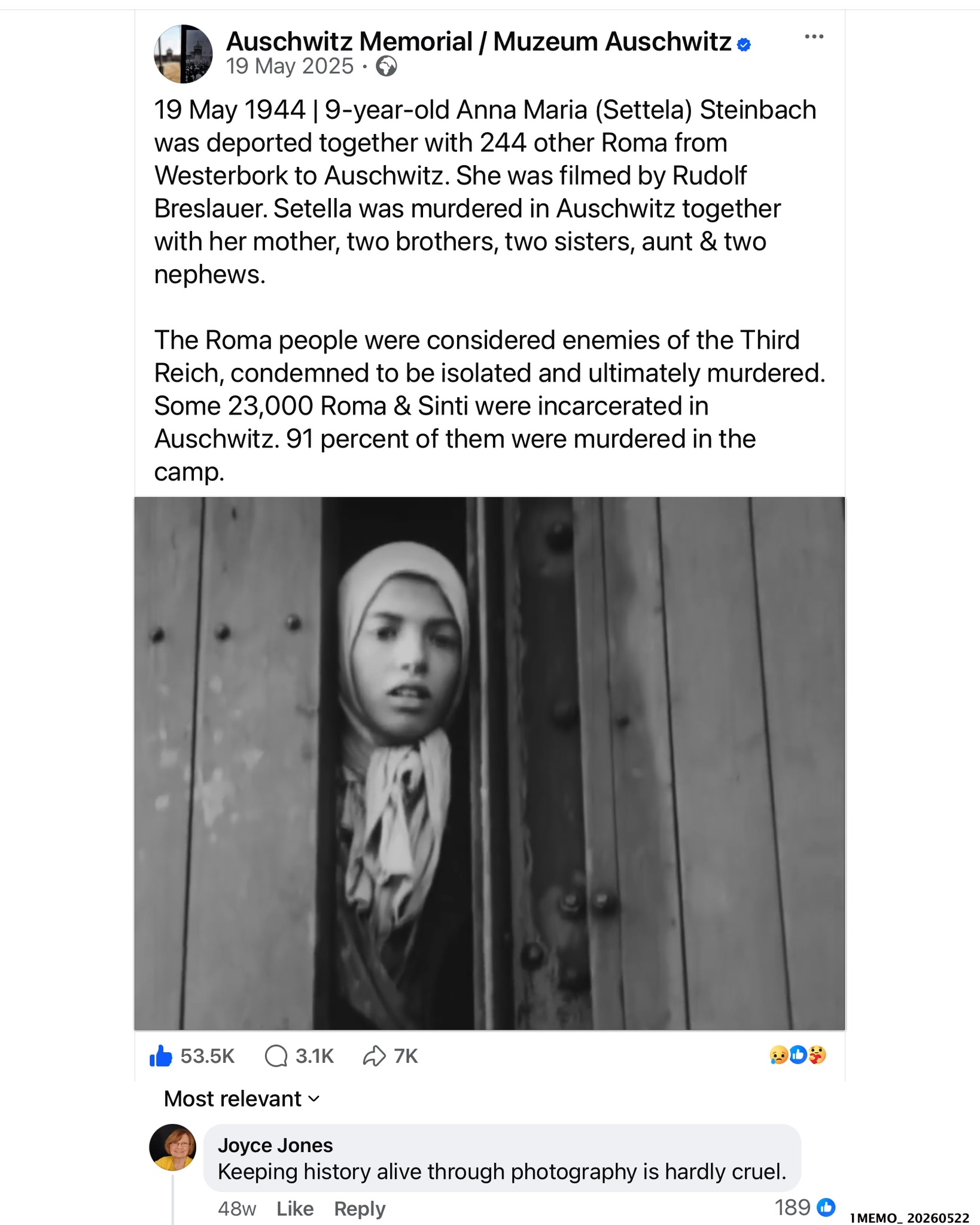
Last year’s post of the film ‘Settela’ , 19th May 2025 at the Auschwitz Memorial / Muzeum Auschwitz facebook page, accumulated by now one million views, and over 3000 comments (Image 1MEMO_20260522).
The film was created in an attempt to keep the scene on screen longer on the one hand, and to preserve the natural and historical original on the other. Thus a compilation was created, showing the same scene twice. The film ends with the original 3 seconds clip selected from the Westerbork film footage shot by Jewish prisoner Rudolf Breslauer (4), and the film starts with that same clip , digitally slowed down 10× in post-production.
This film was created and first online in 2017 (5) , and published (antedated) as the first post (1) shortly after the start May 19, 2019, of the online journal Settela•Communications — short Settela•Com (6).
More on the Roma in Auschwitz , online at the Auschwitz Museum (7).
Citation info : Settela Film Auschwitz Museum • 20260522 | Michel van der Burg | Settela•Com | ISSN 2949-9313 | CC BY 4.0 | URL https://settela.com/2026/05/22
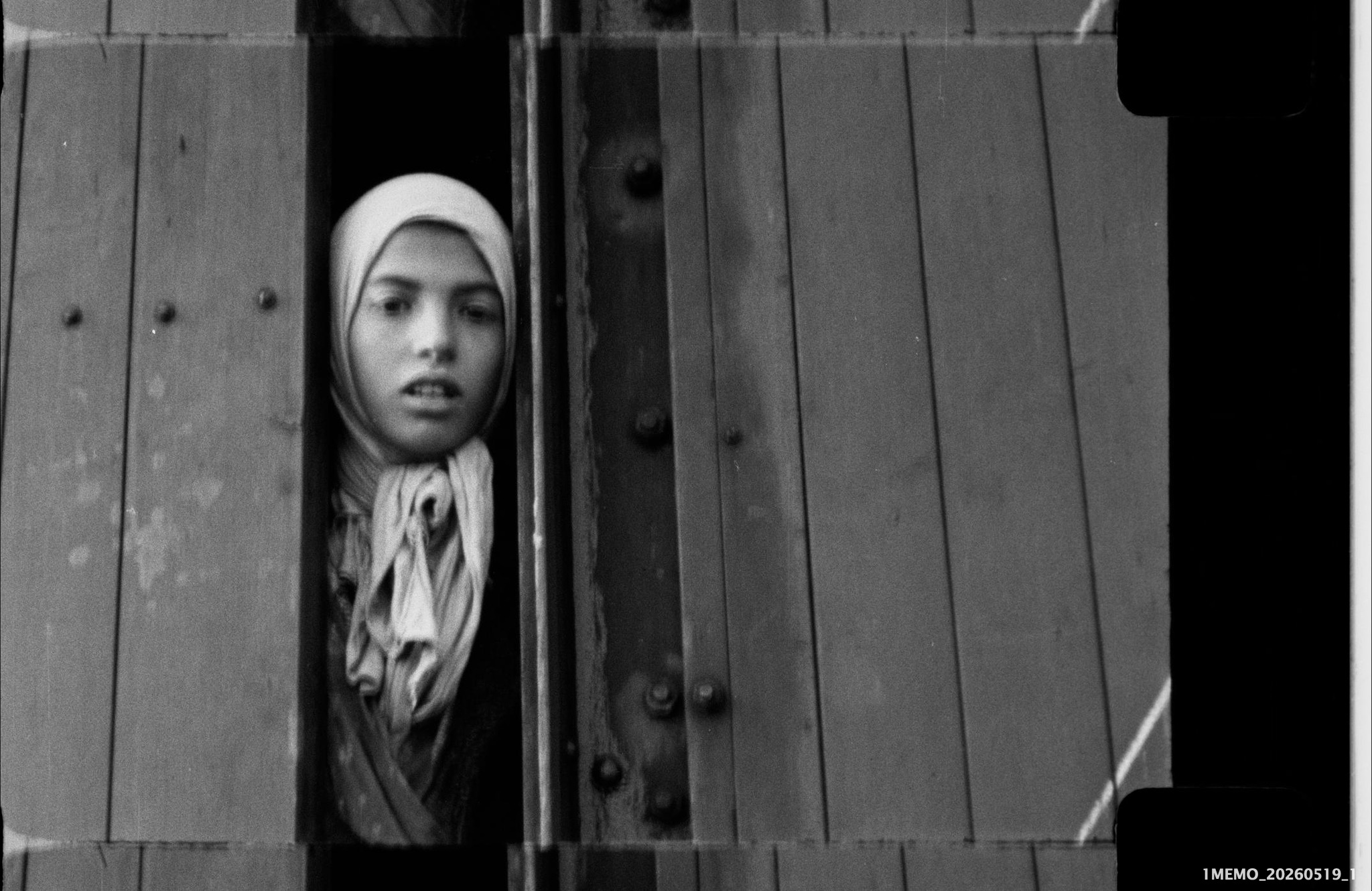
Settela Steinbach — The Girl with the Headscarf • 1MEMO_20260519_1 • Settela•Com • Frame from camera original film reel of the Westerborkfilm (1).
On May 19, 1944, at the Westerbork transit camp, a glimpse of Sinti girl Settela Steinbach wearing a headscarf appears between the sliding doors of a cattle car awaiting deportation to Auschwitz (1,2,3). In May 1945, her father, Moeselman Steinbach, wrote to “Repatriation” in the Netherlands: “…I very politely request you to inform me whether my wife and 10 children have arrived, or only children (Gypsy children) from the Auschwitz concentration camp in Poland.” (4).
The 9-year-old dutch Sinti-girl Anna Maria ‘Settela’ Steinbach peeks outside , at the last moment just before the sliding door is closed , standing inside a cattle car with 74 people on May 19 , 1944 in the Westerbork transit camp in Holland , when this deportation train leaves for Auschwitz-Birkenau – where Settela is murdered a few months later in one of the gas chambers (5).
While Settela peeks outside , her mother cries behind her in that cattle car : “Get out of there, or soon your head gets in between!”
She is wearing a headscarf made from a torn sheet because the Nazis shaved her head upon arrival at Westerbork transit camp on May 16, 1944, following the “Gypsy raid” carried out that same day at the Zwaaikom caravan site in Eindhoven, the Netherlands (6).
Settela Film • 20220630
Settela was filmed only a few seconds by the Jewish prisoner filmmaker Rudolf Breslauer as part of a documentary film being made in 1944 on the Westerbork camp .
Those seconds , also in slow-motion are shown in the 2022 Settela Film • 20220630 (7)
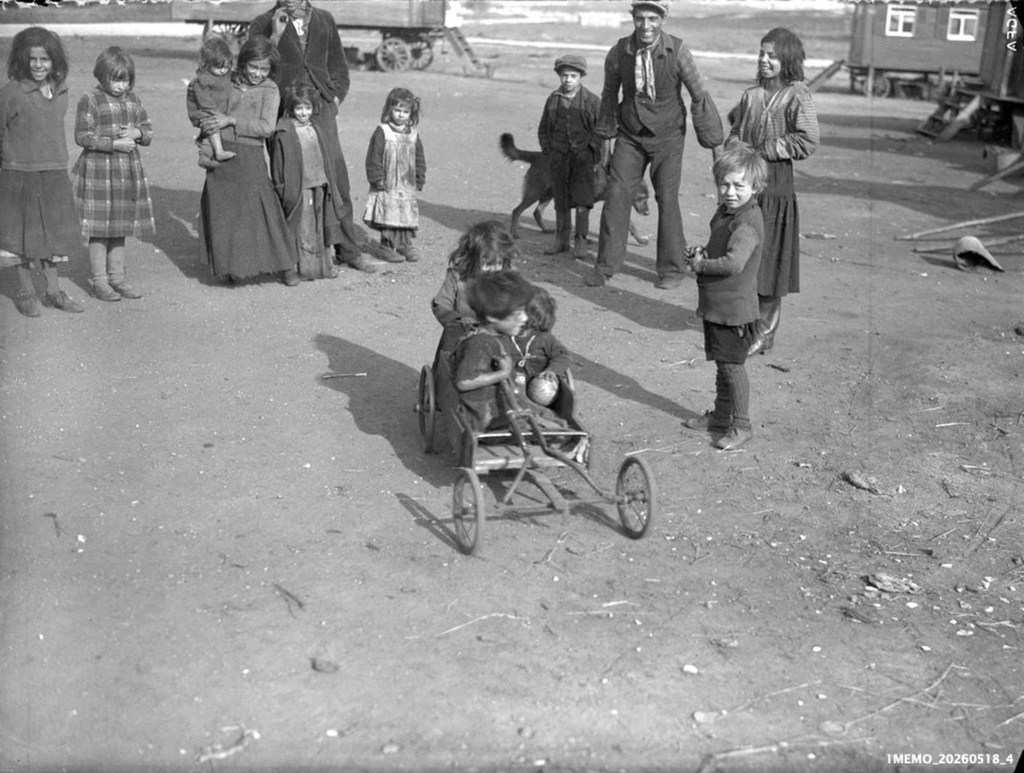
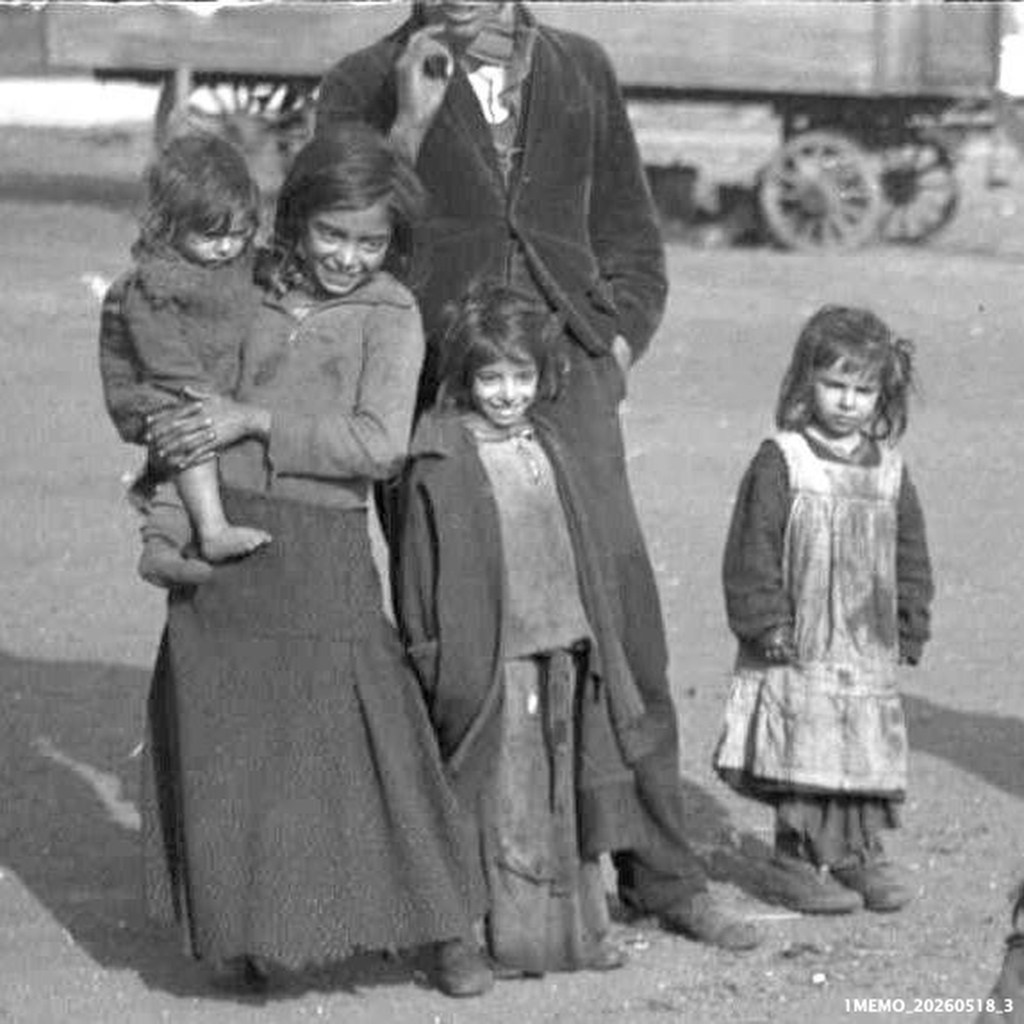
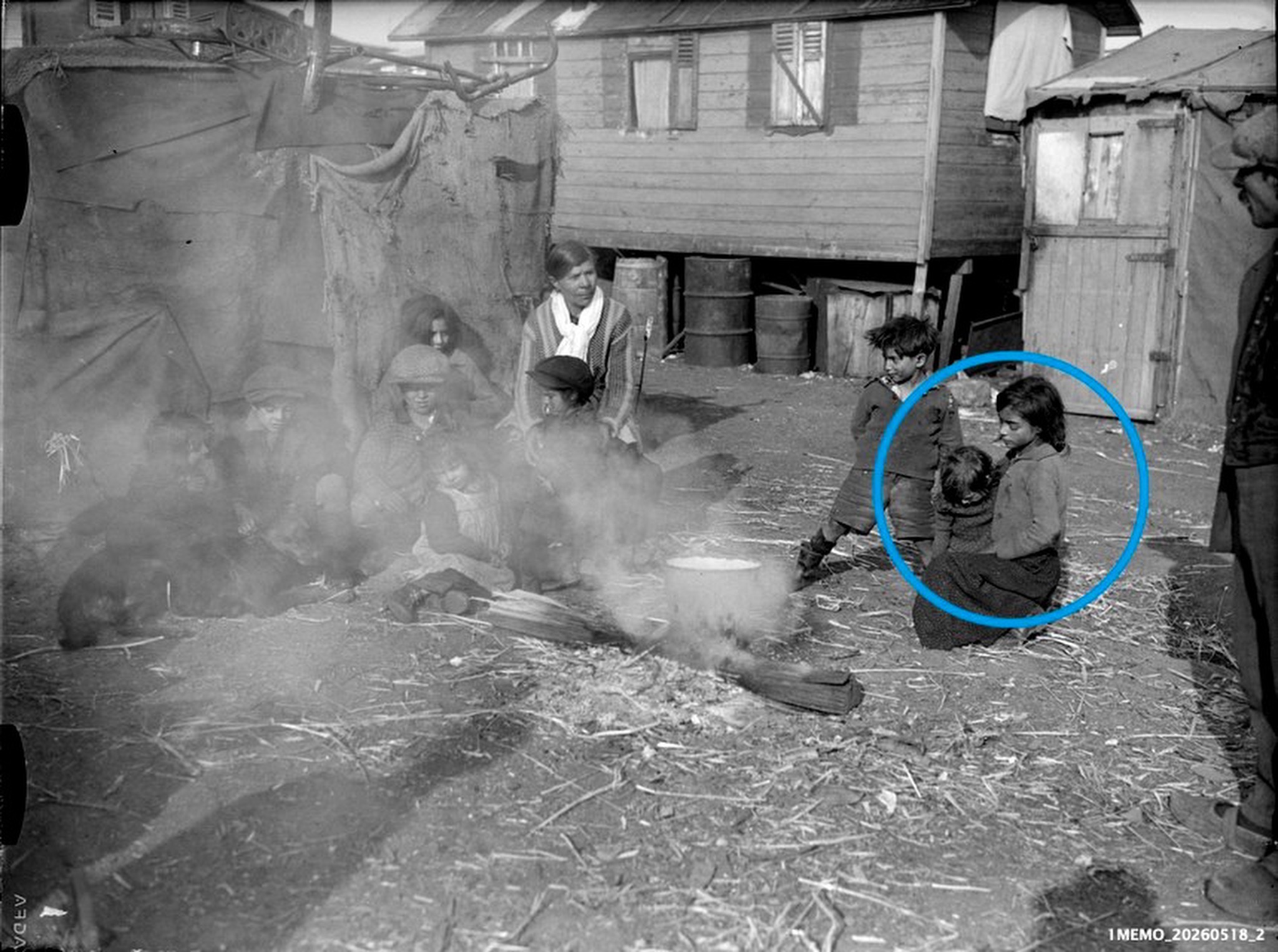
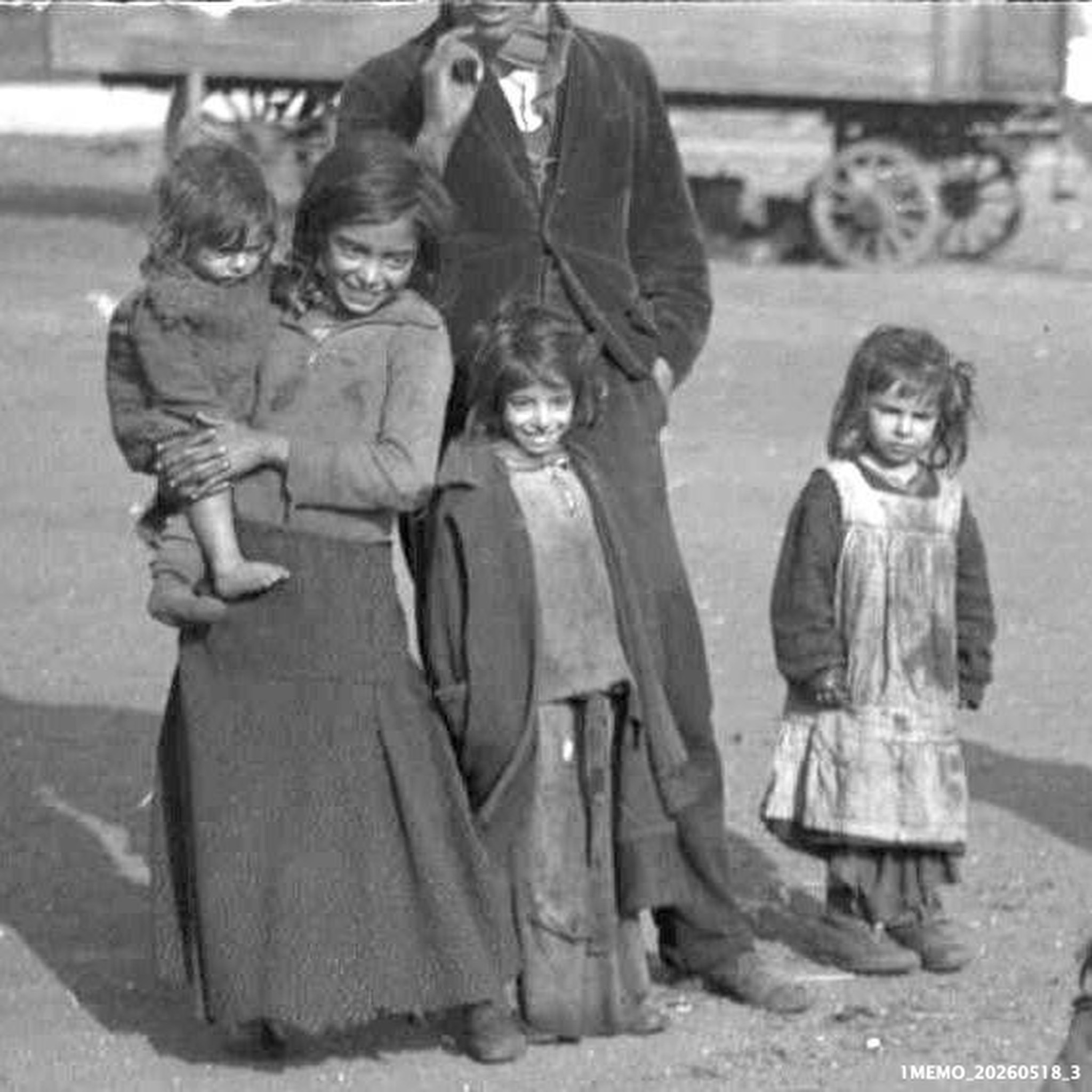
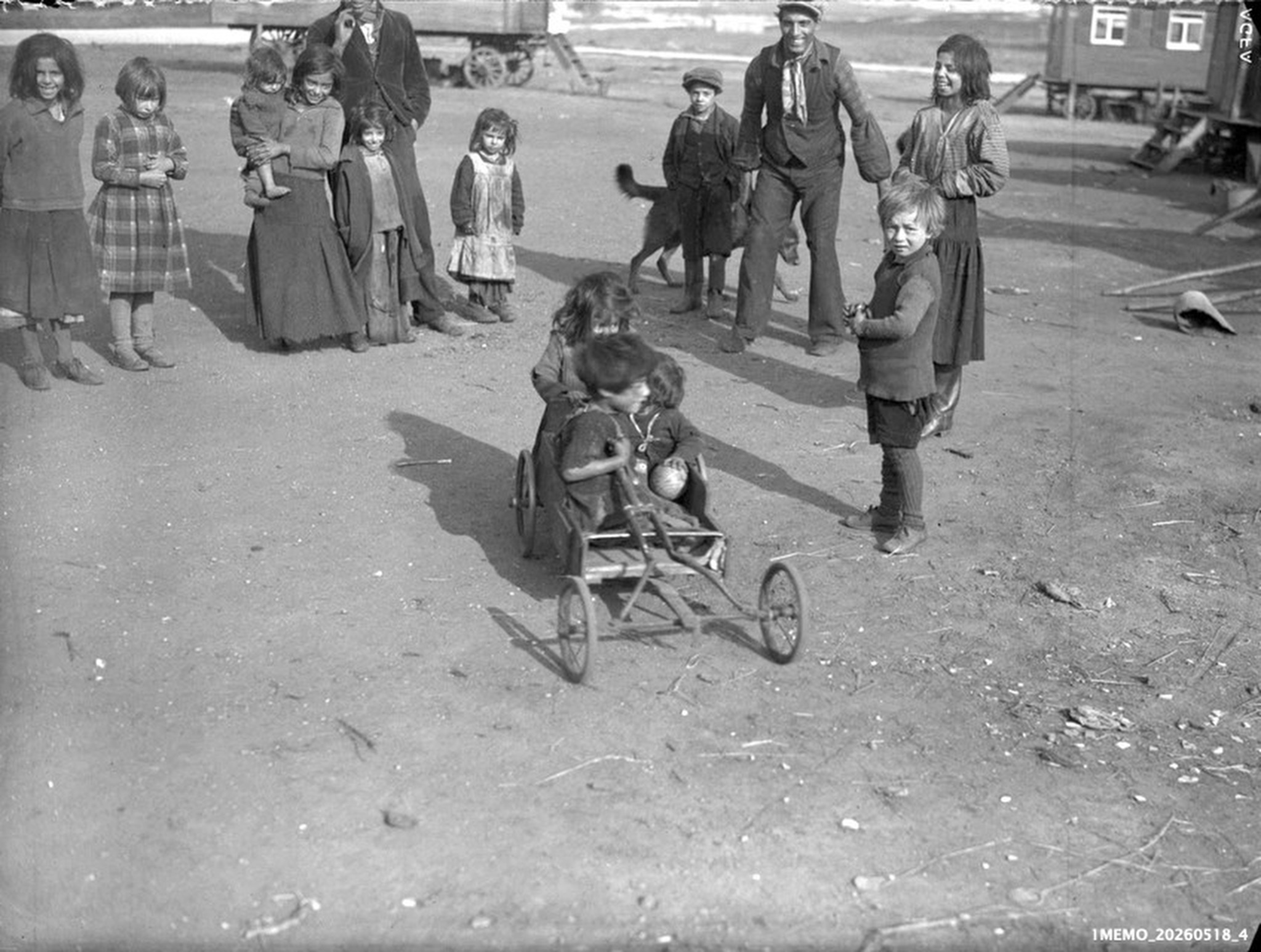
The toddler Settela in the arms of her older sister Elisabeth Steinbach at the Heksenberg Sinti caravan site in 1935 • Photo Jan de Jong • 1MEMO_20260518_4
Anna Maria (‘Settela’) Steinbach was born 23 December 1934 in Buchten, Netherlands, and photographed at age ~1 , in the arms of her older sister Elisabeth Steinbach, with others of the Steinbach family, and other families, at the nearby Sinti caravan site ‘Heksenberg’, October 1935, by photographer Jan de Jong (8) • 1MEMO_20260518_4
Settela was deported together with her brothers and sisters (Willy “Celestinus”, Willem, Elisabeth, Johanna, Philibert, Florentina, Willem, Anna), and mother Toetela (Emilia) Steinbach (born 23 March 1902 in Antwerp, Belgium), with other Steinbach and other nomad families – all together ca 245 Sinti and Roma and ca 450 Jews – on May 19th 1944 from the dutch Camp Westerbork to the Auschwitz and Bergen-Belsen camps (5,6).
Toetela’s eldest child Moekela (Magdalena; born 14 Sep 1922) had gone to Belgium and had been deported earlier – 15 Jan 1944 – with her 6 months old baby Jeanette – Toetela’s granddaughter – on the Z-Transport from transit camp Kazerne Dossin in Mechelen to Auschwitz, were they were murdered on arrival.
Settela’s father Heinrich (‘Moeselman’) Steinbach (born Nov 11, 1901 in Gründorf in Germany) died alone of grief June 6, 1946 in Maastricht in the Netherlands – his wife and 10 children had not survived the camps.
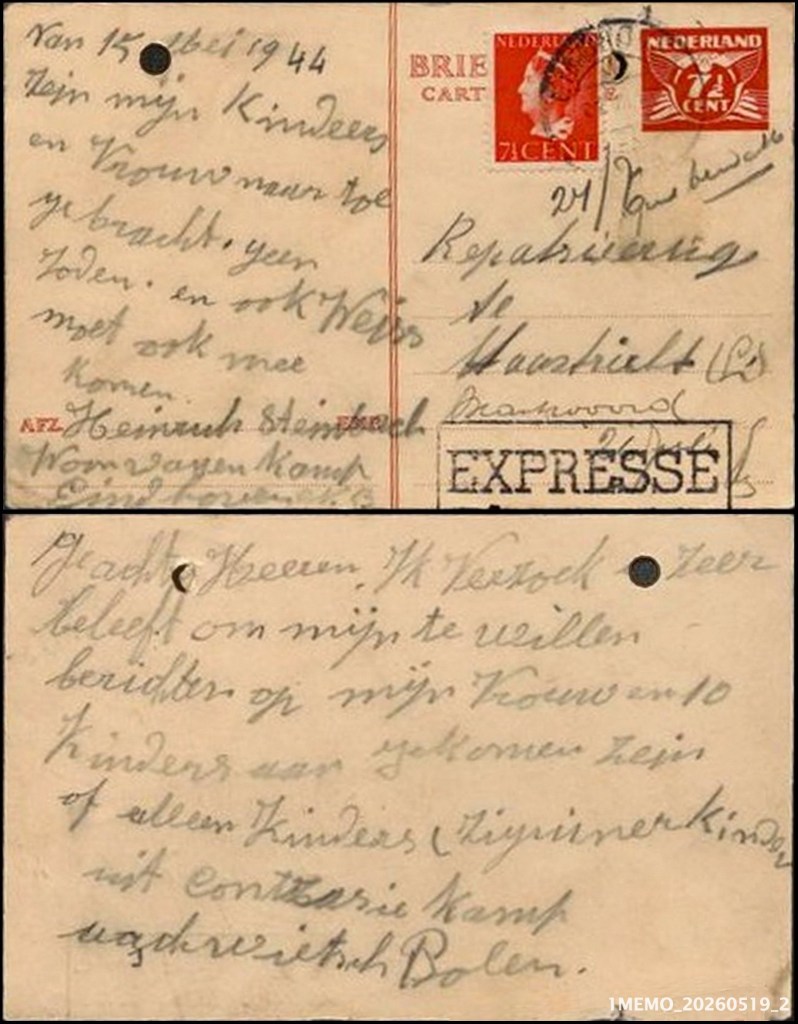
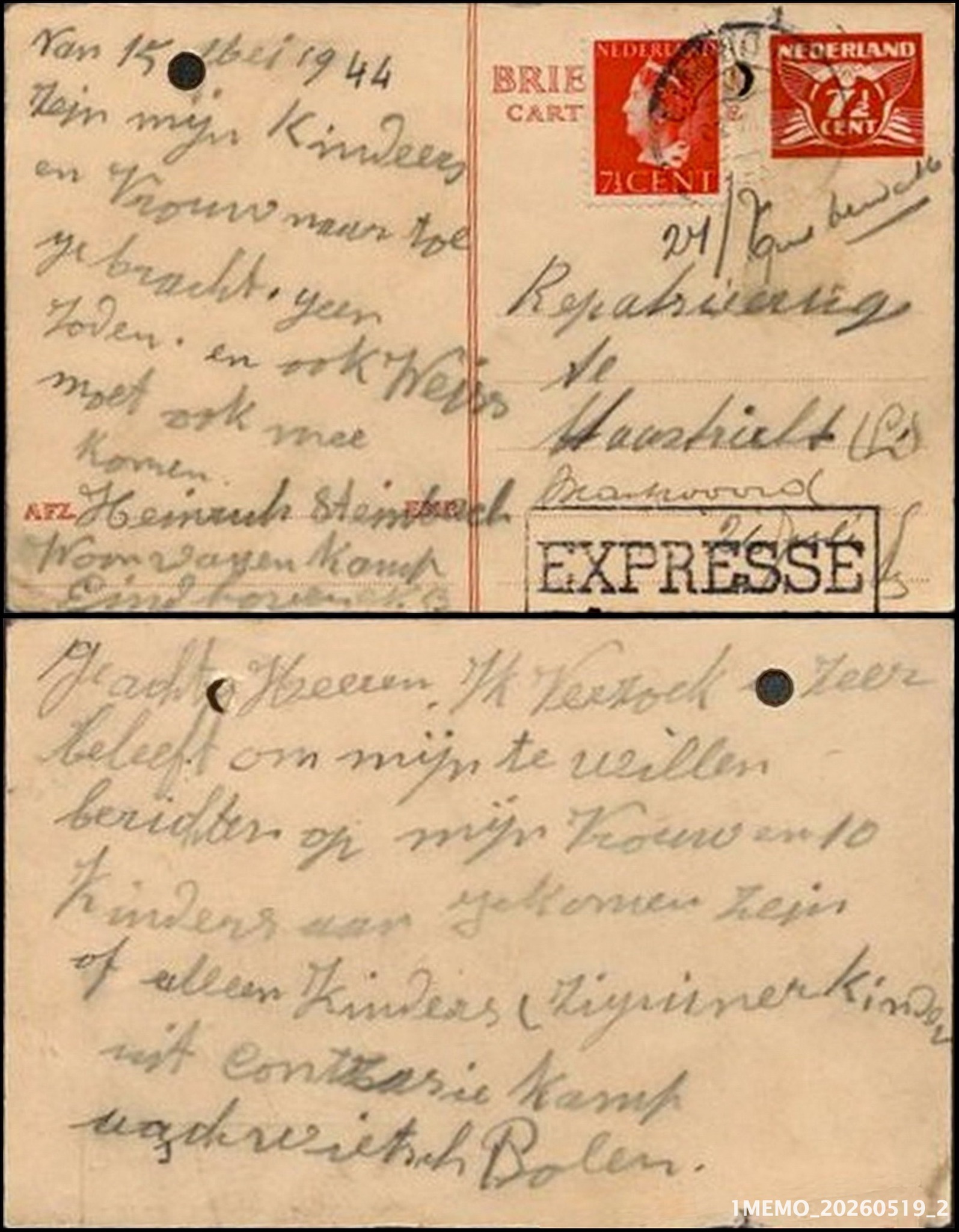
To : “Repatriation” in Maastricht (Netherlands) — “Dear Sirs, I very politely request you to inform me whether my wife and 10 children have arrived, or only children (Gypsy children) from the Auschwitz concentration camp in Poland. From May 15, 1944, my children and wife were taken there; no Jews. And Weiss had to come along too. — Heinrich Steinbach. Caravan site Eindhoven , North Brabant” • 1MEMO_20260519_2 • Settela•Com
One year earlier , May 22, 1945, two weeks after the liberation of Holland, Heinrich Steinbach — living at the caravan site in Eindhoven (North Brabant, Netherlands) — inquires about the fate of his wife and ten children on a postcard written to the “Repatriation” in Maastricht (Netherlands). The text on the postcard reads — translated from dutch (4) :
“Dear Sirs, I very politely request you to inform me whether my wife and 10 children have arrived, or only children (Gypsy children) from the Auschwitz concentration camp in Poland.
From May 15, 1944, my children and wife were taken there; no Jews. And Weiss had to come along too.
4 – May 1945 Postcard Heinrich Steinbach • 1MEMO_20260519_2 • Settela•Com | ISSN 2949-9313 | Source : Collectie HCL, archief Militair Gezag, Maastricht.
‘Moeselman’ Heinrich Steinbach — living at the caravan site in Eindhoven (North Brabant, Netherlands) — inquires about the fate of his wife and ten children on a postcard written to the “Repatriation” in Maastricht (Netherlands). The dutch text on the postcard reads :
“Geachte Heeren, Ik verzoek u zeer beleeft om mijn te willen berichten op mijn vrouw en 10 kinders aan gekomen zein of alleen kinders (zigeunerkinders) uit contrasie kamp uaschwietsch Polen.
Van 15 mei 1944 zein mijn kindeers en vrouw naar toe gebracht, geen joden. En ook Weiss moet ook mee komen. Heinrich Steinbach. Woonwagenkamp Eindhoven N.B.”
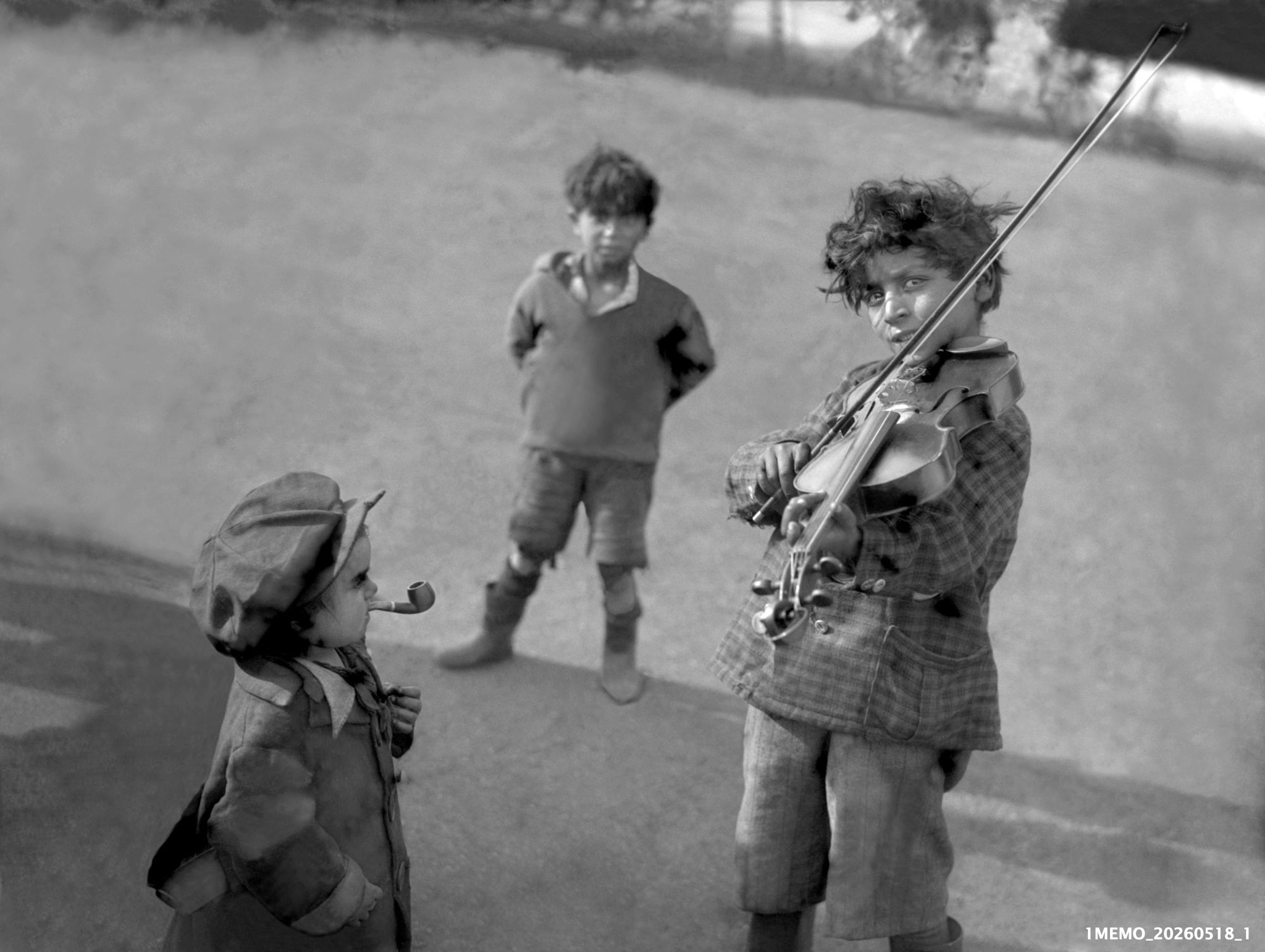
Willy Steinbach plays the violin at the Sinti caravan site Heksenberg in 1935 • Photo Jan de Jong • 1MEMO_20260518_1
In 1935 the nomadic Sinti families Steinbach — musicians — were photographed by Dutch photographer Jan de Jong at their caravan pitch on the heath around the Heksenberg hill in Brunssum, Limburg, Netherlands (1).
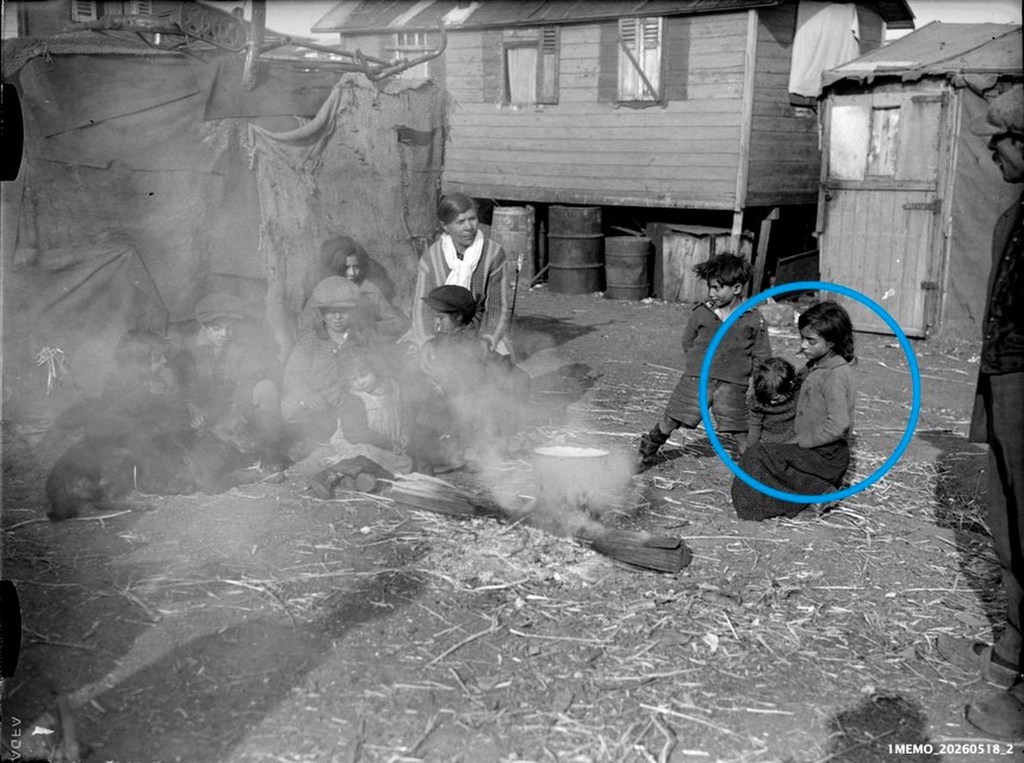
The boy with the violin is Willy Steinbach, an older brother of Settela Steinbach. The other 3 prints from the glass negatives that Jan de Jong made at the Heksenberg site in 1935 also show the Steinbach family, among others, with toddler Settela in the arms of her older sister Elisabeth Steinbach.
The toddler Settela in the arms of her older sister Elisabeth Steinbach (circled in blue) at the Heksenberg Sinti caravan site in 1935 • Photo Jan de Jong • 1MEMO_20260518_2
The toddler Settela in the arms of her older sister Elisabeth Steinbach at the Heksenberg Sinti caravan site in 1935 • Photo Jan de Jong • 1MEMO_20260518_3
The toddler Settela in the arms of her older sister Elisabeth Steinbach at the Heksenberg Sinti caravan site in 1935 • Photo Jan de Jong • 1MEMO_20260518_4
Settela Steinbach became known as the girl with the headscarf, featured a few seconds in the Westerbork film by Werner Rudolf Breslauer showing the deportation of the Steinbachs’ and other nomad families — all together ca 245 Sinti and Roma, and ca 450 Jews — on May 19th 1944 from the dutch transit camp Westerbork to Auschwitz (1,2).
Almost certainly, three Jewish people have been recognized in the unique Westerbork film from 1944 (1). This time it concerns the 9-year-old boy Israël Wijnschenk, his father Max Wijnschenk, and his grandmother Betje Kokernoot-van Furth, who all lived in Utrecht (Holland).
Last week, the Dutch public broadcaster NOS (2) reported the news from the Utrecht (Dutch) news site Nieuws030 (3) that it is very likely that three people were recognized again in this film made by the Jewish prisoner and filmmaker Rudolf Breslauer showing the deportation of Jews, Roma and Sinti by train in Camp Westerbork on May 19, 1944.
Image researcher Koen Hulsbos — who previously identified an Amsterdam couple in this deportation train (4) — thought he recognized the young Israël Wijnschenk, a pupil at the time of the Joodse (Jewish) School Utrecht, and presented this to Victor Frederik, researcher of the Joodse School (5,6). The boy, the man, and the woman seem to belong together, and were recognized from family photos, also by family members.
It is certain that Max and his wife Chel (not in the images) returned to Utrecht after the war, their children Israël and his sister Kitty were murdered. Grandma Betje was also gassed in Auschwitz.
A portrait of Israël Wijnschenk is shown at the site of Joods Monument (7).
According to the transport list, there were two other children in that wagon, Joseph Beugeltas (11 years old) and Manfred Studzinsky (7 years old). Joseph Beugeltas appeared to have blond hair, and could not have been it (6). To be completely sure, the researchers are still looking for a photo of Manfred Studzinsky, for comparison…
Filmmaker Rudolf Breslauer also filmed two of his children in the Westerborkfilm…
Stefan (left) & Ursula Breslauer, children of Rudolf Breslauer, the filmmaker of the Westerbork film at the farm of Camp Westerbork in 1944 – identified by the dutch photographer Sake Elzinga, who received Breslauer’s family photo albums last year when the family of Ursula – the only survivor – visited an expo on Breslauer in the Westerbork museum in the Netherlands.
Camp commander (SS-Obersturmführer) Albert Gemmeker ordered the Westerbork film , made by the German Jewish prisoner, photographer, Rudolf Breslauer in the spring of 1944.
Today 80 years ago – March 5, 1944 – the camp is an ‘Arbeitslager’ – a work camp – when Rudolf Breslauer starts filming the daily life of the Westerbork prisoners — inside : in the barracks, for example a religious service, cabaret, workshops, factories, aircraft and battery recycling, medical care, and outside the barracks : construction of a greenhouse, a football match, women working out, chopping wood, incoming transports, and eventually also the departure of a deportation train. After Breslauer films the deportation of Jews, Roma and Sinti to Bergen-Belsen and Auschwitz on May 19, 1944 the filming stops. The haunting image of the 9-year-old dutch Sinti-girl Settela, standing in the closing doors of the goods train, and the unique footage of that deportation train that leaves the Westerbork camp, became iconic after the war.
Deportation Breslauer family
Werner Rudolf Breslauer , his wife Bella Weihsmann, sons Stefan and Max Michael (Mischa), and daughter Ursula were deported autumn 1944 from Westerbork to Theresienstadt and Auschwitz. Only Ursula survived.
Stefan & Ursula Breslauer in Westerborkfilm | 20240305 | Settela•Com | Frame 127475 from Westerbork Film 🎦 2021 | 20220302 | Settela•Com | ISSN 2949 9313 | Footage filmed by Rudolf Breslauer in 1944, courtesy of NIOD | Sound and Vision
Scene with Stefan & Ursula Breslauer, starting at 56:13 in the 1986 RVD edition of the Westerborkfilm: Stefan & Ursula Breslauer in Westerbork Film RVD | 20240305 | Settela•Com | URL https://youtube.com/clip/UgkxfNzA72JeGgVoOFp_VTI4EQQr3yTwXu6_
Settela Film | 20220630 | Michel van der Burg | Settela•Com
Deportation Westerbork Film | 20210719 | Michel van der Burg | Settela•Com
The new 2021 Westerbork Film is missing part of the image in every frame …
The new high quality restored Westerbork film, presented first May 2021 by the Netherlands Institute for Sound & Vision and the NIOD Institute for War, Holocaust and Genocide Studies, has numerous advantages over the previous well known first edition of the Westerborkfilm made in 1986 in 4 acts by the dutch Rijksvoorlichtingsdienst (RVD ; the Dutch National Centre for Information) .
The full 1986 film including all 4 acts , was first published in 2019 at Settela•Com (Ref 1), with annotations for the various scenes. That 1986 Westerborkfilm however does not include all of the footage shot by Rudolf Breslauer, Spring 1944 in Camp Westerbork, in the Netherlands.
Footage not used in the 1986 Westerbork film compilation was presented in a series of posts published later in 2019 at Settela•Com.
Next, a film compilation of all that known footage was posted online as the WESTERBORK FILMS COLLECTION – UNESCO ALBUM (Ref 2). That film compilation was also made available for download 20 January 2020 by Michel van der Burg | Miracles.Media via the Open Images bank of Sound & Vision (Ref 3). That compilation was prepared without checking / deleting duplicate copies of footage, and thus contains redundant footage.
The 2021 restored Westerbork film is a major upgrade from the 1986 Westerborkfilm edition. Important advantages of the 2021 Westerbork film are , (i) new high quality 4K scans were made of the footage, (ii) containing a complete selection of all known footage, (iii) using only the best copies of all footage found in the archives, (iv) based on an extensive new inventory of all known archives, with the discovery of 2 canisters with ‘camera-original’ footage, and a hitherto unknown clip, and (v) with conservative, digital, restoration applied. Details on that new restored Westerbork film were discussed July 2021 with the co-publication of an important part of the 2021 Westerbork film : the new high quality deportation footage — a film compilation of scans of the newly discovered original camera negative film used by Rudolf Breslauer 19 May 1944 in Camp Westerbork, in the Netherlands (Ref 4).
The complete Westerbork Film 2021 was published too at Settela•Com on May 7, 2022 with all scenes annotated (Ref 5), together with a short introductory film : Westerborkfilm Introduction (Ref 6).
Note that additional digital restoration has been applied by Sound & Vision for the publicly made available so-called ‘display edition’ of this new 2021 Westerbork film according to Conservator Valentine Kuypers | Sound and Vision (Ref 7) – as discussed previously at Settela•Com (Ref 4).
Missing Part Images
It should be noted that the released 2021 ‘display edition’ of the Westerbork film – due to the applied image stabilization – does show less of the actual image in each frame as compared to the 1986 edition.
Below some examples illustrating the crop in the display edition.
2021 edition | not showing ‘nazi with bike’ | 20230519 | Settela•Com
2021 edition – not showing ‘nazi with bike’ in same scene, near identical frame — though he shows up in later frames a few seconds later, walking away ) – https://youtu.be/ZiLNDziwEtc?t=882
Settela’s car (not) showing 74p•
Next a comparison of the frame displaying “74 p.” (chalked on the car with Settela). The dot is shown in the 1986 film. That dot is missing in the 2021 film due to the cropped image resulting from the image stabilization.
Of note : first news clips presented by Sound & Vision announcing the new restored film , are apparently not based on the ‘display edition’, and do show that dot in the original 4K scan.
The full image — including the dot ’74 p.” — was shown in a first news item Sep 12, 2019 on the daily dutch ‘Nieuwsuur’ national news show , on colorized high quality deportation footage, that mentioning the new original footage. Item “Iconische beelden Tweede Wereldoorlog na 75 jaar in kleur” ; URL https://nos.nl/nieuwsuur/artikel/2301340-iconische-beelden-tweede-wereldoorlog-na-75-jaar-in-kleur
Jan 2020 Sound & Vision publicly showed and announced the newly discovered camera original footage via the daily dutch news show NOS (Ref 8) showing the images with no crop — including the dot ’74 p.” and presented an 8 min film compilation a few days later via their Vimeo channel also (at 0021) shwoing 74 Pers • (with dot) . URL https://vimeo.com/386667241
In 2021 Sound & Vision apparently started using the ‘display edition’ for publications on the new found original Westerbork deportation footage ; such as the YouTube uploads “De Westerborkfilm 📽️🎞️” (uploaded Apr 8, 2021) – https://youtu.be/8Y-A4BkWY18?t=2 , a video presented first I believe April 18, 2021 in an online Media Café event by Sound & Vision , and May 18, 2021 on the occasion of the public release of the restored film (Ref 9), in the 20 min presentation “Gerestaureerde filmbeelden Westerbork (1944)” of a compilation of selected images from the restored film – missing again the dot at 0:47 – https://youtu.be/-zCmr6PSNcI?t=47
Missing Image Westerbork Film 2021 | 20230519 | Michel van der Burg | Settela•Com | ISSN 2949-9313
References
1. Westerbork Film | Full version RVD 1986 | 20190605 | Michel van der Burg | Settela•Com | ISSN 2949-9313
2. WESTERBORK FILMS COLLECTION – UNESCO ALBUM | 20200120 | Michel van der Burg | Settela•Com | ISSN 2949-9313
3. WESTERBORK FILMS COLLECTION – UNESCO ALBUM (20200120) Michel van der Burg | Settela•Com | ISSN 2949-9313 | CC BY 4.0 | Open Images – URL https://www.openimages.eu/media/1223905
5. Westerbork Film 🎦 2021 | 20220302 | Michel van der Burg | Settela•Com | ISSN 2949-9313 | Display edition film annotated online in CC
6. Westerborkfilm Introduction | 20220507 | Michel van der Burg | Settela•Com | ISSN 2949-9313 | Introduction by Michel van der Burg on the Westerborkfilm screening in METRO Kinokulturhaus , Vienna , Austria at the DOCUMENTS OF DESTRUCTION | DOKUMENTE DER VERNICHTUNG Symposium 6-7 May, 2022 curated by Florian Widegger. Presented by Filmarchiv Austria in cooperation with the Vienna Jewish Film Festival and the Mauthausen Memorial.
Samudaripen – Genocide of the Gypsies – Claire Auzias
The French author, historian and libertarian, Claire Auzias researches social movements, women’s history and Roma’s history (1). She has written several works on the Roma’s history in the last 20 years. Samudaripen, the Genocide of the Gypsies, first appeared in 1999/2000 (2,3), and is now followed by the 3rd edition (4) published by L’Esprit Frappeur (Paris).
In her book Samudaripen, Claire Auzias sheds light on this poorly documented genocide in the III Reich , Eastern Europe, and Western Europe. This entirely revised 3rd edition now includes two new chapters — one on Switzerland by Claire Auzias, and one on The Netherlands by Erik Van Den Muijzenberg. Claire Auzias , in her foreword (5) : “…the patient discovery of the identity of an anonymous icon of the deportation, in the guise of a Dutch Sinti girl, made the chapter on the Netherlands obligatory, at least for those of the French gypsies who do not read foreign languages.”
2 – Claire Auzias interview (2009) “Samudaripen” – Un entretien avec Claire Auzias, auteure du livre “Samudaripen, le génocide des Tziganes” aux éditions L’Esprit frappeur. Réalisé fin octobre 2009 par Bruno Boudiguet pour Télé Liberté / Le Cobaye international . Dailymotion URL https://dai.ly/xb9lah
5 – Claire Auzias (2022) Samudaripen, le génocide des Tsiganes (Samudaripen, the Genocide of the Gypsies), Paris, L’Esprit Frappeur (3nd edition 2022) ISBN 978-2-85103-051-1 | Avant Propos : “…la découverte patiente de l’identité d’une icône anonyme de la déportation, sous les traits d’une fillette sinti hollandaise, rendait obligatoire le chapitre sur les Pays-Bas, a minima à l’attention de ceux des Tsiganes français qui ne lisent pas les langues étrangères.”
License info :
Samudaripen – Genocide of the Gypsies – Claire Auzias | 20221210 | Settela•Com