Leiden Islet Isolation Chamber • Michel van der Burg • Miracles.Media • @1MEMO 20250116 • TakeNode 398303fe-928a-4c53-839e-9dde0e7d8ec6
Following a working visit February ’92 studying pig islet isolation at the ‘Fondation Transplantation’ in Strasbourg -Hautepierre, France (1) , I designed this islet isolation chamber March 1992 for use in our Leiden Islet Laboratory , together with Gerard Verschagen , head of the precision mechanics workshop of the Laboratory of Physiology of the University Hospital Leiden (AZL , now LUMC), who manufactured this and other of our islet isolation devices.
The chamber was designed with support for use together with the Retsch Vibro Sieving Machine , purchased earlier for our Leiden Islet Laboratory, a vibrating sieving machine I had used in the 70s for isolation cell nuclei (2). The design was based on the Ricordi chamber published 4 years earlier (3).
The drawing was originally designed and produced on a Macintosh computer March 1992, using the MacDraw II application. That Mac file was remastered today in LibreOffice Vanilla, by straightening most of the lines that are slanted after opening in LibreOffice and correcting the font changes. So , not accurate now probably … just for illustration the history of progress in our Leiden Islet Laboratory, and love for art 😉
Notes
1) Xeno Islets • Michel van der Burg • Miracles.Media • @1MEMO 20250113 • URL michelvanderburg.com/2025/01/13/
2) Mennes AM, Bouman H, Van der Burg MPM, Libbenga KR. RNA synthesis in isolated tobacco callus nuclei, and the influence of phytohormones. Plant Sci Lett 1978; 13: 329– 339, ISSN 0304-4211, https://doi.org/10.1016/0304-4211(78)90210-9.
3) Piemonti L, Pileggi A. 25 Years Of The Ricordi Automated Method For Islet Isolation. CellR4 Repair Replace Regen Reprogram. 2013;1(1):e128. PMID: 30505878; PMCID: PMC6267808. URL https://www.cellr4.org/article/128
Citation info : Leiden Islet Isolation Chamber • Michel van der Burg • Miracles.Media • @1MEMO 20250116 • URL michelvanderburg.com/2025/01/16/
4th ESOT Slide #19 • Pancreatic Islets UWS Series 1989 • Kodak PhotoCD • Michel van der Burg • Miracles.Media • 20250103_1 • TakeNode eeb55729-c02b-4f73-ab0e-9f71b65bf85e
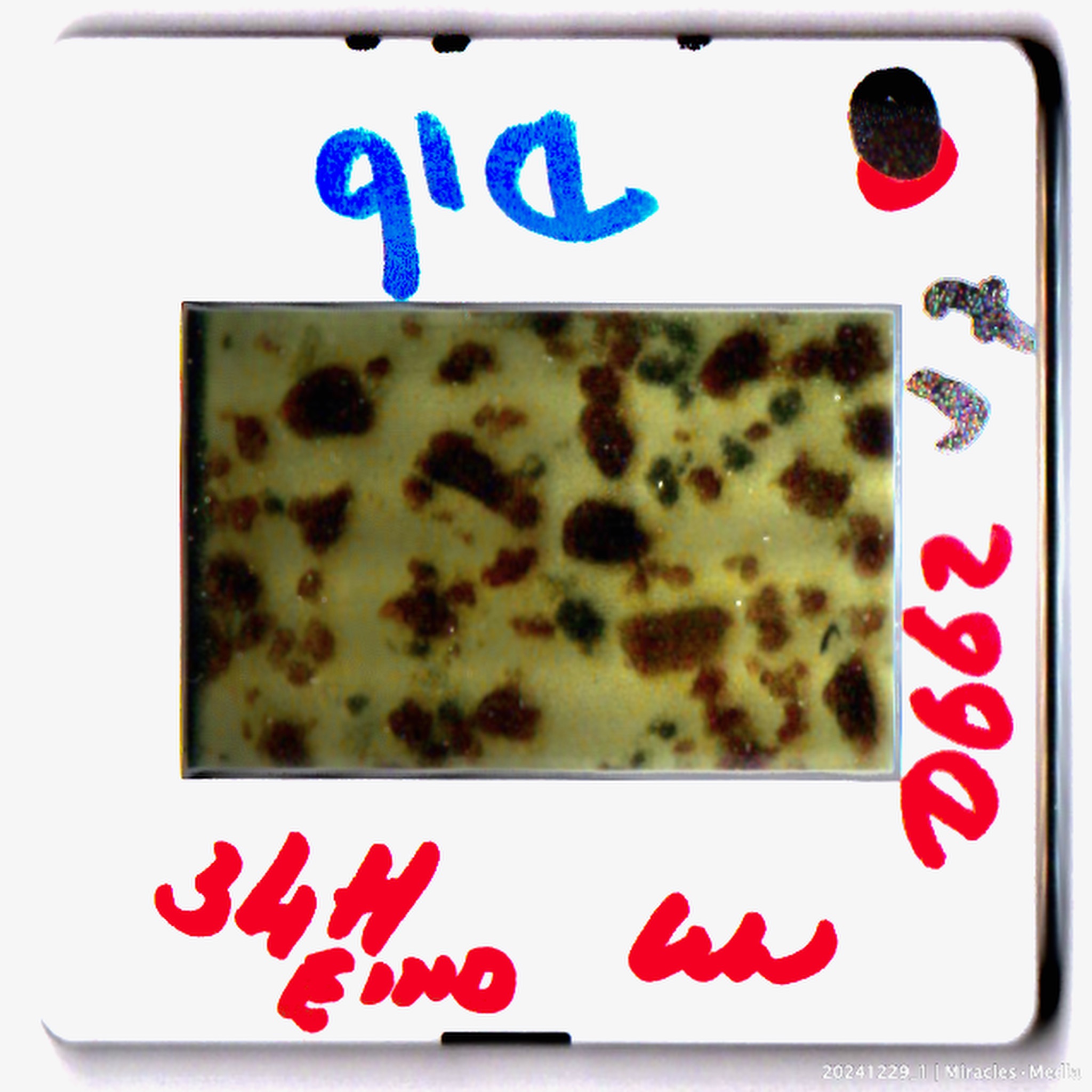
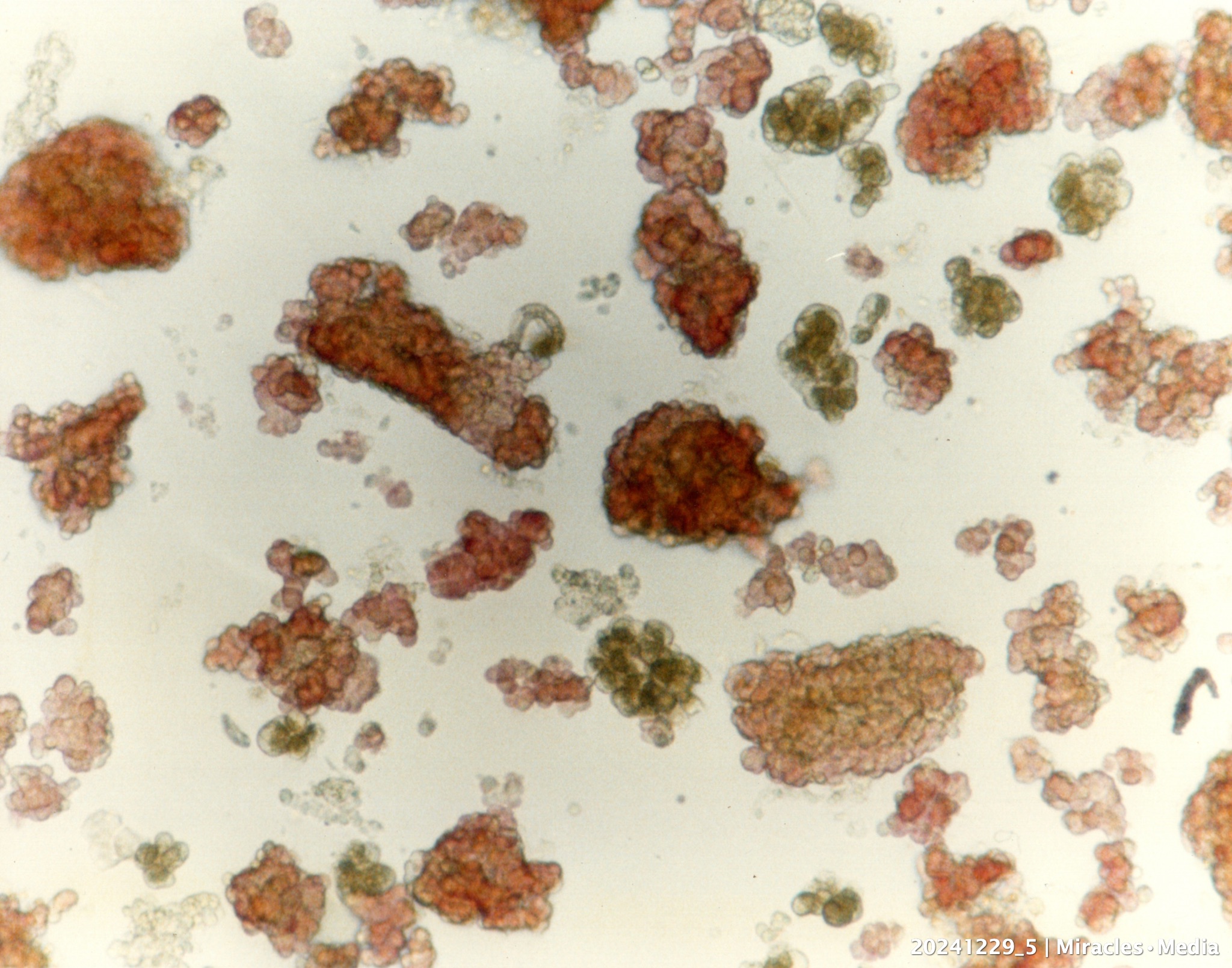
Slide #19 of talk by Michel van der Burg at the 4th ESOT congress in Barcelona (Spain) Nov 1989 on the paper ‘Pancreatic Islet Isolation With UW Solution • A New Concept’ (1,2). Details of this talk were posted recently (2) with a scan of a paper print of slide #19 – slighly cropped with printing. Here the full image of the original slide, scanned by Kodak PhotoCD in 1994, with minor color correction added (20250103_1) in this post.
This ‘Slide #19’ shows the final dithizone stained sample of the UW-isolated islets after dextran density gradient purification — a micrograph made April 18, 1989 , the second islet isolation experiment performed using the UW-Solution as the isolation solution.
In the lab journal of the first isolation experiment with UW-Solution, Wednesday April 12th 1989, I noted on the final purified islet preparation : ‘handpicking for encapsulation was not necessary: preparation more than 90% pure ( translated from dutch : “handpicken voor inkapseling was niet nodig: preparaat meer dan 90% zuiver”)’.
‘Handpicking’ of islets had been done at the start of our islet lab in 1985-1987 for counting rodent islets in cell culture dishes, and monitoring islet insulin secretion in tubes (3). Soon, ‘handpicking’ was no longer needed , when monitoring the insulin secretion of isolated islets in perifusion chambers (4,5). However, the handpicking method was used again in a pilot study on encapsulation of islets in 1989 by medical student Joost Clemens (6). Joost had just started on this research project, and was assisting me with islet ‘counting’ (yield and purity assessment) in the ‘duplo’ samples from this first series of UWS isolations.
Handpicking Pancreatic Islets • Michel van der Burg • Miracles.Media • 20250103_2 • TakeNode 7988ce39-6777-4db3-82c5-8191acdb13d6
Macro photography (Photo paper print, September 1987, AVC, Leiden University) of the aspiration of isolated canine pancreatic islets, in a suspension still contaminated with exocrine pancreatic fragments, at the tip of a hand blown glass handpicking pipette (custom made at the Leiden University) collected and transferred into tubes for monitoring insulin secretion the first year of pilot work in the Leiden islet laboratory (4).
2) Pancreatic Islet Isolation in UW Solution & Transplantation • ESOT 1989 Talk • Michel van der Burg • Miracles.Media • @1MEMO 20241229 • URL michelvanderburg.com/2024/12/29/
3) Lucky #1 Islet • 20240811 • Michel van der Burg • michelvanderburg•com
4) Cradle of Islet Transplants • 20240829 • Michel van der Burg • michelvanderburg•com
5) Monitoring pancreatic islets in perifusion • 20240911 | Michel van der Burg | michelvanderburg•com
6) Joost A.M. Clemens (MSc student in Medicine) at the Department of Biomaterials (Prof. dr K. de Groot) and Department of Surgery of the Leiden University (Michel van der Burg , Hein Gooszen). Pilot study of the encapsulation of dog islets using the alginate polylysine and poly-HEMA-phospate method (1989). At that time , both the Biomaterials department and the Islet Lab of the Surgery department were housed in the building of the Cell Biology department of the Leiden University Hospital (AZL, now LUMC). Below a portrait snapshot I took of Klaas de Groot at a Garden party organized in 1989 by the Department of Cell Biology, Leiden University.
Klaas de Groot, Biomaterials Department of the Leiden University in 1989. Photo by Michel van der Burg • Miracles.Media • 20250103_3 • TakeNode c25a87b7-09a4-49ce-8c42-14142da1e066
Citation info : Pancreatic Islets UWS Series 1989 • Kodak PhotoCD • Michel van der Burg • Miracles.Media • @1MEMO 20250103 • URL michelvanderburg.com/2025/01/03/
Oral Presentation Slide 19 ~ Pure Islets Isolated in UW Solution • Miracles.Media • 20241229_1 • TakeNode ce420e5a-1df7-4e4f-bcb6-6831434ffac7
In November 1989, I had my first chance for a presentation at a major international conference, the 4th ESOT meeting in Barcelona, of a paper centered on the rationale for employing the University of Wisconsin (UW) organ preservation solution in pancreatic islet isolation.
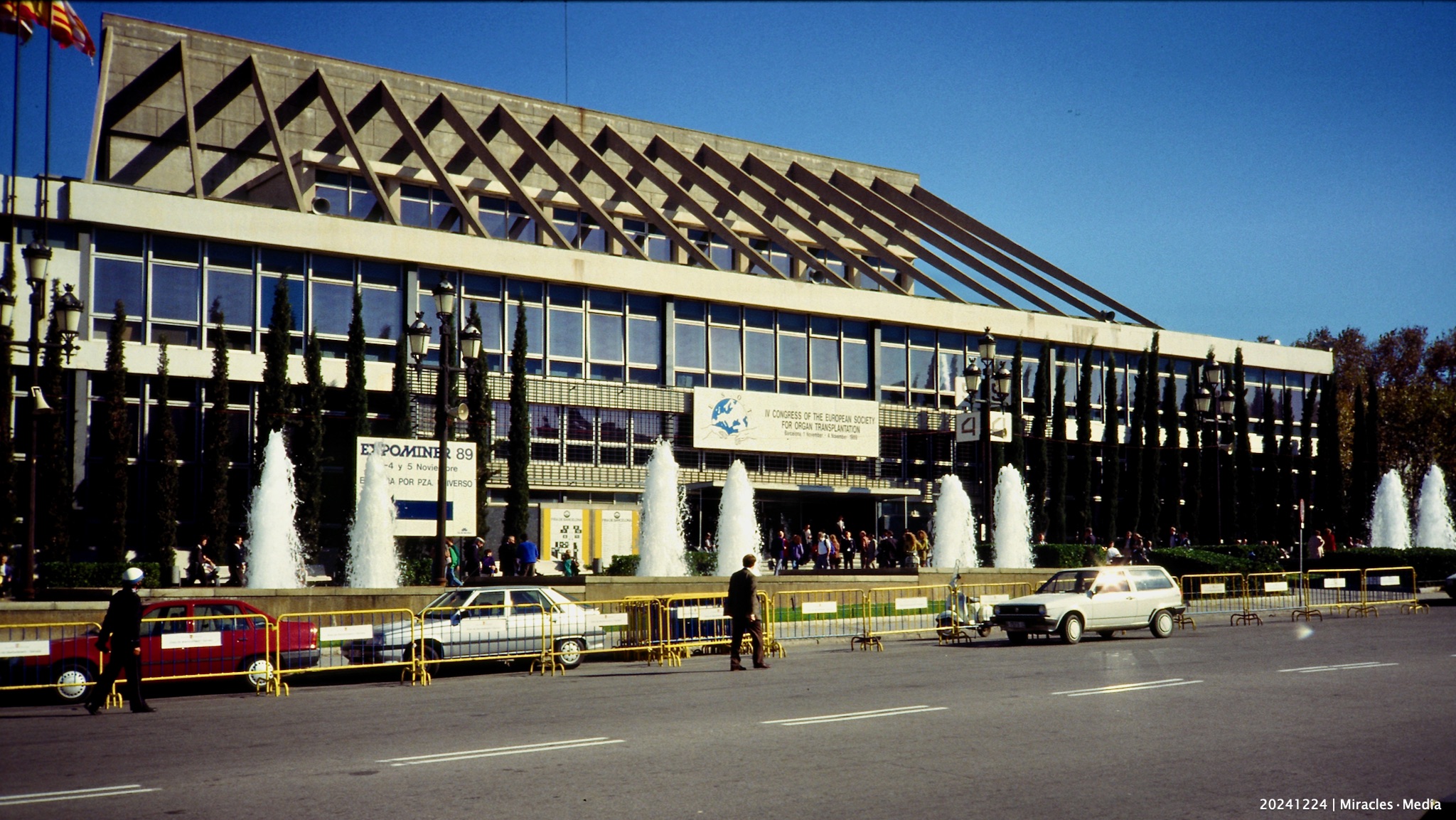
Venue 4th Congress of the European Society for Organ Transplantation, Barcelona (Spain) November 1–4, 1989 • Michel van der Burg • Miracles.Media • 20241224 • TakeNode 103c4c3c-5d36-4111-a5f8-f60e81c5db4d
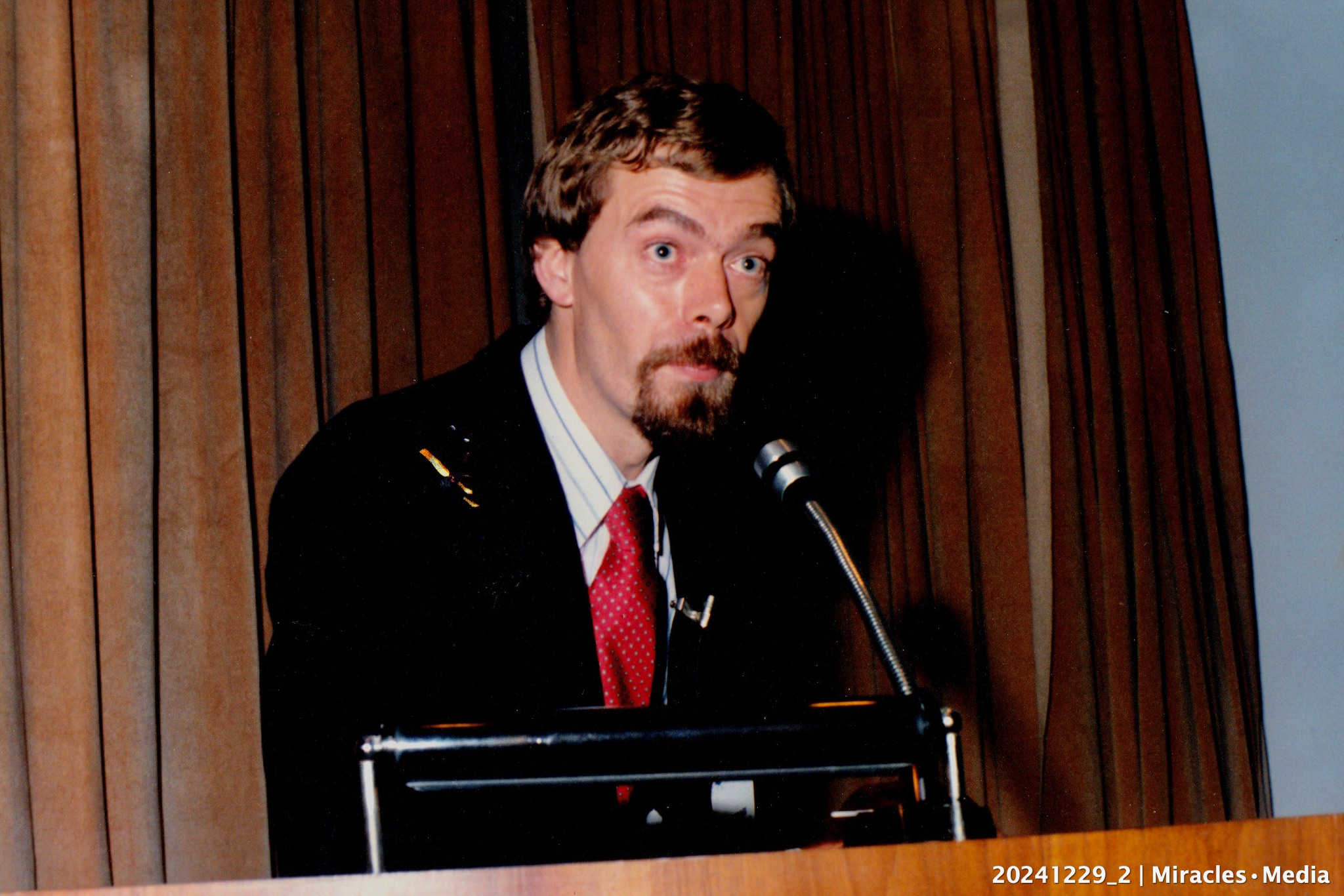
This innovative islet isolation work with the UW-Solution had been accepted as a poster presentation for the 4th ESOT meeting (1). I also took the opportunity to present this new work during a talk on previous isolation work (2,3) at this conference.
Barcelona Nov 1989 4th ESOT • Talk by Michel van der Burg • Miracles.Media • 20241229_2 • Photo : Grup Jaume Muntaner (Barcelona) • TakeNode 96957e2f-1462-48e1-aca1-4745198d9a54
‘Behind the scenes’ I had first remade my lost poster at the congress venue (1), and then I rewrote my speech in the hotel room on the older research (2) updated with the more recent work with the UW-Solution, and including the outcome of our first islet transplantations.
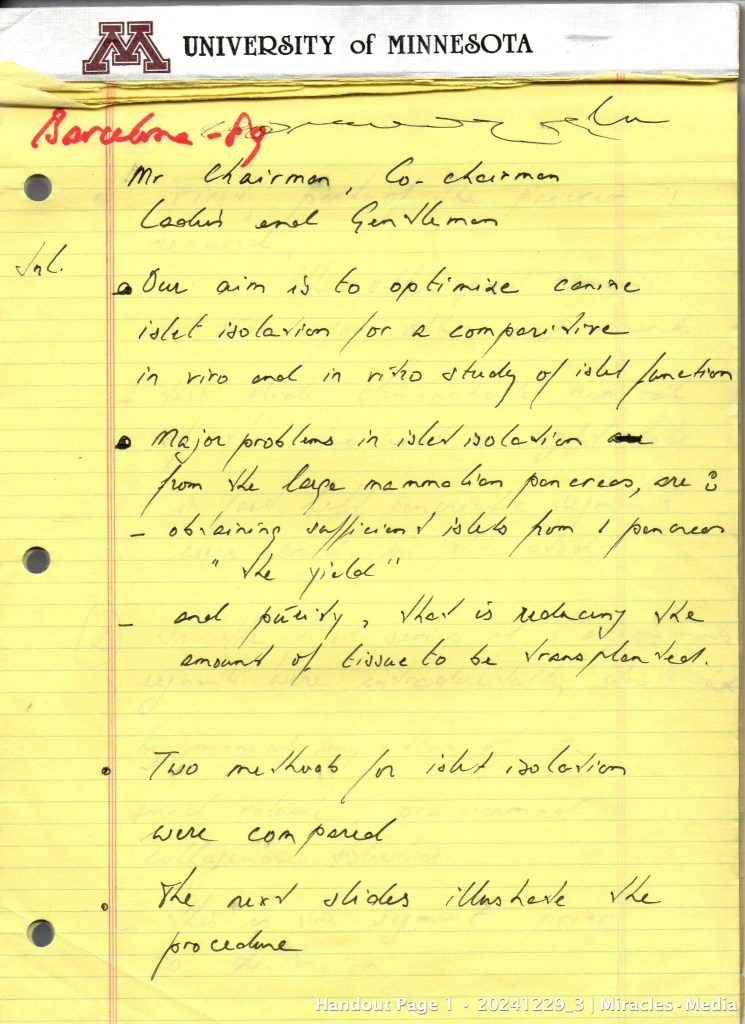
Barcelona 89 • Handout 4th ESOT Talk
Below a scan of that handout of the final speech, written out at full lenght in a notepad from a recent working visit in Minneapolis (4).
Barcelona 89 • Handout 4th ESOT Talk • Michel van der Burg • Miracles.Media • 20241229_3 • TakeNode f8595a82-fba5-4a89-a01f-4c37976d06d7 • PDF FILE 20241229_3 copy is available here
( finishing speech first part on our previous islet isolation methods using the conventional RPMI solution – a solution originally designed for tissue culture, not for cold storage of organs )
Slide 18
Image Slide 18 (scan of print) • Best (Not Usual) Purity Islets RPMI Series • Miracles.Media • 20241229_4 • TakeNode a6afbf29-b3e6-41d0-abd0-07471303be15
This slide shows one of the purest preparations obtained, with an estimated purity of 65% islets. • On the average however a purity of only 30% was obtained.
Recently we adopted an entirely new approach to islet isolation. • Since UW, the new organ cold storage solution has been shown to allow long-term cold storage of the canine pancreas; • and, since islet isolation too is largely performed in the cold; • we tested this preservation solution as the isolation medium, throughout the isolation procedure in another 6 dogs; • as compared to the commonly used solutions like RPMI tissue culture medium.
Slide 19
Image Slide 19 (scan of print) – Usual Purity Islets UWS Series • Miracles.Media • 20241229_5 • TakeNode dacd3b99-5958-44fe-85ed-6abd55db2676
This slide shows the final dithizone stained preparation after dextran purification of UW-isolated islets. • UW did not affect islet yield • however, UW markedly improved purity : • acinar tissue is virtually absent.
2) Van der Burg MPM, Gooszen HG, Field MJ, Scherft JP, Terpstra JL, Van de Woude FT, Guicherit OR, Frölich M, Bruijn JA. Comparison of current islet isolation techniques in dogs. 4th Congress of the European Society for Organ Transplantation, Barcelona (Spain) November 1–4, 1989. Oral presentation. (1)
3) Van der Burg MPM, Gooszen HG, Field MJ, Scherft JP, Terpstra JL, van de Woude FJ, Guicherit OR, Frölich M, Bruijn JA. Comparison of current islet isolation techniques in dogs. Transplant Proc. 1990 Aug;22(4):2044-5. PMID: 1697121. This paper appears to be not readily available online – a reprint copy is available at this site (1)
4) Working visit Sep – Oct 1989, joining the pancreatic islet isolation team of the pioneer transplant surgeon David Sutherland at the University of Minnesota in Minneapolis.
Citation info : Pancreatic Islet Isolation in UW Solution & Transplantation • ESOT 1989 Talk • Michel van der Burg • Miracles.Media • @1MEMO 20241229 • URL michelvanderburg.com/2024/12/29/
Pancreatic Islet Isolation With UW Solution • A New Concept • 20241224
Michel van der Burg • 20241224 • Last update 20241228-1614
In November 1989 in Barcelona, I had my first opportunity to present a paper at a major international organ transplantation meeting — the 4th ESOT — focusing on the rationale for using the UW organ preservation solution during pancreatic islet isolation.
Poster lost
Excited about giving a talk and poster presentation at this 4th ESOT congress in Barcelona, I forgot to take my poster from the overhead compartment of the plane upon arrival in Barcelona. A new poster was made on the spot at the Sandoz booth in the congress venue, by cut and paste work using the manuscript of the congress proceedings paper (PMID 2202137) and enlargement with a Sandoz A3 photocopier. Due to design constraints, the author affiliation info was omitted, and the Du Pont logo was added (image 20241025_1).
Scan of the slide picture taken at the 4th Congress of the European Society for Organ Transplantation, Barcelona (Spain) November 1–4, 1989 • Michel van der Burg • Miracles.Media • 20241025_1 • TakeNode 054301b6-0b6e-458c-84f6-0b76e25092d5
Barcelona ’89 poster remastered
That photo of the poster board in Barcelona (20241025_1) was used for creating this digitally remastered poster presented here (20241025_2) — which now includes the complete manuscript, as well as the Du Pont logo 😉
Poster 4th Congress of the European Society for Organ Transplantation, Barcelona (Spain) November 1–4, 1989 • Digitally remastered from original manuscript of article PMID 2202137 by author, publisher, M.P.M. van der Burg • Miracles.Media • 20241025_2 • TakeNode 124e20db-758a-4bdb-b854-c6cefdb7cc3c
The Nov ’89 Barcelona publications, were the first ones dedicated to presenting the concept , the rationale, for using the UW organ preservation solution during pancreatic islet isolation.
Venue 4th Congress of the European Society for Organ Transplantation, Barcelona (Spain) November 1–4, 1989 • Michel van der Burg • Miracles.Media • 20241224 • TakeNode 103c4c3c-5d36-4111-a5f8-f60e81c5db4d
This wasn’t the first time we reported the news of our results with this new, innovative, method developed in our pre-clinical model for the isolation and purification of pancreatic islets of Langerhans for transplantation in diabetic patients. Below that background, publications, and papers available for download.
Background
I was well aware of the development in the late 80s by Belzer’s team at the University of Wisconsin in Madison (USA) of the new solution to preserve pancreas donor organs during cold storage for transplantation :
In 1986 the Belzer team had reported on the newly developed cold storage solution for pancreas preservation, the University of Wisconsin (UW) Solution (1).
From 1986 our colleague Rutger Ploeg (from the Department of Surgery of Leiden University) had been doing PhD research in Belzer’s organ preservation laboratory in Madison. He introduced the ‘…new cold storage solution, the “UW-Solution” in a letter Dec. 10th, 1987 to all Eurotransplant centres (2), and I had assisted during Rutger Ploeg’s preservation research in Madison on the UW solution in pancreas transplantation in dogs, by calculating the k-values of glucose tolerance (3,4).
1) Wahlberg JA, Southard JH, Belzer FO. Development of a cold storage solution for pancreas preservation. Cryobiology. 1986;23(6):477–482.
2) Alexandre G, Margreiter R, Persijn GG, Pichlmayr R, Terpstra JL, Ploeg RJ. To all Eurotransplant centres : Introduction new cold storage solution, the “UW-Solution”. Letter Dec 10, 1987 , Ploeg RJ, Department of Surgery, University Hospital Leiden (AZL , now LUMC).
3) Ploeg RJ, Goossens D, Sollinger HW, Southard JH, Belzer FO. Efficacy of 48-hour pancreas preservation with UW solution in the dog allograft model. Transplant Proc. 1988 Oct;20(5):1026-8. PMID: 3055478.
4) Ploeg RJ. Preservation of kidney and pancreas with the UW solution : experimental and clinical studies. (Thesis, Leiden University), ‘s-Gravenhage : Pasmans (ISBN 9090042490), 1991: 231 p. URL https://search.worldcat.org/en/title/65672513
First thought
In early 1989, I wondered how our research, into improving the technique of pancreatic islet isolation, could benefit from the great interest in this new organ preservation solution, and the contacts through Ploeg with both the Belzer laboratory and Du Pont (Du Pont Critical Care, Waukegan, USA), the manufacturer of the commercial UW Solution.
Radical choice
The most logical , traditional, choice would be, to investigate organ preservation of the pancreas prior to pancreatic islet isolation. However, logistically, this seemed to be too much of a change in our research. Therefore, in February 1989, I made the radical choice of testing the UW Solution as a replacement for conventional isolation solutions in our preclinical transplantation model of canine islet isolation.
Start
A research plan was drawn up for Du Pont (Robert Carter, Clinical Research Project Coordinator, DuPont, UK), and we started our work March 1989. At first — the first two islet isolation experiments — the UW Solution was only used at the first stage of the isolation procedure, as the collagenase solution for pancreatic injection, transport, and digestion in the laboratory. From April 1989 on, the UW-Solution was used in all our isolation steps, both before density gradient purification, and also for washing the purified islets.
Rationale
The research started in April 1989 with the rationale , that : because the UW-Solution (UWS) protects the viability of the pancreas during cold storage, the UWS can also improve the yield of viable isolated islets, because islet isolation also takes place mainly at low temperature.
Discovery
However, from the first time in April 1989 that the UW-Solution was used during all isolation steps, the tissue immediately appeared different, with almost complete islet purification due to a clear difference in islet density and the darker and more compact looking exocrine pancreatic tissue, compared to the previous conventional isolations.
I did not expect this… but I understood it immediately, even during that first isolation: the effect of UWS during the isolation, the effect on the density, by counteracting cell swelling of especially the other, exocrine, pancreatic tissue, resulting in that tremendous improvement in the purification of islets.
News
The news of the exciting finding of over 90% purity of these UWS-isolated islets was brought first that month, April 1989, during my oral presentation (5) at the General Surgery Science Days, the yearly meeting on the current scientific research taking place at the Department of Surgery of the Leiden University Hospital (now LUMC) in Leiden , Holland .
5) Van der Burg MPM. New methods of islet isolation – a comparative study (dutch : ‘Nieuwe methoden van eilandisolatie – een vergelijkend onderzoek). General Surgery Science Days 1989, Leiden University Hospital (dutch : Wetenschapsdagen Algemene Heelkunde 1989, AZL), Leiden, (The Netherlands) April 28, 1989. Yearly meeting on current research at the Department of Surgery of the Leiden University Hospital (now LUMC) in Leiden , Holland .
Next, a manuscript was submitted June or July 1989 for publication of a Letter in The Lancet (6) …but was rejected.
6) Van der Burg MPM, Gooszen HG, Ploeg RJ, Guicherit OR, Scherft JP, Terpstra JL, Bruijn JA, Frölich M. Pancreatic islet isolation with UW solution: a new concept. Manuscript submitted June/July 1989 for publication as Letter in The Lancet. (rejected). Report online in : Lancet Letter 1989 UW Solution Islet Isolation | 20220823 | Michel van der Burg | michelvanderburg•com
Islet transplantation
Internationally , the news of both our first pre-clinical islet transpant, and the islet purification success when using UWS during islet isolation, was first reported July 8, 1989 at the Anglo Danish Dutch Diabetes Group meeting in Oxford, UK (7). National news reports appeared first September ’89 in the Cicero magazine (8) , and Oct ’89 in the Dutch newspaper Leidsch Dagblad (9).
7). Van der Burg MPM, Gooszen HG, Scherft JP, Terpstra JL, Frölich M, Guicherit OR, Lemkes HHPJ, Bruijn JA. The isolation of canine pancreatic islets for transplantation. Seventh Annual Meeting Anglo Danish Dutch Diabetes Group, Oxford (UK) July 5–9, 1989. Report online in : ADD Diabetes Group 1989, St Edmund Hall, Oxford • Michel van der Burg • Miracles•Media • 20241019 • michelvanderburg•com
8), ‘Eilandjes’ getransplanteerd | by Sylvia van Leeuwen in Cicero, Sep. 15th, 1989 (ISSN 0920-2900), the biweekly publication of the Academic Hospital and Leiden Medical Faculty | 20240830_3 • michelvanderburg•com Report online : Islet Transplantation Breakthrough in Leiden University Hospital • 20240830 • Michel van der Burg • michelvanderburg•com
9). Doorbraak in onderzoek naar behandeling suikerpatiënten. Ontdekking door artsen Leids Academisch Ziekenhuis. (EN tr. “Breakthrough in research into treatment of diabetics. Discovery by doctors of Leiden University Hospital”) | by Gert Visser, in Leidsch Dagblad, Oct 24, 1989 | Dutch newspaper. Report online : Islet Transplantation Breakthrough in Leiden University Hospital • 20240830 • Michel van der Burg • michelvanderburg•com
Internationally at a major meeting, the UWS news was first presented in a poster presentation September 1989 in Minneapolis (10). The UWS data had been added ad hoc in the poster – that is , it wasn’t part of the accepted abstract. The first proceedings paper on our UWS work was also submitted at that meeting , and was published April ’90 (11).
10). Van der Burg MPM, Gooszen HG, Ploeg RJ, Scherft JP, Field MJ, Guicherit OR, Terpstra JL, Van de Woude FT, Frölich M, Bruijn JA. Comparison of islet isolation techniques in dogs: Over 90% purified islets using UW solution. 4th International Symposium on Organ Procurement and Preservation and 2nd International Congress on Pancreatic and Islet Transplantation, Minneapolis (USA) September 17–22, 1989 Report online in : Minneapolis 1989 Poster | 20240804 | Michel van der Burg | michelvanderburg•com
11). Van der Burg MPM, Gooszen HG, Ploeg RJ, Scherft JP, Field MJ, Guicherit OR, Terpstra JL, Van de Woude FJ, Frölich M, Bruijn JA. Comparison of islet isolation techniques in dogs: Over 90% purified islets using UW solution. Transplant Proc. 1990 Apr;22(2):795-6. PMID: 2158174. This paper appears to be not readily available online – a reprint copy is available here PMID_2158174 🔗
A new concept – Nov 1989 , Barcelona, Spain – 4th ESOT
Finally , November 1989 in Barcelona, Spain – at the 4th ESOT meeting – the first presentations followed, focussing on the concept — the rationale — for using the UW organ preservation solution during pancreatic islet isolation — in the book of abstracts (12), the poster shown above (13) that was created from the proceedings paper submitted at this meeting (14), and , I included this UWS work also ad hoc in the talk delivered at this meeting on comparison of islet isolation techniques (12, 15, 16). I plan to post on that talk soon.
As reported in our poster and the manuscript delivered in Barcelona of our paper ‘Pancreatic Islet Isolation With UW Solution: A New Concept’ we had been using collagenase in UW solution in this first short (n=4) series of experiments.
Please note, that I changed the description of the collagenase solution to Hanks’ solution (HBBS) when editing the author proof edition shortly before publication of the final paper August 1990 (PMID_2202137 ; 14) — to best convey our current insights and practice.
For hypothetical reasons only — because the UWS was expected to be detrimental perhaps to cell viablity at the higher temperatures during collagenase digestion of the pancreas (the first stage of islet isolation) — I decided to change the collagenase solution in June 1989 when I began a new series of islet isolations for our first canine islet transplants. From that point on, a modified Hanks’ solution was used for collagenase (17).
We did not observe a difference at the time* , whether using one or the other solution for collagenase digestion , with respect to either islet purity, recovery, or viability at islet isolation and days later in culture.
Years later , collagenase in UWS was chosen for the isolation of pig islets, in experiments with a long cold ischemia time of the pancreas during transport with distant pancreas procurement from sows in a slaugtherhouse — Ballering (distant family) in Son — near the south border of The Netherlands, with injection of cold collagenase solution before transport, with the aim of better preservation of the islets (18).
12) Excerpt from book of abstracts 4th Congress of the European Society for Organ Transplantation, Barcelona (Spain) November 1–4, 1989 , including the abstracts : – Van der Burg MPM, Gooszen HG, Guicherit OR, Ploeg RJ, Scherft JP, Terpstra JL, Bruijn JA, Frölich M. UW solution as the isolation medium markedly improves canine islet isolation (abstract). – Van der Burg MPM, Gooszen HG, Field MJ, Scherft JP, Terpstra JL, Van de Woude FT, Guicherit OR, Frölich M, Bruijn JA. Comparison of current islet isolation techniques in dogs (abstract). Excerpt ESOT abstracts book available here 19891101_ESOT 🔗
13) Van der Burg MPM, Gooszen HG, Ploeg RJ, Guicherit OR, Scherft JP, Terpstra JL, Bruijn JA, Frölich M. Pancreatic islet isolation with UW solution: a new concept. 4th Congress of the European Society for Organ Transplantation, Barcelona (Spain) November 1–4, 1989. Poster presentation. Report online (here) : Pancreatic Islet Isolation With UW Solution – A New Concept • 20241224 • Michel van der Burg • michelvanderburg•com PDF poster — M.P.M. van der Burg • Miracles.Media • 20241025_2 • TakeNode 661fade9-51a7-42b1-a7e1-1e281f74ad6d — available here 20241025_2 🔗
14) Van der Burg MPM, Gooszen HG, Ploeg RJ, Guicherit OR, Scherft JP, Terpstra JL, Bruijn JA, Frölich M. Pancreatic islet isolation with UW solution: a new concept. Transplant Proc. 1990 Aug;22(4):2050-1. PMID: 2202137. This paper appears to be not readily available online – a reprint copy is available here PMID_2202137 🔗
15) Van der Burg MPM, Gooszen HG, Field MJ, Scherft JP, Terpstra JL, Van de Woude FT, Guicherit OR, Frölich M, Bruijn JA. Comparison of current islet isolation techniques in dogs. 4th Congress of the European Society for Organ Transplantation, Barcelona (Spain) November 1–4, 1989. Oral presentation.
16) Van der Burg MPM, Gooszen HG, Field MJ, Scherft JP, Terpstra JL, van de Woude FJ, Guicherit OR, Frölich M, Bruijn JA. Comparison of current islet isolation techniques in dogs. Transplant Proc. 1990 Aug;22(4):2044-5. PMID: 1697121. This paper appears to be not readily available online – a reprint copy is available here PMID_1697121 🔗
17) Michael P.M. van der Burg. Pancreatic islet transplantation: studies on the technique and efficacy of islet isolation and transplantation. (Doctoral Thesis, Faculty of Medicine, Leiden University Medical Center (LUMC) , Leiden University), Boskoop: M.P.M. van der Burg | Miracles.Media (ISBN electronic, pdf, 9789080216402 ; ISBN print 9789080216419, 9080216410), 1994: 192 p. Leiden University https://catalogue.leidenuniv.nl/permalink/31UKB_LEU/18s393l/alma9940161419602711
18) Van der Burg MPM, Graham JM. Iodixanol density gradient preparation in University of Wisconsin solution for porcine islet purification. ScientificWorldJournal. 2003 Dec 1;3:1154-9. doi: 10.1100/tsw.2003.107. PMID: 14646009; PMCID: PMC5974767.
* Audio of data discussion posted in : Percoll UWS Purification Pancreatic Islets • ESOT 1991 Talk • Michel van der Burg • Miracles.Media • @1MEMO 20250114 • URL michelvanderburg.com/2025/01/14/
Updates
20241227-1329 Better copy of Minneapolis proceedings paper replaces PMID_2158174
20241228-1614 Author Proof section on the collagenase solution changes
*20250124-0244 Added reference to audio of data discussion posted in : Percoll UWS Purification Pancreatic Islets • ESOT 1991 Talk • Michel van der Burg • Miracles.Media • @1MEMO 20250114 • URL michelvanderburg.com/2025/01/14/
Citation info : Pancreatic Islet Isolation With UW Solution • A New Concept • Michel van der Burg • Miracles.Media • @1MEMO 20241224 • URL michelvanderburg.com/2024/12/24/
Walking in the rain in the historic center of the dutch city of Leiden, visiting the saturday street market along the Rhine canal with food, flowers, stroopwafels, cheese, ice skating and christmas shopping.
Citation info : Dutch Canal Market Walk In Leiden • Michel van der Burg • Miracles•Media • @1MEMO 20241214 • TakeNode a55adf48-d63c-495f-85df-948e38011d6e
Oral presentation Michel van der Burg, Cell Transplant Society congress 1999 in Montreux, Switzerland
A novel iodixanol density gradient for purification of pancreatic islets was developed in the difficult pig model of islet isolation. Viability of freshly isolated islets is not guaranteed. After short-term storage of the islets in culture, pig islets restored normal blood sugar levels after xeno transplantation in diabetic mice.
Viability of Fresh vs Cultured Pig Islets for Transplants • Montreux Cell Transplant Society 1999 • Michel van der Burg • Miracles.Media • @1MEMO 20241204_2 • TakeNode e745d625-27c2-4eb8-b4c2-4300623c3303 • File 1MEMO_20241204_2
Rijkelijkhuizen JKRA, Bouwman E, Van der Burg MPM. Viability of fresh vs cultured pig islets for transplants. 4th International congress of the Cell Transplant Society, Montreux (Switzerland) March 21–24, 1999
Other Presentations in Montreux
Van der Burg MPM, Rijkelijkhuizen JKRA, Zwaan RP, Bouwman E. Adult pig islet recovery during Liberase isolation, OptiPrep purification and culture for transplantation in nude mice. 4th International congress of the Cell Transplant Society, Montreux (Switzerland) March 21–24, 1999 . The Sydney 1999 presentation of this work has been posted – @1MEMO 20241203
Van der Burg MPM, Ranuncoli A, Molano R, Kirlew T, Ringers J, Bouwman E, Terpstra OT, Ricordi C. Optiprep for human islet purification. 4th International congress of the Cell Transplant Society, Montreux (Switzerland) March 21–24, 1999 . The Igls 1999 presentation of this work has been posted – @1MEMO 20241202
Updates
Update 20260123 : Vimeo video replaced by YouTube copy
Citation info : Viability of Fresh vs Cultured Pig Islets for Transplants • Cell Transplant Society 1999 Montreux • Michel van der Burg • Miracles.Media • @1MEMO 20241204 • TakeNode 3ba1c894-eb71-4c3f-89aa-198c48cd480c • URL michelvanderburg.com/2024/12/04/