Slides oral presentation Michel van der Burg, IPITA congress 1999 in Sydney, Australia
A novel iodixanol density gradient for purification of pancreatic islets was developed in the difficult pig model. The pig islets restored normal blood sugar levels after xeno transplantation in diabetic mice.
Slideshow (pdf) oral presentation Michel van der Burg, IPITA congress 1999 in Sydney, Australia
Recovery of adult pig islets during isolation using Liberase vs collagenase-P, purification in OptiPrep-UWS, and culture for transplantation in nude mice • Sydney IPITA 1999 • Michel van der Burg • Miracles.Media • @1MEMO 20241203_2 • TakeNode 5f53ae49-6fb8-4bef-a434-ac2ce8151c2a • File 1MEMO_20241203_2
Van der Burg MPM, Rijkelijkhuizen JKRA, Zwaan RP, Bouwman E. Recovery of adult pig islets during isolation using Liberase vs collagenase-P, purification in OptiPrep-UWS, and culture for transplantation in nude mice. 7th World congress of the International Pancreas & Islet Transplant Association, Sydney (Australia) August 22–25, 1999
Updates
Update 20260123 : Vimeo video replaced by YouTube copy
Citation info : Iodixanol Purification of Porcine Islets • Sydney IPITA 1999 • Michel van der Burg • Miracles.Media • 1MEMO 20241203 • TakeNode ea1f1abd-6227-4ae6-985b-f8188310cd24 • URL michelvanderburg.com/2024/12/03/
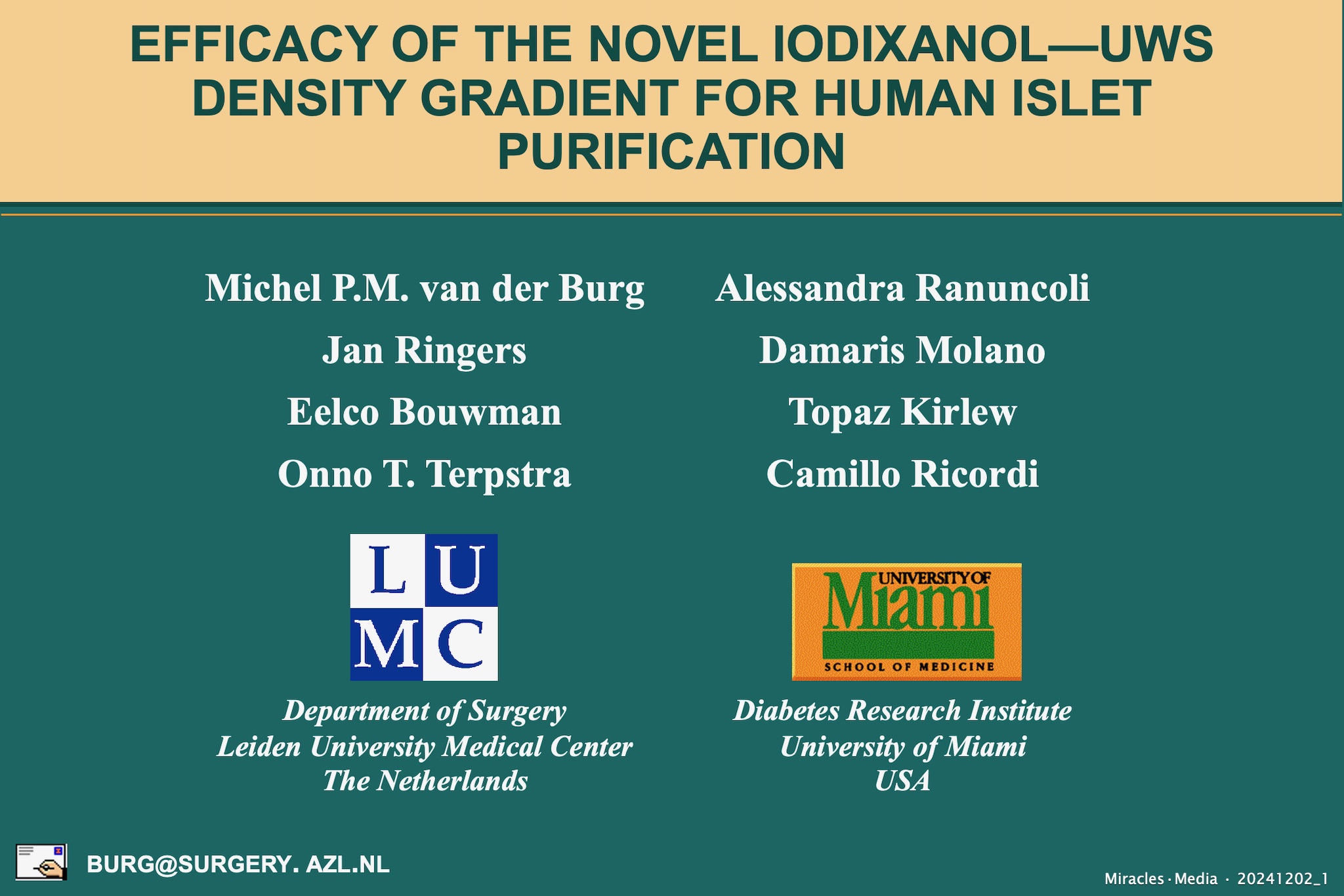
Efficacy of the novel iodixanol-UWS density gradient for human islet purification • Igls Aidspit 1999 • Michel van der Burg • Miracles.Media • 20241202_1
I started an archive at Archive.org November 11, 2010 with this slideshow (pdf) of my January 1999 oral presentation in Igls (Innsbruck), Austria, at the 18th Workshop of the AIDSPIT (Artificial Insulin Delivery Systems, Pancreas and Islet Transplantation) Study Group. (Now known as AIDPIT).
The presented results of this innovative islet purification method — developed over nearly 10 years (from 1989) in our Leiden islet laboratory (LUMC) — were the outcome of work I had done spring 1998 with the human islet transplantation group of Camillo Ricordi at the Diabetes Research Institute in Miami , Florida, USA.
Slideshow (pdf) Archive.org
Description
Efficacy of the novel iodixanol-UWS density gradient for human islet purification • Igls Aidspit 1999
Slides oral presentation Michel van der Burg, Aidspit meeting 25 Jan 1999, in Igls, Austria
Van der Burg MPM, Ranuncoli A, Molano R, Kirlew T, Ringers J, Bouwman E, Ricordi C. Efficacy of the novel iodixanol-UWS density gradient for human islet purification. 18th Workshop Aidspit, Igls (Austria) Jan. 24-26, 1999
Program : 18TH WORKSHOP OF THE AIDSPIT STUDY GROUP – JANUARY 24-26, 1999 – IGLS/AUSTRIA . MONDAY, JAN 25, 1999 – KONGRESSHAUS IGLS, MAIN LECTURE HALL SESSION 2 – ISLET ISOLATION AND TRANSPLANTATION CHAIRMEN:K. FEDERLIN, GIESSEN, GERMANY – G. POZZA, MILAN, ITALY 9.00 – 10.30 FREE COMMUNICATIONS 9.45- Efficacy of the novel iodixanol-UWS density gradient for human islet purification. Van der Burg MPM, Ranuncoli A, Molano R, Kirlew T, Ringers J, Bouwman E, Ricordi C; Leiden, The Netherlands and Miami, USA
File : mvdb19990118_1534_AIDSPIT.pdf | Uploaded 20101111 and replaced by the same pdf with updated metadata of the document on 20101112 (see Notes section).
The slideshow video embedded below, was first posted at 1-memo.com in 2018 as Human Islet Purification Miami 1998 • @1MEMO 20181102
Notes
The slideshow pdf file is available for download at Archive.org. I advise against the other download options presented by Archive.org , which do not correctly represent the slideshow.
Van der Burg MPM, Ranuncoli A, Molano R, Kirlew T, Ringers J, Bouwman E, Ricordi C. Efficacy of the novel iodixanol-UWS density gradient for human islet purification (Abstract). Acta Diabetol 1998; 35: 247. View or download abstract below .
20251101 – Added PDF copy abstract – file 1MEMO_20251102_1.pdf
Citation info (this post) : Efficacy of the novel iodixanol-UWS density gradient for human islet purification • Igls Aidspit 1999 • Michel van der Burg • Miracles.Media • 20241202 • URL michelvanderburg.com/2024/12/02/
Ward Adriaens (Mechelen, Belgium) passed away suddenly on the evening of November 15th, 2024. A wonderful man, a freethinker, author, with a passion for living history, especially the resistance, partisans, in World War II, and the founding director in 1995 of the Jewish Museum of Deportation and Resistance (JMDR) that opened its doors in 1996. In 2012 the JMDR became the Kazerne Dossin museum, with Ward Adriaens as honorary curator. In 2005 Ward Adriaens launched the Give Them a Face archival project. The portraits of all Jewish, Roma and Sinti deportees which passed through the SS-Sammellager Mecheln (Dossin barracks, transit camp, Mechelen) in 1942-1944, were scanned to create the “Give Them a Face” portrait collection. All around 20,000 photos in the Give Them a Face portrait collection are now part of the commemoration wall – a permanent exhibition – at the Kazerne Dossin museum.
In 2009 , I first encountered the Transport XX installation in Brussels, and met Ward Adriaens’ team of the Give Them a Face project in the Jewish Museum of Deportation and Resistance in Mechelen, Belgium (1,2).
Next , Ward Adriaens participated in our 2012 documentary Transport XX to Auschwitz (3).
Recently, May 2024, Ward Adriaens’ opening speech at the TRANSPORT XX installation in Mechelen in 2007, was posted in the ‘Miracles’ project at Miracles•Media (4).
Quote
“…Let us clearly understand that this is the fundamental basis of racism: persecuted because we have a mother. We all have parents and many amongst us have children. In order to protect them it is essential that we do not give an inch to racism. Everyone of us will come under threat should the policy makers be influenced by racism…”
3. Ward Adriaens’ interview by the dutch reporters Piet de Blaauw & Aart Zeeman (Dutch NCRV-Netwerk broadcast, 13 April 2005, NL1) from the documentary ‘Transport XX to Auschwitz’ – a film by Karen Lynne & Richard Bloom and Michel van der Burg • In : Documentary film “Transport XX to Auschwitz” • Miracles•Media • 20130419 • URL (retrieved 20241119) https://michelvanderburg.com/2013/04/19/transport-xx-to-auschwitz/
St Edmund Hall, University of Oxford, July 1989 • Michel van der Burg • Miracles•Media • 20241019_1 • TakeNode af426345-4fb3-48a3-8d5e-4368c56826aa
Venue of the Seventh Annual Meeting of the Anglo–Danish–Dutch Diabetes Group*, Oxford (UK) July 5–9, 1989.
The first international meeting were our new concept was presented, of pancreatic islet isolation in the University of Wisconsin Solution (UW-Solution or UWS) a solution designed recently for preservation of a donor pancreas during cold storage prior to transplantation.
Quote :
“…A few months ago, we adopted an entirely new approach to islet isolation. Recently a new cold storage organ preservation solution was developed at the University of Wisconsin, the UW solution, allowing long term, 24 to 72 h, cold storage of the canine pancreas. Since islet isolation is largely performed in the cold, we tested this preservation solution as the isolation medium throughout the isolation procedure. This slide shows that using the UW solution, purity has increased to over 90%…”
In addition our first successful pre-clinical transplant, we had performed the last month, was reported as breaking news at the end of the talk.
Quote :
“Three weeks ago we did our first autotransplantation of isolated islets from the whole gland by retrograde infusion into the spleen. The dog is doing fine: fasting glucose amounts to 5-6 mM and postprandial glucose between 6-8 mM ; postprandial insulin increases 6-7 fold. Thank you.”
St Edmund Hall, Oxford, 1989, 7th Meeting ADDD Group • Michel van der Burg • Miracles•Media • 20241019_2 • TakeNode ca40adf0-3b86-4ada-93a8-126c6768d420
Notes
Seventh Annual Meeting Anglo Danish Dutch Diabetes Group • Michel van der Burg • Miracles•Media • 20241019_3 • TakeNode bffdea47-9464-4f7b-8299-ec299d41ca4d
* Group supported through the Nordisk UK Professional Programme.
Van der Burg MPM, Gooszen HG, Scherft JP, Terpstra JL, Frölich M, Guicherit OR, Lemkes HHPJ, Bruijn JA. The isolation of canine pancreatic islets for transplantation. Seventh Annual Meeting Anglo Danish Dutch Diabetes Group, Oxford (UK) July 5–9, 1989.
Van der Burg MPM, Gooszen HG, Guicherit OR, Jansen JBMJ, Frölich M, Lamers CBHW. The mechanism of pancreatic duct obliteration induced hyperglycemia. Seventh Annual Meeting Anglo Danish Dutch Diabetes Group, Oxford (UK) July 5–9, 1989.
Citation info : ADD Diabetes Group 1989, St Edmund Hall, Oxford • Michel van der Burg • Miracles•Media • 20241019 • URL michelvanderburg•com
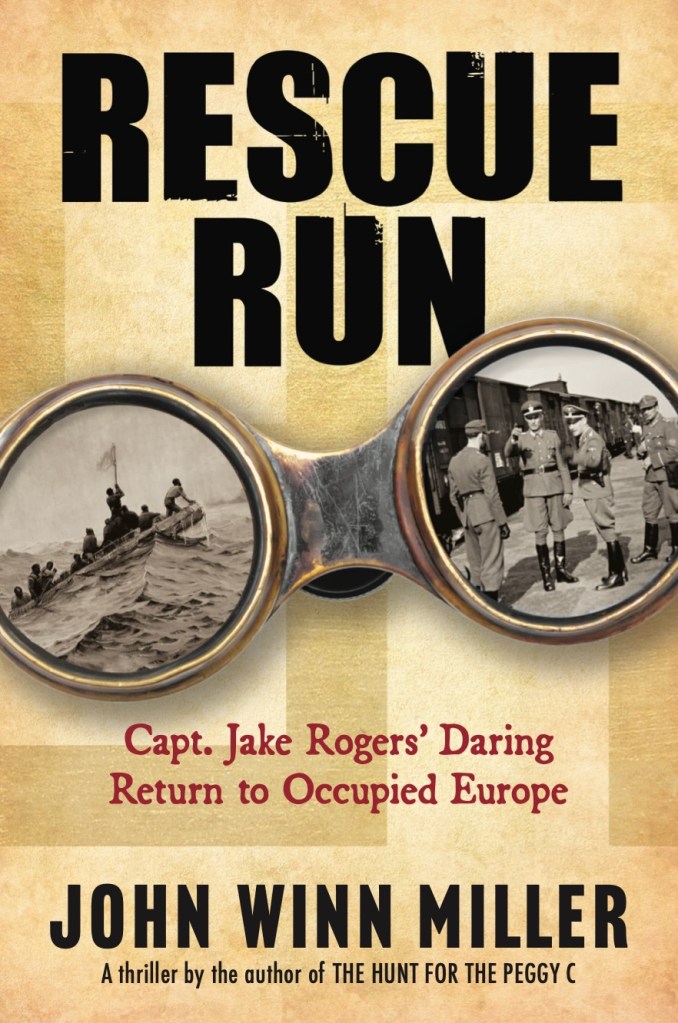
RESCUE RUN : Capt. Jake Rogers’ Daring Return to Occupied Europe • John Winn Miller
After escaping the treacherous waters of WWII, Captain Jake Rogers leads his crew on a daring mission across Nazi-occupied Europe to rescue the father of his beloved, entangled in a web of espionage, betrayal, and relentless pursuit.
Review of John Winn Miller’s novel ‘Rescue Run’
John Winn Miller, a veteran of investigative journalism for decades, masterfully weaves historical detail into his World War II novel Rescue Run. The story follows American ship’s captain Jake Rogers, who, after his U.S. Liberty ship carrying war supplies is wrecked in the North Atlantic, first lands in Ireland. He then sets out with a few of his loyal men on a perilous mission to rescue the father of Miriam Maduro, the love of his life, from the Westerbork transit camp in Nazi-occupied Holland.
A gruelling journey follows from Amsterdam across Nazi-occupied Europe to Spain – on foot, by train, and by boat – via a long series of hiding places, historical locations and events, aided by well-known and lesser-known resistance organisations and historical figures, besieged by con men, double agents, gangsters and pursued by a ruthless Dutch bounty hunter.
As a non-native English speaker, I initially struggled a bit with the first few chapters, particularly the maritime terms and rich language used in the sea adventure with the Liberty ship, besides the introduction of the many characters. However, once past those pages, the novel became a true page-turner. The gripping, almost cinematic narrative had me finishing the book in just two or three days, despite also spending some time online searching for even more historical context, for example when Rogers is helped by the Dutch resistance group ‘Groep 2000’ led by Jacoba van Tongeren, and when characters like Etty Hillesum and Audrey Hepburn appear in the story.
Blending Fiction and Nonfiction
I rarely read fiction these days — almost exclusively occupied with non-fiction — but John Miller’s work intrigued me. I was curious to see how he managed to incorporate the reality of Nazi-occupied Europe, and in particular the Westerbork transit camp, into fiction. The result is exceptional. The blend of fiction and nonfiction strengthens the narrative, bringing the past vividly to life. Miller also provides an extensive set of notes at the end of the book, offering in-depth background information on the events and historical figures featured in the story, detailing also what happened to them after the events of the novel.
I especially appreciate how John Winn Miller brings the wartime past to life in Rescue Run, with accuracy and rich detail, from multiple perspectives. His cinematic storytelling draws readers into a narrative that inspires further exploration of this history.
Michel van der Burg, filmmaker, editor of Settela•Com
Notes
Additional Information:
Title:Rescue Run: Capt. Jake Rogers’ Daring Return to Occupied Europe
John Winn Miller is an award-winning investigative reporter, foreign correspondent, editor, publisher, screenwriter, indie movie producer and novelist. | Photo Bancroft Press. | More info at Miller’s website URL https://www.johnwinnmiller.com
John Winn Miller
Though Rescue Run is a sequel to Miller’s first novel, The Hunt for the Peggy C, no prior knowledge of the first book is required. A summary of the prequel is included for new readers or those needing a refresher.
Westerbork Film Frame
This review was prompted by my contribution of a still (image below) from the Westerbork film for Rescue Run’s jacket/cover, in collaboration with designer Christine Van Bree , and author John Winn Miller. John kindly provided me with a link for a free download of the Advance Reader Copy on the BookSirens’ platform. Since I’m documenting the Westerbork film through the online magazine Settela•Com, I happily accepted BookSiren’s invitation to join the review team.
Deportation | 20240225 | Settela•Com | Commander Albert Gemmeker oversees the deportation of Jews, Sinti, and Roma from the Westerbork transit camp May 19, 1944 | Frame 7426 from Deportation Westerbork Film | 20210719 | Settela•Com | ISSN 2949 9313
Citation info : Review RESCUE RUN • 20240927 • Michel van der Burg • Settela•Com • ISSN 2949-9313
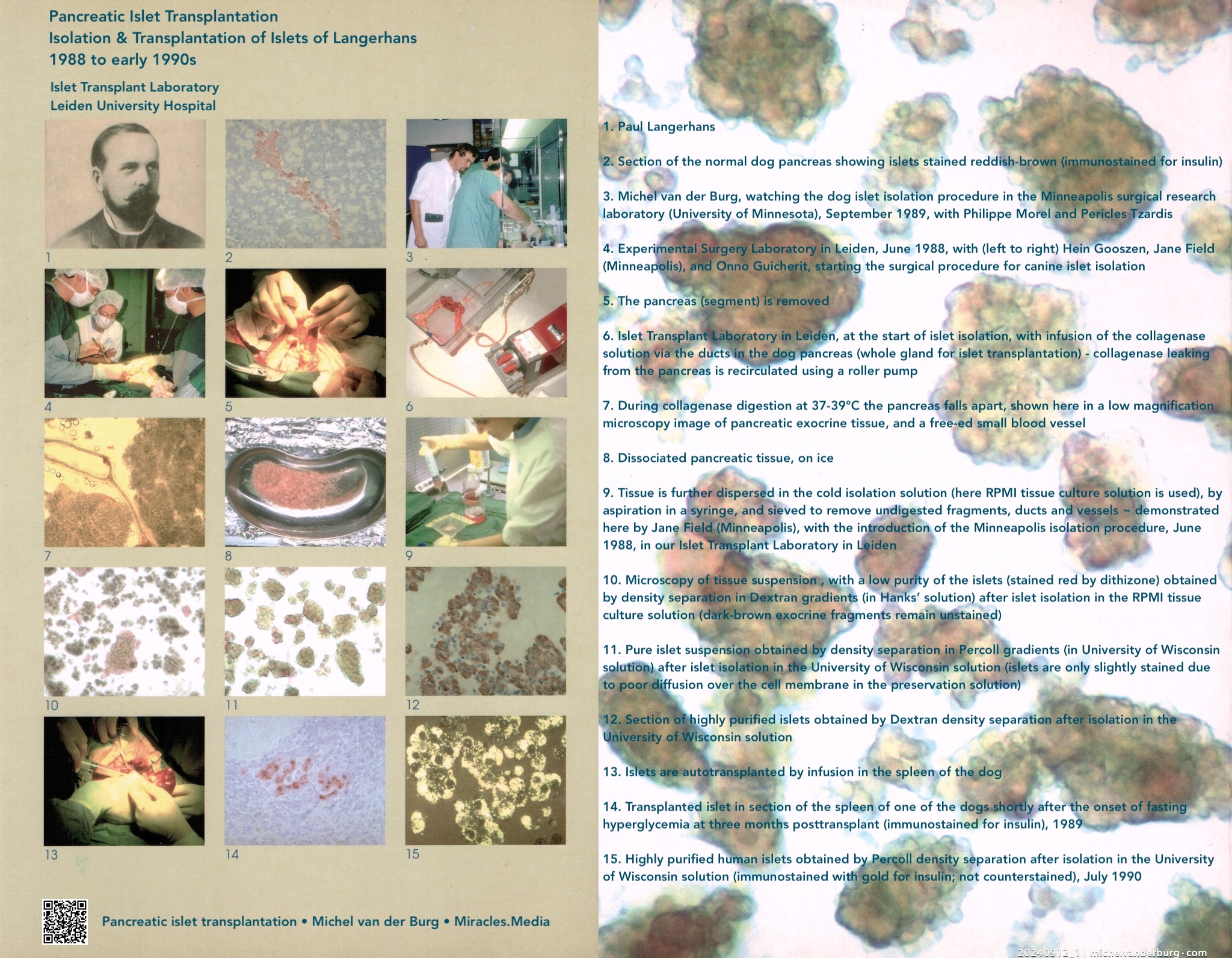
Pancreatic Islet Transplantation • Isolation & Transplantation of Islets of Langerhans • 1988 to early 1990s • Islet Transplant Laboratory • Leiden University Hospital • 20240912_1 (Note 1)
Grants
In 1988, we started a project with unique integration of two important trends in research into the treatment of diabetes by transplantation at the Leiden University Hospital (AZL) in Leiden, with major grants from the dutch Ministry of Welfare, Health and Culture (WVC) and the dutch Diabetes Fund (Diabetes Fonds Nederland).
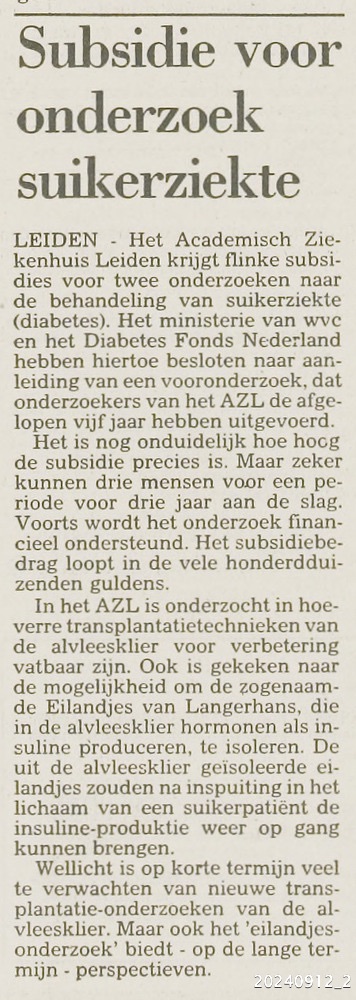
Grants diabetes research • Newspaper Leidsch Dagblad, June 24, 1988 (Note 2)
The generous grants were received — as reported June 24, 1988 in both the dutch newspaper Leidsch Dagblad (2) and in Cicero, the biweekly publication of the Leiden Medical Faculty and University Hospital (3), as a result of our preliminary research over the previous five years into improving the technique of pancreas transplantation, and more recently the development of a technique for isolating the Islets of Langerhans from the pancreas, which produce hormones such as insulin. The idea behind this is, that these isolated islets, after injection into the body, will restart and maintain insulin production.
Questions
What is the consequence of the loss of normal nerve connections to the islets during transplantation? What are the consequences of transplantation of only a segment of the pancreas, or islet transplantation, when fewer islets are available? What is the consequence after transplantation of the different insulin drainage route, where the insulin does not follow the normal path directly to the liver? To what extent do transplantation procedures disrupt the normal architecture and interactions of islets, the pancreas, and other parts of the gastro-intestinal system, and the blood sugar regulation in the body?
Project
With the hope of answering these questions, the grants supported an ambitious new project supervised by Hein Gooszen, integrating two concomitant PhD projects for detailed islet function studies in both experimental pancreas transplantation, by Onno Guicherit (4) , as well as islet isolation by Michel van der Burg (5) in the same model.
A special feature of the experimental design in this preclinical model is that the results of functional studies in the experimental animal can be compared with such functional studies with the isolated islets from the pancreas, where the direct effect on the islets is investigated during perifusion tests in our laboratory (6).
That same month, June 1988, we began research to improve the method of islet isolation in our laboratory, with the assistance of Jane Field, who had come over that month at our invitation from Minneapolis, where she was a key member of the Surgical Research lab, University of Minnesota (led by David Sutherland).
The introduction of this Minneapolis method for islet isolation significantly improved the yield of isolated islets in our Islet Transplant Lab.
New concept : University of Wisconsin solution (UWS) for islet isolation
Next , early 1989 , our Islet Transplant Lab took a major step forward in a new approach to isolation and purification of the islets by replacing the islet isolation solution (the general used basic physiological salt solution or tissue culture solution) with a novel organ preservation solution : the University of Wisconsin solution (UWS). The method of choice nowadays in clinical islet transplantation centers. More on this introduction of UWS will soon be posted here. A reprint of a first poster presented in Minneapolis, Sep. 1989, is now online here (7).
Program
June 1989 our Surgery Department (Leiden University) started an additional project, for ‘auto’ transplantation of isolated islets : Isolation of the islets from the canine pancreas and transplantation of the isolated islets ca 4 hours later in the same animal (8).
Thus, from 1989, we studied the insulin secretion of the isolated islets in perifusion experiments in the laboratory (‘in vitro’) in comparison with both the islet function ‘in vivo’ after transplantation of the isolated islets, and in the concomitant pancreas transplantation experiments — in support of our clinical pancreas transplantation program in Leiden.
Notes
1) Pancreatic Islet Transplantation • Isolation & Transplantation of Islets of Langerhans • 1988 to early 1990s • Islet Transplant Laboratory • Leiden University Hospital • 20240912_1 • michelvanderburg•com | TakeNode 5b5ca362-2adf-497a-b2be-a83e47617017 | Image edit based on : Pancreatic islet transplantation • Michel van der Burg • Miracles.Media • Thesis Repository Leiden University https://hdl.handle.net/1887/3486604
Captions in Note 9
2) Subsidie voor onderzoek suikerziekte. Leidsch Dagblad, June 24, 1988 (leiden.courant.nu) • 20240912_2 • michelvanderburg•com
3) Diabetesonderzoek | AZL krijgt grote subsidies voor diabetesonderzoek | by Sylvia van Leeuwen in Cicero, June 24th, 1988 (ISSN 0920-2900), the biweekly publication of the Academic Hospital and Leiden Medical Faculty | 20240912_3 • michelvanderburg•com | Download PDF article below : file 20240912_3_CICERO
4) Onno R. Guicherit. Long-term metabolic sequelae of beta cell mass reduction, systemic venous drainage and denervation of the canine pancreas : experimental studies in relation to clinical pancreas transplantation. (Doctoral Thesis, Faculty of Medicine, Leiden University Medical Center (LUMC) , Leiden University)(S.l.: s.n.), (ISBN print: 9789090072319, 9090072314), 1994: 149 p. URL WorldCat https://search.worldcat.org/en/title/69433794
5) Michael P.M. van der Burg. Pancreatic islet transplantation: studies on the technique and efficacy of islet isolation and transplantation. (Doctoral Thesis, Faculty of Medicine, Leiden University Medical Center (LUMC) , Leiden University), Boskoop: M.P.M. van der Burg | Miracles.Media (ISBN electronic, pdf, 9789080216402 ; ISBN print 9789080216419, 9080216410), 1994: 192 p. URL Thesis Repository Leiden University https://hdl.handle.net/1887/3486604
9) Pancreatic Islet Transplantation • Isolation & Transplantation of Islets of Langerhans 1988 to early 1990s • Islet Transplant Laboratory • Leiden University Hospital • 20240912_1 • michelvanderburg•com | TakeNode 5b5ca362-2adf-497a-b2be-a83e47617017 |
Captions Image 20240912_1 :
1. Paul Langerhans
2. Section of the normal dog pancreas showing islets stained reddish-brown (immunostained for insulin)
3. Michel van der Burg, watching the dog islet isolation procedure in the Minneapolis surgical research laboratory (University of Minnesota), September 1989, with Philippe Morel and Pericles Tzardis
4. Experimental Surgery Laboratory in Leiden, June 1988, with (left to right) Hein Gooszen, Jane Field (Minneapolis), and Onno Guicherit, starting the surgical procedure for canine islet isolation
5. The pancreas (segment) is removed
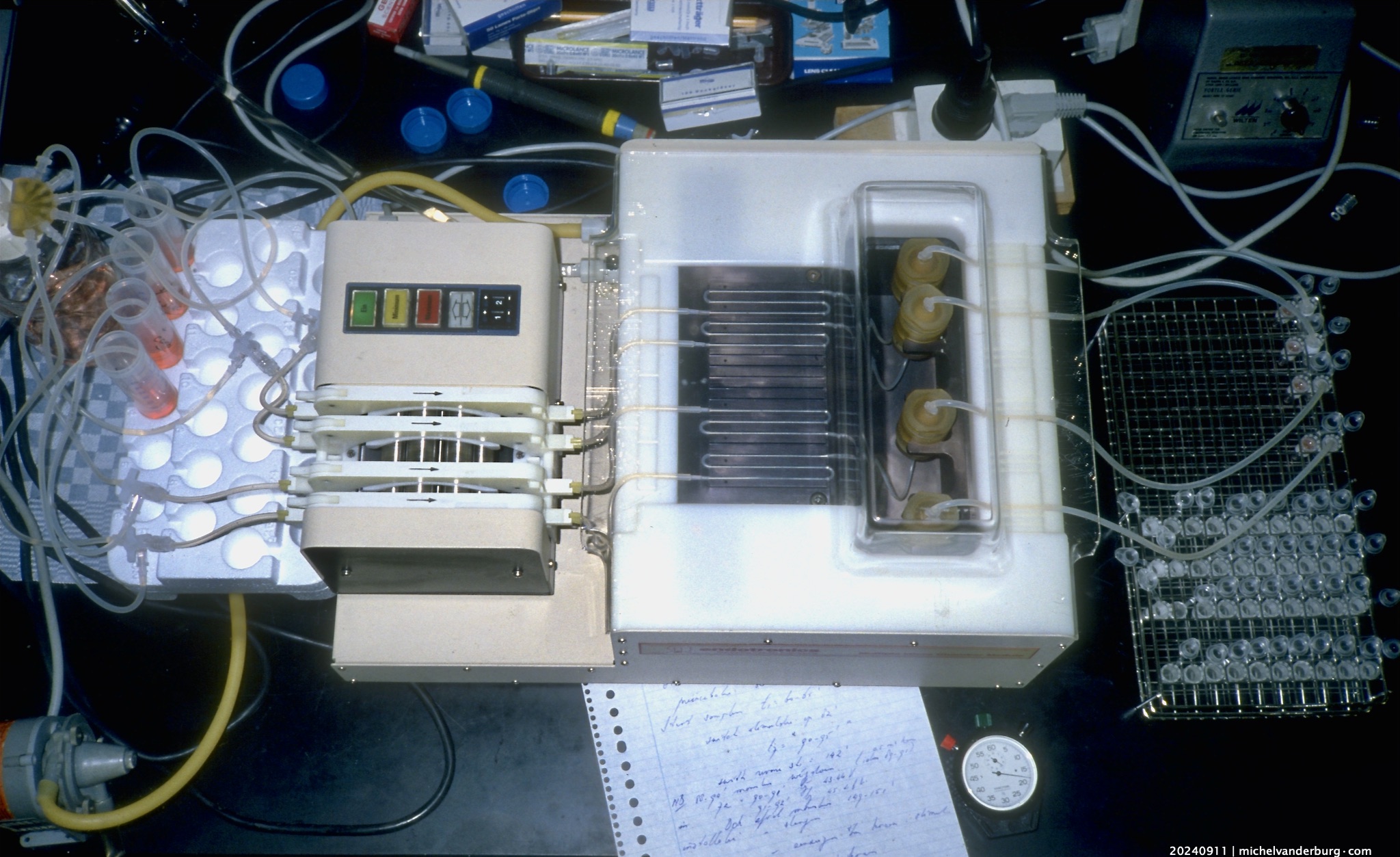
6. Islet Transplant Laboratory in Leiden, at the start of islet isolation, with infusion of the collagenase solution via the ducts in the dog pancreas (whole gland for islet transplantation) – collagenase leaking from the pancreas is recirculated using a roller pump
7. During collagenase digestion at 37-39°C the pancreas falls apart, shown here in a low magnification microscopy image of pancreatic exocrine tissue, and a free-ed small blood vessel
8. Dissociated pancreatic tissue, on ice
9. Tissue is further dispersed in the cold isolation solution (here RPMI tissue culture solution is used), by aspiration in a syringe, and sieved to remove undigested fragments, ducts and vessels ~ demonstrated here by Jane Field (Minneapolis), with the introduction of the Minneapolis isolation procedure, June 1988, in our Islet Transplant Laboratory in Leiden
10. Microscopy of tissue suspension, with a low purity of the islets (stained red by dithizone) obtained by density separation in Dextran gradients (in Hanks’ solution) after islet isolation in the RPMI tissue culture solution (dark-brown exocrine fragments remain unstained)
11. Pure islet suspension obtained by density separation in Percoll gradients (in University of Wisconsin solution) after islet isolation in the University of Wisconsin solution (islets are only slightly stained due to poor diffusion over the cell membrane in the preservation solution)
12. Section of highly purified islets obtained by Dextran density separation after isolation in the University of Wisconsin solution
13. Islets are autotransplanted by infusion in the spleen of the dog
14. Transplanted islet in section of the spleen of one of the dogs shortly after the onset of fasting hyperglycemia at three months posttransplant (immunostained for insulin), 1989
15. Highly purified human islets obtained by Percoll density separation after isolation in the University of Wisconsin solution (immunostained with gold for insulin; not counterstained), July 1990
Pancreatic islet transplantation • Michel van der Burg • Miracles.Media | QR code (link to Thesis Repository Leiden University) https://hdl.handle.net/1887/3486604
Citation info : Pancreas & Islet Transplantation Program • 20240912 | Michel van der Burg | michelvanderburg•com
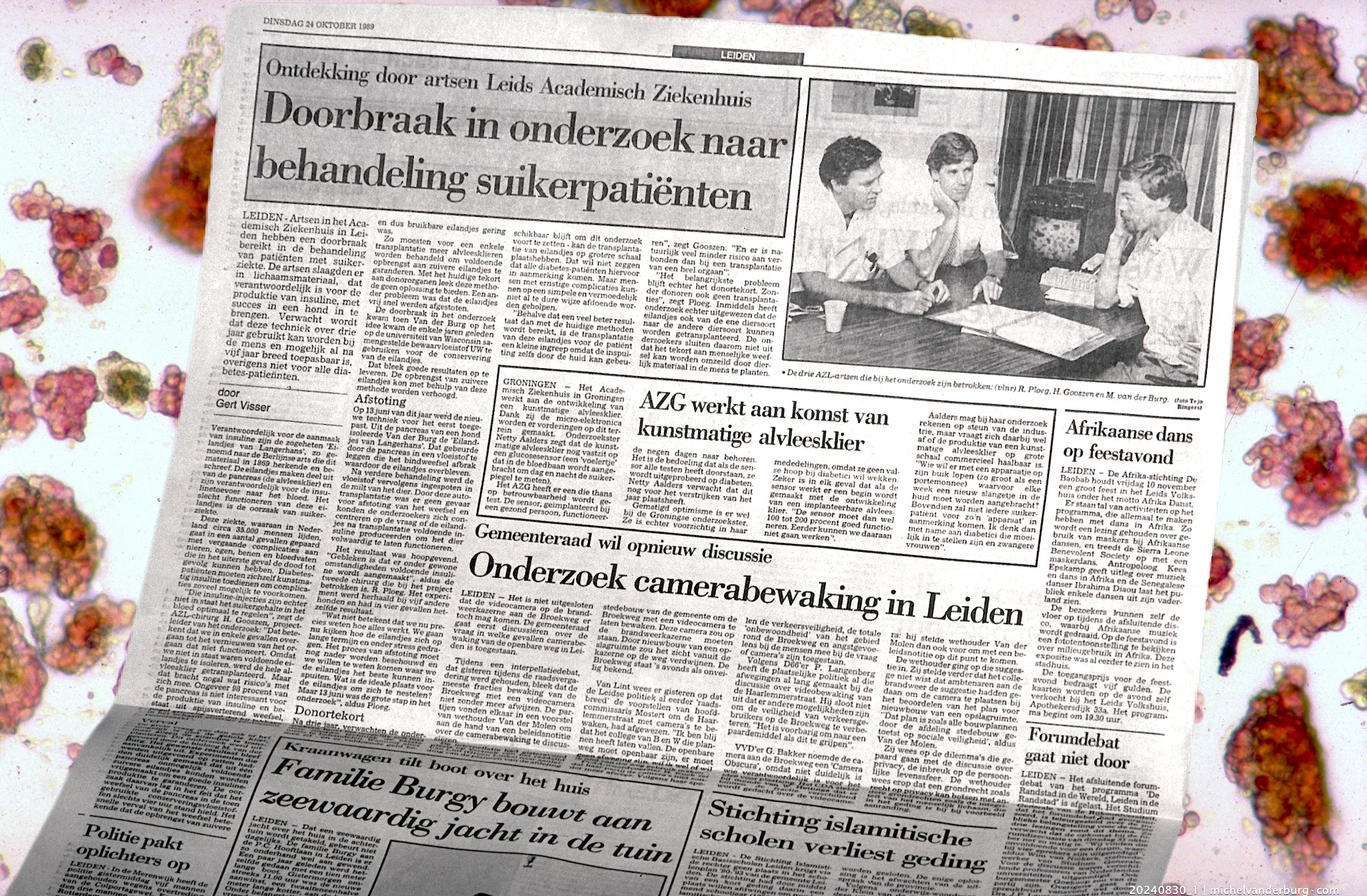
“Breakthrough in research into treatment of diabetics. Discovery by doctors of Leiden University Hospital” …headlines the Dutch newspaper ‘Leidsch Dagblad’ (1).
The dutch newspaper ‘Leidsch Dagblad’ reports October 24, 1989, on a breakthrough in the treatment of diabetic patients…successful transplantation of the insulin producing ‘islets’ in dogs, after isolation of the islets using the UW organ storage solution .
The first successful transplant June 13, 1989 was a big step. Generally multiple pancreases are needed for an adequate number of purified islets for one transplant. Here the dog’s pancreas was used for the isolation of islets, that were injected back in the animals’ spleen.
‘The breakthrough in the research came when Van der Burg came up with the idea of using the UW organ storage solution ( UWS ) — developed several years ago at the University of Wisconsin — for the preservation of the islets. This turned out to yield good results. The yield of pure islets could be increased using this method.’
Cicero
News based on story published Sep. 15th, 1989 by journalist Sylvia Van Leeuwen in Cicero, the biweekly publication of the Academic Hospital and Leiden Medical Faculty (2).
Ploeg, Gooszen and Van der Burg (left to right) discuss the achieved results, Monday Sep 4, 1989 at the Department of Surgery, University Hospital Leiden. Photo Tejo Ringers • 20240830_2 • michelvanderburg•com • TakeNode 3fc69a06-04bf-4f0d-bc77-cedb6d7b7f75
One more thing
We reported long-term function of the islet transplants (3,4). Failure after 3.5 years of a well-functioning islet transplant is puzzling. Nowadays, in clinical islet transplantation, failure of long-term functioning grafts in diabetic patients is still puzzling. Therefore, note (data not published before), that body weight of this autografted animal had increased to almost 150%, from 12.5 kg at the time of islet transplantation, to 18.0 kg at the time of graft failure 3.5 years later (Dec. 1992) — obviously, with an increased insulin demand that may have contributed to graft failure.
Notes
1) Doorbraak in onderzoek naar behandeling suikerpatiënten. Ontdekking door artsen Leids Academisch Ziekenhuis. (EN tr. “Breakthrough in research into treatment of diabetics. Discovery by doctors of Leiden University Hospital”) | by Gert Visser, in Leidsch Dagblad, Oct 24, 1989 | Dutch newspaper, URL https://leiden.courant.nu/issue/LD/1989-10-24/edition/0/page/15
The background in the image here (20240830_1), is the original color slide of the ‘Islets of Langerhans’ showing in the newspaper.
2) ‘Eilandjes’ getransplanteerd | by Sylvia van Leeuwen in Cicero, Sep. 15th, 1989 (ISSN 0920-2900), the biweekly publication of the Academic Hospital and Leiden Medical Faculty | 20240830_3 • michelvanderburg•com | Download PDF article below : file 20240830_3_CICERO
4) Van der Burg MPM, Guicherit OR, Jansen JBMJ, Frölich M, Lamers CBHW, Lemkes HHPJ, Bruijn JA, Gooszen HG. Function and survival of intrasplenic islet autografts in dogs. Diabetologia 39, 37–44 (1996). https://doi.org/10.1007/BF00400411
5) Van der Burg MPM, Gooszen HG, Ploeg RJ, Guicherit OR, Scherft JP, Terpstra JL, Bruijn JA, Frölich M. Pancreatic islet isolation with UW solution: a new concept. 4th Congress of the European Society for Organ Transplantation, Barcelona (Spain) November 1–4, 1989.
6) The islet transplant news was first reported by me at an invited lecture July 8, 1989 for the Anglo Danish Dutch Diabetes Group meeting in St Edmund Hall, University of Oxford, Oxford (UK) : Van der Burg MPM, Gooszen HG, Scherft JP, Terpstra JL, Frölich M, Guicherit OR, Lemkes HHPJ, Bruijn JA. The isolation of canine pancreatic islets for transplantation. Seventh Annual Meeting Anglo Danish Dutch Diabetes Group, Oxford (UK) July 5–9, 1989.
7) Leiden Islet Laboratory History • 20240803 | Michel van der Burg | michelvanderburg•com
Citation info : Islet Transplantation Breakthrough in Leiden University Hospital • 20240830 • Michel van der Burg • michelvanderburg•com